
Calories, sugar, caffeine and smarter ordering
Boba Nutrition: Calories, Sugar, Caffeine and Toppings
Boba nutrition can change dramatically from one cup to the next. A lightly sweetened brewed tea with aloe is not nutritionally similar to a brown sugar fresh milk with warm pearls, even when both are sold in the same size cup.
The most useful way to understand a drink is to separate its five moving parts: base, milk or creamer, sweetener, serving size and toppings. This guide shows how each choice changes calories, sugar, carbohydrates and caffeine without pretending that one number represents every shop.
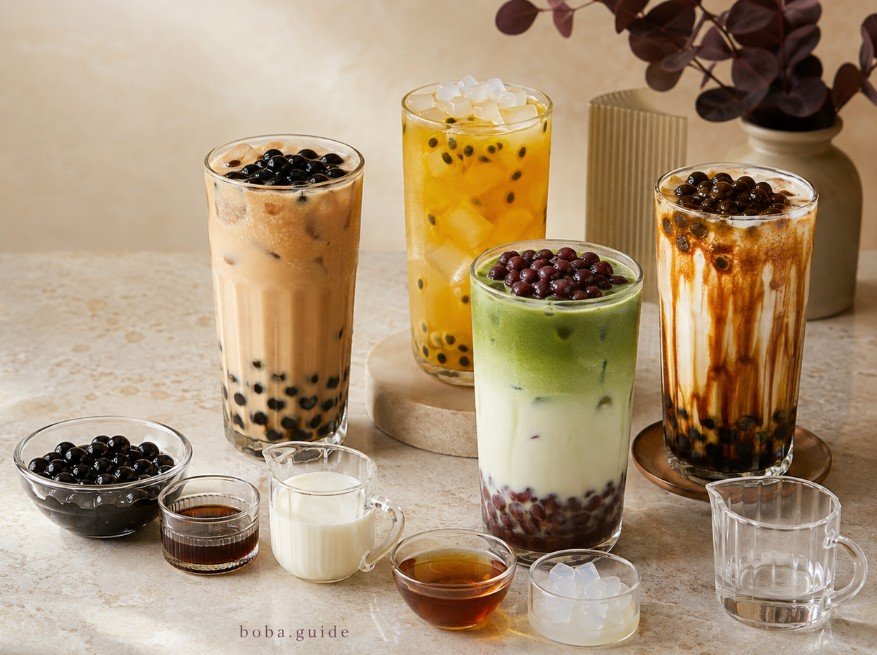
The useful framework
Five Choices Determine Most of a Boba Drink’s Nutrition
No single calorie or sugar number can describe the entire category. These five decisions explain why two drinks that look similar may have very different nutrition profiles.
Drink base
Plain brewed tea contributes very little energy by itself. Fresh milk, creamer, fruit purée, powdered mixes, yogurt-style bases and slush concentrates can add calories and carbohydrates before any topping is included.
Sweetener and flavor system
Some shops add liquid sugar separately. Others rely on fruit jam, flavored syrup, brown sugar coating, condensed milk or pre-sweetened powder. A lower sweetness setting may reduce only the adjustable syrup, not every source of sugar.
Milk or creamer
Fresh dairy milk, non-dairy milk and powdered creamer differ in energy, protein, fat and allergen profile. The word “milk tea” does not reveal which one a shop uses.
Topping portion
Tapioca pearls, pudding, red bean, milk cap, jellies and popping boba can change the final drink substantially. Official menu examples show that a topping can add anything from a modest amount to several hundred calories, depending on type and portion.
Cup size and ice
A larger cup usually contains more liquid and may contain more sweetener. Less ice does not automatically mean fewer calories; some shops replace the missing ice with more prepared drink.
Compare drinks from the same shop, in the same size, using the same sweetness level. Cross-shop comparisons are less precise because recipes, serving sizes and topping portions are not standardized.
Energy in the cup
How Many Calories Are in Boba Tea?
A boba drink can range from a lightly sweetened tea to a substantial dessert beverage. The base recipe, portion and topping choice matter more than the category name alone.
Why published calorie ranges are so wide
Official chain disclosures demonstrate the scale of variation. In Kung Fu Tea’s published nutrition document, individual beverages are often presented as ranges because sugar level and size can change the result. The same document lists standard tapioca bubbles at roughly 199–298 calories depending on serving, while several lighter jelly options are much lower.
This does not mean every shop uses the same topping portion or recipe. It does show why adding pearls to a drink is nutritionally different from adding aloe or a lighter jelly. It also explains why a large signature drink can move far beyond the calories of its tea base.
| Drink pattern | What usually raises calories | What usually keeps them lower |
|---|---|---|
| Freshly brewed tea | Syrup, fruit jam, foam, toppings | Low sweetness, no topping, moderate size |
| Milk tea | Creamer, whole milk, condensed milk, pearls | Less sweet, smaller size, lighter topping |
| Fruit tea | Sweetened purée, jam, syrup, popping boba | Tea-forward recipe, reduced syrup, aloe |
| Brown sugar fresh milk | Brown sugar coating, milk, warm pearls | Smaller serving, no extra topping |
| Slush or smoothie | Powders, concentrates, sweetened fruit, dairy | Simpler fruit-tea alternative |
Start with the drink family
Which Boba Drinks Are Usually Lighter or Heavier?
The drink family gives you a useful first estimate, but it is not a guarantee. A plain brewed tea usually starts light, while a brown sugar fresh milk or creamy slush starts with more energy before toppings are added. Customization can still reverse the order.
| Drink family | Typical starting point | What raises the total | What to ask |
|---|---|---|---|
| Brewed tea | Usually the lightest base when ordered without syrup, milk or toppings. | Liquid sugar, honey, foam, fruit jam and add-ons. | Is the tea pre-sweetened, and can the sweetener be adjusted? |
| Fruit tea | Can be relatively light or highly sweetened depending on whether the flavor comes from fruit, juice, jam or syrup. | Sweetened fruit preparations, large size, popping boba and multiple jellies. | Does the fruit component already contain sugar? |
| Milk tea | Usually higher than plain tea because milk or creamer adds body and energy. | Full sweetness, pearls, pudding, condensed milk and milk cap. | Is the drink made with fresh milk, creamer or a powder mix? |
| Fresh milk or tea latte | Varies with the amount and type of milk. It may provide more protein than creamer-based drinks, but that does not automatically make it lower in calories. | Brown sugar coating, sweetened matcha, red bean, cream and large servings. | Is the milk sweetened, and is the syrup fixed? |
| Slush or smoothie | Often more dessert-like because the recipe may include powder, concentrate, fruit preparation, dairy and blended ice. | Cream, extra syrup, toppings and oversized portions. | Can sweetness be changed, or is the base premixed? |
| Brown sugar drinks | Designed around a concentrated sweet syrup and often paired with warm pearls. | Extra brown sugar, large size, milk cap, pudding and additional pearls. | Is there a smaller size or a version without extra topping? |
Why a fruit tea is not automatically low-calorie
Clear color can create the impression that a drink is light, but color does not reveal how much fruit jam, syrup or sweetener was used. Some fruit teas are close to brewed tea with a modest amount of fruit; others are built from a concentrated sweetened base. The difference is large enough that the same flavor name cannot be used as a reliable nutrition estimate.
A useful question is not simply “Is this fruit tea?” but “What makes it taste like fruit?” Fresh fruit, unsweetened tea and a small amount of syrup behave differently from a premixed concentrate. When exact numbers matter, the shop’s own nutrition disclosure is more useful than the category label.
The most misunderstood setting
What Does 0%, 50% or 100% Sugar Actually Mean?
Sweetness percentages are usually shop-specific preparation settings, not universal grams of sugar. A 50% drink at one chain is not automatically equivalent to 50% at another.
No adjustable syrup
The drink may still contain sugar from fruit jam, flavored powder, cooked pearls, pudding, milk cap or a fixed recipe component.
Light sweetness
Often works well for tea-forward milk tea, matcha or fruit drinks that already contain sweetened ingredients.
Balanced starting point
A practical first reduction for many standard drinks, though the final result still depends on the shop’s recipe.
Clearly sweet
Useful when a strongly brewed base needs more sweetness, but still below the shop’s standard level.
House standard
The recipe as designed by the shop. It may be balanced for some signature drinks and excessive for others.
Why “zero sugar” can still taste sweet
Many menu components arrive pre-sweetened or are prepared in syrup. Tapioca pearls are commonly held in a sweet mixture; fruit jams and powders may contain sugar; pudding and foam may also be sweetened. Ask what the shop can actually adjust rather than assuming the percentage controls every ingredient.
Sugar can enter at several stages
Where Added Sugar Hides in a Boba Order
The sweetness setting controls only the part of the recipe that the shop allows staff to change. Several other ingredients may already contain sugar, which is why a “0% sugar” drink can still contribute a meaningful amount.
Liquid sweetener added during shaking
This is usually the component affected by the 0%, 25%, 50%, 75% or 100% setting. It may be simple syrup, fructose syrup, honey or another house sweetener. Reducing it is often the easiest change because it does not alter the physical structure of the drink.
Fruit jam, purée and flavored syrup
A fruit component may be sweetened before it reaches the cup. Some stores can reduce the additional syrup but cannot remove sugar already present in a jam or concentrate. This is especially important for passion fruit, mango, peach, lychee and other fruit-forward signatures.
Powdered drink mixes
Taro, milk tea, chocolate, smoothie and specialty powders may contain sugar as part of the mix. The visible sweetness selector may therefore change only one layer of the recipe. Asking whether the base is powder-based is more informative than judging the drink by color.
Cooked pearls and sweetened toppings
Tapioca pearls are commonly held in brown sugar or another sweet syrup after cooking. Pudding, red bean, popping boba, jellies and milk foam may also be sweetened. Ordering the liquid at 0% does not remove the sugar in these toppings.
Milk, plant milk and condensed milk
Dairy milk contains naturally occurring lactose, while flavored or sweetened plant milks may include added sugar. Condensed milk is a concentrated sweetened ingredient rather than a neutral milk substitute. A drink can therefore taste sweet even with little added syrup.
A better ordering question
Ask which parts of the recipe are already sweetened.
This gives you more useful information than asking only whether the shop offers 0% sugar. Staff may tell you that the tea base is unsweetened but the fruit jam, powder, pearls or foam are fixed. You can then decide whether to reduce the adjustable syrup, choose a simpler base or keep the full recipe in a smaller size.
Beyond sugar alone
Where Do the Carbohydrates in Boba Come From?
Most carbohydrates come from added sugars, tapioca starch, sweetened powders, fruit preparations and milk. A drink can be lower in added syrup but still contain substantial carbohydrate from its base or toppings.
Tapioca pearls
Made primarily from tapioca starch and usually served in a sweetened preparation. They contribute carbohydrate even when the drink itself is ordered at a lower sweetness level.
Powders and mixes
Taro, milk tea, smoothie and other flavored powders may contain carbohydrate and sugar before the shop adds any liquid sweetener.
Fruit systems
Fresh fruit, juice, purée, jam and syrup are not interchangeable. A fruit tea made mainly with sweetened jam can contain far more carbohydrate than brewed tea with a modest amount of fresh fruit.
Milk and creamer
Dairy milk contains naturally occurring lactose. Plant milks may be sweetened or unsweetened. Powdered creamers vary widely and should be checked separately.
For people tracking carbohydrates
Ask about the base before focusing only on the percentage.
A lower sugar setting is useful, but it may not account for starch-heavy toppings, sweetened powder or fixed syrup in a signature drink. The clearest order is often a simple brewed tea or milk tea with an adjustable sweetener and no pre-sweetened topping.
Tea still counts
How Much Caffeine Is in Boba Tea?
Caffeine depends on the tea or coffee base, brewing strength, serving size and recipe. Fruit flavor does not guarantee a caffeine-free drink when green or jasmine tea sits underneath it.
Black tea, green tea, jasmine tea and oolong
The amount varies with leaf quantity, brewing time, temperature and dilution. Milk does not remove caffeine.
Matcha and coffee-based drinks
Matcha uses powdered tea leaf, while coffee-based boba introduces a different caffeine source. Shop recipes vary widely.
Herbal, fresh-milk and selected fruit drinks
These may be caffeine-free only when no true tea, matcha or coffee is included. Always check the actual base.
How to order with less caffeine
Ask whether the fruit tea uses green, jasmine or black tea.
Choose a smaller size rather than assuming reduced sweetness lowers caffeine.
Ask for an herbal or confirmed non-tea base when available.
Avoid adding coffee or matcha when you are already consuming caffeine elsewhere.
The add-on can change the cup
How Much Do Boba Toppings Add?
Toppings differ in portion, ingredients and energy density. Official menu examples show that choosing a topping can change a drink more than moving from one tea base to another.
Aloe and selected jellies
Often lower than tapioca pearls, but sweetened syrups and serving size still matter.
Crystal boba, pudding and red bean
Can add meaningful calories and carbohydrate, with wide variation by recipe.
Tapioca pearls, milk caps and rich specialty toppings
Published chain data show that these can add a substantial amount to the base drink.
One official menu example
Kung Fu Tea’s published nutrition document lists standard bubbles at approximately 199–298 calories, aloe jelly at about 42–63, crystal bubbles at about 54–80, pudding at about 87–131 and a milk cap at 324 calories. These are examples from one chain, not universal topping values.
Milk choice changes more than calories
Dairy Milk, Plant Milk and Creamer Are Not Nutrition Equivalents
The label “milk tea” can refer to fresh dairy milk, a plant-based alternative, powdered creamer or a blend. Each behaves differently in nutrition, flavor and allergen terms.
Fresh dairy milk
Provides protein and naturally occurring lactose. Fat and calorie content depend on the milk type and serving amount.
- Check
- Whole, reduced-fat or another milk
- Allergen
- Contains milk
Oat, soy or almond milk
Nutrition varies by brand and whether the product is sweetened. Soy often provides more protein than almond or oat milk, but recipes differ.
- Check
- Sweetened or unsweetened
- Allergen
- Soy or tree nuts may apply
Powdered creamer
Can create a rich texture without behaving nutritionally like fresh milk. Ingredients may include oils, sugars or milk-derived components.
- Check
- Ingredient and allergen disclosure
- Allergen
- May still contain milk
Condensed milk and specialty foam
These are usually concentrated, sweetened components rather than simple milk substitutions. They can add both sugar and energy quickly.
- Check
- Whether the recipe is adjustable
- Allergen
- Frequently contains milk
Choosing plant milk does not automatically make a drink dairy-free. Powder, foam, pudding, creamer and shared preparation areas can introduce milk ingredients or cross-contact. Ask the shop about the entire recipe.
Calories and sugar are not the whole profile
What About Protein, Fat, Fiber and Sodium?
Most boba discussions focus on sugar, but other nutrients help explain why two drinks with similar calories can feel very different. These values depend strongly on milk choice, creamer, toppings and portion size.
Protein
Fresh dairy milk and some soy milks can contribute protein. Tea, syrup, tapioca pearls and many jellies contribute little. A milk-based drink may therefore provide more protein than a clear fruit tea, but the exact amount depends on how much true milk is used.
Fat
Whole milk, cream, non-dairy creamer, cheese foam and milk cap can raise fat content. A rich mouthfeel is not proof of dairy, because some creamers use vegetable oils. People managing allergies need ingredient information, not assumptions based on texture.
Fiber
Most standard boba drinks are not major fiber sources. Aloe, chia, red bean or real fruit may add some, but portions are often small and preparation methods vary. A fruit-flavored tea should not be assumed to provide the same fiber as whole fruit.
Sodium
Tea and plain pearls are not necessarily high in sodium, but creamers, foams, powders and prepared toppings can contribute more. Salty milk caps are intentionally formulated to contrast with sweet tea, so their sodium profile may differ from a simple milk addition.
Keep the comparison focused
Do not treat one nutrient as a complete score.
A lower-calorie drink may still contain caffeine or an allergen you need to avoid. A milk-based drink may provide protein but also more added sugar. Start with the question you are actually trying to answer: energy, sugar, caffeine, dairy, allergens, carbohydrate or overall portion.
Practical ordering
How to Build a Lighter Boba Order Without Ruining the Drink
The most effective strategy is to simplify the recipe, not to remove every enjoyable element. Keep the part you value most and reduce the components that matter less to you.
Oolong milk tea, 30–50% sweetness, less ice, no topping
Keeps tea and creaminess while removing the added carbohydrate and energy of a topping.
Jasmine fruit tea, 25–50% sweetness, aloe
A lighter texture than pearls, but confirm whether fruit jam or syrup is already sweetened.
Small black milk tea, 30–50% sweetness, one portion of tapioca
Preserves the iconic chew while controlling size and avoiding extra toppings.
Confirmed herbal or non-tea base, low sweetness, no coffee or matcha
Ask what the base actually contains; a fruit name alone does not prove that a drink is caffeine-free.
Small brown sugar fresh milk, standard build, no extra topping
Choose the full experience in a smaller format rather than stacking additional syrup, foam and pudding.
Tea-based fruit drink with confirmed dairy-free ingredients
Check powder, jelly, foam and cross-contact instead of relying only on the milk selection.
Pick one priority
Trying to keep all four while making a major nutrition change usually does not work. Choose the feature that makes the drink worthwhile, then simplify the rest.
Reading published numbers correctly
Why Nutrition Information Still Has Limits
Official chain data are useful, but they should be read as recipe-specific information rather than universal facts about every cup of boba.
Ranges may combine sizes or sweetness settings
Read the notes attached to the menu. A range may reflect multiple cup sizes, sugar levels or preparation choices.
Local stores may have operational variation
Portioning, substitutions and seasonal recipes can affect the result even within one brand.
Independent shops may not publish full data
Ask about ingredients, size and adjustable sweetness. Staff may be able to explain the recipe even when exact laboratory nutrition is unavailable.
Nutrition is not a moral score
A higher-calorie drink is not automatically “bad,” and a low-calorie tea is not automatically suitable for every dietary need. Context, frequency and individual needs matter.
Our method
How Boba Guide handles nutrition ranges
We use official chain disclosures as real-world examples, identify the brand when quoting specific values, and avoid presenting one company’s recipe as an industry standard. For caffeine safety context, we prioritize public-health guidance. Individual medical or dietary decisions should be discussed with a qualified professional.
Use published numbers without misreading them
How to Read Boba Nutrition Information at a Chain or Independent Shop
Nutrition pages can look precise while still leaving important questions unanswered. Before comparing two drinks, confirm that the serving size, sugar setting, topping portion and recipe version are actually comparable.
Match the exact drink name
A classic milk tea, a milk tea made with fresh milk and a brown sugar milk drink may sit next to one another but use different bases. Do not transfer the number from the closest-sounding item when the recipe is not the same.
Check the serving size
A nutrition table may list small and large drinks together, use a range, or publish one standard size only. A calorie number without ounces or milliliters is difficult to compare. Confirm whether the topping portion also changes with cup size.
Look for the sugar setting
Some chains publish values for several sweetness levels; others publish only the standard recipe. If the table shows a range, read the footnotes to see whether the range reflects sugar level, size or both. Never assume the lowest number applies to every customization.
Add toppings separately when required
Some menu values describe the drink before toppings. Others include a standard topping in the named item. A brown sugar pearl drink may already include pearls, while a plain milk tea may not. Count only what the chain’s document tells you to add.
Read allergen notes apart from calories
A nutrition panel may not fully explain cross-contact, milk-derived creamer, soy lecithin, nuts or egg in pudding. Allergy information often lives in a separate document. A low-calorie option is not automatically suitable for someone with an allergy.
Treat seasonal drinks as separate recipes
Limited drinks may use sauces, foam, cookies, fruit preparations or branded ingredients that are absent from the permanent menu. The nutrition of a basic tea should not be used as a substitute for a seasonal specialty.
What to do when a shop publishes no nutrition data
Independent shops may not have laboratory-tested values, but you can still make a more informed comparison. Ask what the base is made from, whether the flavor comes from syrup, jam or powder, whether the sweetness is adjustable, what milk or creamer is used, and whether the topping portion is fixed. These questions will not produce an exact calorie count, but they reveal the main sources of sugar, carbohydrate, fat and caffeine.
When precision matters for a medical reason, a drink without published data may not be the best place to estimate. Choose a simpler order whose ingredients are easier to identify, or select a business that provides the information you need. Estimating a complex signature drink from a generic online average can create false confidence.
Why generic online averages should be handled carefully
Many articles repeat one number for “a cup of boba” without identifying size, recipe, milk, sugar level or topping portion. That number may describe one research sample, one chain or one homemade recipe. It can be useful as context, but it should not replace the current menu disclosure for the drink in front of you.
Primary references
Sources Used for the Practical Ranges
This page relies on current official disclosures rather than copied averages from unsourced nutrition blogs.
Frequently asked questions
Boba Nutrition Questions
These answers summarize the most practical points for comparing drinks and placing an order.
How many calories are in boba tea?
There is no single number. A plain or lightly sweetened tea can be relatively low, while a large milk tea, brown sugar drink or slush with toppings can be several hundred calories. Use the shop’s data for the exact recipe and size.
Are tapioca pearls high in calories?
They can add a substantial amount because they are starch-based and commonly served in a sweetened preparation. One official Kung Fu Tea disclosure lists standard bubbles at approximately 199–298 calories, though values are not universal across shops.
Does 0% sugar mean the drink contains no sugar?
Not necessarily. It often means no adjustable syrup was added. Fruit jam, powder, milk, pearls, pudding, foam or another fixed ingredient may still contain sugar.
Is fruit tea always lower in calories than milk tea?
No. A tea-forward fruit drink may be lighter, but a recipe made with a large amount of sweetened jam, syrup or popping boba can contain substantial sugar and calories.
Does boba tea contain caffeine?
Most drinks made with black, green, jasmine or oolong tea contain caffeine. Matcha and coffee drinks also contain caffeine. Some herbal, fresh-milk and non-tea drinks may be caffeine-free, but the base must be confirmed.
Does less sugar also mean less caffeine?
No. Sweetness and caffeine are separate. Reducing syrup does not remove caffeine from tea, matcha or coffee.
Which boba toppings are usually lighter?
Aloe and some jellies are often lighter than tapioca pearls, milk caps or rich pudding, but exact portions and recipes vary. Check the shop’s published data when available.
Is plant milk always lower in calories?
No. The result depends on the brand, serving amount and whether the product is sweetened. Plant milk may also introduce soy or tree-nut allergen considerations.
What is a practical lower-calorie boba order?
Try a smaller brewed tea or tea-forward milk tea with 25–50% sweetness and no topping, or choose one lighter topping such as aloe. Keep the feature you value most and simplify the rest.
Is boba tea healthy?
Boba is a broad category, so the answer depends on the recipe, portion, frequency and individual needs. It is more useful to examine the specific drink’s sugar, toppings, caffeine, allergens and serving size than to label the entire category healthy or unhealthy.
What to remember
Read the Drink as a Recipe, Not a Category
The base tells you where the drink starts. Sweetener, milk, size and toppings determine where it ends. A clear nutrition comparison keeps those parts separate and uses the actual shop’s information whenever exact numbers matter.