
What Is Boba? Pearls, Drinks, Ingredients and Texture
Boba most commonly means chewy tapioca pearls, but in everyday American English it can also mean the entire bubble tea drink. Traditional boba pearls are made mainly from tapioca starch derived from cassava, cooked until springy and usually soaked in sweet syrup.
The same word therefore works in two ways. On a menu, “add boba” normally means adding pearls. In conversation, “let’s get boba” usually means visiting a bubble tea shop and choosing any drink from the wider category—including milk tea, fruit tea, fresh milk, coffee, matcha, smoothies or slushes.
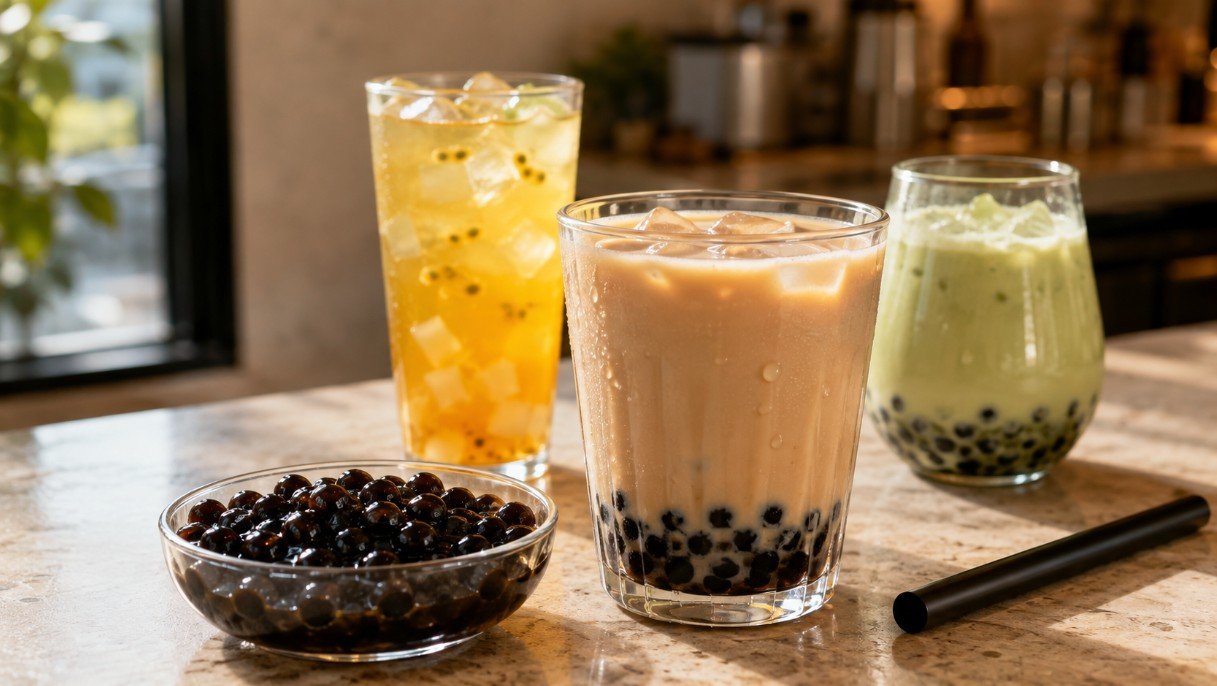
Boba Can Mean the Pearls or the Whole Drink
In menu language, “boba” usually means tapioca pearls. In casual conversation, it often means bubble tea as a whole.
Boba is a topping
When a menu lists boba under toppings, it normally refers to chewy tapioca pearls. They sit near the bottom of the cup and travel through a wide straw with the drink. A request such as “extra boba” or “add boba” usually means more pearls, not more tea.
Boba is the entire drink category
In everyday speech, especially in the United States, boba can mean the complete beverage or even the social activity of going to a tea shop. Someone who says “Let’s get boba” may order fruit tea, matcha, coffee or a smoothie without traditional pearls.
What “Boba” Means in Common Phrases
The same word changes meaning depending on where it appears. These examples show how the word is used on menus, ordering apps and in everyday conversation.
| Phrase | Usually means | What you receive | Useful question |
|---|---|---|---|
| Add boba | Traditional tapioca topping | A scoop of chewy pearls | Are black, golden or mini pearls available? |
| Extra boba | A larger topping portion | More pearls and less space for liquid | Is there an extra charge? |
| Boba milk tea | Milk tea served with pearls | Tea, milk or creamer, sweetener and tapioca | Are pearls included or added separately? |
| Brown sugar boba | Pearls coated or held in dark sugar syrup | A sweeter, caramel-like topping or drink | Does the drink contain tea? |
| Popping boba | Juice-filled spheres | A topping that bursts rather than chews | Which flavor and ingredients are used? |
| No boba | No tapioca pearls | The drink without that topping | Does the base contain jelly or pudding by default? |
| Let’s get boba | A bubble tea outing | Any drink the person chooses | What style of drink do you want? |
| Boba shop | A bubble tea café | A menu of drinks and toppings | What does the shop specialize in? |
Traditional Boba Pearls Begin with Tapioca Starch
Traditional chewy boba pearls are made mainly from tapioca starch derived from cassava. Water forms the dough; sugar, coloring or flavor may be added depending on the recipe; cooked pearls are commonly soaked in syrup before serving.
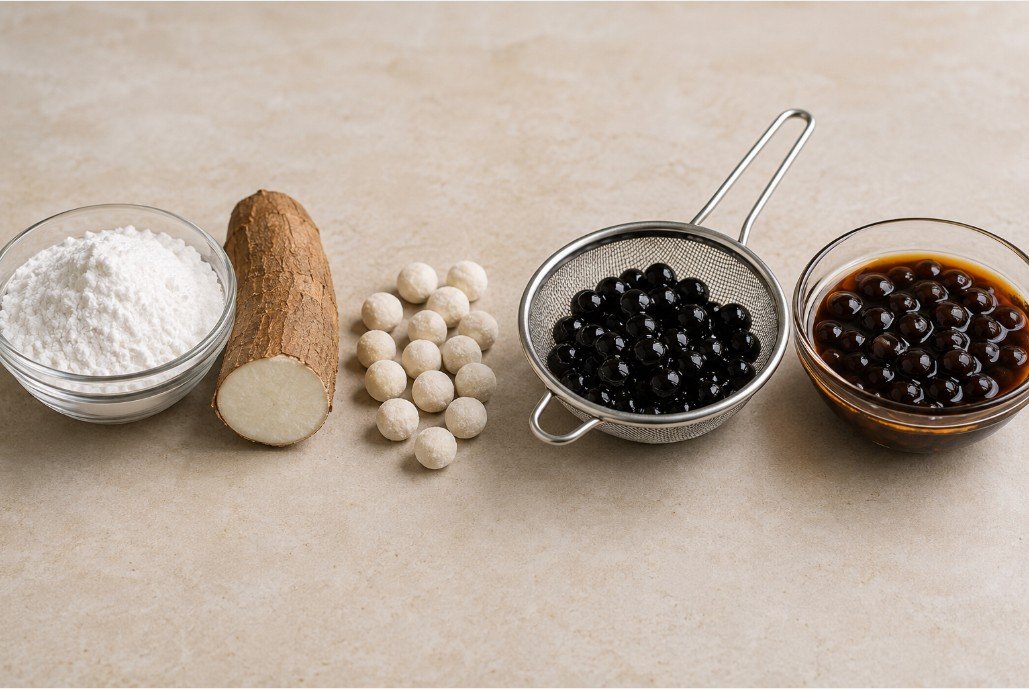
Cassava is the plant
Cassava is a starchy root crop. Tapioca is the purified starch extracted from that root. The terms are related, but cassava flour and tapioca starch are not identical: cassava flour uses more of the whole root, while tapioca starch is the refined starch fraction.
Tapioca starch forms the structure
The starch is mixed with hot water or another liquid to create a workable dough. That dough is rolled into small spheres. Pearl size matters because larger pearls need more time to cook through and are more likely to develop a hard center if rushed.
Syrup supplies much of the flavor
Plain tapioca is mild. The recognizable brown sugar, honey or caramel-like character often comes from the syrup used after cooking. Pearls absorb sweetness while resting, so the topping can remain sweet even when the drink is ordered with less adjustable sugar.
Why are black boba pearls black?
Tapioca starch itself is pale. Dark pearls may get their color from brown sugar, black sugar, caramel coloring, food coloring or a prepared commercial pearl formula. A black appearance does not prove that a pearl contains a large amount of brown sugar, and two shops can use visually similar pearls with different ingredient lists.
Golden pearls are often lighter in color and may use a different sweetener or formula. Mini pearls are primarily a size variation. Packaged quick-cook pearls may include additional starches, stabilizers, color or flavor so they cook faster and hold consistently.
Ingredient questions worth asking
- Are the pearls traditional tapioca or another product?
- Are they sweetened with brown sugar, honey or plain syrup?
- Do the packaged pearls contain added colors or flavors?
- Are they prepared in shared equipment?
- Are they included in the drink or charged as an add-on?
Heat Turns Tapioca Dough into a Springy Pearl
Boba texture is created through hydration, shaping and controlled cooking. The process is simple in concept but sensitive to time, temperature, pearl size and holding conditions.
Hydrate the starch
Hot water or syrup is added to tapioca starch. The heat helps the mixture bind into a dough instead of remaining a loose powder.
Form a workable dough
The dough must be soft enough to roll but firm enough to keep its shape. Too dry and it cracks; too wet and it becomes sticky.
Roll and size the pearls
Small pieces are rolled into spheres. Even sizing matters because uneven pearls finish cooking at different times.
Boil thoroughly
The pearls cook in plenty of water. Their centers need enough heat to lose the raw, chalky or hard texture associated with undercooking.
Rest or steep
Some methods include a covered resting period after boiling so heat continues moving through the center without violently breaking the exterior.
Sweeten and hold briefly
Cooked pearls are transferred to syrup, where they gain flavor and stay soft for a limited service window.
| Characteristic | Fresh-made or traditional cook | Quick-cook or instant pearl |
|---|---|---|
| Preparation | Longer boiling and resting process | Designed to finish rapidly |
| Texture control | More control but more skill required | Consistent when directions are followed |
| Ingredient formula | May be relatively simple | May include additional starches or processing aids |
| Holding | Often excellent at first, then changes quickly | Designed for convenience, but still not permanent |
Boba Is Chewy Because Cooked Tapioca Starch Forms an Elastic Gel
When tapioca starch absorbs water and heats, its granules swell and reorganize into a soft, elastic structure. That transformation creates the springy bite associated with well-prepared pearls.
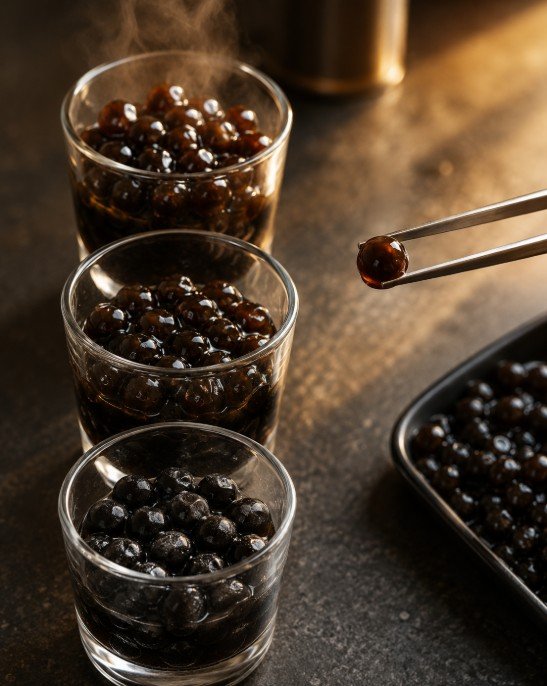
What QQ means
In Taiwanese food language, QQ describes a satisfyingly springy, bouncy and chewy texture. It is not simply “hard.” Ideal QQ pearls compress under the teeth, resist slightly and then rebound without a chalky center or mushy exterior.
Why cooling changes the chew
As starch-based foods cool, their structure becomes firmer. Pearls therefore tighten as they sit, and refrigeration makes them noticeably denser. Cold storage may keep a drink safe for later, but it does not preserve the same fresh-pearl texture.
Why syrup matters
Warm syrup keeps the surface moist and adds flavor, but it cannot permanently stop texture change. Pearls continue absorbing liquid, and the balance between their exterior and center shifts over time.
Usually caused by insufficient cooking, steeping or water temperature.
The pearl is tender, springy and easy to pull through the straw.
Excessive heat or holding can weaken the outer structure.
Continued moisture movement changes both surface and center.
Cold temperatures rapidly reduce the fresh springy sensation.
Plain Tapioca Is Mild; Most Boba Flavor Comes from Syrup
Boba does not have one universal flavor. The pearl itself is subtle, while syrup, tea, milk, fruit and other ingredients create the taste people remember.
Neutral
Plain tapioca starch contributes little flavor and mainly provides texture.
Lightly sweet
Simple syrup gives pearls sweetness without a strong additional aroma.
Brown sugar
Dark syrup can add molasses, caramel and toasted notes.
Honeyed
Some shops hold pearls in honey or a honey-style syrup.
Flavored
Prepared pearls may include fruit, tea, herbal or artificial flavoring.
The drink base usually has the strongest effect. Black milk tea tastes malty and creamy; jasmine tea tastes floral; mango tea tastes bright and tropical; matcha tastes grassy; coffee tastes roasted. See how boba flavors differ.
Boba, Bubble Tea and Tapioca Pearls Overlap, but They Are Not Identical
The terms overlap across regions, but each one points to a different part of the drink, topping or broader category.
| Term | Narrow meaning | Broader meaning | Typical use |
|---|---|---|---|
| Boba | Tapioca pearls | Bubble tea or the outing itself | “Add boba” or “Get boba” |
| Bubble tea | A shaken tea drink | The modern customizable drink category | Category name |
| Boba tea | Tea served with boba | Often used as another name for bubble tea | Common U.S. wording |
| Tapioca pearls | The chewy starch topping | Sometimes casually called boba balls | Ingredient description |
| Pearl milk tea | Milk tea with tapioca pearls | A classic bubble tea style | Menu item |
| 珍珠奶茶 | Pearl milk tea | A central Taiwanese name for the drink | Chinese-language menus |
| 粉圓 | Starch pearls | A traditional Taiwanese tapioca-style ingredient | Ingredient terminology |
| Popping boba | Liquid-filled spheres | A modern topping category | Fruit drinks and desserts |
The “Bubble” Originally Points to Shaken Foam, Not Only the Pearls
Bubble tea is associated with vigorous shaking. When sweetened tea is shaken with ice, a layer of fine foam or bubbles forms at the top. Modern English speakers often connect “bubble” with the round toppings, but the shaken foam explanation is an important part of the drink’s history.
Shaken tea
Tea, sweetener and ice are mixed in a shaker, cooling the drink quickly and creating aeration.
Foamy surface
The shaking creates visible bubbles, especially in tea without heavy milk or fruit puree.
Pearl association
As tapioca drinks became globally recognizable, many customers began interpreting “bubble” as the round toppings.
Modern Bubble Tea Developed in Taiwan in the 1980s
The drink grew from Taiwan’s tea-shop culture, cold shaken tea, milk tea and long-standing tapioca desserts. The precise invention story is disputed, so responsible history should describe competing claims rather than naming one uncontested inventor.
Tea and tapioca already existed separately
Taiwan had established tea culture, sweet cold drinks and tapioca-based desserts before the modern combination became famous. Bubble tea did not appear from a single ingredient discovery; it emerged by recombining existing foods and service ideas.
Cold shaken tea becomes a shop innovation
Tea houses experimented with cold service, shaking, foam and takeaway presentation. Chun Shui Tang is associated with the development of shaken cold tea and later claimed the addition of tapioca to milk tea.
Competing pearl tea stories emerge
Hanlin Tea Room also claims an early pearl tea, connected to its founder’s use of tapioca pearls. Chun Shui Tang has a separate story involving Lin Hsiu Hui adding pearls during a staff meeting in 1988. Both stories remain part of the public history.
The drink spreads internationally
Bubble tea shops expanded across East Asia and became increasingly visible in North American cities. Menus began adapting to local preferences while retaining the Taiwanese identity of pearls, tea and customization.
Boba becomes a global category
The modern market includes fresh tea, milk tea, fruit tea, fresh milk, coffee, matcha, yogurt, slushes, sparkling drinks, foam and many toppings. The category has expanded, but its Taiwanese origin remains central.
Not Every Round Topping Is Tapioca
Traditional black pearls are tapioca-based, but not every round topping is tapioca. Texture, ingredients and best drink pairing can be completely different.
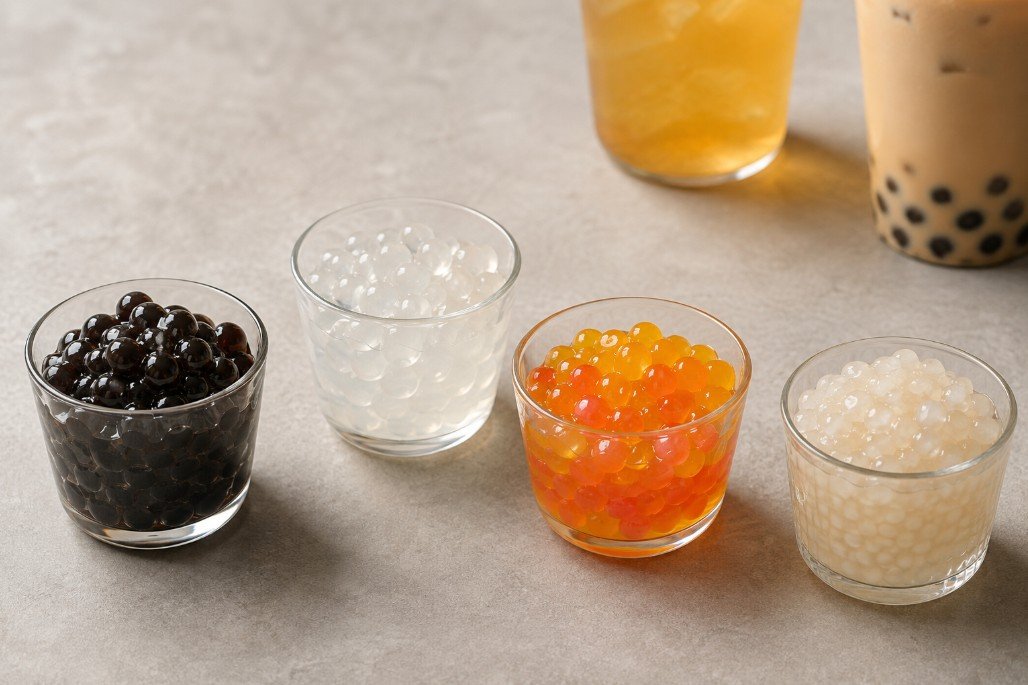
| Topping | Main texture | Appearance | Usually tapioca-based? | Best with |
|---|---|---|---|---|
| Black tapioca | Dense and chewy | Dark, glossy, medium-sized | Yes | Milk tea, roasted tea, brown sugar drinks |
| Golden boba | Chewy, sometimes softer | Amber or pale gold | Usually | Jasmine, oolong, lighter milk teas |
| Mini pearls | Chewy but faster to sip | Small black or amber spheres | Usually | Slushes and thick drinks |
| Crystal boba | Springy, delicate or jelly-like | Translucent | Not always | Fruit tea and floral tea |
| Popping boba | Thin shell with liquid center | Bright translucent spheres | No | Fruit tea, lemonades, frozen yogurt |
| Sago | Small, soft and bead-like | Tiny pale translucent pearls | Varies by product and region | Mango, coconut and dessert drinks |
| Jelly cubes | Soft, firm or slippery | Cubes or strips | No | Fruit tea and pure tea |
For a full guide to pudding, aloe, grass jelly, crystal pearls and other textures, compare boba toppings.
Tea, Milk and Pearls Are All Optional
Tea, milk and tapioca are classic elements, but each one can be omitted. “Boba” now describes a flexible café category rather than one fixed recipe.
Does every boba drink contain tea?
No. Fresh milk drinks, coffee, smoothies, slushes and some fruit drinks may contain no brewed tea. Matcha is tea, even though it is whisked powder rather than a normal tea infusion.
Does every boba drink contain milk?
No. Pure tea and fruit tea are often made without milk, although foam, pudding or creamer can still introduce dairy-derived ingredients. Always confirm the whole recipe rather than judging by drink color.
Does every boba drink contain pearls?
No. Many shops sell drinks without toppings by default. A customer may add jelly, pudding, aloe, foam or nothing at all and still be ordering from a bubble tea menu.
See examples of boba drinks made without tea.
A Boba Drink Is Built from Five Separate Decisions
Once the word “boba” is clear, the menu becomes easier to read. Most drinks can be understood as a combination of base, flavor, sweetness, temperature and texture. These parts are related, but they are not interchangeable.
Base
The base is the main liquid: black tea, jasmine tea, oolong, green tea, matcha, coffee, milk, yogurt, fruit mixture or a blended frozen base. It controls body, aroma and usually caffeine.
Flavor
Flavor may come from fruit, taro, chocolate, brown sugar, herbs, floral ingredients or a house syrup. A flavor name does not always reveal the underlying base.
Sweetness
Many shops let customers reduce adjustable syrup, but powders, puree, pearls and brown sugar coating may remain sweet. “Zero percent” is not a universal zero-sugar claim.
Temperature and ice
Ice controls chill and dilution. Hot or warm service changes aroma and pearl softness. Frozen drinks rely on ice for structure and cannot simply be ordered without it.
Topping
Toppings create the texture layer. Tapioca is chewy, pudding is soft, jelly is slippery, popping boba bursts and foam adds a creamy surface rather than a chew.
Final balance
The cup succeeds when these choices support one another. Strong black tea can carry dense pearls; delicate jasmine often works better with a lighter topping; a thick slush needs small add-ins that can move through the straw.
| Menu phrase | Base | Flavor or style | Topping | Likely experience |
|---|---|---|---|---|
| Brown sugar fresh milk with boba | Fresh milk | Brown sugar syrup | Tapioca pearls | Rich, sweet and dessert-like; may contain no tea |
| Jasmine milk tea with pudding | Jasmine tea | Milk or creamer | Pudding | Floral, creamy and soft-textured |
| Passion fruit green tea with crystal boba | Green tea | Passion fruit | Crystal boba | Tart, refreshing and lightly springy |
| Taro smoothie with mini pearls | Blended milk or powder base | Taro | Mini tapioca pearls | Thick, cold and easier to sip than large pearls |
Boba Works Best When the Serving Format Matches the Topping
A good drink is not only a recipe. Cup size, ice, straw diameter, temperature and topping size determine whether the drink is easy and pleasant to consume.
Small or hot size
Useful for tea-forward drinks, hot milk tea or a smaller first order. Availability varies by shop.
Common regular size
A typical range for standard U.S. cold drinks, though brands define “regular” differently.
Common large size
More total volume, but toppings and ice can take up a meaningful part of the cup.
Extra-large formats
Available at some chains and specialty shops; balance can change as the drink warms.
| Choice | What changes | Practical effect |
|---|---|---|
| More toppings | Less room for liquid | The drink becomes heavier and may need a larger straw |
| Less ice | Warmer serving temperature and different dilution | Pearls may soften differently and tea may taste stronger |
| Hot drink | No cold ice barrier | Pearls may feel softer at first but the cup needs safe handling |
| Thick slush | Higher resistance through the straw | Mini pearls or small jelly pieces are easier than large toppings |
| Foam topping | Creamy layer sits at the surface | Sip through the foam first before mixing if desired |
Explore the wider range of boba drink families.
Fresh Pearls Are Best Within Hours, Not Days
Tapioca pearls are a same-day topping. Their texture changes continuously after cooking, especially when they cool, sit in liquid for too long or are refrigerated.
This is the peak period when the outside is tender and the center remains pleasantly springy.
Pearls remain chewy when held correctly in warm syrup, though they continue absorbing sweetness and moisture.
Some batches become dense, sticky or too soft. A practical home-use guideline often cited is to consume them within about four hours.
Cold storage quickly hardens the starch structure. The drink may still be usable, but the original QQ texture is not preserved.
Reheating a complete drink can damage tea, milk and ice balance. Fresh pearls are generally a better solution than trying to restore old ones.
Boba Is Mostly a Starch-Based Topping, While the Whole Drink Determines Most Nutrition
Pearls contribute carbohydrate and added sugar, but the full cup may also include sweetened tea, milk, creamer, fruit base, foam, pudding or several toppings. There is no single calorie or sugar number that describes every boba drink.
Pearls
Mostly starch, plus the sugar absorbed from syrup. A larger topping portion increases both carbohydrate and total volume.
Drink base
Unsweetened tea is very different from brown sugar fresh milk, a creamy smoothie or condensed-milk coffee.
Adjustable sweetness
Reducing syrup can help, but it does not remove sugar already present in pearls, flavored powders, puree or pudding.
Allergens
Milk, soy, egg, gelatin, coconut, nuts and shared equipment may matter. A category name cannot guarantee safety.
Young children and anyone with swallowing difficulties require particular caution with chewy pearls because they are swallowed through a wide straw. Drinking slowly, chewing thoroughly and choosing an age-appropriate topping matters more than the popularity of the product.
For deeper comparisons of sugar, caffeine and common drink components, review boba nutrition.
Start with One Familiar Drink and One Texture
A simple first order teaches you more than a cup overloaded with unfamiliar toppings. Choose the experience you want, begin at moderate sweetness and change one variable on the next visit.
Black milk tea + tapioca pearls
Choose 50–70% sweetness, regular ice and one scoop of pearls. This gives you the standard contrast between creamy tea and QQ chew.
Peach or mango tea + aloe
A lighter route with clear fruit flavor and a soft, refreshing topping. Good for people who do not want a creamy drink.
Jasmine or oolong tea + light topping
Choose crystal boba, grass jelly or no topping so the aroma remains clear.
Brown sugar fresh milk + included pearls
Rich, sweet and texture-focused. Avoid adding several more toppings to an already complete drink.
Good Boba Should Be Elastic, Fresh and Easy to Drink
Branding and cup design cannot replace good pearl texture. The topping itself should feel balanced from the first sip to the last.
Shape
Pearls should be reasonably uniform. Extreme size variation can produce hard centers and overcooked small pieces in the same batch.
Outer texture
The surface should be soft and glossy, not slimy, torn or dissolving into the drink.
Center
The center should resist gently without feeling chalky, raw or rock-hard.
Sweetness
Syrup should complement the drink instead of overpowering tea, fruit or milk.
Temperature
Warm pearls can be pleasant in a cold drink, but they should not make dairy unsafe or melt the entire cup immediately.
Straw flow
Pearls should pass through the straw without constant clogging or dangerous forceful sipping.
Holding quality
The batch should remain separate and springy rather than forming one solid sticky mass.
Pairing
The topping should support the drink. Heavy black pearls can overwhelm delicate floral tea, while tiny pearls may disappear in a thin drink.
What People Commonly Get Wrong About Boba
“Boba always means milk tea.”
Milk tea is only one drink family. Boba shops also sell fruit tea, pure tea, fresh milk, coffee, matcha, smoothies and slushes.
“Bubble tea must contain pearls.”
A drink can belong to the bubble tea category while using jelly, pudding, aloe, foam or no topping.
“Black pearls are naturally black.”
Tapioca starch is pale. Dark color comes from sugar, coloring or the pearl formula.
“Popping boba is tapioca.”
Popping boba is a liquid-filled sphere with a completely different bite and manufacturing method.
“Every boba drink contains tea.”
Fresh milk, coffee, fruit drinks and blended beverages may contain no brewed tea.
“Zero adjustable sugar means zero sugar.”
Pearls, puree, powder, pudding and brown sugar syrup may remain sweet even when no extra syrup is added.
Boba Is a Texture, a Drink Language and a Taiwanese Food Tradition
In its narrowest meaning, boba is the chewy tapioca pearl at the bottom of a cup. In everyday use, it can mean the complete world of customizable drinks that grew from Taiwan’s tea-shop culture.
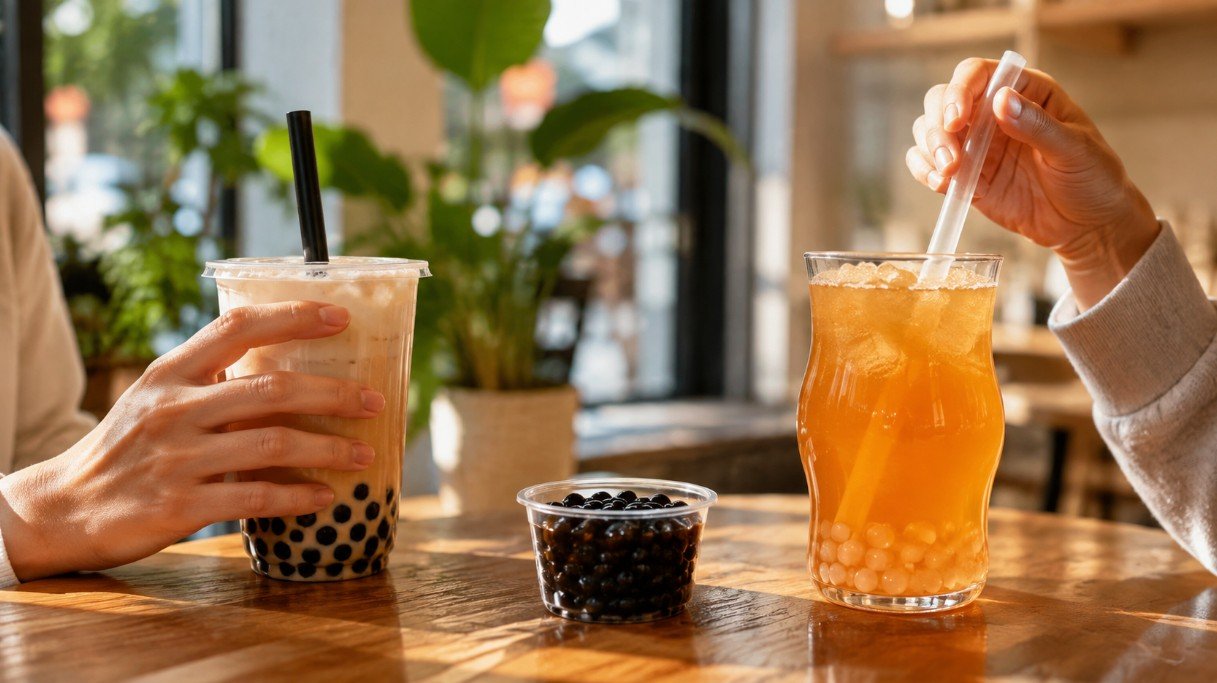
You do not need to memorize every topping or menu term before trying boba. Begin with one drink style that already sounds appealing, add one texture you are curious about and notice how freshness, sweetness and temperature affect the experience.
The first cup gives you a reference point. From there, you can decide whether you prefer more tea flavor, a lighter fruit base, a richer milk drink, softer jelly or a stronger QQ chew.
That process is part of why boba became more than one fixed recipe. The category invites comparison: warm pearls against cold tea, floral jasmine against caramel-like syrup, a clean fruit base against a creamy foam. Understanding the vocabulary lets you make those choices deliberately instead of ordering by color alone today.
What People Ask About Boba
These answers cover the most common questions about the word, the pearls and the drink itself.
What exactly is boba?
Boba can mean chewy tapioca pearls or the complete bubble tea drink. On a menu, “add boba” usually means pearls. In everyday conversation, “getting boba” usually means buying a bubble tea or related drink.
Is boba the drink or the balls?
It can mean either. The balls are traditionally tapioca pearls, while the word is also widely used as a casual name for the whole drink category.
What is traditional boba made of?
Traditional chewy boba pearls are made mainly from tapioca starch derived from cassava. Water forms the dough, and sugar, coloring or flavor may be added. Cooked pearls are commonly soaked in syrup.
Is tapioca the same as boba?
Tapioca is the starch ingredient. Boba is the prepared pearl or, in broader use, the drink category. Traditional boba is tapioca-based, but popping boba and some other toppings are not.
Why is boba chewy?
Heat and water cause tapioca starch to gelatinize into a soft elastic structure. Correct cooking creates a springy QQ texture; undercooking leaves a hard center and refrigeration makes pearls firm.
What does QQ mean in boba?
QQ is a Taiwanese expression for a pleasantly springy, bouncy and chewy texture. Ideal QQ pearls are soft outside, elastic in the center and not chalky or mushy.
Does boba always contain tea?
No. Classic milk tea and fruit tea often contain tea, but fresh milk drinks, coffee, smoothies, slushes and some fruit drinks may not.
Does boba always contain milk?
No. Pure tea and fruit tea can be milk-free, although foam, pudding or creamer may still add dairy-derived ingredients. Always confirm the full recipe.
Is popping boba made from tapioca?
No. Popping boba has a thin gel-like shell and a liquid center. It bursts when bitten and is different from the dense chew of tapioca pearls.
Why are black boba pearls black?
Tapioca starch is pale. Black pearls get their dark color from brown sugar, black sugar, caramel coloring, food coloring or a commercial pearl formula.
How long do boba pearls stay chewy?
They are best within hours of cooking. Proper warm syrup holding helps temporarily, but the texture becomes denser or softer over time and refrigeration quickly makes pearls firm.
Can you order bubble tea without boba?
Yes. Most shops allow no topping or a substitute such as jelly, pudding, aloe, crystal boba, foam or red bean.