
Tapioca Pearls: Taste, Texture, Sizes, Prices & How Boba Pearls Work
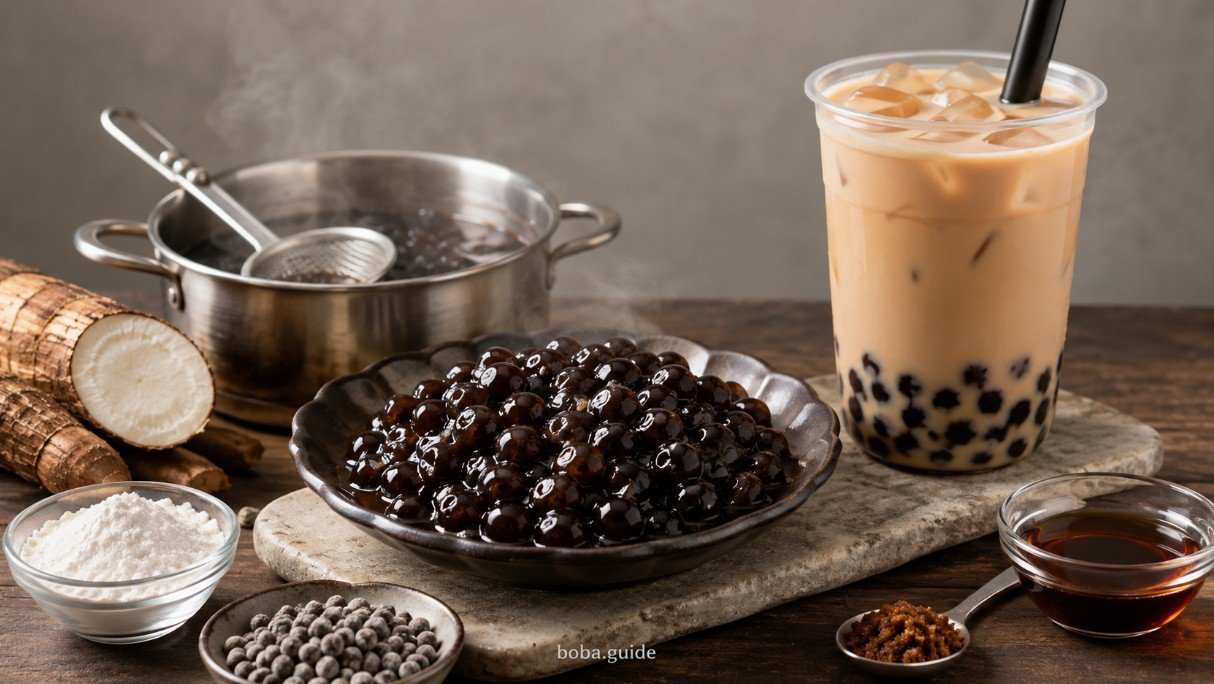
Tapioca pearls are the classic chewy boba topping made primarily from tapioca starch, a starch obtained from cassava. Before cooking they are dry, compact and relatively hard; after cooking, water and heat transform the starch into a soft, elastic structure that can be sweetened with brown sugar, honey or syrup.
The familiar black pearl is only one version. Taiwan suppliers also sell smaller pearls, golden pearls and pale “white jade” pearls, while food-service brands offer traditional and quick-cook formats. The ingredients, cooking time, finished diameter, sweetness and holding quality can all vary, so “tapioca pearls” describes a family of products rather than one universal recipe.
What are tapioca pearls?
Tapioca pearls are starch-based balls cooked in boiling water until the starch hydrates and gelatinizes. Once fully cooked, the center changes from a dry, chalky core into a flexible gel-like starch network with the dense chew associated with classic boba.
A pearl has two very different lives: dry and cooked
Dry commercial pearls are compact shelf-stable products designed to survive storage and transport. Cooking introduces water into the starch structure. The pearl expands, softens and becomes much more elastic.
That transformation is why the package weight and the finished drink experience cannot be understood by looking at dry pearls alone. Cooking method, resting time, rinsing and sweetening all change the final topping.
Compact, firm, low-moisture pearl.
Starch absorbs water and gelatinizes.
Heat continues moving through the center.
Syrup adds flavor after cooking.
For the deeper ingredient question, including cassava and starch formulation, continue to what tapioca pearls are made of. To compare tapioca with the wider topping family, use our boba toppings guide.
“Boba,” “pearls,” 珍珠, 粉圓 and 波霸 do not always mean exactly the same thing
American menus often use “boba” as the generic word for tapioca pearls. Taiwan has a richer vocabulary that can describe the topping, its size or its role in the drink.
Zhēnzhū — “pearls”
A common menu and product term for tapioca pearls. It emphasizes the small round shape.
Fěnyuán — starch pearls / tapioca balls
A traditional Taiwanese term for round starch-based pieces. Supplier language often combines it with 珍珠.
Bōbà — often associated with larger pearls
In Taiwan, 波霸 can distinguish larger pearls from smaller 珍珠 in some menu contexts. In the U.S., “boba” became a much broader name for the category.
Brown-sugar pearls
Usually refers to pearls served with a strong brown-sugar character. The exact formulation and syrup treatment vary by shop and manufacturer.
White-jade pearls
Taiwan suppliers sell pale or translucent tapioca pearls made from tapioca starch and intended to be sweetened after cooking.
Japanese menus commonly use タピオカ for tapioca pearls, while Korean product listings use 타피오카 펄. Korean food-product databases also show white, colored and quick-pearl products imported from multiple countries, reinforcing that “tapioca pearl” is a product family with many commercial forms.
Why are tapioca pearls chewy?
The chew comes from starch behavior under heat and water. Taiwan’s chemical-management authority explains that the Q-bouncy texture of tapioca pearls is tied to starch gelatinization: heated starch loosens, absorbs water and swells, changing from a dry granule-rich structure into an elastic cooked matrix.
Taiwanese food language uses Q or Q彈 for a pleasantly resilient, springy chew. It is not a precise laboratory measurement; it is a sensory description.
If your pearls are hard, mushy or losing bounce, the deeper diagnosis belongs in our boba quality guide.
Tapioca pearl size, color and style vary more than most U.S. menus show
Large black pearls dominate U.S. bubble tea, but Taiwan suppliers sell several size and color families. Diameter affects straw choice, cooking behavior, portion count and how much chew a drink delivers.
Bossen lists its cooked large pearl at about 8.5 mm diameter and recommends a 12 mm straw.
Smaller pearls create faster, lighter chew and allow more pieces in each sip. Taiwan suppliers sell small 珍珠粉圓 alongside larger 波霸-style products.
Usually lighter in color than classic black pearls. Ingredient and flavor systems vary by brand.
Pale tapioca pearls can be sweetened with brown sugar, light sugar or honey after cooking without starting as a black pearl.
Black does not mean “naturally black cassava.” Commercial ingredient lists can include caramel color, brown-sugar flavor or other coloring/flavoring systems. Exact formulas vary, so check the product rather than assuming every black pearl gets its color the same way.
What do tapioca pearls taste like?
Plain tapioca starch is mild. Much of the flavor people associate with classic boba comes from what happens after cooking: brown sugar, black sugar, honey, cane sugar, fructose or another syrup is absorbed onto and into the warm pearls.
Mild, starchy, mostly about texture.
Caramelized, molasses-like and richer.
Rounder sweetness with a distinct honey aroma.
Less dominant, allowing tea to remain the main flavor.
The soaking and sweetening step deserves its own treatment; see how to sweeten boba pearls for ratios and methods.
Why do tapioca pearls taste different from one boba shop to another?
The pearl brand matters, but preparation often matters just as much. Two shops can start with similar dry pearls and produce noticeably different chew, sweetness and freshness because of how they cook, rest, rinse, sweeten and hold each batch.
Too little boiling water can drop the temperature sharply when dry pearls are added and make cooking less even. Bossen’s current traditional directions use a 1:10 tapioca-to-water ratio as one product-specific reference.
Pearls can settle and stick early in cooking. Controlled stirring helps keep the batch moving without crushing softened pearls later in the process.
The center needs enough heat exposure to lose a hard uncooked core. Traditional and express formulations require different schedules.
Rinsing removes surface starch and stops some carryover cooking. Aggressive cold treatment can also change the immediate feel of the outer layer.
Brown sugar, honey, fructose and cane sugar produce different aroma and surface sweetness even when the underlying pearl is the same.
A pearl served 30 minutes after finishing can feel very different from one held for several hours. Freshness is part of the recipe.
If the pearl center is soft but still has elastic resistance, the outside is not dissolving into the drink, and the sweetener tastes integrated rather than merely sticky, the shop is probably managing both cooking and holding reasonably well. That is an observation, not a guarantee of any specific recipe or brand.
Tapioca pearls vs popping boba, crystal boba and jelly
American menus often group several toppings under the casual word “boba,” but their physical structures are completely different. Tapioca is the starch-based option: it is cooked from a dry pearl and stays chewy throughout rather than containing a liquid center or behaving like a ready-to-serve gel.
Dense, elastic and syrup-friendly. Usually cooked in batches and best served fresh.
Ready to serve and designed to burst rather than chew. See popping boba.
Translucent, ready to serve and springy rather than starch-dense. See crystal boba.
Often sold as cubes or strips rather than round pearls. Lychee versions may use nata de coco; see lychee jelly.
Choose tapioca when the chew itself should be part of the drink
Tapioca is especially natural in milk tea, brown-sugar drinks and other drinks where a warm caramelized or honeyed pearl can complement the base. Fruit tea can also work, but popping boba, crystal boba or jelly often gives a lighter texture when the drink is built around acidity and fresh fruit flavor. That is a pairing judgment rather than a fixed menu rule.
Traditional and quick-cook tapioca pearls solve different problems
Food-service suppliers now sell both long-cook and express pearls. The difference matters most to kitchens and shops because it changes labor, timing and batch planning.
About 25 minutes cooking + 35 minutes resting
Bossen’s current Large Boba directions use a 1:10 tapioca-to-water ratio, 25 minutes on low heat and 35 minutes covered off heat before rinsing and sweetening.
The benefit is a familiar food-service process with a full hydration/rest stage. The cost is roughly an hour of elapsed preparation before the pearls are ready.
About 25 minutes cooking + 5 minutes resting
Bossen’s Express Cook product keeps a 25-minute cooking stage but shortens the covered rest to about 5 minutes, cutting a substantial part of the waiting time.
That can matter for a shop that needs another batch quickly, but “quick-cook” is not a universal formula: other manufacturers, including Possmei, sell 5-minute products with different preparation systems.
For a side-by-side buying decision, see quick-cook vs traditional tapioca pearls. For exact preparation, use our boba pearl cooking guide.
Cooked tapioca pearls have a short texture window
Dry pearls can sit in storage for months, but cooked pearls are a different food. Bossen recommends serving both its traditional and express cooked pearls within about 4 hours for best texture.
Hot, hydrated pearls are rinsed, sweetened and brought into service.
The pearls should remain soft and elastic if the batch was cooked correctly and held appropriately.
Extended holding can reduce bounce or make the outside too soft depending on temperature, syrup and formulation.
Cooked starch can firm during refrigeration as starch molecules reorganize and lose some of the fresh elastic character.
This is why a good boba shop thinks in batches rather than treating cooked tapioca as a topping that stays identical all day. Product formulation, ambient temperature, syrup and holding equipment can extend or shorten the ideal window.
For leftover handling rather than same-day service, see how to store cooked boba.
What should a fresh tapioca pearl feel like in the cup?
A customer cannot see the shop’s timer or cooking ratio, but the finished pearl gives useful clues. The best result is usually neither extremely soft nor aggressively rubbery: it should compress under the teeth, recover with some spring and remain pleasant through the drink.
A noticeably dry or brittle center usually means the pearl did not hydrate enough for that product and batch. A very tiny firmer center may be intentional in some styles, but a clearly raw-tasting core is not the classic target.
Good Q-style chew gives resistance without forcing you to keep working the same pearl. If the topping behaves like a dense rubber pellet, texture has moved away from the soft-elastic balance most bubble-tea drinkers expect.
The outside should be soft and glossy without dissolving into a paste. Pearls that smear together, collapse into fragments or make the bottom of the cup unusually starchy may have been overcooked or held too long.
A well-sweetened pearl should not taste like completely bland starch wrapped in a sticky film. Warm pearls can take on syrup flavor during the post-cook resting stage, although the depth of sweetness varies by shop.
Ice, time and drink temperature continue changing starch after service. A pearl that starts pleasant and becomes firmer near the end of a long iced drink is not automatically defective; the useful question is how quickly and how severely the texture changes.
These are sensory clues, not a laboratory freshness test. Different pearl formulas deliberately target different chew levels, and a shop’s syrup, drink temperature and holding method can all shift the result.
How much tapioca goes in one boba drink?
There is no universal scoop size, but supplier references give a practical starting point. Bossen recommends 60–80 g (2.1–2.8 oz) of cooked large tapioca pearls for a 16 fl oz drink.
Lighter topping load
Middle reference
Heavier topping load
Actual shops may use different cup sizes, scoops and pearl diameters. Mini pearls also change the number of individual pieces per gram, so the sensory experience can be very different even at the same topping weight.
Tapioca pearls are strongly associated with Taiwan, but the cassava story extends into Southeast Asia
Taiwan made pearl milk tea globally famous, but the modern tapioca supply chain is regional rather than confined to one island. Thailand is one of the world’s major cassava and tapioca-starch producers, while processed pearl products are manufactured and exported from Taiwan and other Asian markets. Culinary identity, starch origin and final pearl manufacturing therefore do not always point to the same country.
Cassava-growing regions
Thailand and other Asian producers supply large volumes of cassava and tapioca starch into regional and global food manufacturing.
Starch processing
Cassava roots are processed into tapioca starch, the functional base that gives classic pearls their cooked structure.
Taiwanese pearl manufacturing and know-how
Taiwan manufacturers formulate pearl products in multiple sizes, colors and cooking formats for domestic use and export.
Global bubble-tea distribution
Dry pearl bags move through ingredient distributors to boba shops in the United States and other markets.
Taiwan’s Ministry of Health and Welfare has specifically discussed 粉圓 products as an export food category and notes that exported products must comply with the destination country’s food rules. This is another useful reminder that “Taiwanese boba” can describe culinary origin, product know-how and manufacturing identity without implying that every starch input was grown in Taiwan.
How much do tapioca pearls cost in the U.S.?
Current food-service listings show classic dry tapioca pearls as one of the lower-cost boba toppings by raw pound. Bossen lists a 6.6 lb bag at $10.18, or about $1.54/lb. Fanale lists a six-bag 39.6 lb case at $61.95, or about $1.56/lb.
Across the two current listings above.
Not a national average; just the arithmetic midpoint of these two current examples.
Why you should not calculate a finished serving from dry price alone
A 60–80 g drink serving refers to cooked pearls, while the $1.54–$1.56/lb price refers to dry product. Pearls absorb substantial water during cooking, so simply multiplying the cooked serving weight by dry cost per pound would overstate the raw dry-ingredient cost.
Supplier yield claims are more practical — but still approximate
Bossen says one 6.6 lb bag makes approximately 35–50 servings. At $10.18 per bag, that is roughly $0.20–$0.29 in dry pearls per stated serving, before sweetener, water, labor, energy, waste and shipping.
For a shop, the larger cost is often operational rather than the dry starch itself
A traditional batch can require about 25 minutes of active cooking plus 35 minutes of covered resting in Bossen’s current directions, followed by rinsing and sweetening. If the best texture is expected within four hours, the shop also has to forecast demand well enough to avoid both running out and discarding old pearls. Cheap raw material does not automatically mean cheap service.
Prices are current examples verified August 19, 2026 and can change with supplier, freight, promotion, pearl format and case quantity. They should not be treated as a universal U.S. average.
Dry traditional, quick-cook, instant and frozen pearls are different products
“Tapioca pearls” on a shopping page can describe products that demand very different amounts of work. Before comparing price, check what kind of pearl you are actually buying and what the package expects you to do before service.
Lowest-tech format, longest preparation
These are compact dry pearls that require a full boiling and resting cycle. Bossen’s current 3 kg example uses 25 minutes cooking plus 35 minutes covered rest. Traditional dry pearls make sense when a shop can schedule batches and values a familiar full-cook workflow.
Formulated to reduce waiting time
Bossen’s Express Cook product keeps a 25-minute cooking stage but cuts the covered rest to about 5 minutes. Possmei sells another format described as 5 minutes cooking plus 10 minutes stewing. “Quick” therefore describes the job, not one universal recipe.
Convenience for small-volume use
Pre-portioned instant formats reduce batch planning and can be practical for home use, offices or menus where tapioca demand is low. The trade-off is normally a higher unit cost and a texture profile that may not match a freshly cooked traditional pearl.
Another route to speed and consistency
Imported-food databases in Korea currently list frozen tapioca-pearl products, showing that the global market is not limited to shelf-stable dry bags. Frozen formats can move preparation work upstream to the manufacturer, but storage, thawing or reheating instructions become product-specific.
Small package size, simple preparation and low waste can matter more than the cheapest dry price per pound.
Batch yield, labor, holding window and predictable texture usually matter more than saving a few cents on the dry bag.
What should you check before buying tapioca pearls?
The right pearl is not simply the cheapest bag. Cooking time, size, package volume and holding quality determine whether a product fits a home kitchen or a busy shop.
Cooking method
Traditional, express and five-minute products require different labor and planning.
Finished size
Match pearl diameter with your straw and desired chew.
Ingredient list
Do not assume every black pearl is simply tapioca starch plus brown sugar. Commercial formulas vary.
Package size
A 6.6 lb bag is convenient for a shop but can be excessive for occasional home boba.
After-opening storage
Bossen currently recommends resealing the dry bag and using it within 48 hours after opening for its large pearls.
Expected yield
Compare supplier serving estimates, but treat them as approximate because shops portion differently.
Freshness window after cooking
If your sales are slow, a large batch can create waste even when the raw pearls are inexpensive.
Freight
Cases are heavy. Shipping can materially change the apparent per-pound advantage of bulk ordering.
When you are ready to compare actual products rather than the category itself, continue to best tapioca pearls. For format selection, see fresh vs instant boba pearls.
Tapioca pearls can be a choking hazard for young children
Bossen’s current Large Boba packaging guidance says not to feed its product to children under 5. That is a manufacturer-specific warning, not a universal legal age rule, but it is a useful reminder that round chewy pearls require age-appropriate serving and supervision.
Do not assume a soft pearl is automatically easy for a small child to manage. Round shape, chewiness and wide-straw drinking can increase choking risk.
Keep the exact package warnings available to staff and do not make stronger safety claims than the manufacturer or authoritative guidance supports.
Tapioca pearls are one topic with several very different next questions
The category page explains the pearl as a food and boba topping. Detailed recipes, nutrition and comparisons belong in their own focused guides.
Sell Tapioca Pearls in the U.S.? Get Considered for Boba.guide
We are interested in current product information that helps shops and home buyers compare pearls on something more useful than package artwork.
Editorial inclusion is not guaranteed. Paid placements, when offered, must be clearly identified as sponsored.
Found a pearl with unusually good chew?
If a U.S. shop serves tapioca that stays soft in the center, keeps a clean Q-bounce and does not turn mushy halfway through the drink, send the shop, city, drink and what you noticed to info@boba.guide. Product or preparation details are especially useful when you know them.
Tapioca pearls: common questions
What are tapioca pearls made of?
Tapioca pearls are primarily made from tapioca starch derived from cassava, but commercial formulas can also include water, colors, flavoring, sweeteners, stabilizers or preservatives. The exact ingredient list varies by product.
Are tapioca pearls the same as boba?
Tapioca pearls are the classic topping many Americans call boba. However, the word boba is also used more broadly for bubble tea drinks and sometimes for other pearl-style toppings, so the terms are not perfectly interchangeable in every context.
Why are tapioca pearls black?
Tapioca starch itself is pale. Commercial black pearls can get their dark appearance from caramel color, brown-sugar-style ingredients or other coloring systems. Recipes differ by manufacturer.
What do tapioca pearls taste like?
Plain cooked tapioca is mild and mostly contributes texture. The familiar sweet boba flavor usually comes from soaking or coating the cooked pearls with brown sugar, honey, cane sugar, fructose or another syrup.
Why are tapioca pearls chewy?
Heat and water gelatinize the starch. The starch absorbs water and forms a soft elastic structure. Taiwanese food language often describes the desirable springy chew as Q or Q彈.
How much tapioca goes in one bubble tea?
There is no universal shop portion. Bossen currently suggests 60–80 g (2.1–2.8 oz) of cooked large tapioca pearls for a 16 fl oz beverage. Shops may use different amounts depending on cup size and pearl style.
How long do cooked tapioca pearls stay good in a boba shop?
Texture changes quickly. Bossen recommends serving its cooked traditional and express pearls within about four hours for best texture. Other products and shop procedures can have different holding guidance.
How much do tapioca pearls cost?
In an August 19, 2026 U.S. supplier check, Bossen listed a 6.6 lb bag at $10.18, about $1.54 per dry pound, while Fanale listed a 39.6 lb six-bag case at $61.95, about $1.56 per dry pound. Shipping and package format can change the delivered cost.
Are quick-cook tapioca pearls the same as traditional pearls?
They serve the same basic topping role but are formulated for different preparation times. Bossen’s express product shortens the covered rest substantially, while other manufacturers sell even faster five-minute products. Texture and ingredients can vary by brand.
Can young children eat tapioca pearls?
Round chewy pearls can present a choking risk. Bossen currently warns not to feed its Large Boba product to children under 5. Follow the warning and serving guidance for the exact product you are using and supervise children appropriately.