
Crystal Boba: What It Is, Taste, Texture, Flavors & How to Use It
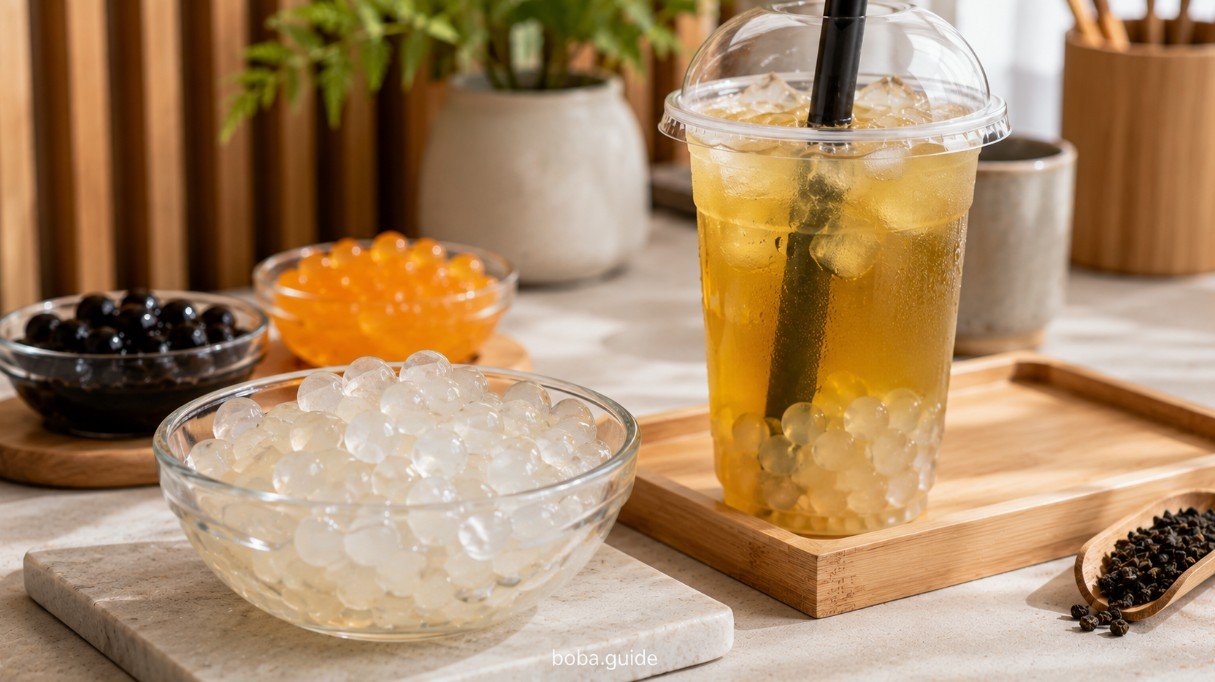
Crystal boba is a translucent, jelly-style bubble-tea topping with a soft, springy chew; most commercial versions are sold ready to serve in sweet syrup. Unlike classic black tapioca pearls, the category is not defined by tapioca starch. Depending on the product, the gel structure may use konjac, carrageenan, alginate, pectin, agar or a combination of food-grade hydrocolloids.
That difference changes almost everything about the experience. Crystal boba is lighter in appearance, usually less dense and sticky than cooked tapioca, often needs no cooking, and works especially well when you want a topping that stays visually delicate in fruit tea, jasmine tea, clear tea or lightly colored milk tea.
What is crystal boba?
Crystal boba is a ready-to-eat or ready-to-serve jelly-style pearl used in bubble tea, fruit tea and desserts. It is usually translucent and sweetened, with a gentle chew rather than the dense elasticity of cooked tapioca.
The easiest way to recognize it
Look for pale, clear or lightly colored round pearls sitting in syrup. They often appear almost glassy in a clear drink, but good crystal boba still looks soft and edible rather than hard like candy or ice.
Commercial examples are commonly around 1 cm in diameter. One major supplier recommends roughly 60–80 g (2.1–2.8 oz) per serving, while another lists a similar personal-preference range of about 1.76–2.82 oz. Those are useful reference points, not a universal serving rule.
Crystal boba is one of many modern bubble-tea toppings. For the larger topping family, compare it with tapioca, jellies, pudding and popping pearls in our boba toppings overview.
Crystal boba, agar boba, white pearls and crystal pearls are often used for overlapping products
Store menus and supplier catalogs do not use one perfectly standardized name. That is why two products labeled “crystal boba” may have different ingredient systems, flavors or textures.
The broadest modern retail term for translucent jelly-style pearls used as a bubble-tea topping.
A common supplier name. Some products marketed this way actually contain agar; others rely on a broader blend of gelling ingredients and still use “agar boba” as the category label.
A menu-friendly name often used when the topping is clear, pale or translucent rather than black like traditional tapioca.
Another descriptive name that emphasizes appearance. Always read the ingredient list if the exact composition matters to you.
The name does not guarantee the formula. Treat the package ingredient list as the source of truth for that specific product.
Crystal boba is sold under different names across mature bubble-tea markets
American packaging usually favors “crystal boba,” “crystal pearls,” “agar boba” or “white pearls.” Taiwanese, Japanese and Korean supplier catalogs reveal a wider naming family. Knowing those terms helps when comparing imported products because the English phrase “crystal boba” may not appear prominently at all.
寒天晶球 · 蒟蒻珍珠 · 白玉珍珠
寒天晶球 literally describes an agar-style crystal sphere and is common in Taiwanese beverage-supply catalogs. Manufacturers also use 蒟蒻珍珠 for konjac pearls and 白玉珍珠 for pale or white-jade-style pearls. These names can overlap commercially without guaranteeing one identical ingredient formula.
啵啵晶珠 · 脆啵啵 · 波波球
Some Taiwanese suppliers list several playful names for crisp or bouncy crystal-style pearls. The wording emphasizes the bite and appearance more than a strict food-science category, which is another reason to verify the ingredient statement rather than classify a topping by name alone.
寒天パール
Japanese menus and product references may use 寒天パール, essentially “agar pearls.” The term helps distinguish the topping from the classic tapioca category, while still focusing on its translucent jelly-style character.
화이트펄 · 곤약펄
Korean retail listings commonly use 화이트펄 (“white pearl”) and 곤약펄 (“konjac pearl”) for translucent bubble-tea and dessert toppings. Coffee-flavored and brown versions are also sold within the konjac-pearl family.
If an imported bag says agar pearl, konjac pearl, white pearl or one of the Asian-language terms above, it may belong to the same broad crystal-boba family—but check the ingredients, texture description and serving directions before assuming it is equivalent to another brand.
What does crystal boba taste like?
Original crystal boba is usually mildly sweet rather than intensely flavored. The syrup and added flavoring matter more than the pearl’s base material, so “crystal boba taste” can range from subtle citrus-like sweetness to brown sugar, lychee, mango, taro, matcha or floral flavors.
Soft chew with a light snap
Taiwanese texture language often uses Q / QQ for a pleasantly springy, resilient chew. Crystal boba can fit that broader sensory family, but its bite is typically more jelly-like and less starchy than classic tapioca. Some commercial products describe the bite as a soft chew or soft crunch. It should not burst with liquid like popping boba.
Usually gentle enough to let the tea show
Original versions are often lightly sweetened so they can sit in jasmine, green tea or fruit tea without dominating the drink.
Lighter-feeling than black tapioca
The experience is less starchy and less dense. That makes crystal boba attractive when classic tapioca feels too heavy in a refreshing drink.
Well suited to cold drinks
Because it is commonly sold ready to serve, there is no fresh-cooked warm-pearl stage to preserve. It fits naturally into iced tea, smoothies and chilled desserts.
What is crystal boba made of?
There is no single ingredient list that defines every product sold as crystal boba. Commercial formulas can combine water and sweeteners with several plant-derived or food-grade gelling ingredients to create the translucent, resilient pearl structure.
A plant-derived hydrocolloid commonly seen in crystal-boba formulas. It can contribute to the elastic, jelly-like bite.
Another common gelling or texturizing ingredient used in some commercial products.
These can help create and stabilize gel structures, depending on the formulation.
Different suppliers may use different combinations. That is why “agar boba” should not be treated as proof that agar is the only gelling agent.
The exact gelling system deserves its own ingredient-level explanation because supplier formulas are not identical. This overview stays focused on how crystal boba behaves as a topping rather than turning one commercial formula into a universal recipe.
Crystal boba vs tapioca pearls vs popping boba
They can all be round and served through a wide straw, but the eating experience is completely different.
The key distinction is simple: crystal boba is a jelly-style pearl, while classic boba is built around tapioca starch. A full head-to-head comparison is covered in the comparison page listed later in this crystal-boba library.
Crystal boba vs honey boba
Honey boba is usually tapioca boba sweetened with honey or honey syrup, not another name for crystal boba. Current shop menus and packaged honey-boba products describe chewy tapioca pearls paired with honey, while crystal boba uses a jelly-style gel system. The practical difference is texture: honey boba keeps the denser tapioca chew; crystal boba stays lighter and more jelly-like.
Choose crystal boba
for a translucent, ready-to-serve, jelly-style topping.
Choose honey boba
when you want classic tapioca chew with honey sweetness.
Most commercial crystal boba is ready to serve
Unlike dry tapioca pearls, many crystal-boba products are packed in syrup and do not need boiling, steeping or a post-cook sugar soak.
Open the package
Check the product label for storage and serving directions.
Separate any gentle clumping
Some ready-to-serve pearls can stick together in the bag. A scoop is usually enough to separate them.
Scoop into the cup
A commercial reference serving is often around 50–80 g, but home portions can be smaller or larger depending on the drink.
Add the finished drink
Fruit tea, jasmine tea, milk tea, smoothies and shaved-ice desserts can all work depending on the flavor.
Use a genuinely wide straw
Commercial products around 1 cm across are commonly paired with boba straws around 12 mm wide.
Serving ready-made crystal boba is different from manufacturing the pearls or attempting a home version. Those two processes are separated into their own pages in the crystal-boba library below.
Crystal boba changes the workflow behind the counter
For a bubble-tea shop, the difference is not only flavor or appearance. Ready-to-serve crystal boba removes several steps that fresh tapioca normally adds to service.
No cooking cycle
Many commercial crystal pearls arrive already sweetened in syrup. Staff can portion them instead of boiling, resting, rinsing and sweetening a fresh tapioca batch.
More predictable cold service
Classic tapioca quality changes noticeably as cooked pearls sit and cool. Ready-to-serve crystal boba is designed around chilled drinks and does not depend on maintaining a freshly cooked warm center.
Simple portion control
A supplier reference of 60–80 g per drink gives an operator a repeatable starting range. Shops can then standardize their own scoop according to cup size, drink style and food cost.
Visual flexibility
Translucent pearls preserve the color of jasmine tea, fruit tea and layered drinks instead of creating the strong dark contrast of black tapioca.
But opened-pack waste matters
A 4.4 lb / 2 kg food-service bag can represent roughly 25–33 reference servings. If a product label calls for rapid use after opening, low sales volume can erase the labor advantage through waste.
Operator takeaway: crystal boba is operationally attractive when the shop sells enough of it to finish an opened pack quickly. For a low-volume shop, smaller packages or tighter menu placement can matter more than the lowest wholesale cost per pound.
What drinks work best with crystal boba?
Its visual lightness and mild chew make it especially useful where black tapioca would visually or texturally dominate the drink.
Jasmine green tea
Original, lychee or floral crystal boba can stay visually delicate while adding texture to a fragrant tea.
Fruit tea
Mango, passion fruit, peach, strawberry, lychee and citrus-style drinks pair naturally with translucent or fruit-flavored pearls.
Clear black or oolong tea
Original crystal boba adds sweetness and texture without turning a tea-forward drink into a heavy milk-tea dessert.
Light milk tea
When you want chew but not the visual weight of black tapioca, crystal pearls can create a cleaner-looking cup.
Smoothies and slushes
Flavored crystal boba can echo the fruit or dessert flavor while remaining easier to serve than freshly cooked tapioca.
Shaved ice and yogurt
The topping is not limited to drinks. Ready-to-serve pearls also work as a chilled dessert garnish.
Crystal boba flavors range from original to brown sugar, lychee, mango and beyond
The category now extends well beyond a single original translucent pearl.
Usually mild, lightly sweet and easiest to pair across different teas.
Brown sugar or black-sugar crystal boba keeps the translucent or jelly-style pearl structure but adds a darker, richer syrup profile. It is not the same experience as freshly cooked brown-sugar tapioca: the pearl remains jelly-like rather than starchy and elastic, while the sweetener supplies most of the caramelized character.
A natural match for jasmine tea, fruit tea and floral or tropical drinks.
Works particularly well with green tea, fruit tea and smoothie-style drinks.
A more unusual flavored pearl that can reinforce green-tea or creamy matcha profiles.
These are more visual and novelty-driven, so choose them when their flavor or color actually fits the drink.
A flavored crystal boba can contain additional colors, sweeteners and flavoring ingredients. If dietary or allergen details matter, check the exact product label instead of assuming every flavor uses the same formula.
How to store crystal boba
Storage instructions vary by manufacturer. Commercial examples from major suppliers list a 12-month unopened shelf life, cool and dry storage, and refrigeration after opening; the exact after-opening window must come from the product label.
Follow the package shelf-life date
Commercial examples may list around 12 months of shelf life. Treat the printed expiration date and manufacturer directions as authoritative for the product in your hand.
Refrigeration is commonly required
One major supplier recommends refrigerating after opening and using the product within 48 hours; another advises refrigeration and consumption as soon as possible. Do not generalize one brand’s window to every product.
Extreme temperatures can damage texture
Some suppliers warn that high shipping temperatures can soften or change the product. Store it away from excessive heat.
Use clean utensils
Scoop from the container with clean equipment and return the opened package to proper refrigeration promptly.
How much does crystal boba cost in the U.S.?
Food-service crystal boba is inexpensive by the pound when purchased directly from a specialty supplier, but package size changes the real value dramatically. In the current U.S. listings we checked, a standard 4.4 lb bag costs about $13.58–$16.95, or roughly $3.09–$3.85 per lb before shipping and tax.
Observed direct-supplier range in our August 2026 check.
For the 4.4 lb single-bag examples we checked.
Fanale: six 4.4 lb bags, 26.4 lb total, listed at $77.95.
Fanale: 1,000 g crystal agar boba bag listed at $19.99.
These are market examples, not a universal national average. Flavor, package size, retailer, wholesale tier, shipping, promotions and regional availability can move the final price substantially. Prices were checked on August 19, 2026 and can change.
Higher cost per pound, lower commitment
A smaller bag can make more sense at home because you have less product to finish after opening. The Fanale 1 kg example works out to about $9.07/lb.
The practical café-size benchmark
Bossen lists its Original Crystal Boba at $13.58 for 4.4 lb, while Fanale lists a 4.4 lb crystal-tapioca bag at $16.95. That puts the direct-supplier examples around $3.09–$3.85/lb.
Lower unit cost for higher-throughput shops
Fanale lists six 4.4 lb bags for $77.95, approximately $2.95/lb. The case only becomes a better deal if the shop can use the inventory efficiently.
What does one crystal-boba serving cost?
Using Bossen’s recommended 60–80 g scoop as a common food-service reference, the raw topping cost from the direct 4.4 lb examples is roughly $0.41–$0.68 per serving before shipping, tax, waste and labor.
Bossen 4.4 lb bag at $13.58.
Bossen 4.4 lb bag at $13.58.
Fanale 4.4 lb bag at $16.95.
Fanale 4.4 lb bag at $16.95.
A cheap bag can become expensive if you cannot finish it
Bossen lists about 25–33 servings in a 4.4 lb bag and recommends refrigerating after opening and consuming within 48 hours. If a shop followed that specific product guidance and wanted to finish the bag within that window, it would need to move roughly 12–17 reference servings per day.
That does not mean every crystal-boba brand has the same 48-hour rule. It shows why the opened-package instructions can matter more than price per pound.
≈25–33 servings
≈12–17 servings/day
For home use
Do not judge value only by dollars per pound. A smaller bag can be cheaper in practice if it prevents most of a 4.4 lb food-service package from becoming waste.
For a busy boba shop
Case pricing becomes more attractive when crystal boba is used across several drinks and the shop can turn opened bags quickly.
Six things to check when buying crystal boba
Crystal boba is convenient, but commercial packs can be much larger than a home user expects. The best purchase is not automatically the cheapest price per pound.
Choose crystal boba when you want chew without the heaviness of tapioca
Crystal boba occupies a useful middle ground: more substantial than jelly cubes, less dense than classic tapioca, and completely different from the burst of popping boba.
You may prefer crystal boba if…
- you like chewy toppings but find black tapioca too dense;
- you want a translucent topping that does not visually dominate a pale tea;
- you prefer a ready-to-serve option instead of cooking pearls;
- you drink jasmine, green tea, fruit tea or lighter oolong-based drinks;
- you want a topping that also works on shaved ice, yogurt or chilled desserts.
Classic tapioca may suit you better if…
- you want the deepest, most elastic chew;
- brown-sugar-soaked pearls are central to the drink;
- you enjoy the warm-fresh pearl contrast in cold milk tea;
- you want the traditional black-pearl appearance;
- you are willing to cook and hold pearls carefully for better texture.
How many calories are in crystal boba?
There is no reliable universal calorie number for crystal boba. A search result that gives one number without a brand, serving weight and syrup context is incomplete because formulations and serving sizes vary.
Kung Fu Tea’s official nutrition sheet lists both Crystal Bubbles and Berry Crystal Bubbles at 54–80 calories, depending on serving size. Treat this as a real menu example, not the calorie count for every crystal-boba product.
Why the range matters
A chain topping portion is a better real-world benchmark than assigning one calorie number to the entire category. Different suppliers use different sweeteners, syrups and serving weights.
Serving size changes the answer
A 30 g home scoop and an 80 g shop portion are not nutritionally equivalent. Always compare nutrition using the actual grams served.
Syrup matters
Many commercial crystal pearls sit in sweet syrup, so the topping is not simply “water plus gel.”
Flavor changes the formula
Brown sugar, mango, taro and other flavored versions may use different sweeteners, colors or flavor ingredients.
The label beats a generic web estimate
If calories, sugar or allergens matter to you, use the nutrition panel and ingredient statement for the exact product.
Crystal boba library
This page gives you the broad orientation: naming, texture, serving, flavors, shopping and shop use. For ingredient chemistry, manufacturing, a home recipe or a full tapioca comparison, continue to the focused pages below.
Understand the main gelling ingredients and why recipes differ by manufacturer.
Labels Crystal Boba IngredientsLearn how to read ingredient lists, sweeteners, stabilizers and flavor additions.
Process How Crystal Boba Is MadeFollow the manufacturing logic behind translucent jelly-style pearls.
Home preparation How to Make Crystal BobaExplore a home-focused approach rather than a commercial ready-to-serve bag.
Comparison Crystal Boba vs TapiocaCompare texture, ingredients, preparation, appearance and drink pairings.
Sell Crystal Boba? Get Featured on Boba.guide
If you manufacture, import, distribute or sell crystal boba, send us the information shoppers and bubble-tea businesses actually need to compare suppliers. We are building this section around verifiable product details rather than generic promotional copy.
Business or brand name
Retail, wholesale or both
Crystal boba flavors
Package and case sizes
Countries or regions served
Shipping or local pickup options
Website and contact information
Product photos or specification sheets
Supplier information is reviewed before inclusion. Editorial inclusion is not guaranteed, and paid placements must be clearly identified as sponsored.
Tell us what the pearls were actually like
Send the brand or shop name, flavor, texture, drink pairing and where you found it to info@boba.guide. Details such as “soft chew in jasmine tea” or “very sweet brown-sugar syrup” are much more useful than a simple thumbs-up.
Crystal boba: common questions
Quick answers about ingredients, flavor, texture, cooking, storage and how crystal pearls differ from other bubble-tea toppings.
What is crystal boba?
Crystal boba is a translucent jelly-style bubble-tea topping with a soft, springy chew. Commercial versions are usually sweetened, packed in syrup and ready to serve without cooking.
What is crystal boba made of?
The formula varies by product. Commercial crystal boba can combine water and sweeteners with gelling ingredients such as konjac, carrageenan, sodium alginate, pectin, agar and other gums or stabilizers. Check the exact ingredient label because there is no single universal recipe.
Is crystal boba the same as tapioca boba?
No. Traditional tapioca pearls are primarily built around tapioca starch and usually require cooking. Crystal boba is a jelly-style pearl made with a different gelling system and is commonly sold ready to serve.
Does crystal boba pop?
No. Crystal boba is meant to be chewed. Popping boba has a thin shell surrounding a liquid center that bursts in the mouth, while crystal boba has a jelly-like texture throughout the pearl.
What does crystal boba taste like?
Original crystal boba is usually mildly sweet and may have a subtle citrus-like flavor. Flavored versions can taste like brown sugar, lychee, mango, taro, matcha or other fruit and dessert flavors.
Do you have to cook crystal boba?
Many commercial crystal-boba products are sold ready to serve and require no cooking. Scoop them from the syrup and add them to the finished drink. Always follow the directions on the specific package.
What drinks go well with crystal boba?
Crystal boba works especially well with jasmine tea, green tea, fruit tea, clear black or oolong tea, light milk tea, smoothies and slushes. Match the pearl flavor to the drink rather than adding a strongly flavored topping automatically.
How much does crystal boba cost in the U.S.?
In our August 19, 2026 check, direct-supplier 4.4 lb bags were listed around $13.58 to $16.95, or roughly $3.09 to $3.85 per pound before shipping and tax. Smaller retail-style packages can cost much more per pound, while wholesale cases can cost less.
How should crystal boba be stored after opening?
Follow the manufacturer label. Refrigeration after opening is common. Some commercial products recommend using the opened package within 48 hours, while others say to refrigerate and consume as soon as possible.
Is agar boba the same as crystal boba?
The terms often overlap in supplier catalogs, but they are not a precise ingredient guarantee. Some products marketed as agar boba contain agar, while other crystal-boba formulas use combinations of konjac, carrageenan, alginate, pectin and other gelling ingredients.