
Ordering & menu choices
Boba Cup Sizes: Small, Regular, Large and What You Actually Get
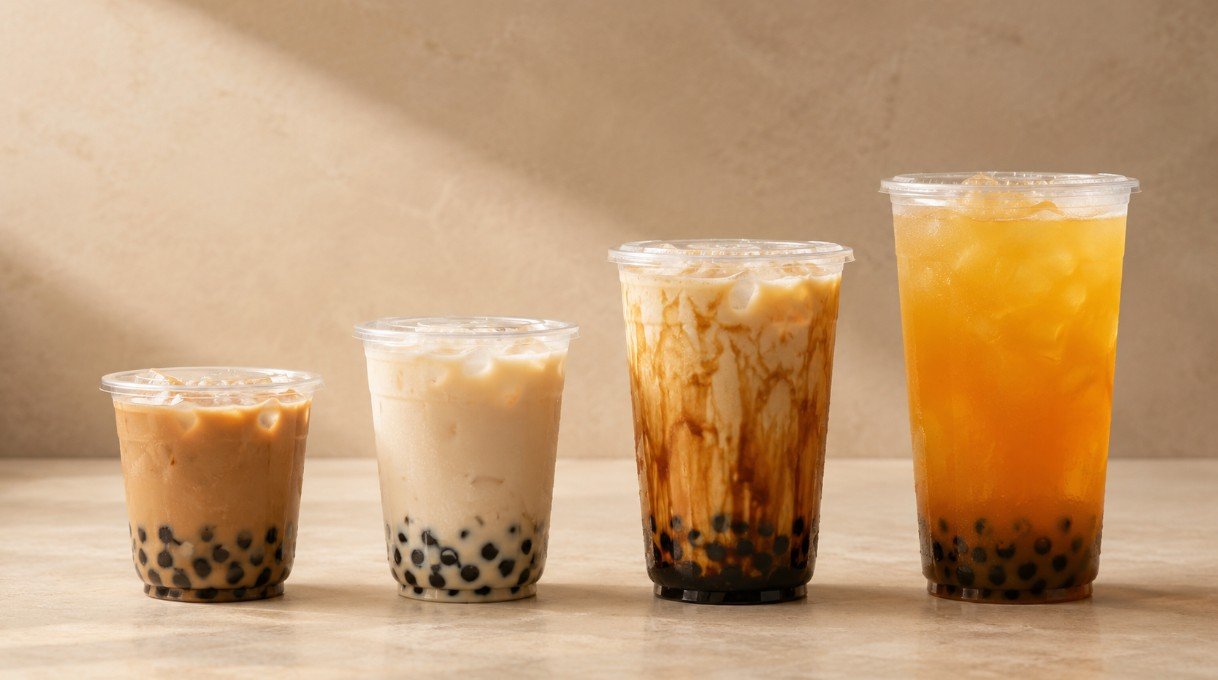
A boba “large” is not a universal size. One shop may call 24 oz large, another may offer only a single 24 oz cold-drink size, and another may extend the menu to 32 oz. Even familiar labels such as small, medium, regular and large only make sense within that shop’s own menu.
For cold bubble tea, 16 to 24 oz is a useful range to expect at many shops, while 32 oz appears as a jumbo or extra-large option at some locations. Smaller cups also exist, especially for hot drinks, children’s portions, samples or shops with a more compact serving format. But cup capacity is only the beginning: ice and toppings also occupy space, so the number printed beside a size is not necessarily the amount of tea you will actually drink.
What Sizes Do Boba Cups Usually Come In?
You will commonly encounter cups somewhere between about 12 and 32 fluid ounces in North American bubble tea settings, but individual shops normally use only part of that range. A menu might be as simple as 16 oz and 24 oz, while another shop may add 20 oz or a 32 oz jumbo.
The labels below are therefore a navigation guide, not an industry standard. Always trust the actual ounces or milliliters on the shop’s menu over the words small, regular or large.
The safest ordering habit: look for ounces or milliliters instead of assuming that “medium” or “large” means the same thing at every boba shop.
“Small,” “Regular” and “Large” Are Shop Labels, Not Measurements
Bubble tea menus do not share one mandatory sizing system. That is why a 16 oz cup can be called small at one shop and medium at another, while some shops skip multiple sizes altogether and sell many cold drinks in one standard cup.
A shop might use 16 oz as small and 24 oz as large. There is no medium because the menu does not need one.
Another shop may use 16, 20 and 24 oz and label them small, medium and large.
A shop can extend the range to 32 oz and use names such as jumbo or extra large.
Some specialty drinks have a fixed serving size because the recipe, cup shape, foam layer or preparation method was designed around that format.
If menu terminology itself is slowing you down, the broader boba shop terms guide separates useful ordering language from shop-specific naming.
A 24 oz Cup Does Not Mean 24 oz of Tea
A cup’s stated capacity describes the container. Your finished drink may also contain ice, tapioca pearls, jelly, pudding, fruit pieces, foam or other additions. Those ingredients occupy part of the same physical space.
This distinction matters because customers sometimes compare cup capacity as though every ounce were liquid. In a finished boba drink, the cup is better understood as a shared volume budget.
A heavily iced 24 oz fruit tea with two toppings and a 24 oz tea with less ice and one topping can therefore have the same container size but a very different distribution of liquid, ice and solids.
More Toppings Change the Meaning of Cup Size
A larger cup can give a complicated drink more physical room, but toppings do not magically sit outside the serving volume. Pearls, jelly, pudding and other additions take up space inside the cup and also change how quickly the drink becomes filling.
One topping
Usually keeps the drink easy to understand: one main texture plus the beverage itself.
Several toppings
More of the cup becomes solid or semi-solid, and each sip can contain a much denser mixture of textures.
Extra topping
May increase the topping portion rather than the amount of tea, depending on how the shop builds the cup.
If you are deciding whether two or three add-ons are actually an upgrade, keep the size question separate and use our guide to how many boba toppings to order. That page owns topping quantity; this one owns the container and serving-size decision.
The Right Cup Size Also Depends on What You Are Drinking
Bigger is not automatically better. A rich milk tea, bright fruit tea and frozen slush can feel very different at the same nominal volume. Sweetness, texture and how quickly you plan to finish the drink matter as much as appetite.
| Drink | Size range you may encounter | Possible menu name | What to think about |
|---|---|---|---|
| Classic milk tea | 16–24 oz | Small, regular, medium or large | Richness, sweetness and the amount of tapioca can make a larger serving surprisingly substantial. |
| Fruit tea | 16–32 oz | Regular through jumbo | Larger cold servings are easier to finish for some people because the drink can feel lighter and more refreshing. |
| Fresh milk drink | 16–24 oz | Regular or large | Think about richness and syrup concentration rather than choosing only by volume. |
| Slush or smoothie | 16–32 oz | Medium, large or jumbo | Blended ice is part of the drink itself, so comparing its volume directly with a shaken tea can be misleading. |
| Hot milk tea | Often smaller than cold options | Shop-specific | Hot-drink cup systems can differ from the shop’s cold sealed-cup sizes. |
These are practical ranges rather than standards. The actual menu wins. If you are still deciding on the drink before worrying about its size, choose your boba by the flavors and textures you already enjoy first.
Which Boba Size Should You Order?
Choose the smaller size when…
You are trying an unfamiliar flavor, ordering a rich milk-based drink, adding a filling topping, watching how much sweetness you consume at once, or simply want boba without turning it into a very large snack-sized drink.
Choose the middle size when…
You want the shop’s normal experience and do not yet know how its portions compare with places you already visit. A middle or standard option is often the easiest baseline for learning a new shop.
Choose the larger size when…
You already know you like the drink, expect to sip it over a longer period, want more room for a refreshing fruit-tea style, or deliberately want a larger serving rather than choosing it only because the price difference looks small.
Pause before ordering jumbo when…
The drink is very sweet, rich, heavily topped or completely new to you. A 32 oz drink is roughly twice the container capacity of a 16 oz drink, so the jump is meaningful even when the menu makes the upgrade look visually small.
For your first visit to a shop, a standard or middle size gives you a useful reference point. Our first-time boba ordering guide handles the rest of that decision without requiring you to memorize the menu.
Less Ice Does Not Automatically Turn a Cup Into a Bigger Drink
It is tempting to look at a 24 oz cup and assume that removing ice means every newly empty ounce will be replaced with tea or milk. That is not a universal rule.
Shops build drinks differently. Some may add more base liquid when you request less or no ice. Others work from standardized recipes, have restrictions on certain drinks, change preparation, or treat reduced ice differently depending on the product.
The important distinction is between cup capacity and recipe yield. Cup size tells you the maximum physical capacity of the container. It does not tell you the shop’s policy for filling the space created when ice is reduced.
That separate ordering question belongs to our guide to regular, less and no ice in boba.
Is a Large Boba Better Value?
Not automatically. The arithmetic can make a larger cup look attractive because the upgrade may cost much less than buying a second drink. But value depends on whether you actually want the extra serving.
A larger drink can also mean more sweetened base, more milk, more syrup or simply more of a drink you may not finish. Toppings may be charged separately, and shops do not necessarily scale every ingredient in exactly the same way.
So there are really two different questions:
How much additional capacity do you receive for the upgrade price?
Do you actually want and enjoy that much of this particular drink?
Does the larger version preserve the balance you like between tea, sweetness, ice and toppings?
Size also interacts with the rest of your customization. If you are changing several variables at once, use the full guide to customizing a boba order rather than treating cup size as an isolated upgrade.
Size Can Change How the Same Recipe Feels
Imagine a 16 oz milk tea with tapioca and a 24 oz version of the same named drink. If the shop scales every component proportionally, the larger drink may taste very similar and simply provide more of it. But menus and recipes are not always that mathematically tidy.
A topping scoop might remain the same. Ice may be portioned differently. A syrup pump may increase in whole steps rather than perfectly proportional fractions. Some signature drinks may have their own build rules. This is why “the large tastes weaker” or “the small has more boba in every sip” can occasionally be a real customer experience without proving that the recipe is objectively wrong.
For sweetness in particular, size should not be confused with the percentage selector. A larger cup at 50% sweetness is still following the shop’s own recipe system; “50%” is not a universal number of grams of sugar. The separate guide to boba sweetness levels explains how those controls should be interpreted.
A Better Way to Read the Size Line on a Boba Menu
1. Find the actual volume
Look for oz or mL beside the menu label. That tells you far more than the word “large.”
2. Check whether your drink has every size
Signature drinks, hot teas, slushes and specialty cups may use a different size system from the rest of the menu.
3. Decide on toppings before chasing maximum liquid
Several toppings change both physical volume and how filling the drink feels.
4. Treat ice as a separate decision
Do not assume that less ice automatically guarantees a fixed amount of additional tea.
5. Order for the drink, not the upgrade
A larger cup is useful when you want more of that particular drink. A cheap upgrade is not automatically a better order.
If the whole board still feels like a decoding exercise, start with how to read a boba menu. Cup size is only one decision inside a much larger ordering system.
Four Cup-Size Assumptions That Cause Bad Orders
“Large always means 24 oz.”
No. It is common to encounter 24 oz as a larger size, but shop naming varies. Read the stated capacity whenever it is available.
“No ice means the cup becomes all tea.”
Not necessarily. The shop’s recipe and no-ice policy determine what replaces the missing ice.
“More toppings means more total product.”
Toppings normally live inside the same cup. They can change the ratio of liquid to solids rather than simply adding unlimited volume.
“The biggest size is always the best deal.”
Price per ounce is only one kind of value. A drink you do not finish is not automatically a better purchase.
These are exactly the kinds of small menu assumptions that can turn an easy order into a disappointing one. We collect the broader patterns separately in common boba ordering mistakes.
Build the Cup in the Right Order
Size makes more sense when it comes after the main drink decision rather than before it. First decide whether you want milk tea, fruit tea, fresh milk, matcha, coffee, a slush or another style. Then choose the size that fits how much of that drink you actually want.
After that, sweetness, ice and toppings can be adjusted as separate controls. Keeping those decisions separate makes it much easier to remember what you liked and change only one thing next time.
If you want examples rather than theory, the planned boba order examples guide turns those individual choices into complete orders. For the complete process from menu to finished cup, use how to order boba.
Does Your Local Boba Shop Use a Completely Different Size System?
That is exactly the kind of detail we want to know about. Bubble tea sizing is far less standardized than a neat small-medium-large chart suggests, and local shops often use their own cup volumes, names, specialty sizes and rules for ice or toppings.
If a shop near you uses an unusual size, sells one enormous signature cup, has different sizes for milk tea and fruit tea, or explains its serving system particularly well, send the Boba Guide Editorial Team the details. Menu photos, cup-size information and corrections are especially useful when they help us understand how people actually order boba in different cities and countries.
Reader tips help us find things worth checking; they are not treated as verified facts automatically. We review information before using it to update our guides.
Boba Cup Size Questions
What is the standard boba cup size?
There is no single standard size used by every boba shop. Many cold bubble tea menus use cups around 16 to 24 oz, while some shops offer smaller servings or extend the range to 32 oz. Check the actual ounces or milliliters because labels such as small, medium and large vary by shop.
How many ounces are in a large boba?
A 24 oz cup is commonly used as a large at many shops, but large is not a universal measurement. Some shops use different capacities or add a 32 oz jumbo or extra-large size. The menu’s stated volume is more reliable than the size name.
Is 16 oz a small or medium boba?
It can be either. Some shops call 16 oz small, while others use it as medium or regular. Bubble tea shops do not share one mandatory naming system, so check the specific menu.
How many milliliters are in a 24 oz boba cup?
Twenty-four US fluid ounces is about 710 milliliters. That number describes the cup’s capacity, not necessarily the amount of liquid tea in the finished drink because ice and toppings also occupy space.
Does less ice mean more boba tea in the cup?
Not always. Less ice creates more available space, but shops differ in how they fill it. Some may add more base liquid, while others use standardized recipes or have specific reduced-ice policies. Cup capacity and recipe yield are not the same thing.
Do toppings reduce how much tea fits in a boba cup?
Toppings occupy physical space inside the cup, so a finished drink with a large portion of pearls, jelly or pudding can contain a different liquid-to-topping ratio from the same cup with fewer additions. Exact preparation varies by shop.
Is a 32 oz boba too big?
That depends on the drink and your preference. A 32 oz cup has roughly twice the container capacity of a 16 oz cup. It may make sense for a drink you already enjoy, but a rich, sweet or heavily topped jumbo drink can be much more substantial than the menu presentation suggests.
Are hot boba drinks served in smaller cups?
They can be. Some shops use different cup systems for hot and cold drinks, so a hot milk tea may not be available in the same sizes as an iced drink. Check the individual shop’s menu rather than assuming that cold-drink sizes also apply to hot tea.