
Popping boba buyer’s field guide
Best Popping Boba: How to Choose Flavor, Quality and Value
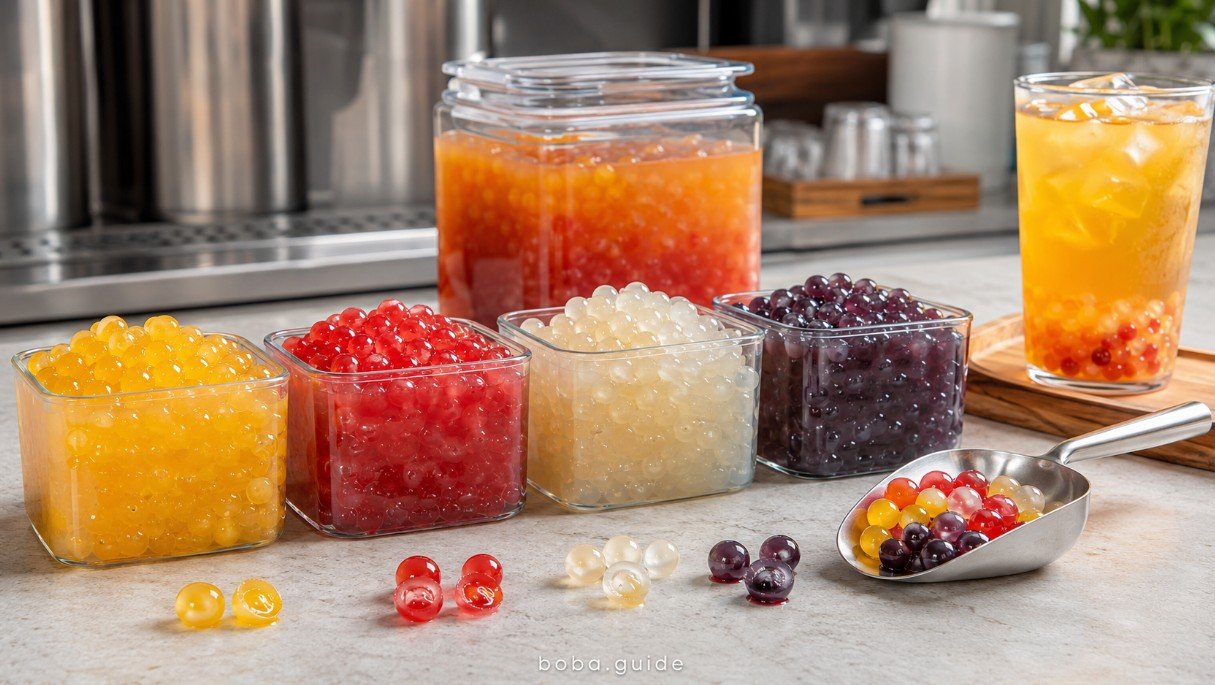
The best popping boba is not automatically the brightest flavor, the jar with the most fruit on the label or the product with the longest unopened shelf life. What matters is how the pearls actually fit the drink and the way you plan to use the container.
A fruit-tea shop may care about acidity, juice content and clean fruit flavor. A frozen-yogurt counter may value color and broad flavor compatibility. A low-volume boba shop needs to think hard about how quickly a seven-pound jar can be used after opening. A home buyer may be much better served by a smaller container even when the cost per pound is higher.
This guide focuses on those buying decisions. If you first want the basic explanation of how the liquid center and gel membrane work, start with our complete guide to popping boba.
There Is No Single Best Popping Boba
Popping boba is sold as one topping family, but different products solve very different jobs. A tart passion-fruit pearl can be excellent in jasmine fruit tea and distracting in a delicate milk tea. A seven-pound jar can be efficient in a busy shop and absurd for someone making two drinks per week.
| What you need | What to prioritize | Why |
|---|---|---|
| Bright fruit tea | Fruit-forward flavor and useful acidity | The topping should extend the fruit profile without turning the drink into candy. |
| Creamy drink | Softer fruit, yogurt, honey or dessert-style flavors | Very sharp citrus-style pearls can clash with creamy bases. |
| High-volume shop | Large container, predictable supply and fast turnover | A seven-pound jar is economical only if you can use it while quality remains good. |
| Low-volume counter | Opened-life management and flexible flavor use | Waste can erase a lower price per pound. |
| Home use | Smaller retail container | A practical package can be more valuable than food-service scale. |
| Strong fruit identity | Disclosed juice content where available | “Fruit flavored” and a specifically declared real-juice formula are not the same claim. |
If you are comparing popping pearls with tapioca rather than comparing brands within this category, use our tapioca pearls vs popping boba guide.
The Six Things That Separate One Popping Boba From Another
Most popping pearls use the same basic physical idea: a liquid or syrupy center held inside a thin gel membrane. That common structure can make jars look interchangeable, but the finished experience depends on several variables.
Flavor system
Some products are built around fruit juice, some around syrup and flavoring, and some around non-fruit profiles such as yogurt, honey, soda or brown sugar.
Sweetness and acidity
Fructose, glucose-fructose syrup, sugar syrups and acids such as citric or malic acid change how sweet or sharp the burst feels.
Shell-to-liquid ratio
A larger pearl can carry more liquid, while shell thickness influences whether the bite feels delicate or rubbery.
Serving size
How many grams you use per drink determines actual cost much more accurately than jar price alone.
Opened-container window
An 18-month unopened shelf life tells you very little about the economics of a jar once service begins.
Package format
A 1.21 lb retail bottle, a 7 lb food-service jar and a 5 kg commercial container belong to different kitchens.
The shell chemistry itself is a separate subject. Our guide to how popping boba works explains the gel membrane and calcium-alginate system in more depth.
Juice, Syrup and Flavor Are Not the Same Thing
One of the easiest mistakes when buying popping boba is assuming that every fruit-named pearl contains roughly the same amount of fruit.
Current product specifications show otherwise. Bossen’s Pure25 strawberry and passion-fruit products explicitly list 25% fruit juice. Taiwan manufacturer Tachiz makes the same type of 25% real-juice claim for its Rainboba line. Other current products disclose water, fructose or syrup, acids and flavoring without publishing a comparable fruit-juice percentage.
This does not automatically make a flavor-based formula bad. Flavor systems are useful because they can be consistent, stable and inexpensive. The point is to compare like with like.
More measurable fruit identity
If a manufacturer declares a specific juice percentage, you have a concrete product specification to compare.
Judge the actual use case
A well-designed flavored pearl can still work beautifully in fruit tea, soda or desserts even when no meaningful juice percentage is disclosed.
If ingredient composition is the question you care about most, continue to our dedicated popping boba ingredients guide.
What Popping Boba Currently Costs in the U.S.
Large commercial jars are surprisingly close in price across several mainstream suppliers. That makes package size, opened-life and actual serving usage more important than a difference of one or two dollars on the shelf.
Those observed listings translate to roughly:
- Tea Zone: about $2.71 per pound;
- Possmei standard 7.05 lb flavors: about $2.84 per pound;
- Possmei Rainbow: about $3.22 per pound;
- Possmei retail bottle: about $5.78 per pound.
This is an August 2026 supplier snapshot, not a U.S. national average. Shipping, case pricing, promotions, business accounts and distributor contracts can change the delivered price materially.
The Open Jar Matters More Than the Expiration Date
A long unopened shelf life is useful for inventory planning, but it can distract from the more important question: how quickly should the product be used after opening?
Unopened shelf life on current 7.04 lb products.
After opening: about 1 week recommendedCurrent shelf-life statement on verified popping-pearl products.
After opening: within 14 daysCurrent 6.82 lb Rainbow listing.
After opening: refrigerate and use promptlyCurrent 7.05 lb flavors such as yogurt and soda.
After opening: refrigerate and use promptlyThat difference matters in a small shop. A seven-pound container may look inexpensive, but if only one flavor sells slowly, some of the value can be lost after opening.
This is the opposite of the classic tapioca problem. Tapioca requires cooking and has a short cooked-texture window. Popping boba is ready to use, but the operator must manage the opened container.
For the broader chemistry and composition behind the category, see what popping boba is made of.
How Much Popping Boba Goes in One Drink?
There is no universal scoop, but a manufacturer serving specification gives us a useful commercial reference.
Bossen currently recommends approximately 20–25 g, or around 30–40 individual pearls, per serving for its standard 7.04 lb tubs. The company estimates roughly 100 servings per container.
That does not mean every shop should use exactly 25 g. A wide 24 oz fruit tea may need a different topping experience from a 16 oz drink. Pearls can also settle differently depending on ice, jelly, fruit pieces and cup shape.
The useful rule is consistency: choose a portion that suits the drink, then measure it predictably instead of letting every employee use a different oversized scoop.
What Does One Serving of Popping Boba Cost?
If a seven-pound Tea Zone jar costs $19, the ingredient looks extremely inexpensive. But we should not divide jar weight by an arbitrary scoop. Supplier serving guidance gives a more realistic benchmark.
Using Bossen’s approximate 100-servings-per-tub reference, a similarly priced $19–$22 food-service container would represent roughly $0.19–$0.22 of topping per listed serving before shipping and waste.
That last variable is the important one. A popular mango jar that turns quickly may deliver excellent economics. A novelty flavor that sells four servings per week may become expensive if the shop regularly throws out unused product.
That is why a supplier catalog full of twenty flavors is not an instruction to stock twenty open jars at once.
For the larger ecosystem of topping jars, cups and preparation supplies, see our boba supplies guide.
Choose the Flavor by the Drink, Not by the Color
A topping works best when it adds a second layer to the drink rather than competing with it. The easiest approach is to think about flavor direction.
Lychee, peach, mango, passion fruit
These flavors can reinforce floral or tropical fruit without hiding the tea base when used in a restrained portion.
Passion fruit, pomegranate, raspberry, green apple
Sharper fruit flavors work naturally with acidity and carbonation.
Yogurt, honey or softer fruit
A very tart popping pearl can feel disconnected from a creamy base, while softer profiles can create a dessert-like contrast.
Choose contrast
The cold, thick base softens aroma, so a more aromatic or acidic pearl can stay noticeable.
Do not treat these as mandatory pairings. A strawberry pearl from two manufacturers can differ in sweetness and acidity enough to behave differently in the same drink.
For more pairing logic, use our guide to the best toppings for fruit tea.
Size and Shell Change the Experience
Most customers do not measure popping boba with calipers, but size still changes the way a topping feels.
Tea Zone currently describes its popping pearls as about 3/8 inch in diameter, which is approximately 9.5 mm. Taiwan manufacturer Tachiz describes its Rainboba pearls as 10 mm and markets the larger format as holding more liquid.
A larger sphere gives each bite a more obvious burst, while smaller spheres can distribute more individual pops through the drink. Shell thickness matters too: a large pearl with a heavy membrane may feel less delicate than a slightly smaller pearl with a thin shell.
Because suppliers use different formulations, diameter alone cannot tell you which pearl has the best texture. A buying guide should treat size as one specification, not a quality score.
Home Buyers and Boba Shops Need Different Containers
Smaller can be smarter
Possmei currently sells several flavors in 1.21 lb retail bottles for $6.99. The per-pound cost is much higher than a seven-pound jar, but the total quantity is far more realistic for occasional drinks.
If you make two drinks per week, buying several seven-pound flavors because they look cheaper per pound creates a storage problem rather than a bargain.
Turnover decides the economics
A busy shop can make excellent use of 7 lb jars, four-jar cases or even larger supplier formats. The key is whether each opened flavor moves quickly enough.
Core flavors such as mango, strawberry or passion fruit may justify large containers. Experimental flavors may be better introduced one jar at a time until demand is known.
Taiwan manufacturers also offer formats larger than the common U.S. seven-pound jar. Tachiz, for example, lists 5 kg food-service popping-pearl formats. That makes sense for high-volume operators but offers no obvious advantage to a household.
How to Compare Two Jars Side by Side
If two products have the same flavor name, ignore the front label for a minute and work through these checks.
Read the ingredients
Look for actual fruit juice, syrup, sweeteners, flavor, acids, stabilizers, preservatives and color.
Look for a declared juice percentage
If the producer claims 25% real juice, that is more informative than a fruit image on the package.
Check pearl size
Around 10 mm is common in current examples, but size can vary and affects the burst-to-shell experience.
Check the opened-storage instruction
An 18-month unopened date does not answer how quickly the refrigerated jar should be consumed after opening.
Calculate cost per usable serving
Jar price divided by realistic servings is more useful than price per pound—and waste belongs in the equation.
Match the flavor to an actual menu item
A product that fits three popular drinks is usually easier to use efficiently than a novelty flavor with only one purpose.
Judge the pearl in liquid
Taste it in the tea, soda or smoothie where it will actually be served. A pearl that tastes intense by itself may become balanced once diluted by a full drink.
The best popping boba is therefore not a universal brand winner. It is the product that gives the right burst, flavor balance and ingredient profile at a package size your kitchen can actually use.
Tell Us What Happens After the Jar Is Open
Supplier specifications are valuable, but real service conditions reveal details that labels rarely explain: whether shells soften after a week, which flavors move fastest, how many drinks a jar actually produces and which products hold up best in tea versus frozen desserts.
If you operate a boba shop, manufacture or distribute popping pearls, or have a correction to a current product specification, send useful details to info@boba.guide. Editorial inclusion is not guaranteed, and submitting a product does not buy a recommendation.
Questions About Buying Popping Boba
These follow-up questions cover the practical details that matter once you have narrowed the choice to a few jars.
What is the best popping boba flavor for fruit tea?
Mango, lychee, peach and passion fruit are practical starting points because they pair naturally with many jasmine, green and fruit teas. The best choice still depends on the drink itself: a sharp passion-fruit pearl can work well with citrus or tropical tea, while lychee can suit a lighter floral drink. Compare sweetness and acidity, not just the flavor name.
Does popping boba contain real fruit juice?
Some products do, but not all disclose the same amount. Current Bossen Pure25 and Taiwan Tachiz Rainboba products specifically state 25% real fruit juice for selected fruit flavors. Other popping boba products may rely more heavily on fructose or syrup, acids and flavoring. Check the current ingredient list and any declared juice percentage for the exact product.
How much popping boba should I put in one drink?
Bossen currently suggests about 20–25 g, or roughly 30–40 pearls, as a serving for its standard popping boba products. That is a useful commercial reference rather than a universal rule. Cup size, other toppings and the intensity of the flavor can justify a smaller or larger portion.
How many servings are in a large jar of popping boba?
Bossen lists approximately 100 servings for its 7.04 lb tubs when using its suggested 20–25 g serving. Actual yield varies with scoop size, spillage, drained syrup and how heavily a shop portions toppings.
How much does popping boba cost?
In an August 2026 supplier snapshot, Tea Zone 7 lb jars were listed at $19.00, many Possmei 7.05 lb flavors at $19.99 and Possmei Rainbow at $21.99 for 6.82 lb. These examples work out to roughly $2.71–$3.22 per pound before shipping. Prices change, so treat this as an observed current sample rather than a national average.
How long does popping boba last after opening?
Opened-life guidance varies by producer. Bossen currently recommends refrigeration and using its products within about one week after opening. Verified Tea Zone products state an opened window of about 14 days. Possmei instructs users to refrigerate opened containers and consume them as soon as possible. Always follow the label on the exact jar you buy.
Does popping boba need to be cooked?
Commercial popping boba is generally sold ready to eat and does not require the boiling and resting process used for tapioca pearls. You normally scoop it directly into the finished drink or dessert. That convenience is one of its main operational advantages for shops and home users.
What size is popping boba?
Current examples are close to 10 mm in diameter. Tea Zone describes its popping pearls as about 3/8 inch, approximately 9.5 mm, while Taiwan manufacturer Tachiz lists 10 mm for its Rainboba line. Size is only one quality factor because shell thickness and liquid volume also affect the bite.
Is a 7 lb jar of popping boba worth buying for home use?
Usually only if you use popping boba frequently or serve a group. A seven-pound food-service container can represent many drinks and must be managed after opening. Smaller retail bottles cost more per pound but can be more practical for occasional home use because less product is at risk of being wasted.