
Manual bubble tea shaker buyer’s guide
Best Boba Shakers: Size, Material and Mixing Guide
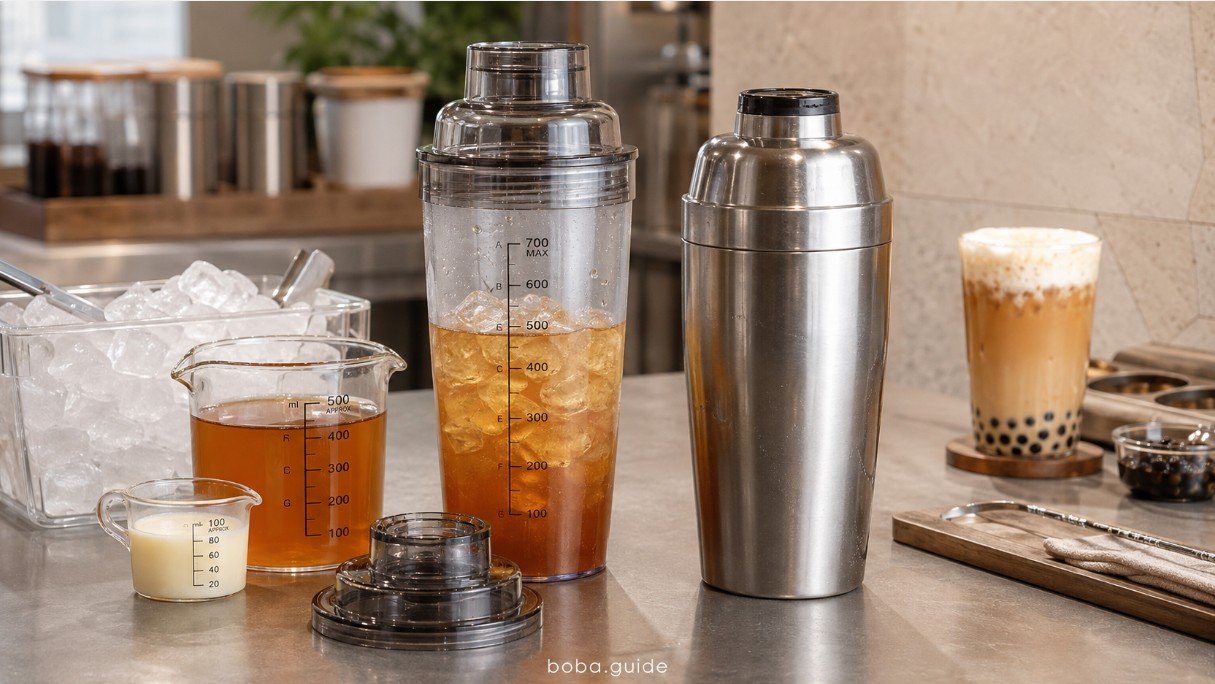
A good boba shaker is not a protein bottle with a bubble-tea label. Its job is to combine brewed tea, sweetener or milk and ice quickly enough to chill the drink, distribute the recipe evenly and create the fine foam associated with Taiwan’s hand-shaken tea culture. For home use, almost any genuinely secure food-safe vessel can sometimes do that job. For frequent use, details such as capacity, empty weight, grip, measurement marks and how easily the lid releases become much more important.
The most useful buying question is therefore not “plastic or stainless?” It is “what happens during the entire shake?” A 700 ml transparent PC shaker gives you visual control of ice and volume. A stainless shaker hides the recipe but can feel extremely durable. A lid that seals beautifully may become irritating if temperature changes make it hard to remove. And a nominal 700 ml capacity does not mean you should fill the vessel to 700 ml before shaking.
This page focuses on manual shakers. Automatic shaker machines belong to a different operational problem—throughput and labor—and are discussed only at the point where hand shaking stops making practical sense. For the wider setup, see our boba supplies guide.
Start with the technique
A Boba Shaker Has Three Jobs: Mix, Chill and Aerate
Before pearl milk tea became the international shorthand for bubble tea, the “bubble” in Taiwan’s shaken tea culture referred to foam created by shaking tea with ice. The technique integrates tea and ice while generating frothy bubbles that change the texture and character of the drink. Shaking is therefore part of the drink-making method rather than simply a theatrical final step.
Mix
Tea, milk, creamer, syrup or dissolved powder need to become one uniform drink rather than separate layers with concentrated sweetness at the bottom.
Chill
Ice rapidly pulls heat from the tea. The drink leaves the shaker cold enough for service, but some ice also melts and becomes part of the final dilution.
Aerate
Vigorous movement introduces air and can produce a fine foam. That foam is not a defect; it is one reason hand-shaken tea has a different texture from tea that was merely stirred over ice.
This is why shaker design matters. A vessel that is only convenient for storage may not leave enough room for vigorous movement. A vessel that is uncomfortable when cold may be unpleasant during repeated service. The shaker is part of the preparation method, not simply packaging.
Why 700 ml Became Such a Useful Manual-Shaker Size
Current specialty suppliers in both the United States and Taiwan repeatedly converge on a working format around 700 ml, 700 cc or roughly 24 U.S. fluid ounces. U.S. bubble-tea suppliers sell 700 ml / 24 oz plastic shakers specifically for beverage preparation, while Taiwanese food-service suppliers sell 700 cc PC shaker cups as shop tools.
The attraction is not that every finished drink contains 700 ml of liquid. The attraction is that a vessel in this size class can accommodate the recipe, a useful amount of ice and enough empty volume for the contents to move.
That makes 700 ml particularly flexible for large milk tea and fruit tea recipes. A smaller shaker can still be ideal for smaller servings, and automatic machines commonly support both 500 ml and 700 ml cups. The useful lesson is not “always buy 700 ml.” It is that 700 ml is an established working format rather than an arbitrary oversized container.
Capacity also interacts with the serving cup. If you usually build a 500 ml finished drink, a 700 ml shaker can provide useful working room without forcing you into a 700 ml serving. Conversely, a small shaker may require splitting a large recipe into two shakes, which adds another opportunity for variation. For frequent use, choose the vessel around the largest recipe you make routinely rather than the largest cup in the supplier catalog.
Capacity trap
Nominal Capacity Is Not Your Fill Line
If a shaker is sold as 700 ml, filling it with 700 ml of tea, syrup and ice defeats part of the purpose. Shaking requires headspace so liquid and ice can travel through the vessel instead of simply vibrating as a tightly packed mass.
There is no single universal headspace percentage that works for every recipe. Ice size, liquid volume, temperature and shaker geometry all matter. Use the recipe and manufacturer markings as the starting point, then verify that the lid closes cleanly and the contents have room to move.
PC vs Stainless Steel: The Taiwan Shop Perspective Is More Interesting Than “Premium vs Plastic”
Stainless steel looks professional, but Taiwan’s beverage-tool market gives polycarbonate-style shakers a serious operational case. A current Taiwan-made 700 cc PC shaker is marketed specifically around impact resistance, lower heat transfer to the hand, lighter weight, visible measurements and easier lid release after temperature changes.
PC and PP are also not interchangeable words for performance. Polycarbonate, polypropylene and other clear plastics can differ in stiffness, clarity, temperature tolerance and odor behavior. Read the exact material and care instructions instead of treating every transparent shaker as the same product. For stainless steel, inspect whether the walls dent easily and whether the lid depends on a precise round fit; a durable metal body is less useful if a deformation makes the closure unreliable.
The same Taiwanese seller notes an important limitation rather than presenting PC as perfect: some odor can remain, and its customers may dedicate separate shakers to black-tea and green-tea drinks. That is exactly the kind of operational detail a simple “best material” ranking misses.
Material claims are product-specific. A temperature range or impact claim listed for one PC shaker should not be assumed to apply to every plastic shaker on the market.
Weight Becomes a Real Feature After the 50th Shake
A shaker that feels pleasantly substantial during one home recipe can feel completely different after repeated drinks. Current Taiwanese 700 ml PC examples are sold around the low-200-gram range; one current listing is approximately 205 g empty. Once tea and ice are added, the operator is moving much more mass than the cup weight alone suggests.
current 700 ml PC example
tea, milk or syrup plus ice
where ergonomics start to matter
For home use, the difference may be trivial. For frequent manual shaking, empty weight, grip diameter and how cold the outside surface becomes can influence wrist and hand fatigue. This is one reason a lighter transparent shaker can remain a professional choice rather than merely a budget choice.
Transparent and Opaque Shakers Encourage Different Workflows
A transparent shaker gives the operator immediate visual feedback. You can see where the tea sits against the volume marks, how much ice remains, whether powder clumps are still present and how foam develops during the shake.
Transparent shaker
Visual control
- read liquid level without opening;
- see ice quantity;
- spot unmixed powder or creamer;
- monitor foam and color;
- use printed volume marks quickly.
Opaque metal shaker
Recipe discipline
- works well with standardized measured recipes;
- contents stay visually hidden;
- durable professional feel;
- easy to dedicate to a repeatable station;
- less dependent on visual judgment.
Neither workflow is automatically more accurate. A transparent cup makes visual checking easier, while a disciplined shop can produce excellent consistency with an opaque shaker by measuring every component before it enters the vessel.
The Lid Is the Part Most Likely to Annoy You
A shaker can have perfect capacity and still become a bad purchase if the lid leaks, jams or traps residue. Repeated temperature changes make lid design especially important because warm tea may meet cold ice inside a tightly sealed vessel.
Water should not escape from the lid seam during vigorous shaking.
The cap should still open without excessive force after the vessel becomes cold.
Condensation should not turn the lid into a smooth slippery disc.
Milk, syrup and tea should not disappear into inaccessible channels.
The Taiwan-made PC shaker referenced above is specifically marketed with a lid geometry intended to reduce sticking, and the seller contrasts it with metal shakers that can deform after drops or become harder to separate after temperature changes. Treat that as a product-specific design claim, but use the underlying question for every shaker you compare: does the lid still work when the tool is cold, wet and used repeatedly?
Measurement Marks Are Useful—But They Do Not Replace a Scale
A current 700 cc Taiwan-made PC shaker begins its volume markings at 50 cc and continues in 50 cc increments. For fast beverage preparation, that is genuinely useful. The operator can measure tea, milk or water directly in the vessel and keep a recipe visually repeatable.
- brewed tea;
- water;
- milk;
- liquid syrup when the recipe is volume-based;
- quick visual checks.
- powder is specified in grams;
- you are developing a recipe;
- small differences materially change the drink;
- ingredient density makes volume inconsistent;
- you need tighter batch control.
The best measuring workflow can therefore use both tools: volume marks for speed and a scale where weight is the more repeatable unit. Our boba measuring tools guide handles that decision separately.
What Should Actually Go Into the Shaker?
The exact recipe changes by drink, but the shaker is normally used for the beverage phase rather than as a container for violently shaking every topping in the order.
Black tea, jasmine, oolong or another brewed base.
Syrup, milk, creamer or dissolved powder according to the recipe.
Chills the mixture and contributes controlled dilution.
Prepared pearls or toppings are commonly waiting here.
Classic tapioca pearls generally do not need to be shaken aggressively with the tea. They can be portioned into the serving cup and the shaken beverage poured over them. That protects texture and keeps the shaker easier to clean.
The drink-building details differ by recipe. See how to make milk tea and how to make fruit tea for boba for the recipe side rather than forcing one universal shaker formula onto every drink.
Ice Is Part of the Recipe, Not Just Something That Makes the Shaker Cold
When warm or room-temperature tea meets ice, two things happen at once: the tea cools and some ice melts. That melted ice becomes water in the final drink. If the recipe ignores that dilution, a tea that tasted correct before shaking can become weak afterward.
This is why there is no responsible universal statement such as “fill one-third of every shaker with ice.” The correct amount depends on tea temperature, tea strength, cup size, sweetness, final ice level and whether the finished drink will receive additional ice.
For a new recipe, measure the tea and ice rather than relying on “a handful.” Once the result is correct, volume markings and a standard ice scoop can turn that recipe into a repeatable routine.
Shaking time also should not be copied blindly from another recipe. The goal is not to keep shaking until every piece of ice disappears. A hot, concentrated tea base may need a different amount of movement from a drink that starts cold. Stop when the recipe has reached the intended temperature, integration and foam rather than treating a dramatic long shake as proof of quality.
The Best Home Shaker and the Best Frequent-Use Shaker Are Not Necessarily the Same Tool
Home
Convenience can beat specialization
If you make one or two drinks, you may care most about a reliable seal, dishwasher compatibility, modest storage space and whether the vessel can perform another kitchen job.
A dedicated 700 ml shaker can still be convenient, but it is not mandatory simply because the drink is boba.
Frequent manual use
Ergonomics and repeatability move up the list
Low empty weight, clear volume marks, secure lid fit and easy lid release matter much more when the same motion is repeated throughout service.
A dedicated bubble-tea shaker begins to justify itself through speed and consistency rather than novelty.
If you are assembling the first complete home setup rather than buying only a shaker, the boba starter kit guide is the narrower place to start.
Current Manual-Shaker Market Snapshot
Shaker prices vary by seller, country and material, so a small sample should not be presented as a national average. These current examples are more useful as reference points for what different formats look like.
- 700 ml / 24 oz
- plastic
- 8¾” high
- 2¾” bottom diameter
- 700 cc
- about 22 cm overall height
- about 8.6 cm cup opening
- 50 cc measurement increments
These listings also illustrate why price alone is a weak comparison. The Taiwan product description is unusually detailed about impact behavior, temperature transfer, lid release and odor carryover, while the U.S. product page gives a straightforward food-service size and dimensional specification. A better purchase decision compares the operating details you can actually verify.
You May Not Need a Dedicated Boba Shaker at Home
A dedicated tool is useful when it makes a repeated job easier. If you make boba occasionally, a different food-safe vessel may already do the job.
The vessel must leave real headspace after tea and ice are added.
A friction lid that is fine for storage may not be safe for vigorous shaking.
The outside should remain controllable when cold and wet.
Milk and syrup should not disappear into a lid you cannot disassemble.
A large lidded jar or well-sealed kitchen shaker can be enough for occasional home milk tea. A cocktail shaker can also perform the mechanical job if it is food-safe, large enough and easy to clean, although many cocktail formats are smaller than the 700 ml beverage-shop format.
The dedicated bubble-tea shaker earns its place when its capacity, measurement markings and lid design make the workflow faster than improvising with another vessel.
The boundary
When Manual Shaking Stops Making Sense
An automatic shaker solves a fundamentally different problem. It is not “a better manual shaker”; it is equipment for moving repetitive labor into a machine and standardizing the motion.
One current commercial shaker provides a useful scale marker rather than a recommendation: it is listed at $1,082, supports 500 ml and 700 ml plastic or stainless shaker cups, offers 10 speeds and 5 custom programs, draws 75 W and weighs about 51 lb.
A home user does not need a machine to make authentic hand-shaken tea. A shop should consider automation only when real volume, staffing and consistency justify the extra equipment, counter space, maintenance and capital cost. The broader shop setup belongs in our boba equipment checklist.
The Five-Minute Shaker Test Before You Commit to a Setup
Specifications are useful, but five minutes with water and ice can expose most practical problems quickly.
Fill below maximum capacity and shake with water
Check the seam and lid under vigorous movement. Do not begin with hot liquid when testing an unfamiliar vessel.
Add ice and judge the grip
Notice condensation, surface temperature and whether your hand can hold the body securely without excessive force.
Open it immediately after the cold shake
A seal that becomes frustrating after one temperature change will not improve during a busy workflow.
Read the marks while the vessel is on the counter
Measurement lines should be useful from a normal working position, not technically present but impossible to read.
Take the lid apart and clean it
If the cleaning path is annoying with plain water, it will be worse after milk tea, syrup or powder residue.
For most people who specifically want a dedicated manual bubble-tea shaker, a food-safe 500–700 ml vessel with a genuinely secure lid, enough headspace for the intended recipe and easy cleaning is the useful starting point. Transparent PC or PP makes visual measurement and repeated shop-style preparation easy; stainless steel is compelling when durability and lower odor carryover matter more than seeing the drink. The right choice is the shaker you can seal, grip, open and clean comfortably every time.
Have a Shaker That Has Survived Real Boba-Shop Use?
Long-term details are more useful than unboxing impressions. If you operate a boba shop or use a manual shaker heavily, tell us how the lid, markings, grip and material perform after repeated service. Manufacturers and suppliers can also send current dimensions, material specifications and care instructions to info@boba.guide.
Submitted products and specifications are research leads. A submission does not guarantee inclusion or a favorable recommendation.
Questions About Manual Boba Shakers
These are the practical questions that matter when you are choosing a shaker for real hand-shaken tea rather than simply buying another drink bottle.
What size shaker is best for boba?
A 500–700 ml manual shaker is a practical range for many home and shop recipes. The 700 ml / 24 oz format is especially common because it leaves room for tea, ice and working headspace. The correct size depends on the largest drink you make regularly rather than on maximum catalog capacity.
Why are 700 ml shakers common in bubble tea shops?
Seven-hundred-milliliter shakers are widely used because they can handle large hand-shaken drinks while still leaving room for ice and movement. Current U.S. and Taiwan specialty suppliers both sell 700 ml / 700 cc bubble-tea shakers, so the size is an established working format rather than a random large container.
Is a plastic or stainless steel shaker better for boba?
Neither is universally better. Transparent PC or PP can be lighter, easier to read and slower to transfer cold to the hand. Stainless steel is durable and usually easier to manage for odor carryover, but it hides the drink and can feel colder during repeated use. Compare the exact material, lid and weight rather than choosing from appearance alone.
Do I need to fill a 700 ml shaker to 700 ml?
No. Nominal capacity is not the same as working fill volume. Shaking needs headspace so tea and ice can move through the vessel. A shaker filled to the brim has less room for effective movement and may place more stress on the lid. Follow the recipe and product markings rather than using the maximum capacity as a fill line.
Do tapioca pearls go into the shaker?
Usually the beverage is shaken separately and cooked tapioca pearls are portioned into the serving cup. The shaken tea is then poured over the pearls. This avoids aggressively shaking the pearls, helps protect their texture and keeps the shaker easier to clean.
Are measurement marks on a boba shaker useful?
Yes. They make tea, milk, water and liquid sweetener easier to repeat quickly. Some current Taiwan-made 700 cc shakers use 50 cc measurement increments. A scale is still better when a recipe specifies ingredients in grams or when tighter recipe control is required.
Can I use a cocktail shaker or jar for bubble tea?
For occasional home use, yes, if the vessel is food-safe, large enough to leave headspace, easy to clean and has a closure that is genuinely secure during vigorous shaking. Many cocktail shakers are smaller than dedicated 700 ml bubble-tea shakers, so capacity should be checked before using one for a large drink.
How much does a manual boba shaker cost?
Prices vary by seller and material. As an August 2026 reference, One Stop SupplyCo lists a 700 ml / 24 oz plastic bubble-tea shaker at $17, while a Taiwan-made 700 cc PC shaker is currently listed at NT$195 by a Taiwanese food-service retailer. These are examples, not national averages.
When does a boba shop need an automatic shaker machine?
An automatic shaker becomes relevant when repeated manual shaking creates a real throughput, fatigue or consistency problem. It is a different equipment class: one current commercial example supports 500 ml and 700 ml cups, has 10 speeds and 5 programs, and costs more than $1,000. Home users do not need one to make hand-shaken tea.