
Bubble tea syrup buyer’s guide
Best Boba Syrups: How to Choose Flavor, Quality and Value
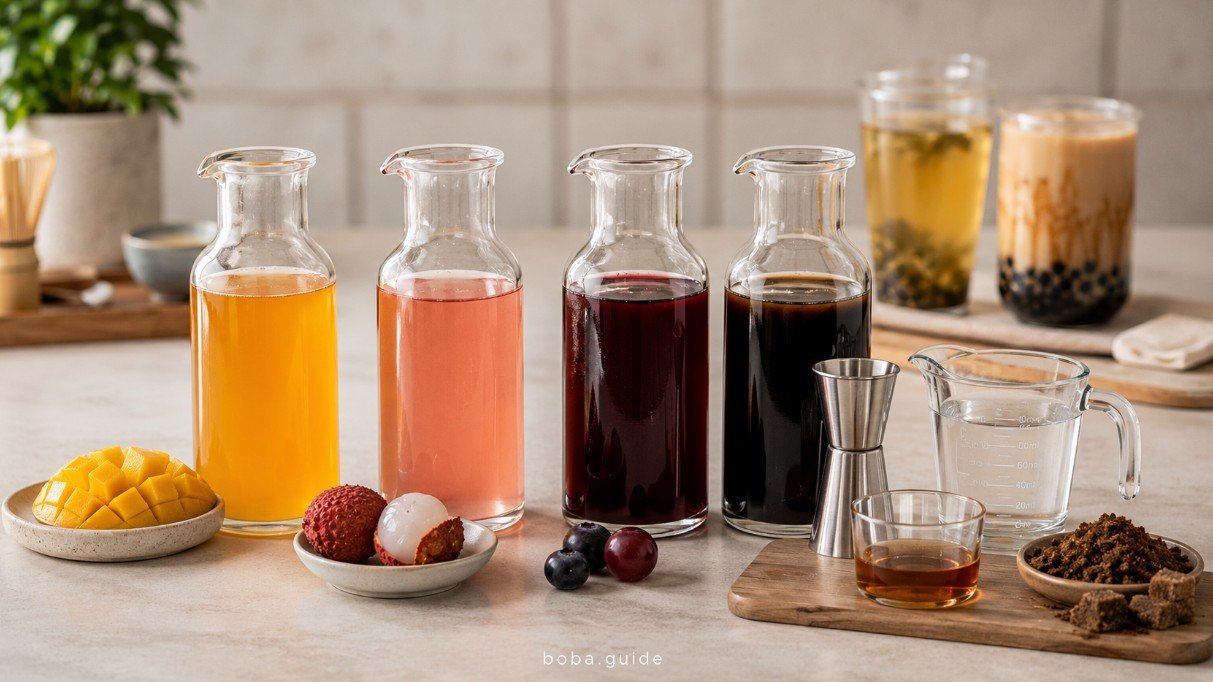
The best boba syrup is not necessarily the bottle with the strongest color, the highest fruit percentage or the lowest price. A syrup has a job inside the drink: it may provide fruit flavor, sweetness, acidity, body, brown-sugar depth or a combination of those things. The right product depends on what the rest of the recipe is already doing.
That is why two mango syrups can behave differently in the same jasmine tea, and why brown sugar syrup should not be judged by the same standards as lychee or passion fruit. Package size matters too. A large food-service bottle can be economical in a busy shop and completely impractical for a household that makes two drinks a week.
This guide focuses on buying and comparing commercial syrups. For the broader ingredient category and how syrups fit into bubble tea recipes, start with our guide to syrups for boba.
Start With the Job the Syrup Must Do
Boba syrups are often grouped together by flavor, but the more useful distinction is function. One bottle may mainly contribute fruit aroma. Another may supply a large share of the drink’s sweetness. A third may be used for coating the cup rather than simply mixing into tea.
Fruit flavor
Mango, peach, lychee, passion fruit, strawberry and similar syrups are commonly used to flavor tea, lemonade, slushes and sparkling drinks.
Sweetness
Many fruit syrups contain fructose or sugar, so adding more syrup changes sweetness at the same time as flavor intensity.
Acidity
Citric acid, malic acid and fruit ingredients can make a syrup taste sharper. That matters when it is paired with already-acidic citrus or fruit tea.
Texture and body
Gums, pectin and the concentration of sugars can change viscosity. A thick brown-sugar syrup behaves differently from a lighter fruit syrup.
This is also why syrup should be considered together with the rest of the boba ingredient system, not as an isolated topping.
Fruit Syrup Is Not the Same as Fruit Puree
A fruit-flavored syrup and a puree can produce the same menu name while creating very different drinks.
Consistent and easy to measure
Syrup is usually designed to pour or pump easily, disperse quickly and deliver predictable flavor from one serving to the next.
It can contain fruit juice or fruit ingredients, but it may also rely heavily on fructose, sugar, flavoring, acids, color and stabilizers.
More fruit texture and body
A puree can provide pulp, thicker body and a more obvious fruit character. It may also settle differently, require more shaking and behave differently around ice and tea.
Neither format is automatically superior. They solve different recipe problems.
The Fruit Name Does Not Tell You the Fruit Content
This is one of the clearest reasons to read the actual formulation rather than judging syrup by the picture on the package.
Current Possmei examples sold in the same 5.5 lb format and at similar prices show large differences in disclosed fruit content:
The numbers do not create an automatic quality ranking. Citrus is naturally intense and formulated differently from mango. What the comparison proves is narrower and more useful: the flavor name alone cannot tell you what proportion of the formula comes from the named fruit.
Some flavor systems go even further. A syrup may use another fruit ingredient as part of its base or depend mainly on fructose, flavoring and acids. This is normal in commercial beverage formulation, but it means buyers should distinguish a flavor claim from a juice-percentage claim.
What Boba Syrups Currently Cost
Current U.S. listings show that commercial syrup prices can be close enough that recipe suitability matters more than chasing a difference of one or two dollars.
These are current August 2026 supplier examples, not a national average. Shipping, business pricing, case discounts and promotions can change the delivered cost.
The Tea Zone example also illustrates why package units matter. Its common syrup format is listed by fluid ounces, while Possmei’s larger bottles are sold by weight. Those numbers should not be treated as if they were directly interchangeable measurements of syrup volume.
How Much Syrup Goes in One Boba Drink?
There is no universal syrup dose because drink size, tea strength, ice, fruit acidity and the concentration of the syrup all matter.
Possmei currently suggests approximately 1–1.5 oz per serving for many of its fruit syrups. Tea Zone sells a syrup pump designed to dispense approximately 1 oz per pump, which illustrates how shops can convert a recipe into a repeatable service procedure.
A recipe should still be tested in the full drink. One ounce in 12 oz of tea is not the same sensory concentration as one ounce in a 24 oz iced drink.
For fruit tea specifically, syrup should support the brewed base rather than erase it. Our fruit tea for boba guide covers that drink-building side in more detail.
What Does the Syrup Actually Cost Per Drink?
A 5.5 lb bottle weighs 88 oz by weight. If a supplier recommends 1–1.5 oz per serving, that gives a rough theoretical framework for comparing usage, although fluid volume and net weight are not perfectly interchangeable for a dense syrup.
Using the supplier’s listed package and serving figures simply as a planning approximation, a $14.59 bottle would represent roughly:
Those numbers are useful for menu planning, not laboratory yield. Syrup density, bottle residue, over-pouring and the exact recipe all affect real output.
For a shop, a $0.08 difference in theoretical syrup cost may be less important than a product that creates a better drink, pumps cleanly and is used across three popular menu items.
Choose the Syrup Type by the Drink
Lychee, peach, mango, passion fruit
Floral and tropical flavors can complement jasmine without requiring a heavy creamy base.
Peach, strawberry, mango, berry
The stronger tea base can handle richer fruit flavors without disappearing as quickly.
Passion fruit, mango, strawberry
Watch total acidity. A citrus drink plus a highly acidic syrup can become sharp before it becomes flavorful.
Concentrated fruit syrup
Ice dilution suppresses aroma, so a flavor that seems strong in tea may become balanced after blending.
Passion fruit, lychee, berry, peach
Clear fruit syrups are easy to integrate into soda-style drinks without adding thick fruit solids.
Use compatibility, not assumption
Highly acidic fruit systems can behave poorly with dairy. Dessert-style syrups, taro-style flavors or brown sugar may be easier fits.
A good menu also considers turnover. A mango syrup that works in tea, lemonade, slush and soda may be operationally more valuable than a novelty flavor that has only one use.
Brown Sugar Syrup Needs Different Buying Rules
Brown sugar syrup is not simply another flavor in the fruit-syrup row. It can act as the sweetener, the flavor and part of the visual presentation at the same time.
Usually selected for fruit identity, acidity and versatility across tea, slush or soda.
Viscosity, caramel character and how the syrup clings to the cup become part of the experience.
Current Possmei examples demonstrate how different the formulations can be. Its standard Black Sugar Flavored Syrup lists 37.5% black sugar and is currently priced at $14.59 for 5.5 lb. Its Premium Brown Sugar Syrup is $21.59 for the same listed weight and has a much simpler ingredient statement built around black sugar, water and fructose.
Both are brown-sugar products, but a buyer should not assume they are simply the same syrup at two price points.
If brown sugar itself is your primary ingredient question, use the dedicated brown sugar for boba guide. For broader sweetness systems, see sweeteners for boba.
Home Bottle and Shop Bottle Are Different Purchases
Food-service pricing can look much better per pound, but a home buyer should care about total quantity and how quickly an opened bottle will be used.
Possmei currently sells Mango Syrup in two useful comparison sizes:
About $4.99 per pound.
About $2.65 per pound.
The larger bottle costs roughly half as much per pound. That makes obvious sense for a busy shop. It does not automatically make sense for a household.
Optimize for practical quantity
If you make boba occasionally, a smaller bottle can reduce total spend, storage space and the chance that an open flavor stays unused for months.
Optimize for turnover
Large bottles and cases make sense when the same flavor moves consistently. A core mango or passion-fruit syrup can justify food-service scale much faster than an experimental flavor.
If purchasing channels and case quantities are the bigger question, continue to our boba ingredient sourcing guide.
Read These Ingredients Before Buying a Syrup
The ingredient list tells you more than the color of the bottle. These are the components worth noticing first.
Primary sweetener
Fructose, high-fructose syrup, sucrose or sugar can dominate the formula and determine how much sweetness arrives with every ounce of flavor.
Named fruit
If fruit content matters to you, look for an actual juice, puree or fruit percentage rather than inferring it from the product name.
Acids
Citric and malic acids adjust sharpness and can help create a convincing fruit profile, but they also influence milk compatibility and total drink acidity.
Flavoring
Flavoring can create consistency across seasons and batches. The useful question is how heavily the product relies on it relative to other ingredients.
Texture ingredients
Xanthan gum, pectin and related ingredients can change body, suspension and pouring behavior.
Color
A bright syrup is not evidence of higher fruit content. Added colors may contribute significantly to the final appearance.
How to Compare Two Boba Syrups Properly
If two bottles have the same flavor name, compare them in this order.
Identify the job
Decide whether you need fruit flavor, sweetness, acidity, cup coating or a multi-purpose syrup.
Read the ingredient list
Look at sweeteners, fruit ingredients, acids, flavors, colors and texture agents instead of relying on front-label imagery.
Check the recommended dose
A concentrated syrup that works at a lower dose can cost less per drink even when the bottle price is higher.
Normalize package size
Compare ounces, pounds and bottle count carefully. Two prices mean little when the package sizes differ.
Calculate usable serving cost
Include realistic over-pouring and leftover product instead of assuming every last drop becomes a saleable drink.
Test the complete drink
A syrup can taste artificial by itself and become balanced in tea—or taste pleasant from a spoon and disappear after ice dilution.
Check menu versatility
A syrup that fits several high-volume drinks can be easier to keep fresh and economically useful.
The best boba syrup is therefore not a universal winner. It is the product that creates the flavor you want at a measured dose, in a package your kitchen can use efficiently, without forcing the rest of the recipe into a balance you do not like.
For the larger purchasing system around pumps, containers and related items, see our boba supplies guide.
Know a Syrup We Should Compare?
Commercial formulations and package specifications change, and small regional suppliers can be difficult to discover nationally. If you operate a boba shop, manufacture beverage syrup or distribute bubble-tea ingredients in the United States, send current ingredient panels, serving recommendations, package sizes or corrections to info@boba.guide.
Submitted information is treated as a research lead. Providing a product or specification does not guarantee inclusion or a favorable recommendation.
Questions About Choosing Boba Syrups
These are the practical follow-up questions that matter when you are deciding what bottle to buy and how much to use.
What is the best syrup for boba tea?
There is no single best syrup for every boba drink. Mango, passion fruit, peach and lychee are versatile choices for fruit tea, while brown sugar syrup serves a different role in milk-based drinks and cup coating. Compare the syrup’s sweetness, acidity, fruit content, recommended dose and package size against the recipe you actually want to make.
How much syrup should I put in bubble tea?
Many current commercial fruit syrups recommend about 1–1.5 oz per serving, but that is a starting range rather than a universal rule. Cup size, tea strength, ice and the concentration of the syrup all affect the final balance. Measure the syrup consistently and test it in the complete drink before setting a house recipe.
Are fruit syrups made from real fruit?
Some contain meaningful fruit ingredients, while others rely more heavily on sweeteners, flavoring and acids. Current Possmei examples include mango and passion fruit syrups listing 20% juice, while orange and lemon versions list 1.7% juice. The flavor name alone does not tell you the fruit percentage, so check the exact ingredient statement.
What is the difference between boba syrup and fruit puree?
Syrup is generally easier to pour, pump and disperse into a drink, while puree or jam-style fruit bases usually contain more solids and can add more texture and body. Syrup is useful for repeatable flavor and service speed; puree can create a more fruit-forward texture. They should not automatically be substituted at the same dose.
How much does boba syrup cost per drink?
It depends on bottle price and dose. As a rough planning example, a $14.59 food-service syrup used at approximately 1–1.5 oz per serving can represent roughly $0.17–$0.25 of syrup per theoretical serving before shipping, over-pouring and waste. Syrup density means package weight and fluid volume are not perfectly interchangeable, so use the calculation as an operating estimate rather than an exact yield guarantee.
Is brown sugar syrup the same as fruit syrup?
No. Brown sugar syrup often functions as both a sweetener and a flavoring and may also need enough viscosity to coat the inside of a cup. Fruit syrup is typically selected for fruit aroma, sweetness and acidity in tea, lemonade, soda or blended drinks. They should be evaluated using different criteria.
What boba syrup flavors are most versatile?
Mango, passion fruit, peach, strawberry and lychee are useful starting points because they can work across fruit tea, lemonade, slushes and sparkling drinks. A versatile flavor that appears in several popular menu items can also be easier for a shop to use before an opened bottle sits too long.
Should I buy a large food-service bottle for home use?
Only if you make drinks frequently enough to use it. Large bottles can cost much less per pound, but the total quantity may be excessive for occasional home boba. A smaller retail bottle can cost more per pound and still be the better purchase because it requires less cash, storage space and product turnover.
What should I check on a boba syrup ingredient list?
Check the main sweetener, any declared fruit or juice percentage, acids such as citric or malic acid, flavoring, colors, texture ingredients and preservatives. Then compare that formula with the recommended serving size and the drink in which you plan to use it. A bright color or fruit image is not enough to judge the product.