
Boba Safety: Choking Risks, Allergens, Storage and Safer Choices
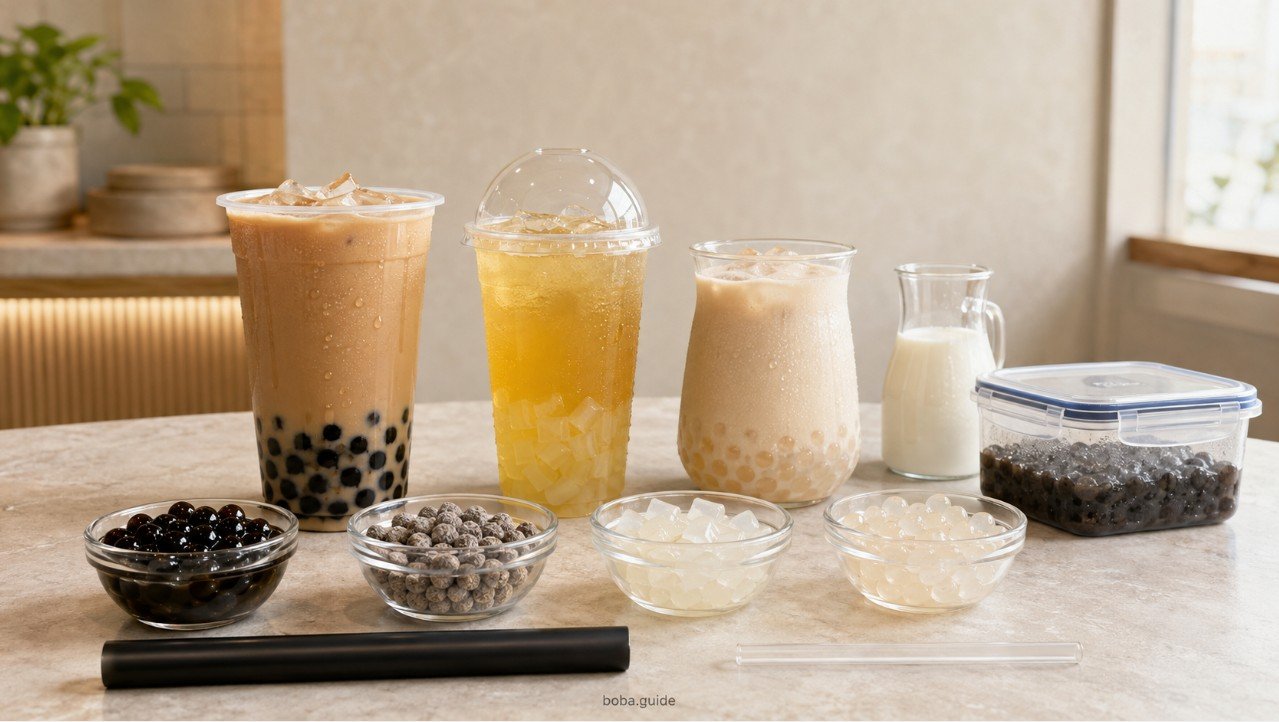
Bubble tea can be enjoyed safely when the drink, topping texture, person drinking it and storage conditions all match. This guide explains the risks without panic and gives practical ways to choose, serve and store boba more carefully.
What makes a boba drink safer or riskier?
There is no single “safe” or “unsafe” bubble tea. Risk depends on several interacting factors: the topping’s size and chewiness, how quickly someone drinks, whether they can chew and swallow reliably, the presence of allergens, the drink’s temperature, and how long milk, fruit or cooked toppings have been held.
Texture and size
Traditional tapioca pearls are round, smooth and chewy. They require deliberate chewing. A topping that is unusually firm, dried out or swallowed whole presents a different challenge from a soft topping eaten slowly.
The person drinking
Age, development, dental function, alertness and swallowing ability matter. A drink that is manageable for a healthy adult may be inappropriate for a young child or someone with dysphagia.
Preparation and holding
Milk, fruit purees and cooked toppings need clean preparation and sensible time-temperature control. A beautiful drink can still be a poor choice if it has sat warm for too long.
Choking risk: why tapioca pearls deserve attention
Boba pearls combine several features that require care: they are small, rounded, slippery and chewy. The safest habit is simple—sip slowly, allow only a few toppings into the mouth at a time, and chew every pearl before swallowing.
A wide straw changes the drinking pattern
A wide straw can deliver liquid and several toppings quickly. That convenience can also reduce the pause people normally take between bites. Do not pull hard on the straw or try to finish a cluster of pearls in one swallow.
For anyone who tends to gulp drinks, using a spoon for toppings or ordering fewer pearls can create a slower, more deliberate pace.
Texture matters more than color
Freshly cooked tapioca should be soft enough to chew but not disintegrating. Pearls that have hardened, dried at the surface or developed a tough core are less pleasant and demand more chewing. A shop should not serve pearls that are stale, unusually hard or clearly past their best texture.
Crystal boba, jelly, aloe and popping boba are different materials, but they still should not be swallowed carelessly.
Safer drinking rhythm
Take a small sip, stop pulling from the straw, separate the liquid from the topping in your mouth, chew the topping completely, then swallow. Repeat. This sounds slow only because bubble tea is often marketed as a drink; once toppings are present, it is also food.
Children and boba: development matters more than a birthday
CDC guidance for young children emphasizes matching food shape, size and texture to the child’s development, avoiding small sticky or hard foods that are difficult to chew and swallow, feeding slowly, and supervising eating. Traditional tapioca pearls do not fit the profile of a food that dissolves easily in saliva.
Do not assume that “a few pearls” removes the risk
A child can still receive a whole round topping through a wide straw. Cutting, modifying or replacing a topping may reduce some concerns, but the decision should reflect the child’s chewing skill, impulse control and ability to remain seated and supervised.
For infants and toddlers, a topping-free drink does not automatically become appropriate either: caffeine, added sugar, dairy ingredients and the drink’s role in the child’s diet still matter.
Better ways to include children
Let the child choose a flavor without chewy toppings. Consider a small serving, lower sweetness, no caffeine and a texture already known to be manageable. Serve it in an open cup or with an ordinary straw rather than allowing toppings to shoot through a wide straw.
Keep the child seated, remove distractions and provide direct adult supervision for the entire serving—not only the first sip.
Do not use an age number as a universal guarantee
Children develop chewing and swallowing skills at different rates. A child with dental problems, developmental differences, impulsive eating behavior or a history of choking needs individualized guidance. When a parent is unsure, the safer choice is a topping-free drink and a conversation with the child’s pediatric clinician.
Swallowing difficulties, dental problems and other higher-risk situations
People with dysphagia, reduced oral sensation, weak chewing, missing teeth, neurologic conditions, sedation, fatigue or impaired alertness may have difficulty managing chewy toppings. In these situations, “just chew carefully” is not enough advice.
Allergens: the cup may contain more than tea, milk and pearls
In the United States, FDA recognizes nine major food allergens: milk, eggs, fish, crustacean shellfish, tree nuts, peanuts, wheat, soybeans and sesame. Bubble tea menus can involve several of these through creamers, powders, syrups, toppings, bakery add-ons and shared preparation equipment.
| Possible allergen | Where it may appear | What to ask |
|---|---|---|
| Milk | Fresh milk, condensed milk, milk powder, whipped topping, foam, pudding, premixed flavor powder. | Is the base dairy-free, and is the topping or foam made separately? |
| Soy | Soy milk, non-dairy creamer, emulsifiers, powders and some packaged toppings. | Can staff check the original ingredient label rather than relying on the menu name? |
| Tree nuts or peanuts | Almond milk, nut pastes, flavored foams, praline syrups, toppings or neighboring menu items. | Are blenders, scoops and shakers shared with nut-containing products? |
| Wheat or gluten-containing ingredients | Cookies, cake crumbs, cereal toppings, malt ingredients, flavored powders or sauces. | Are pearls and syrups packaged with a clear ingredient list, and is there shared contact? |
| Egg | Custard, pudding, cake toppings, cream foams or dessert-style add-ons. | Is the pudding egg-based, and are utensils shared? |
| Sesame | Sesame milk, black sesame paste, dessert powders, toppings or specialty drinks. | Does the shop prepare sesame products in the same blender or shaker? |
“Non-dairy” does not always mean allergen-free
Some creamers may be marketed as non-dairy while still containing milk-derived ingredients, and plant milks may introduce soy or tree nuts. The useful question is not “Is this dairy-free?” alone, but “Can I see the ingredient label for the exact creamer, powder, syrup and topping used?”
Cross-contact is a separate question
A shop can use an allergen-free ingredient and still prepare it with shared scoops, shakers, blenders, strainers or sealing areas. Someone with a severe allergy needs to know whether staff can use clean equipment and a process designed to reduce cross-contact.
For a history of severe allergic reactions
Do not rely on visual inspection, flavor names or an employee’s guess. Ask for ingredient labels and preparation details. Follow the emergency plan provided by your clinician, carry prescribed medication, and do not consume the drink when information is incomplete.
Storage and time: pearls, milk and fruit do not keep the same way
A finished bubble tea may contain brewed tea, milk, fruit puree, cooked starch, jelly and ice. The safest storage decision should be based on the most perishable component, not the tea alone.
Finished drinks
Drink refrigerated milk- or fruit-based boba promptly. If a perishable drink has remained at room temperature for more than two hours—or more than one hour above 90°F/32°C—FoodSafety.gov guidance supports discarding it rather than trying to rescue it with ice or refrigeration.
Cooked tapioca pearls
Texture quality and microbiological safety are separate issues. Pearls can harden in the refrigerator, but leaving them warm indefinitely to preserve chewiness is not a safe solution. Follow the package or manufacturer’s holding directions and make small batches.
Cold storage
Keep the refrigerator at 40°F/4°C or below. Use clean, covered containers and label preparation time. Do not pour a fresh batch on top of an older batch because that hides age and mixes storage histories.
Texture is not a safety test
A pearl can still feel chewy while the surrounding syrup or milk has been held too long. A drink can also smell normal even when unsafe bacteria are present. Time and temperature records are more useful than tasting “just a little” to check.
| Situation | Better action | Avoid |
|---|---|---|
| Fresh café drink you will finish soon | Keep cold and drink promptly. | Leaving it in a warm car or on a desk for hours. |
| Homemade pearls | Cook a manageable batch, use clean utensils and follow the product’s storage guidance. | Keeping warm syrup at room temperature all day without a controlled process. |
| Unfinished milk tea | Refrigerate promptly if still within safe time limits. | Assuming added ice resets the clock. |
| Unknown preparation time | Choose a fresh portion or discard. | Tasting to decide whether it is safe. |
Safer home preparation: clean, separate, chill and label
Home boba is easiest to manage when preparation is treated like a small food-service workflow. The goal is not sterility; it is preventing avoidable contamination and losing track of time.
Start with clean hands and tools
Wash hands before cooking pearls or handling ready-to-eat toppings. Clean the pot, strainer, spoon, knife, cutting board and storage containers. Rewash equipment after contact with raw egg, unwashed produce or allergenic ingredients.
Keep raw and ready-to-eat items separate
Fresh fruit, cooked pearls and finished tea should not share dirty cutting boards or utensils with raw animal foods. Use clean tasting spoons once rather than repeatedly returning the same spoon to the batch.
Cool perishable ingredients promptly
Do not leave milk, cream foam, cut fruit or cooked pudding on the counter while decorating drinks. Return them to refrigeration between uses and keep the refrigerator at 40°F/4°C or below.
Label time, not only date
For short-lived toppings, “made Tuesday” may be too vague. Write the preparation time and planned discard time. This is especially useful during parties when several people assemble drinks over an extended period.
Caffeine, sugar and serving size
Tea-based boba can contain caffeine, but the amount varies with tea type, leaf quantity, steeping time, concentrate strength and cup size. Menu labels may not provide a precise number, so people who are sensitive should ask whether the drink uses brewed tea, concentrate, matcha or a caffeine-free base.
Caffeine sensitivity
FDA notes that caffeine can be part of a healthy diet for most people, but sensitivity varies. Consider total caffeine from coffee, tea, energy drinks, chocolate, medicines and supplements—not only the bubble tea cup.
Added sugar
Sweetness settings do not always control every sugar source. Pearls may be soaked in syrup, fruit toppings may be sweetened, and premixed powders can contain sugar before the cashier applies a percentage. “Zero percent” may therefore mean no additional syrup rather than a sugar-free drink.
Large portions
A large drink can combine more tea, more syrup and more toppings. Ordering a smaller cup, fewer toppings or sharing a dessert-style drink may be more practical than trying to make every component “healthy.”
Pregnancy and individual medical considerations
ACOG states that moderate caffeine consumption below 200 mg per day does not appear to be a major contributing factor in miscarriage or preterm birth. Because caffeine varies across tea drinks, a pregnant customer may prefer a smaller size, a lighter tea, a caffeine-free option or confirmation from the shop when available.
Think beyond caffeine
Pregnancy-related choices can also involve pasteurization, blood sugar management, nausea, reflux, food allergies and individualized medical advice. Ask whether milk and dairy toppings are pasteurized and whether fruit or toppings have been kept refrigerated.
Personal plans take priority
People with diabetes, kidney disease, gastrointestinal conditions, medication interactions or other health concerns should use the plan provided by their clinician. This guide cannot determine whether a specific drink fits an individual treatment plan.
How to assess a boba shop without pretending to be an inspector
Customers cannot see every food-safety process, but several visible signals can help. None proves perfection; together they show whether the shop treats ingredients as food rather than decoration.
A five-step safer ordering check
A safe order does not need to become an interrogation. Five focused questions cover most practical concerns.
Who will drink it?
Consider age, chewing skill, swallowing ability, alertness, allergies, caffeine sensitivity and whether the person can remain seated and attentive.
Which topping is appropriate?
Choose fewer toppings, smaller portions or no topping when chewiness and mixed textures could be difficult. Ask whether the pearls are fresh and soft.
What are the exact ingredients?
Check tea base, creamer, milk, powder, syrup, foam and topping. Severe allergies require label-level information and a cross-contact conversation.
Will it stay cold?
Plan to drink it soon. If traveling, use an insulated bag with ice packs rather than leaving the cup in a warm vehicle.
Can the order be simplified?
A smaller cup, half sweetness, one topping or a topping-free drink is often easier to manage than a heavily customized dessert drink.
When something is wrong: act, do not keep testing the drink
Most bubble tea experiences are uneventful. Still, choking and severe allergic reactions are time-sensitive emergencies. A website cannot replace emergency training or local emergency services.
Possible choking
If someone cannot breathe, speak or cough effectively, treat it as an emergency. Call local emergency services and provide first aid appropriate to the person’s age and condition if you are trained. Do not offer more liquid or blindly sweep the mouth with fingers.
Possible severe allergic reaction
Rapid breathing difficulty, throat tightness, widespread hives, swelling, collapse or symptoms affecting more than one body system can signal anaphylaxis. Follow the person’s emergency plan, use prescribed epinephrine when indicated, and call emergency services.
Topping-by-topping safety differences
Not every topping behaves like tapioca. Texture, shape, slipperiness and how the topping is served all change the experience. The practical question is not which topping has the friendliest name, but whether the person can see it, control it, chew it and swallow it safely.
Traditional tapioca pearls
Black tapioca pearls are dense, elastic and round. Their chewiness is part of the appeal, but it also means they should be treated like food. A serving with many pearls can encourage continuous suction through the straw, so ordering a lighter portion may be sensible for someone who tends to drink quickly.
Fresh pearls should be pliable throughout. A hard center, dry shell or rubbery resistance is a quality problem and may make chewing more difficult.
Mini pearls and sago
Smaller does not automatically mean harmless. Mini pearls can travel through a straw in clusters and may be harder to notice individually. Sago varies widely in size and firmness depending on preparation. Eat slowly and avoid assuming that several tiny pieces can be swallowed without chewing.
Crystal boba
Crystal boba is often made from konjac or similar gelling ingredients and may feel crisp, springy or slippery. It is not the same as tapioca, but it remains a solid inclusion. Check the package for ingredients and allergens, especially when serving a commercial product at home.
Popping boba
Popping boba has a thin shell and liquid center. The shell may burst easily, yet the spheres still arrive through a wide straw. People with swallowing difficulty should not assume a bursting topping fits their prescribed texture plan. Flavored fillings can also contain colors, acids and sweeteners that matter to individual diets.
Jelly and aloe
Rectangular jelly, coconut jelly and aloe pieces are often softer than tapioca but can be slick and irregular. Large pieces should be chewed. Shops may cut them differently, so a familiar menu name does not guarantee the same size or texture in every location.
Pudding, red bean and foam
Pudding and red bean introduce different concerns: dairy or egg allergens, refrigeration and spoonable textures. Cheese foam and whipped toppings are usually perishable. Ask whether these ingredients are pasteurized, kept cold and prepared with shared equipment.
Hot boba, ice and temperature control
Bubble tea is often served cold, but some shops offer warm milk tea or hot tea with pearls. Temperature changes both comfort and topping behavior. A hot drink can create a burn risk, while a heavily iced drink can mask how long a perishable base has been held.
Hot drinks need a different pace
Test the liquid temperature before pulling through a straw. A straw can deliver hot liquid farther into the mouth than an open-cup sip, reducing the chance to notice excessive heat at the lips. Children and people with reduced oral sensation need particular care.
Warm pearls can also be softer than expected and arrive quickly. Use a spoon or remove the straw until the drink has cooled to a comfortable temperature.
Ice does not sanitize or reset time
Adding fresh ice to a drink that sat warm does not reverse bacterial growth. Likewise, a cup can feel cold on the outside while an ingredient container at the shop was held improperly before assembly. Time and storage history remain important.
At home, use clean ice made from potable water and a clean scoop. Do not handle ice with drinking glasses or bare hands.
Takeout, delivery, parties and travel
Boba is frequently carried home, delivered across town or placed on a party table. These situations add time, heat and uncertainty. A little planning protects both texture and safety.
Delivery quality is not the same as safety
A delayed drink may arrive with hardened pearls, melted ice or separated milk. Those changes can signal poor quality, but they do not provide a complete safety assessment. Check delivery time, cup temperature, seal integrity and whether the order contains perishable ingredients. Contact the shop when the seal is broken or the drink arrives unusually warm.
When to discard a drink or topping
Throwing away food is frustrating, but keeping an uncertain milk, fruit or cooked-starch mixture is not worth the risk. Use clear discard rules before the drink is served so decisions are not driven by price or appearance.
Discard immediately when
The cup seal is damaged, the drink has leaked during delivery, an allergen-specific order cannot be identified, visible mold is present, the smell is fermented or sour when it should not be, milk is curdled unexpectedly, toppings are slimy in an unusual way, or the holding time exceeded the two-hour rule for perishable foods.
Ask for a remake when
The wrong milk was used, a requested allergen precaution was ignored, pearls are extremely hard, a hot drink is dangerously hot, the cup includes an unknown topping, or staff cannot confirm which order is yours. A remake should use clean equipment when allergy concerns are involved.
Do not scrape off a suspect foam, remove visible pearls or pour the drink into a new cup and assume the remaining portion is safe. Ingredients mix during shaking, and cross-contact or time-temperature problems affect more than the visible component.
Common boba safety myths
Simple slogans can create false confidence. Safer choices come from understanding the whole drink and the person drinking it.
“If pearls are soft, they cannot cause choking.”
Softness makes chewing easier, but a soft round topping can still be swallowed whole or inhaled. Pace, supervision and swallowing ability still matter.
“Fruit tea is automatically dairy-free.”
Some fruit drinks include milk foam, yogurt powder, creamer or shared preparation with dairy products. Verify the exact recipe.
“No added sugar means no sugar.”
Sweetened pearls, fruit bases and powders can contribute sugar before customization. Ask what the sweetness control actually changes.
“A sealed cup can sit out all day.”
Sealing prevents spills; it does not keep milk or fruit at a safe temperature. Perishable ingredients still require time-temperature control.
“Plant milk removes all allergy concerns.”
Plant milks can contain soy, almonds, cashews or other allergens, and shared equipment may cause cross-contact.
“Caffeine is only in black milk tea.”
Green tea, jasmine tea, oolong, matcha and tea concentrates can all contain caffeine. Some coffee-boba drinks add even more sources.
Before handing over the cup: a thirty-second check
The final safety check belongs at the moment of service, when the drink, topping and customer are all visible. This is useful at home, in a café and at a party.
Check the order
Confirm the correct milk, tea base, sweetness and topping. For an allergy-specific drink, verify the name and preparation request before adding the straw. Do not rely on cup color or position on the counter when several orders look similar.
Check the topping
Look for pearls that are excessively hard, clumped, dried or unusually old-looking. Confirm that the portion is appropriate for the person receiving it. Fewer toppings are easier to control than a cup packed with mixed textures.
Check the temperature
Make sure hot drinks are comfortable to sip and cold perishable drinks are actually cold. If a delivery cup arrives warm, leaking or unsealed, stop and resolve the issue before drinking.
Give one useful instruction
For a first-time drinker, say: “Sip slowly and chew every topping.” For a child, keep the drink with the supervising adult. For a guest with an allergy, state exactly what was verified and what could not be guaranteed.
Useful tools for safer home boba preparation
Basic equipment can make timing, cooling and portion control easier. Choose food-safe containers, a refrigerator thermometer, clean strainers and clearly labeled storage boxes rather than accumulating single-purpose gadgets.
Affiliate disclosure: We may earn a commission from qualifying purchases.
Boba safety questions
Are tapioca pearls a choking hazard?
They can present a choking risk because they are round, slippery and chewy. Risk is higher when someone gulps through a wide straw, does not chew, is very young, has swallowing difficulty or is not fully alert. Sip slowly and chew each topping completely.
Can young children drink boba?
Traditional tapioca pearls are not an easy-dissolving toddler food. Development, chewing skill and supervision matter more than a single age cutoff. A small topping-free, caffeine-free and lower-sugar drink is generally easier to manage, but parents should follow pediatric guidance for their child.
Is crystal boba safer than tapioca?
Crystal boba has a different texture, but it is still a solid topping delivered in liquid. It should not be swallowed whole or treated as risk-free. The person’s chewing and swallowing ability remains the deciding factor.
How long can a milk tea sit out?
Use the general food-safety rule for perishable foods: no more than two hours at room temperature, or one hour when the temperature is above 90°F/32°C. When the holding time is unknown, discard rather than taste-test.
Can cooked tapioca pearls be refrigerated?
Follow the product or manufacturer’s directions. Refrigeration often makes pearls firm, but keeping them warm at room temperature for long periods is not an acceptable workaround. Make smaller batches and track preparation time.
Does zero-percent sugar mean sugar-free?
Not necessarily. Pearls, fruit bases, powders, flavored milks and toppings may already contain sugar. Ask whether the percentage controls only added syrup or the entire recipe.
Which allergens are common in bubble tea?
Milk and soy are common, while tree nuts, peanuts, wheat, egg and sesame may appear in plant milks, powders, puddings, foams, cookies, sauces and specialty drinks. Shared blenders and scoops can also create cross-contact.
Is non-dairy creamer safe for a milk allergy?
Not automatically. Some products labeled non-dairy can contain milk-derived ingredients, and others may contain soy. Ask staff to check the original package label and discuss shared equipment.
Can pregnant people drink boba?
Many can, but caffeine, sugar, pasteurization and personal medical considerations matter. ACOG advises keeping caffeine below 200 mg per day during pregnancy. Because tea caffeine varies, ask about the base and choose a smaller or caffeine-free option when uncertain.
How can I tell whether boba has spoiled?
Off odors, visible mold, separation, sliminess or unusual fermentation are reasons to discard, but the absence of those signs does not prove safety. Time and temperature are more reliable than appearance or taste.
Is it safer to eat pearls with a spoon?
For some people, yes. A spoon allows the person to see and control the amount of topping rather than receiving it unexpectedly through a wide straw. It does not make the topping suitable for someone who cannot chew or swallow it safely.
What should I order when I am unsure?
Choose a small topping-free drink with a clearly identified base, lower sweetness and an ingredient list the shop can verify. Drink it promptly and keep it cold. Simpler orders are easier to assess.
Official guidance used for this page
Boba-specific research is limited, so this guide applies established guidance on choking prevention, allergens, caffeine and time-temperature food safety to bubble tea ingredients and serving practices.