
Boba Atlas · Ingredients Guide
What Is Boba Made Of? Pearls, Drinks and Ingredients Explained
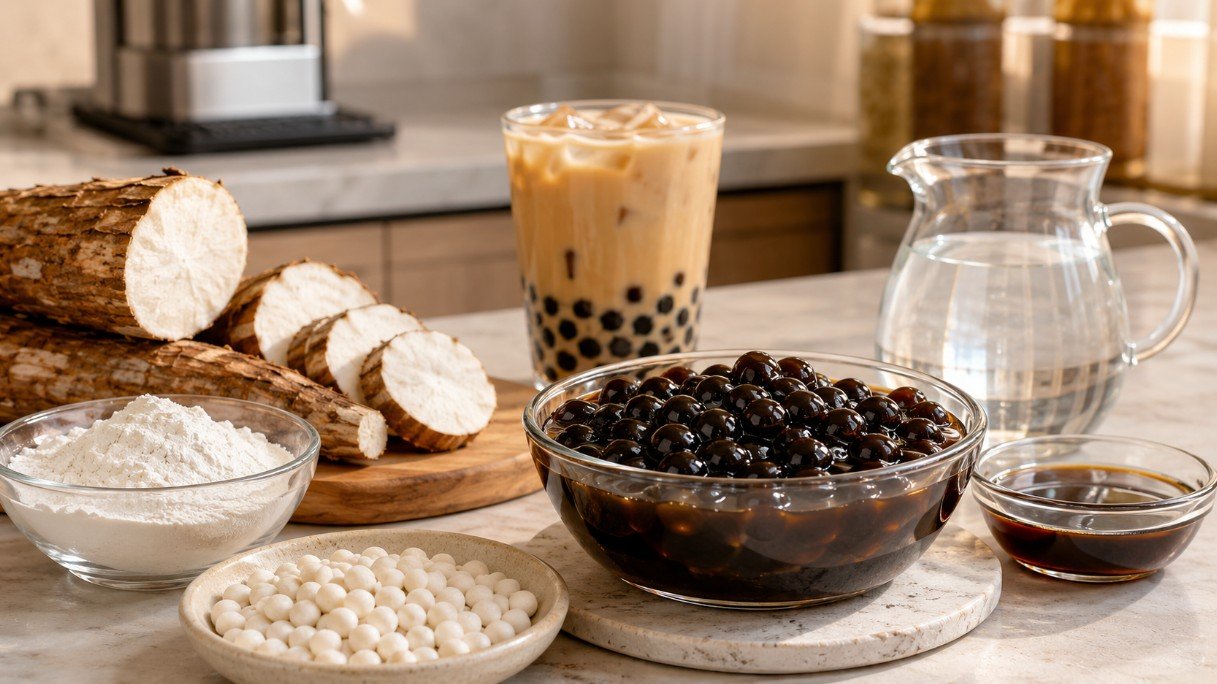
Traditional boba pearls are made mainly from tapioca starch extracted from cassava root. Water turns the starch into a workable dough, while sugar, coloring and flavoring depend on the recipe. After cooking, the pearls are usually soaked in a sweet syrup that gives them much of their familiar flavor and glossy finish.
A complete boba drink contains more than the pearls. Depending on the order, the cup may also include brewed tea, milk or creamer, fruit, flavored powder, sweetener, ice, foam, jelly, pudding or another topping. That is why the answer changes depending on whether someone means the pearl itself or the whole bubble tea drink.
Traditional Boba Pearls Start with Tapioca Starch
At their simplest, chewy tapioca pearls need starch and water. Most pearls sold in tea shops also include sweetener, color or processing aids, and the cooked pearls are commonly held in syrup before they reach the cup.
The basic pearl formula
Tapioca starch provides the structure. Hot water hydrates part of the starch so the mixture can be kneaded and shaped. Sugar may be mixed into the dough, added during cooking or used mainly in the soaking syrup. A homemade pearl can therefore have a very short ingredient list, while a commercial quick-cook pearl may contain extra starches, colors, thickeners or preservatives.
The ingredient list is not identical across every brand or tea shop. “Boba” describes a type of topping, not one legally fixed recipe. The most reliable statement is that traditional chewy pearls are tapioca-starch based, while the exact supporting ingredients vary.
In Taiwan, the broader category of fen yuan starch balls can also include blends of tapioca with potato, arrowroot or other starches. That makes “tapioca-based” more accurate than claiming every pearl is made from 100% tapioca. The actual package label remains the best source for a specific product.
The syrup is part of the experience
Plain cooked tapioca is mild. The familiar brown-sugar, caramel or honey character often comes from the liquid in which the pearls are held after cooking. That syrup coats the surface, seeps into the outer layers and helps prevent the pearls from drying too quickly during service.
This matters when ordering less sugar. A shop may reduce the sweetener added to the tea, yet the pearls can remain sweet because they were prepared earlier in syrup. A “0% sugar” setting usually refers to adjustable drink syrup, not automatically to every ingredient already present in the cup.
| Ingredient | Purpose | How common is it? | What changes when it varies? |
|---|---|---|---|
| Tapioca starch | Forms the pearl body and chewy gel | Core ingredient | Starch quality and blend influence elasticity and firmness |
| Water | Hydrates the starch and creates dough | Essential | Too little makes crumbly dough; too much makes sticky dough |
| Sugar | Adds sweetness and may deepen color | Frequent | Flavor, browning and surface stickiness |
| Coloring | Creates black, amber or specialty colors | Recipe dependent | Appearance more than the basic chew |
| Flavoring | Creates brown sugar, honey or fruit-flavored pearls | Optional | The pearl contributes more noticeable flavor |
| Modified starch or gums | Improve processing, shape or holding stability | Some commercial products | Consistency, cooking behavior and shelf life |
| Preservative | Protects packaged product during storage | Some shelf-stable products | Storage life rather than the defining ingredient |
| Soaking syrup | Sweetens and coats cooked pearls | Very common in shops | Most of the final sweetness and aroma |
For a deeper guide focused only on the topping, see traditional tapioca pearls.
Cassava Is the Root; Tapioca Is the Extracted Starch
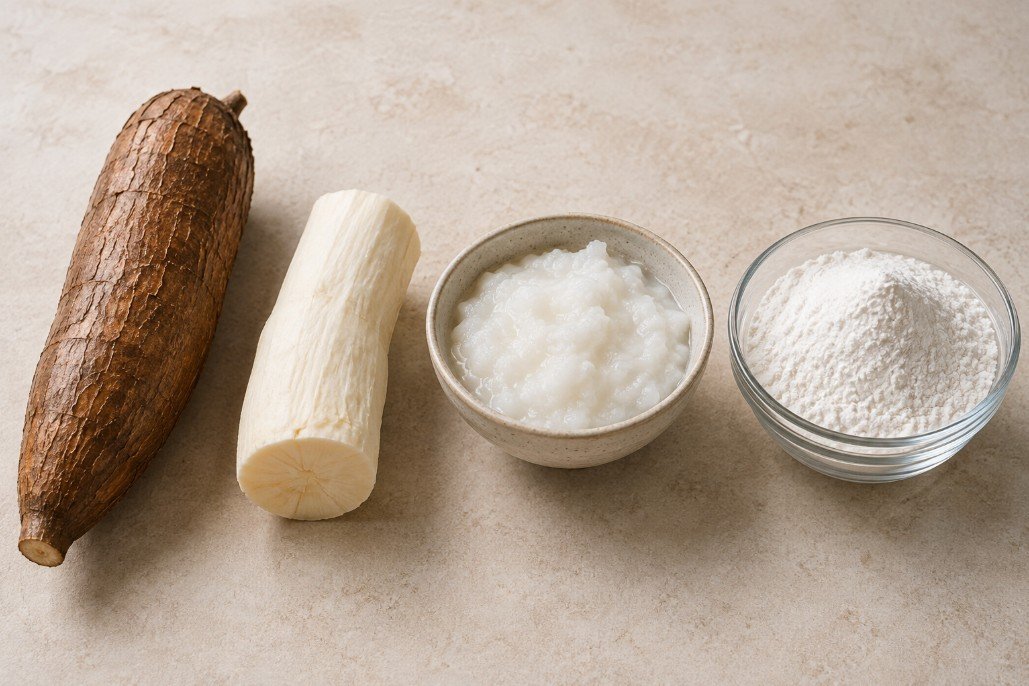
Cassava and tapioca are closely related words, but they do not describe the same ingredient. Cassava is the plant root. Tapioca starch is the purified starch separated from that root and dried into a fine powder.
How starch is separated
In broad terms, cassava roots are cleaned, peeled and reduced to a wet pulp. Water helps release starch granules from the plant tissue. The fibrous material is separated, while the starch-rich liquid is allowed to settle or is processed mechanically. The collected starch is then dewatered and dried.
The resulting powder is mostly starch rather than ground whole root. That purity is useful for pearls because starch can form a smooth, cohesive gel when heated with water. Whole cassava flour behaves differently because it retains more fiber and other root components.
Tapioca starch and cassava flour are not interchangeable
Labels can be confusing because “tapioca flour” is commonly used as another name for tapioca starch in retail baking. By contrast, a product specifically sold as cassava flour is generally made from more of the whole root. For boba pearls, recipes usually call for tapioca starch or tapioca flour in the starch sense—not ordinary whole-root cassava flour.
Substituting a different flour can change hydration, smoothness and elasticity. The dough may crack, become grainy or fail to develop the familiar translucent chew. When making pearls at home, the product name and ingredient statement matter more than the word “flour” by itself.
Heat and Water Turn Powder into a Chewy Pearl
Tapioca starch begins as a dry powder. The bouncy texture appears only after water, heat, shaping and cooking change how the starch granules hold moisture and connect with one another.
Heat the liquid
Hot water or hot sugar syrup starts hydrating the starch. If the liquid is too cool, the mixture can remain dusty and refuse to bind. If the ratio is uncontrolled, the dough may become either crumbly or excessively sticky.
Start the starch paste
Many methods first combine a small portion of starch with hot liquid. This creates a sticky paste that acts as a binder for the remaining dry starch. The approach is different from developing gluten in wheat dough.
Build a workable dough
More starch is incorporated until the dough can be handled without flowing. It needs enough moisture to roll without cracking but enough dry matter to keep its shape.
Shape and dust
The dough is rolled into ropes, cut and rounded into small pieces. A light starch coating prevents the uncooked pearls from sticking together. Commercial factories use equipment to create consistent size and speed.
Boil and rest
Boiling water cooks the outer layer first and gradually heats the center. Many pearl methods include both active simmering and a covered resting period so the interior can finish hydrating without the surface breaking apart.
Rinse or drain
Excess surface starch is removed according to the recipe. This reduces unwanted cloudiness and prevents the pearls from forming one solid sticky mass.
Soak in syrup
Cooked pearls are commonly mixed with brown sugar, black sugar, honey or plain sugar syrup. The syrup adds flavor and keeps the surface moist during the service window.
Serve while fresh
The ideal texture does not remain unchanged all day. Time, cooling and moisture movement make pearls firmer, softer or stickier, depending on the product and holding conditions.
Why tapioca becomes elastic
When tapioca starch is heated in water, the organized structure of the starch granules breaks down, the granules absorb water and the mixture thickens. As the cooked starch cools, it forms a gel-like network. In a pearl, that transformation creates a soft exterior and a resilient center rather than the crumb of bread or the snap of candy.
Why cooking instructions differ
Fresh pearls, dried traditional pearls, frozen pearls and quick-cook pearls are processed differently before they reach the kitchen. Their size, moisture content and degree of precooking change how much boiling and resting they need. A universal cooking time would be misleading, so package instructions should take priority.
Tapioca Starch Is Pale, So Black Pearls Get Their Color from the Recipe
Freshly extracted tapioca starch is white or off-white. The deep brown or black color associated with classic boba comes from added sugar, coloring or a combination of ingredients—not from naturally black cassava.
Brown or black sugar
Dark sugar can color the dough and create caramel, molasses or toasted notes. The final shade depends on the type of sugar, its concentration and how much is actually mixed into the pearl rather than added later as syrup.
Caramel color
Some commercial black pearls use caramel coloring to keep appearance consistent from batch to batch. A very dark pearl therefore does not prove that a large amount of brown sugar is present.
Specialty colors
Golden, white, green, fruit-colored and pastel pearls may use different sugars, flavors or colors. Color can help identify a product style, but it does not reliably reveal the full ingredient list.
Fresh, Dried, Frozen and Quick-Cook Pearls Use Different Processing
The phrase “tapioca pearl” covers several product formats. They can share a tapioca base while differing in moisture, additives, cooking time, storage and final texture.
| Pearl format | Before cooking | Typical preparation | Texture potential | Main advantage | Main trade-off |
|---|---|---|---|---|---|
| Fresh handmade | Moist dough | Cook soon after shaping | Very soft and elastic when handled well | Ingredient control and fresh texture | Labor and short storage |
| Traditional dried | Hard, dry spheres | Longer boiling and resting | Dense classic chew | Stable storage | More time and water |
| Quick-cook | Processed dry or semi-finished pearls | Short boiling cycle | Consistent, often softer | Fast service | May use a more complex formula |
| Frozen raw | Moist pearls held frozen | Cook from frozen or thaw as directed | Can resemble fresh pearls | Convenience with fresh-style chew | Requires freezer storage |
| Instant or microwave | Precooked and packaged | Reheat briefly | Soft, convenient, product dependent | Minimal equipment | Less control over texture and sweetness |
A short ingredient list is not automatically proof of the best pearl, and a longer list is not automatically proof of poor quality. Freshness, cooking accuracy, pearl size, holding temperature and syrup balance can matter as much as the package formula. The useful question is whether the product fits the intended service: immediate home use, high-volume shop service, frozen storage or a quick single drink.
The Pearls Are Only One Part of a Complete Boba Drink
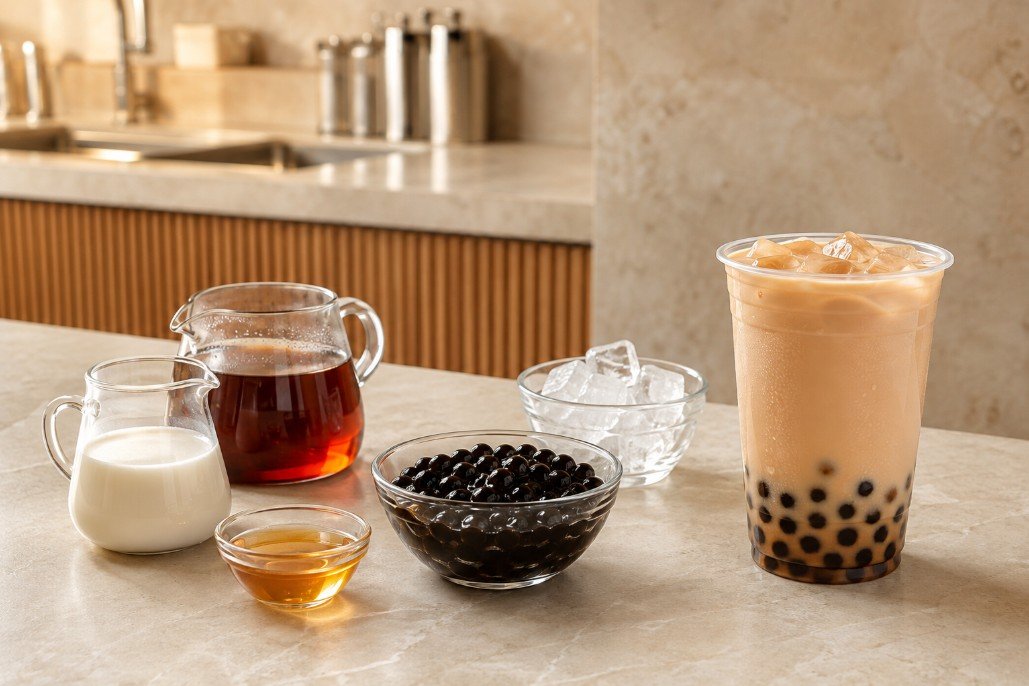
A finished cup can be understood as a set of layers: the main liquid, tea or another flavor base, a milk or fruit component, sweetness, temperature and texture. Each layer can introduce its own ingredients and allergens.
Liquid base
The main liquid may be brewed black, green, jasmine or oolong tea. It can also be milk, coffee, a fruit mixture, sparkling water, yogurt-style drink or a blended frozen base. This first decision controls much of the body and caffeine.
Milk, creamer or fruit component
Milk tea may use fresh dairy milk, evaporated milk, condensed milk, milk powder, plant milk or powdered creamer. Fruit drinks may use juice, puree, jam, concentrate, syrup or powder. Similar menu names can therefore hide very different formulas.
Flavor and sweetener
Brown sugar, fructose syrup, cane sugar, honey, flavored syrup, sweetened puree and powdered mixes can all contribute sweetness. Some flavors are already sweet before the shop adds adjustable syrup.
Ice and water
Ice affects dilution and temperature. Tea concentrates may be balanced with water and ice, while slushes rely on ice for structure. Ordering less ice does not always mean receiving the same recipe with more tea.
Topping or foam
Tapioca, jelly, pudding, aloe, red bean, sago, cheese foam and popping boba all add different ingredients. A dairy-free tea can become a dairy-containing order when pudding or foam is added.
| Drink family | Typical base | Common additions | Ingredients that often need checking |
|---|---|---|---|
| Milk tea | Brewed tea | Milk, creamer, sugar, pearls | Dairy proteins, creamer formula, presweetened powder |
| Fruit tea | Tea or water | Juice, puree, jam, syrup, jelly | Added sugar, artificial color, tea content |
| Fresh milk drink | Dairy or plant milk | Brown sugar, matcha, taro, pearls | Whether tea is present, milk type, fixed syrup |
| Slush or smoothie | Ice and flavor mixture | Fruit, powder, milk, syrup | Dairy, premix ingredients, fruit content |
| Coffee boba | Coffee | Milk, cream, sweetener, pearls | Caffeine, dairy, coffee concentrate |
| Yogurt-style drink | Cultured dairy or flavored base | Fruit, tea, syrup, crystal boba | Actual dairy content and acidity |
The broader ingredient system is mapped in the boba ingredients guide.
Milk Tea May Use Fresh Milk, Powder or Creamer
The words “milk tea” describe the finished style, not one universal milk ingredient. Two drinks with the same name can have different dairy content, richness and allergen information.
Fresh dairy milk
Whole milk, reduced-fat milk or another dairy milk produces a recognizable creamy body. Some shops brew strong tea specifically to balance fresh milk. Lactose-free dairy milk is still dairy and may still contain milk proteins.
Plant-based milk
Oat, soy, almond and coconut beverages can replace dairy in some recipes. Availability, added sugar and allergen risks vary. A plant milk substitution does not automatically make pudding, foam or pearls vegan.
Powdered creamer
Creamer is common because it creates a stable, rich texture and works well with strong tea. The term “non-dairy creamer” can be misleading for allergy purposes because some products contain milk-derived caseinate even when they contain little or no lactose.
Milk powder and condensed milk
Milk powder adds body without as much liquid, while condensed milk adds both dairy and concentrated sweetness. These ingredients can make the drink sweeter than the adjustable sugar setting suggests.
Fruit Tea Can Use Fresh Fruit, Puree, Jam, Juice, Syrup or Powder
A fruit name on the menu tells you the intended flavor, not necessarily the exact form of fruit used. Shops choose ingredients according to season, speed, consistency, cost and the texture they want.
Fresh fruit
Fresh pieces, squeezed citrus or blended fruit can provide natural aroma and pulp. The flavor may vary with ripeness and season, and the drink often has a shorter holding time.
Puree
Puree offers concentrated fruit body and a more consistent texture. It may be unsweetened or sweetened, so the word “puree” alone does not reveal the sugar level.
Fruit jam
Tea-shop jam commonly combines fruit pieces, sugar and a thickened syrup. It provides visible fruit texture and strong flavor but can add substantial fixed sweetness.
Juice or concentrate
Juice creates a lighter drink than puree. Concentrate can be diluted for consistent service. Both can be mixed with tea, water or sparkling water.
Flavored syrup
Syrup is fast and reliable and may contain natural flavor, artificial flavor or both. It creates a clear, bright drink but may provide little whole fruit.
Powdered mix
Powder can combine flavor, color, sugar and acidity in one ingredient. It is especially common in blended drinks, but formulas differ widely.
A mango green tea made with fresh puree can taste thick and pulpy, while a mango jasmine tea made with syrup may be clear and candy-bright. Neither description can be assumed from the color alone. A useful shop will be able to tell you whether the fruit component is fresh fruit, puree, jam, juice, syrup or a prepared mix.
Prepared Powders and Pastes Can Combine Several Ingredients at Once
Taro, matcha, chocolate, milk tea and yogurt-style flavors may come from a whole ingredient, a prepared blend or a mixture of both. The menu name alone rarely tells the complete story.
| Menu flavor | Whole-ingredient approach | Prepared approach | Why the result differs |
|---|---|---|---|
| Taro | Cooked taro root or taro paste | Sweetened powder with flavor and color | Real taro is earthy and starchy; powder can be sweeter and more aromatic |
| Matcha | Pure ground green tea powder | Matcha latte mix with sugar or milk solids | Caffeine, sweetness and tea intensity change |
| Mango | Fresh mango or puree | Syrup, powder or jam | Pulp, acidity and fixed sugar vary |
| Classic milk tea | Freshly brewed tea plus milk | Tea concentrate or all-in-one powder | Aroma, dairy content and sweetness control vary |
| Chocolate | Cocoa or melted chocolate | Sweetened cocoa beverage powder | Cocoa intensity, milk solids and sugar vary |
| Yogurt | Cultured dairy or yogurt drink | Acidified flavored base | Live cultures, dairy content and texture may differ |
Prepared ingredients are not automatically inferior. They can provide consistency, food safety, speed and a flavor customers expect. The important issue is transparency. Someone managing dairy, caffeine, sugar or a specific allergy needs the actual product information, not a guess based on whether the drink looks “natural.”
Not Every Topping Called “Boba” Is Made from Tapioca
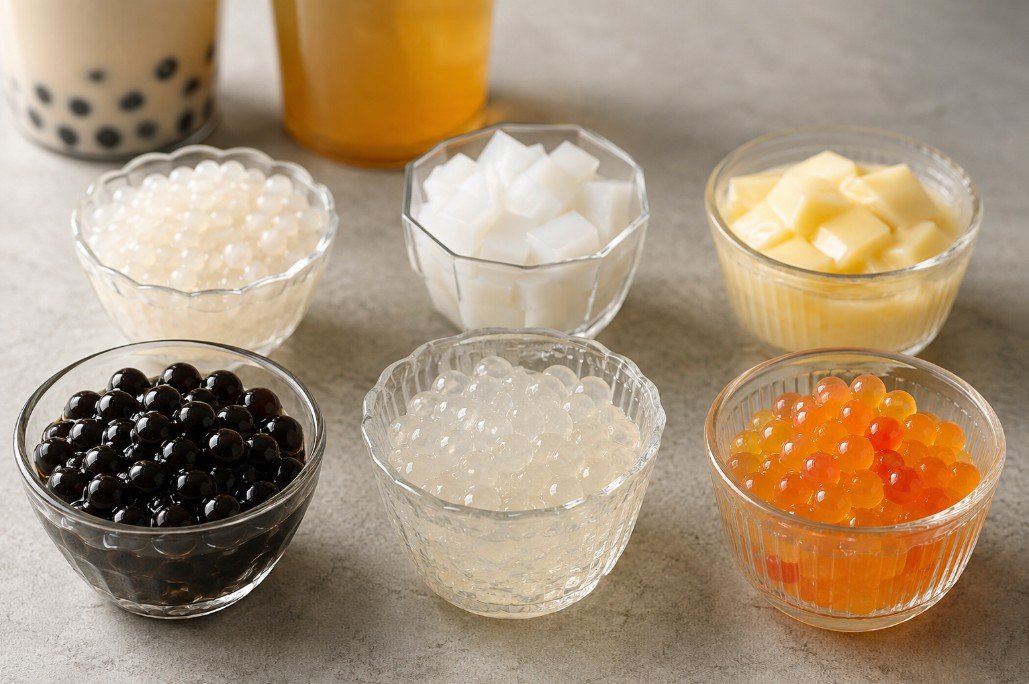
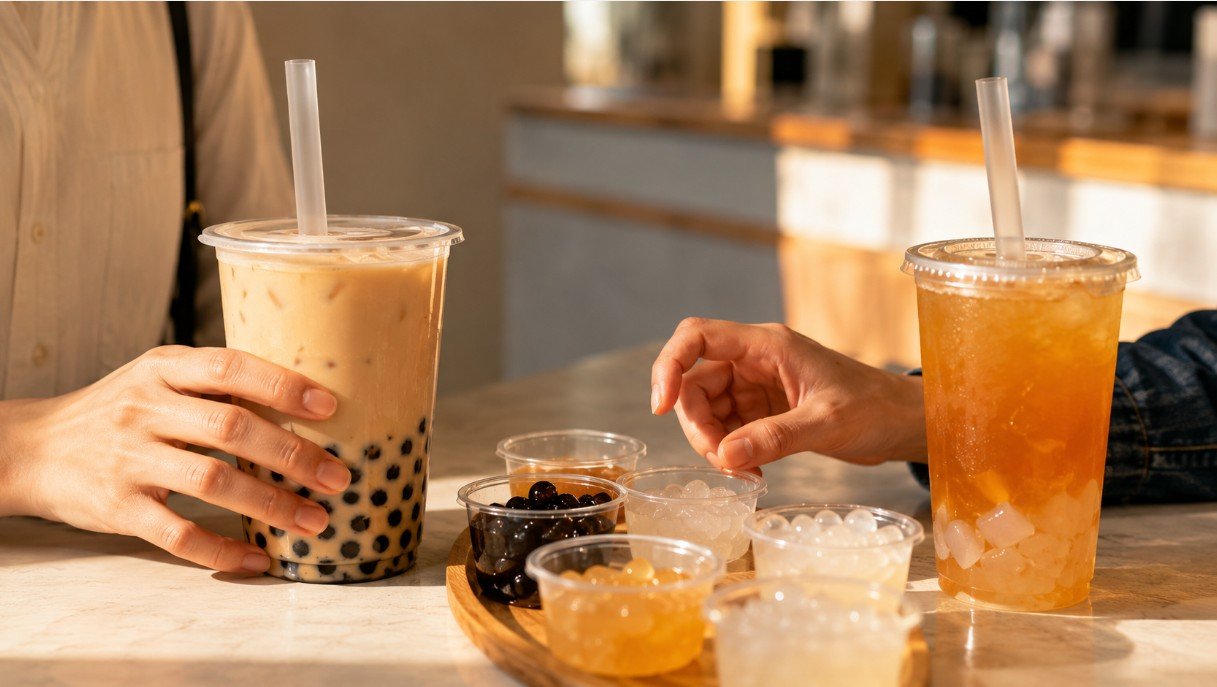
Modern menus use the word loosely. Traditional black pearls, crystal boba, popping boba, sago, jelly and pudding can all appear in the same topping list while using completely different ingredients and production methods.
Black tapioca pearls
Primarily tapioca starch, water and recipe-specific sweetener or color. The defining sensation is a dense, elastic chew.
Crystal boba
Often made from konjac or other gelling ingredients rather than traditional tapioca dough. It is usually translucent and more delicate or jelly-like.
Popping boba
A flavored liquid is enclosed in a thin gel membrane. Common commercial formulas use water, sugar, flavor, an alginate-type gelling ingredient and a calcium source. It bursts instead of chewing like starch.
Sago
True sago comes from sago palm starch, although some products sold in everyday commerce use tapioca. The small beads are softer and less substantial than standard black boba.
Coconut jelly
Depending on the product, this can use coconut-derived ingredients, nata de coco or another gel base. It is cut into cubes or strips and has a crisp, slippery bite.
Grass jelly
Traditionally made by cooking a herbal plant material into a dark gel, often with starch or another setting aid. It has a mild herbal character rather than tapioca chew.
Pudding
A soft custard-style topping that may contain milk, egg, sugar and setting ingredients. Commercial pudding mixes can use a different formula, so dairy and egg should be verified.
Taro balls
Often made with taro or sweet potato plus starch. Their dense chew can resemble boba, but the root vegetable contributes color and flavor.
For a broader comparison by texture and drink pairing, visit the boba toppings guide.
Dietary Answers Depend on the Exact Pearl and the Complete Cup
Plain tapioca starch is simple, but packaged pearls, syrups, powders, creamers, foams and toppings can change whether an order suits a particular diet. The safest approach is to check each component separately.
Is boba gluten-free?
Tapioca starch is naturally gluten-free. A basic pearl made from tapioca starch, water and sugar can therefore be gluten-free by ingredients. That does not guarantee every commercial pearl or tea-shop order is safe for someone with celiac disease. Added starch blends, flavored powders, shared utensils, manufacturing lines and other toppings can introduce uncertainty.
Look for a product statement or certification when strict avoidance is required. At a shop, ask about both the pearl package and cross-contact during preparation.
Is boba vegan?
Traditional pearls do not require animal ingredients. Tapioca starch, water and sugar can create a plant-based pearl. Variations may use honey, milk-derived flavor, confectionery glaze or another additive, while the surrounding drink may contain dairy, condensed milk, pudding or cheese foam.
Sugar processing practices can also matter to some vegans. A shop can confirm the listed ingredients, but it may not know every upstream processing detail unless the supplier provides it.
Does boba contain gelatin?
Gelatin is not needed to make traditional tapioca pearls chewy. Starch creates the texture. However, gelatin may appear in a pudding, jelly or specialty topping, and the recipe can vary by supplier. Popping boba generally relies on a different gel system rather than a tapioca dough.
Do not use the round shape as evidence. Ask about the named topping, because tapioca, popping boba and jelly are separate products.
Does boba contain dairy?
Plain tapioca pearls commonly contain no dairy, but the answer is product specific. Milk tea, pudding, foam, milk powder and some creamers can introduce dairy. Even a fruit tea can receive dairy from an added foam or pudding topping.
The label “non-dairy creamer” is not sufficient for a milk allergy. Some creamers contain a milk-derived protein such as sodium caseinate.
For ingredient checks across multiple diets and allergies, use the boba dietary guide.
The Pearls Usually Provide Starch and Sugar, While the Base Controls Caffeine
Nutrition questions become clearer when the topping and the liquid are separated. Tapioca pearls are mainly a carbohydrate-rich topping. Tea, coffee, milk, fruit bases and foam supply different nutrients and caffeine.
Caffeine
Traditional pearls do not normally contain tea or coffee, so they are not the main caffeine source. Black tea, green tea, oolong, matcha and coffee can add caffeine. Fresh milk and many fruit bases can be caffeine-free, but a fruit tea may still use a caffeinated tea infusion.
Sugar
Sugar may appear in the pearl dough, soaking syrup, drink syrup, fruit jam, flavored powder, condensed milk, foam and popping boba. Reducing one syrup does not remove sugar from ingredients that were prepared in advance.
Calories
There is no single calorie count for “boba.” Portion size, pearl amount, cup size, milk, creamer, fruit mixture and toppings all matter. A lightly sweetened tea with one topping differs greatly from a large brown-sugar milk drink with foam and pudding.
See how cup size, sweetness and toppings affect the full order in the boba nutrition guide.
Packaged Pearls Can Contain More Than Tapioca, Water and Sugar
An ingredient label shows how a specific product achieves color, shelf life and fast preparation. It should be read as that product’s formula, not as the universal definition of boba.
Example label pattern
Tapioca starch, water, sugar, modified starch, caramel color, thickener, preservative.
This is an illustrative pattern, not a copied brand label.What to check before buying pearls
Product format: dried, quick-cook, frozen or instant.
Cooking instructions: boiling time, resting time and water ratio.
Sweetness: whether sugar is already in the pearl or included as a syrup packet.
Color and flavor: what produces black, golden or specialty appearance.
Allergens and dietary claims: use the label, not assumptions about tapioca.
Storage: unopened package requirements and instructions after opening.
Cooked Pearls Are a Fresh Product Even When the Dry Package Is Shelf-Stable
Dry pearls can keep for months according to their package, but cooking changes the starch and introduces water. The finished topping has a much shorter window in which it remains soft, separate and pleasantly elastic.
Warm, glossy and highly elastic
The pearls have just finished cooking and soaking. The outer layer is soft, the center has resistance and the syrup coats the surface evenly.
Balanced chew
Well-held pearls remain springy and separate. This is the ideal time for most tea-shop service and home drinks.
Texture begins to drift
Depending on the formula and temperature, pearls may become firmer, stickier or softer. Syrup can continue moving into the pearl while the surface loses freshness.
Cold starch becomes firm
Standard cooked tapioca often hardens in the refrigerator. Returning it to a drink does not always restore the original elastic structure.
Usually no longer shop-quality
The topping may be edible if handled safely, but texture is commonly far from fresh boba. Follow the product or recipe guidance rather than assuming all pearls can be stored the same way.
Why syrup does not preserve ideal texture indefinitely
Syrup keeps the surface moist and adds flavor, but it cannot freeze the starch structure in time. Water continues to move, temperature changes the gel and the pearl keeps aging after cooking.
Why delivery can disappoint
Warm pearls placed in an iced drink cool during travel. Long delivery time can produce a firm center, while a hot car can melt ice and dilute the tea. Ordering pearls separately can help only when the shop is set up to package them properly.
A Home Pearl Recipe Can Be Simple, While Commercial Pearls Solve Different Problems
Home cooks often prioritize ingredient control and fresh texture. Shops and manufacturers also need speed, storage, batch consistency and predictable performance during a busy service period.
Homemade pearls
- Can use only tapioca starch, water and sugar
- Allow custom size, flavor and sweetness
- Require careful handling while the dough is warm
- Can vary from batch to batch
- Are usually cooked and eaten the same day
Commercial pearls
- May include processing aids for consistency
- Must survive packing, shipping and storage
- Can be designed for long or short cooking cycles
- Need repeatable size and service performance
- Still have a limited quality window after cooking
The most useful comparison is not “natural versus artificial” as a slogan. It is whether the ingredient list, preparation method and storage format match the buyer’s needs. A restaurant serving hundreds of cups needs consistency. A home cook making two drinks may prefer a small fresh batch. Both approaches can produce enjoyable pearls when the product is handled correctly.
Ask About the Base, Milk, Sweetener and Topping Separately
A broad question such as “What is in this boba?” can be difficult for staff to answer because the cup contains several prepared components. Specific questions are faster and more accurate.
About the base
“Is this made with brewed tea, tea concentrate, milk or a fruit base?”
About caffeine
“Does this drink contain black tea, green tea, matcha or coffee?”
About milk
“Does the original recipe use dairy milk, milk powder or a creamer with milk protein?”
About fruit
“Is the mango component fresh fruit, puree, jam, juice, syrup or powder?”
About sweetness
“Which parts are presweetened even if I choose zero added syrup?”
About the pearl
“Are the pearls already soaked in brown sugar or honey syrup?”
About toppings
“Does the pudding, jelly or foam contain dairy, egg or gelatin?”
About allergens
“Can I see the supplier ingredient or allergen information for this component?”
Common Assumptions About Boba Ingredients Are Often Wrong
The category is too diverse for ingredient claims based only on color, texture or a menu name. These distinctions prevent the most common mistakes.
Black pearls are naturally black
They are not. Tapioca starch is pale. Dark sugar, caramel color or another recipe ingredient creates the black or deep brown appearance.
Every boba drink contains tea
Fresh milk drinks, coffee, smoothies and some fruit drinks may contain no brewed tea. The shop category is broader than tea alone.
Every fruit tea uses fresh fruit
Fruit flavor can come from juice, puree, jam, concentrate, syrup or powder. Ask when the ingredient form matters.
Non-dairy creamer is safe for a milk allergy
Not necessarily. Some products contain milk-derived caseinate. Only the ingredient and allergen information can answer the question.
Popping boba is tapioca
It is normally a liquid-filled gel sphere, not a cooked tapioca-starch dough. The texture and formula are completely different.
Zero percent sugar means no sugar
It often means no adjustable syrup. Pearls, fruit jam, powder, condensed milk or foam may already contain sugar.
Taro drinks always contain real taro
Some do; others use a flavored powder or a mixture. Purple color alone does not prove the use or amount of real root.
All tapioca pearls have the same ingredients
They share a tapioca-starch foundation, but sweeteners, colors, starch blends and processing aids vary by product.
Where the Ingredient Guidance Comes From
This guide combines food-science research, government labeling guidance and Taiwanese material about starch pearls. Product formulas still vary, so a package label or supplier specification takes priority for a specific brand.
Cassava and starch processing
The Food and Agriculture Organization explains how starch is separated and purified from cassava root before further processing.
Read the FAO processing guideWhy heat changes tapioca starch
Peer-reviewed research describes the structural changes and viscosity increase that occur during tapioca-starch gelatinization.
Read the gelatinization studyHow ingredient lists are ordered
The U.S. Food and Drug Administration states that packaged-food ingredients are listed from greatest to least amount by weight.
Read the FDA ingredient guideTaiwanese starch-label detail
Taiwanese rules require starch products to identify the actual starch source, such as tapioca or potato starch, rather than using only a generic starch name.
Read the Taiwan FDA ruleQuestions About Boba Ingredients
The answers below separate traditional tapioca pearls from the rest of the drink so each ingredient question has a clear scope.
What is traditional boba made of?
Traditional chewy boba pearls are made mainly from tapioca starch extracted from cassava root and water. Sugar, coloring, flavoring or additional starches may be used depending on the recipe. After cooking, the pearls are commonly soaked in sweet syrup.
Is boba made from cassava?
Yes. Tapioca starch comes from cassava root. The root is processed so the starch can be separated, purified and dried. Pearls are made from that starch rather than from pieces of whole raw cassava.
Is tapioca starch the same as cassava flour?
No. Tapioca starch is the purified starch fraction of cassava. Whole-root cassava flour retains more fiber and other plant material. Retail packages may call tapioca starch “tapioca flour,” but a product labeled cassava flour generally behaves differently in pearl dough.
Why are boba pearls black?
Tapioca starch is naturally pale. Black or dark brown pearls receive their color from brown sugar, black sugar, caramel coloring or another added color. A dark pearl does not automatically contain a large amount of brown sugar.
Does boba contain gelatin?
Traditional tapioca pearls do not need gelatin because cooked starch creates the chewy texture. Pudding, jelly and specialty toppings may have different formulas, so those products should be checked separately.
Is boba gluten-free?
Plain tapioca starch is naturally gluten-free, and a simple tapioca pearl can be gluten-free by ingredients. Commercial additives, shared equipment and cross-contact vary, so people who require strict avoidance should verify the specific product and shop practices.
Is boba vegan?
A basic pearl made from tapioca starch, water and sugar can be vegan. Some recipes or syrups may use honey or other ingredients, and the full drink can contain dairy, pudding or foam. The specific product should be checked.
Does boba contain dairy?
Traditional plain tapioca pearls often contain no dairy, but formulas vary. Milk tea, creamer, pudding, foam and milk powder can add dairy to the complete order. “Non-dairy creamer” may still contain milk-derived protein.
Does boba contain caffeine?
The tapioca pearls usually do not provide caffeine. Caffeine normally comes from black tea, green tea, oolong, matcha or coffee in the drink base. A fresh milk or tea-free fruit drink may be caffeine-free, but the recipe should be confirmed.
What is popping boba made of?
Popping boba is generally made from a flavored sweet liquid enclosed in a thin gel membrane. Commercial formulas commonly include water, sugar, flavor, an alginate-type gelling ingredient and a calcium source. It is not a traditional tapioca pearl.
Why does boba become hard in the refrigerator?
Cooling changes the structure of cooked starch and makes standard tapioca pearls firmer and less elastic. Syrup can keep the surface moist, but it does not fully prevent the texture from changing. Freshly cooked pearls are usually best within the same service window.
Does zero-sugar boba still contain sugar?
It can. A zero-percent setting often removes adjustable drink syrup, while tapioca pearls, brown sugar coating, fruit jam, powder, condensed milk, popping boba or foam may remain sweetened. Ask which components are presweetened.