
What Does Boba Mean? The Drink, the Pearls and the Word Explained
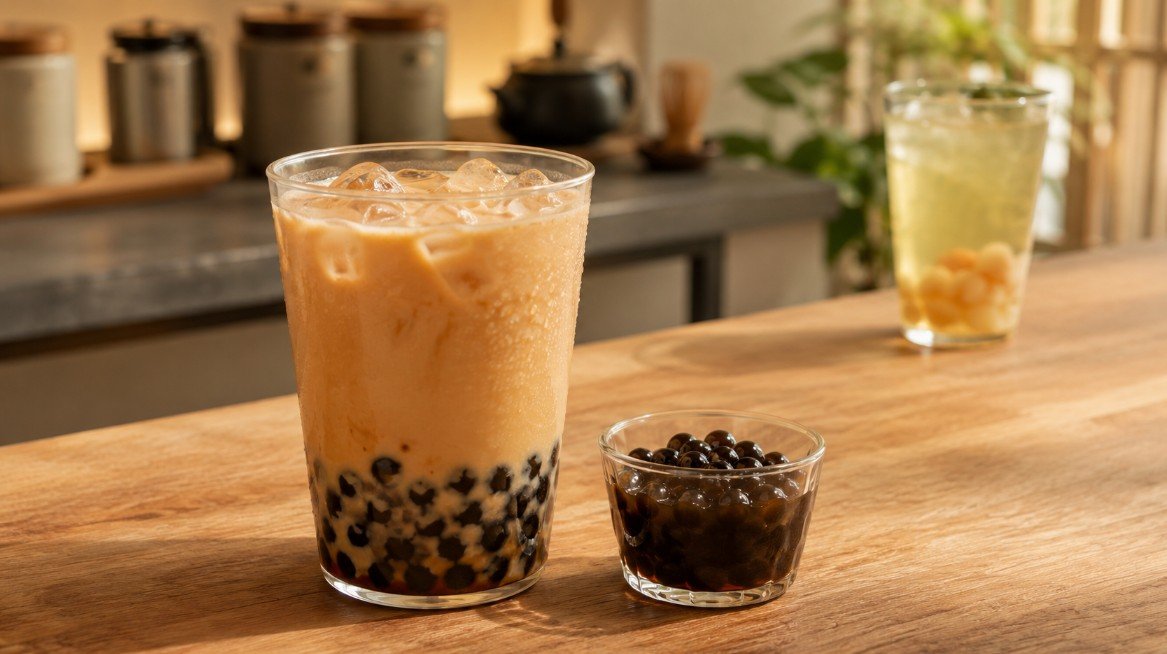
“Boba” most commonly means either bubble tea or the chewy pearls added to it. The meaning changes with context. If someone says, “Let’s get boba,” they almost certainly mean drinks. If they say, “Add boba,” they are usually asking for pearls. And if they talk about a “boba shop,” the word describes the type of business rather than one ingredient.
That flexibility is why the word can seem confusing when you first encounter it. Boba is not limited to one strict dictionary-style object. It works as shorthand for a drink category, a familiar topping and, increasingly, the culture and businesses built around those drinks.
You do not need to memorize a complicated vocabulary system. Learn a few context clues and the meaning becomes easy to recognize: drink language points toward the beverage; topping language points toward the pearls.
Boba can describe the drink, the topping or the wider category around them
The easiest way to understand the word is to stop looking for one definition that replaces every other definition. In everyday English, boba does several related jobs.
“I ordered a boba.”
Here the word points toward a prepared beverage: milk tea, fruit tea, fresh milk or another drink sold within the modern bubble tea category.
“Can I add boba?”
Here boba usually means the pearls added to a drink, most often the classic chewy tapioca topping when no other modifier is given.
“There’s a new boba shop nearby.”
The word describes a type of beverage business or food-and-drink category. The shop may sell dozens of drinks, including many that do not contain traditional tapioca pearls.
These meanings are connected rather than random. The pearls became one of the most recognizable elements of the drink, while the drink itself grew into a recognizable category. The same short word now moves between those levels depending on the sentence.
For a complete definition of the beverage itself, rather than the word’s usage, start with what boba is.
You can usually tell what “boba” means from the words around it
English speakers rarely stop to define boba before using it. Instead, verbs, adjectives and the rest of the sentence reveal the intended meaning.
The verb “get” and the social context suggest going for drinks, not purchasing loose pearls as an ingredient.
Something is being added to a drink, so boba refers to a topping rather than the full beverage.
Hardness is a texture judgment that makes sense for cooked pearls. It would be unusual as a description of the drink category itself.
Sweetness often describes the whole beverage, although a very sweet pearl syrup could make the sentence ambiguous without more context.
The word identifies the kind of place, much as “coffee shop” identifies a beverage business rather than one coffee bean.
The practical lesson is simple: do not isolate the word from its sentence. “Boba” becomes far less confusing once you pay attention to what the speaker is doing with it.
When people say “boba,” they often mean bubble tea
In everyday conversation, boba commonly functions as a shorter name for bubble tea or boba tea. That is why phrases such as “get boba,” “boba place,” “boba run” and “boba drink” are easy to understand even when nobody mentions tapioca pearls.
The category itself is broad. A person going out for boba might order classic black milk tea with tapioca, jasmine fruit tea with aloe, matcha fresh milk, a tea with jelly or another customized drink. The word identifies the style of beverage experience, not one mandatory recipe.
Invitation to get a drink.
Boba refers to a preferred drink within the category.
Boba describes the type of shop, while oolong describes a tea choice inside it.
This is also why saying that boba “only means tapioca pearls” is too restrictive for modern English. The topping meaning is genuine, but the beverage meaning is equally important in ordinary speech.
If you want the detailed distinction between the two category names, see boba vs bubble tea.
When boba appears inside an order, it often means the pearls
At topping level, boba most often points toward the familiar chewy pearls served in bubble tea. Traditional black boba pearls are typically tapioca-based, which is why “boba,” “boba pearls,” “black boba” and “tapioca pearls” can overlap in a classic ordering context.
This use becomes especially clear after verbs and modifiers such as add, extra, remove or double.
Put pearls into the drink.
Increase the portion of pearls.
Keep the drink but leave out the pearls, depending on the shop’s terminology.
Judge the texture of the pearls rather than the liquid beverage.
But even here, precision matters. Modern menus may also use terms such as popping boba or crystal boba for toppings that are not identical to classic black tapioca pearls. So “boba” can act as a broad topping word as well as the familiar short name for traditional pearls.
Our boba vs tapioca pearls comparison focuses specifically on that distinction.
A signature topping became shorthand for a whole drink experience
There is a useful way to think about how the meanings relate without pretending that language evolved according to a neat diagram. Traditional pearls became one of the most recognizable visual and textural features of pearl milk tea. As the drinks spread and diversified, the short word associated with that signature feature also became convenient shorthand for the drinks and the places selling them.
The recognizable chewy component.
A shorthand name for the beverage.
A wider label around the beverage experience.
The result is a word that can zoom in or out. In one sentence, it points to a handful of pearls at the bottom of a cup. In another, it describes an entire trip to a tea shop.
This kind of semantic expansion is not unusual in food language, but you do not need a linguistics lesson to use it correctly. The surrounding sentence normally supplies all the information you need.
The word alone does not guarantee one recipe, one topping or even one texture
Because boba has become a broad category word, it is risky to infer too much from the label by itself.
Boba menus can include fruit tea, tea-forward drinks, fresh-milk drinks and other formats.
A drink can contain another topping or no traditional pearls at all.
“Boba” does not tell you whether a drink will taste roasted, fruity, floral, earthy or dessert-like.
Classic tapioca is chewy, while jelly, pudding, aloe and popping toppings create very different mouthfeel.
The category can range from restrained brewed tea to rich brown-sugar drinks.
The word identifies a family of experiences more reliably than it identifies a formula. Once you want to know what will actually be in the cup, the drink name and topping choices matter more than the category label.
The major beverage styles are broken down separately in our guide to boba drinks.
Different questions about boba are often asking about completely different things
This is useful when reading menus, reviews or search results. Two people can type the word boba while looking for very different information.
The person probably wants a flavor or beverage recommendation, such as jasmine milk tea, roasted oolong or passion fruit green tea.
The question is about cooking, freshness or texture because hardness describes the physical topping.
The person is looking for a place serving the beverage category rather than an ingredient supplier.
The answer depends on the beverage base because tapioca pearls themselves are not what determines the tea’s caffeine level.
The speaker may mean the pearls or the entire beverage. A precise answer should identify which level is being discussed rather than silently assuming one.
Recognizing this distinction is useful beyond vocabulary. It prevents questions about the pearls from being answered with a recipe for the drink, and questions about the beverage from being reduced to tapioca starch alone.
Boba tea is another name for bubble tea, not a separate required recipe
Adding the word tea can make the beverage meaning clearer, especially for someone who has never heard boba used as a standalone noun. In normal English, boba tea is widely understood as another name for bubble tea.
That does not mean every drink sold under the boba tea umbrella must contain classic tapioca. Modern shops frequently let customers choose between several toppings or skip them entirely.
The phrase is therefore useful as a category label, not as a strict ingredient list.
“Boba” has a Chinese-language slang history, but the modern English meaning is broader
The English food word did not begin as a technical term for tapioca starch. Its naming history is associated with Chinese-language colloquial usage and the name applied to large round pearls.
That origin is sometimes retold online in a sensational way because the earlier slang carried an adult body-related association. For a practical food guide, the useful point is simply that the name came through colloquial language rather than through the scientific name for the ingredient.
As bubble tea spread internationally, English usage made boba a familiar food and beverage word. Today, when someone says “boba shop,” there is normally no reason to read the older slang meaning into the sentence. The modern context is the drink culture.
The naming history deserves more detail than is useful here. For that subject specifically, continue to why it is called boba.
You will hear “boba” used as a topping noun, modifier and shorthand category name
You do not need to worry much about whether boba is singular or plural in casual speech. English speakers use it flexibly, and the construction usually tells you what is being counted — if anything.
“Add some boba.”
The speaker treats the pearls as a portion, similar to saying “add some jelly.” They are not counting every individual sphere.
“I’m getting boba.”
The word stands for the beverage experience rather than counting individual pearls.
“Boba shop,” “boba drink,” “boba menu.”
The word tells you what kind of shop, drink or menu is being discussed.
“Boba pearls.”
The extra noun makes the topping meaning explicit and reduces confusion with boba as the overall drink.
Normal usage matters more than forcing the term into one rigid grammatical box. The reader’s task is simply to notice whether the sentence is talking about drinking, ordering, adding a topping or describing a business.
If you are unsure, look for the action around the word
“Get boba,” “drink boba,” “boba shop” and “boba place” normally point beyond the individual pearls.
These words usually interact with the physical pearls inside the cup.
There will always be sentences where context is slightly ambiguous. That is normal. If exact ingredients matter, especially when ordering, use the specific topping name shown on the menu rather than relying on the broadest possible meaning of boba.
One word, three connected levels
Bubble tea / boba tea beverage.
Pearls added to the drink.
The wider beverage business or culture.
Questions about what boba means
What does boba mean?
Boba most commonly means either bubble tea itself or the pearls added as a topping. It can also describe the broader drink category, as in “boba shop.” The surrounding sentence usually tells you which meaning is intended.
Does boba mean bubble tea?
Yes. In ordinary English, boba is commonly used as a shorter name for bubble tea. Phrases such as “get boba” or “boba shop” normally refer to drinks and the beverage category.
Does boba mean tapioca pearls?
It can. In topping context, boba often means traditional chewy tapioca pearls. But the word is broader than tapioca alone because it can also mean the drink and appears in names for other toppings such as popping boba.
Why does boba have more than one meaning?
The pearls became a signature part of the drink, and the short name associated with them also became convenient shorthand for the beverage and the businesses serving it. Modern usage therefore operates at both topping and category level.
What does “get boba” mean?
It normally means to go buy or drink bubble tea. It does not usually mean purchasing tapioca pearls by themselves.
What does “add boba” mean?
It usually means add the shop’s standard pearl topping to a drink. If several boba types are available, the menu may require you to specify black tapioca, popping boba or another option.
What is a boba shop?
A boba shop is a business specializing in bubble tea-style beverages and related drinks. Its menu may include milk teas, fruit teas, fresh-milk drinks and many toppings, not only traditional tapioca pearls.
What does boba tea mean?
Boba tea is another common English name for bubble tea. The phrase names the beverage category rather than guaranteeing one particular topping or recipe.
Is boba a drink or a topping?
It is used for both. “Boba” can refer to the drink category, while in ordering language it can refer to the pearls. Context determines the meaning.
Where does the word boba come from?
The word has roots in Chinese-language colloquial usage associated with the naming of large round pearls. In modern English, it has become a familiar food term for the pearls, bubble tea drinks and the wider category around them.
WHAT “BOBA” MEANS IN ONE SENTENCE
Boba can mean the bubble tea drink, the pearls inside it or the wider beverage category — and the words around it tell you which meaning is intended.