
Boba vs Bubble Tea: What’s the Difference?
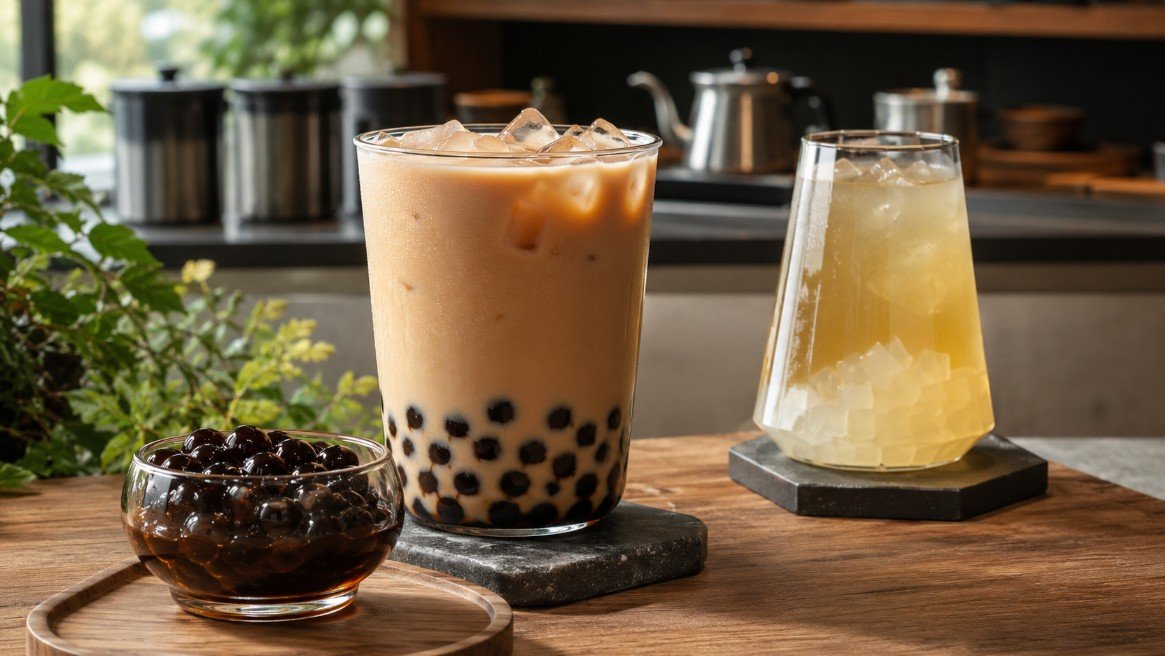
As names for a drink, boba and bubble tea usually refer to the same broad category. If one friend says, “Let’s get boba,” and another says, “Let’s get bubble tea,” they are probably suggesting the same kind of stop: a shop serving customizable Taiwanese-style tea drinks, milk teas, fruit teas and related beverages.
The words are not perfectly interchangeable in every sentence, however. Bubble tea normally refers to the beverage, while boba can refer either to the beverage category or specifically to the chewy pearls used as a topping. That extra meaning is the most important practical difference between the terms.
There is a second distinction that clears up a lot of confusion: pearl milk tea is more specific than either boba or bubble tea. Pearl milk tea describes a classic drink style built around milk tea and pearls. Modern bubble tea has grown into a much wider category that can include fruit tea, fresh milk drinks, jelly, aloe, pudding, popping boba, foam or no solid topping at all.
So the useful answer is not simply “they are exactly the same” or “boba means pearls and bubble tea means the drink.” Both explanations miss part of how people actually use the words. The real difference is mostly about context, category level and language, not two competing recipes.
The difference is mostly about language, not two different recipes
If a store calls itself a boba shop and another calls itself a bubble tea shop, there is no reason to assume that one sells a fundamentally different beverage system. In contemporary English, both terms commonly point toward the same broad drink culture.
What changes is the precision of each word. Bubble tea is normally a category-level term. Boba can operate at that same level, but it can also move down one level and identify the pearls inside the cup.
| Term | Usually means | Can mean pearls? | Requires tapioca? |
|---|---|---|---|
| Boba | The drink category or the topping, depending on context | Yes | No when referring to the drink category |
| Bubble tea | The broad beverage category | Normally no | No |
| Boba tea | Another common name for the beverage category | The phrase names the drink rather than loose pearls | No |
| Pearl milk tea | A more specific milk-tea style containing pearls | Pearls are part of the drink description | Traditionally, yes |
That is the comparison in its most useful form. Boba has two common linguistic jobs; bubble tea usually has one. When boba names the beverage category, the difference nearly disappears. When boba names a topping, the difference becomes obvious.
Our broader guide to what boba is goes deeper into the drink, the topping and the category. Here, the focus is what happens when the major English terms are placed side by side.
Boba and bubble tea can mean exactly the same thing in ordinary conversation
Most casual conversations give you enough context to understand whether boba means the whole drink category. In these situations, replacing boba with bubble tea changes very little.
“Do you want to get boba after dinner?”
“Do you want to get bubble tea after dinner?”
“There’s a good boba shop around the corner.”
“There’s a good bubble tea shop around the corner.”
“I haven’t had boba in months.”
“I haven’t had bubble tea in months.”
“What boba should I order?”
“What bubble tea should I order?”
In each example the conversation is already about beverages. Nobody needs to wonder whether the speaker is inviting them to eat a bowl of plain tapioca pearls.
This explains why arguing that “boba is not the drink, only the pearls” does not match normal modern usage. The topping meaning is real, but so is the broader beverage meaning.
Boba can stop meaning the drink and start meaning the topping
This is where a simple dictionary-style equivalence stops being enough. Once you begin ordering or discussing ingredients, boba can suddenly refer to something inside the beverage rather than the beverage itself.
“Add boba.”
You are asking for pearls to be added to an existing drink. Replacing the phrase with “add bubble tea” would not make sense.
“No boba, please.”
You usually still want the drink. You are asking for the pearl component to be removed.
“Bubble tea with boba.”
The two roles are visible in the same sentence: the first term identifies the beverage, and the second identifies what goes inside it.
“Their boba is always soft and chewy.”
Texture words such as chewy, firm, soft or overcooked strongly suggest that the speaker is evaluating tapioca rather than the whole category.
“This boba is too sweet.”
Sweetness can refer to the entire cup, so the surrounding conversation matters. The same word is less precise here than it was in the texture example.
That flexibility is not a flaw in the language. Food words often expand from an ingredient or preparation into a wider category. What matters for the reader is recognizing that context determines which meaning of boba is active.
For the word itself rather than the comparison between category labels, see what boba means.
The bubbles in “bubble tea” should not automatically be interpreted as tapioca pearls
A very common explanation says that bubble tea is called bubble tea because the tapioca pearls look like bubbles. It sounds logical when you see a cup filled with round black pearls, but the historical terminology is more complicated.
Taiwan’s Tea and Beverage Research Station describes a Taiwanese tea house introducing a form of bubble black tea in 1983 and later presenting pearl milk tea in 1988. That chronology matters because it shows bubble terminology existing in connection with shaken tea before the later pearl milk tea milestone described by the same official source.
A shaken cold-tea format appears in the official historical account.
Pearls become part of another influential Taiwanese beverage format.
The term now covers a large family of customizable drinks.
Shaking tea can create a foamy layer of small bubbles at the surface. That helps explain why it is safer to understand “bubble tea” through the history of shaken Taiwanese tea culture rather than treat the word as a literal instruction that every cup must contain tapioca spheres.
There are competing stories about who first combined particular ingredients and who should receive credit for inventing pearl milk tea. A terminology comparison does not need to resolve that dispute in order to make the important point: the language evolved alongside the drink culture.
The full naming question is separate from this comparison. Our guide to why it is called boba is where that terminology can be explored without turning this page into a history article.
The easiest way to understand boba terminology is to separate three levels
A lot of confusion disappears once you stop treating every term as if it belongs on the same level.
A family of customizable beverages that can include milk tea, fruit tea, fresh milk and other formats.
A specific milk-tea format containing pearls.
The classic chewy starch-based pearl.
Different textures that can replace or accompany tapioca.
The hierarchy explains a sentence such as “I ordered bubble tea with boba.” The drink sits at the category level. The boba sits at the topping level. There is no contradiction.
It also explains why a bubble tea without tapioca is still bubble tea. The category does not disappear just because one topping is removed.
Traditional tapioca boba has its own ingredient and texture story, which is covered separately in what boba pearls are.
Pearl milk tea is one classic boba style, not the definition of the entire category
If you picture a caramel-brown milk tea with black pearls when someone says bubble tea, that image makes sense. Pearl milk tea is one of the category’s most recognizable forms.
But it is still only one form. Modern bubble tea shops often organize menus into multiple families that can look and taste dramatically different from classic pearl milk tea.
One recognizable category, many constructions.
Tea combined with milk, creamer or another creamy component, with or without tapioca.
Tea paired with fruit flavors and often jelly, aloe, fruit pieces or popping toppings.
Milk-centered combinations that may feature brown sugar pearls without tasting like classic brewed milk tea.
Black, green, jasmine or oolong tea served with restrained additions rather than a heavy milk base.
Slushes, smoothies and house creations can also appear under a modern boba menu.
Calling every one of these drinks “pearl milk tea” would erase useful differences. Calling them boba or bubble tea, on the other hand, keeps them inside the shared category while leaving room for different bases and toppings.
The boba drinks guide compares those actual beverage families rather than just the words used to name the category.
Seeing “boba” or “bubble tea” on a menu tells you the category, not the exact contents
This distinction becomes especially useful when you are ordering for the first time. The category name may tell you what kind of shop you have entered, but it does not tell you exactly what will be in your cup.
Often present, but the modern category is broader. Many classics are tea-based, yet some shops also place fresh-milk drinks, smoothies or slushes in the same boba menu.
Not guaranteed. Fruit teas and straight tea-based drinks can belong to the category without containing milk.
Not guaranteed. A drink can use jelly, aloe, pudding, popping boba or no solid topping.
Not predictable from the category name alone. Caffeine depends much more on the drink base and recipe.
Highly variable. One boba drink can be lightly sweetened tea while another is a rich dessert-like brown sugar drink.
Also variable. Tapioca creates a chewy experience, while pudding is soft, jelly is slippery and popping boba bursts.
So when somebody asks whether boba and bubble tea taste different, the terminology alone cannot answer the question. Two drinks both called boba can have completely different tea bases, sweetness levels, milk choices, temperatures and toppings.
Boba tea is not a third competing beverage category
Once you learn that boba can already mean the drink, the phrase boba tea may sound redundant. In actual English usage, however, it functions naturally as another recognizable name for bubble tea.
The extra word can even make communication clearer. Someone who has never heard the shorter noun boba may immediately realize that you are discussing a beverage when they hear boba tea.
What you should not do is create a fake recipe distinction such as “boba tea always has tapioca but bubble tea does not.” Modern naming is not that tidy. A shop can call the overall category boba tea while allowing customers to select jelly, pudding, aloe or no tapioca at all.
The preferred name can change without the beverage category changing
Food language moves through families, immigrant communities, cities, social groups, menus and commercial branding. Because of that, two English speakers can prefer different terms while still picturing the same general type of drink.
Boba is firmly established in contemporary American English. Bubble tea is also widely understood and can sometimes be clearer for someone encountering the category for the first time. Boba tea combines the two ideas in a way that is also common and understandable.
What we should avoid is inventing rigid maps that claim one city “says boba” and another “says bubble tea” as if everyone inside those places follows one rule. Language is rarely that clean. A single neighborhood can contain shops using several different naming styles.
The actual tea base, milk, flavor and toppings tell you much more than whether the sign outside says “boba” or “bubble tea.”
The same flexibility appears internationally. English naming sits alongside local-language names, translations, brand terminology and older expressions such as pearl milk tea. That mixture is part of how Taiwanese beverage culture became global rather than evidence that the drinks split into completely separate categories.
For the broader cultural story rather than terminology alone, see our guide to boba culture.
Common boba vs bubble tea claims often contain part of the truth, not the whole truth
“Boba means only the pearls.”
Too narrow. Boba absolutely can mean the pearls, especially when ordering toppings, but it is also widely used as the name of the overall beverage category.
“Boba and bubble tea are always perfectly interchangeable.”
Too broad. They overlap at the drink-category level, but “add boba” and “bubble tea with boba” demonstrate that boba has an additional ingredient-level meaning.
“Bubble tea is called bubble tea because tapioca pearls are bubbles.”
Historically oversimplified. Taiwanese tea history documents bubble black tea before the pearl milk tea milestone, so the terminology should not be reduced to the shape of tapioca pearls.
“If there are no tapioca pearls, it is not real bubble tea.”
Too restrictive for the modern category. Contemporary boba shops offer many drink and topping combinations, including drinks with jelly, aloe, pudding or no traditional pearls.
Choose the word that makes your meaning clearest in that moment
You do not need to memorize a strict vocabulary rule before walking into a tea shop. Most of the time, context does the work for you.
“Boba” or “bubble tea”
Both are natural when everyone already understands that you are discussing beverages.
“Bubble tea, also called boba”
This immediately connects the two major English names and avoids creating the impression that they are separate drink categories.
“Tapioca pearls” or the shop’s listed name
Specific wording helps when the menu also contains popping boba, crystal boba, jelly or other pearl-like toppings.
“No tapioca pearls”
This is clearer than assuming the shop interprets “no boba” exactly the way you do.
Follow the shop’s vocabulary
If the menu calls its classic topping “pearls,” use “pearls.” If it calls it “boba,” use “boba.” You do not gain anything by correcting the menu terminology.
If the question has shifted from terminology to what actually defines the beverage family, continue to what bubble tea is.
Think category first, then drink style, then topping
The broad modern beverage family.
A classic member of the larger family built around milk tea and pearls.
The chewy pearl that can be added to many different drinks.
Questions about boba vs bubble tea
Is there actually a difference between boba and bubble tea?
As names for the overall beverage category, there is usually very little difference. The important linguistic distinction is that “boba” can also refer specifically to the pearls, while “bubble tea” normally refers to the beverage.
Does boba mean the drink or the pearls?
It can mean either. “Let’s get boba” generally means drinks. “Add boba” generally means add pearls. Context normally makes the intended meaning clear.
Is boba tea the same as bubble tea?
Yes in normal modern English usage. Boba tea is another established name for the bubble tea category rather than a separate drink with a required recipe.
Is pearl milk tea the same as bubble tea?
Not exactly. Pearl milk tea is a more specific drink style that combines milk tea and pearls. Bubble tea is now a broader category containing many additional drink bases and topping combinations.
Does bubble tea always contain tapioca pearls?
No. Modern bubble tea can contain jelly, aloe, pudding, popping boba or other toppings, and many drinks can also be ordered without any solid topping.
Why can someone say “bubble tea with boba” if boba and bubble tea mean the same thing?
Because the words are operating at different levels in that sentence. “Bubble tea” identifies the beverage category, while “boba” identifies the topping added to the beverage.
Why is bubble tea called bubble tea?
The history is more complicated than simply saying the tapioca pearls are the bubbles. Taiwanese tea history records bubble black tea before its pearl milk tea milestone, reflecting the importance of shaken tea and evolving beverage terminology.
Does all boba contain tea?
No. Tea is central to the category’s Taiwanese roots and many classic drinks, but modern boba menus can include fresh-milk drinks, smoothies, slushes and other products without a conventional brewed-tea base.
Which name is more correct: boba or bubble tea?
There is no need to declare one universally correct in contemporary English. Both are established names. Bubble tea is unambiguous as a beverage term, while boba can refer either to the beverage category or the pearls depending on context.
Why do different shops use different terms?
Terminology reflects community usage, branding, regional habits and menu style. A different word on the storefront does not by itself mean that the shop sells a fundamentally different type of beverage.
BOBA VS BUBBLE TEA IN ONE IDEA
The beverage category is usually the same; the words are not perfectly identical. Bubble tea normally names the drink, while boba can name either that drink category or the chewy pearls inside it.