
Taiwanese roots, global culture
Boba Culture: From Taiwanese Tea Shops to a Global Drink
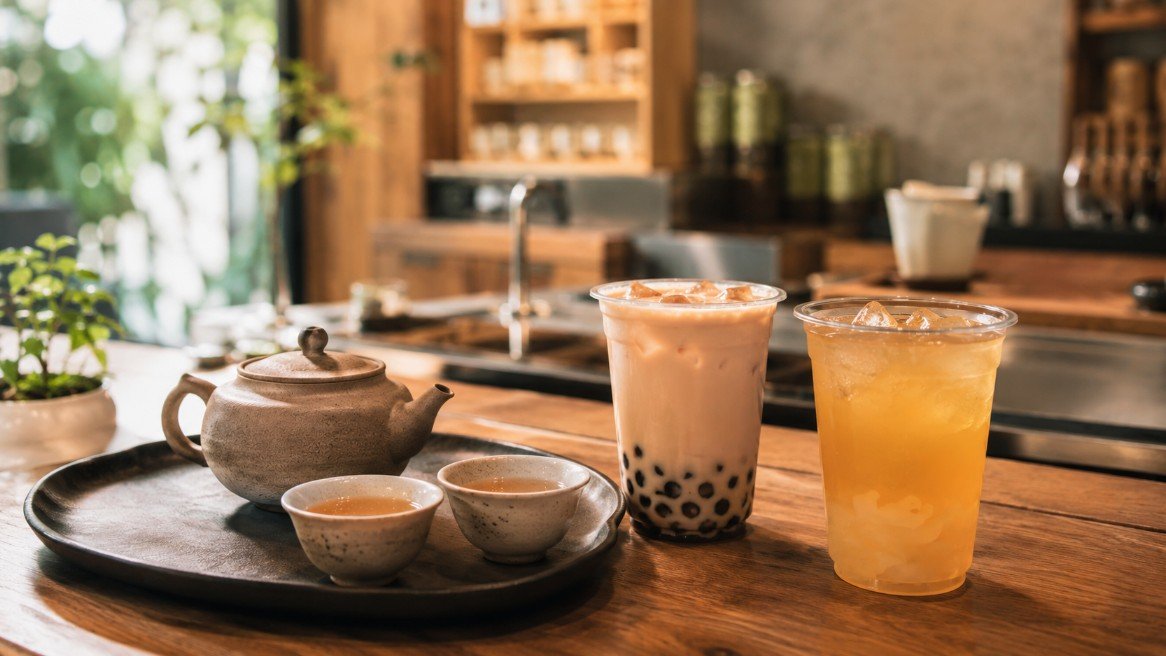
Boba is Taiwanese in origin, but the culture around it is larger than one origin story, one tea shop or one recipe. What became bubble tea grew from several things already present in Taiwan: a deep relationship with tea, a lively urban food culture, cold and shaken beverages, tapioca pearls as a familiar food texture, and tea shops willing to experiment with how tea could be served.
That matters because the familiar story—someone suddenly dropped pearls into milk tea and invented a global phenomenon—is too simple. Pearl milk tea emerged in Taiwan during the 1980s, but the pieces that made it possible were already developing around it. Cold tea had become more normal. Tea houses were experimenting with shaken drinks. Tapioca pearls were not a new substance waiting to be discovered. What changed was the way these elements converged into a portable, customizable drink that people could order in countless variations.
As boba traveled, the recipe expanded faster than the original drink. Fruit teas, fresh-milk drinks, matcha, coffee, slushes, cheese foam, aloe, jelly and regional flavors all entered the same cultural system. The result is unusual: boba can be unmistakably Taiwanese in origin while also being radically different from shop to shop and country to country. Understanding that tension—between roots and reinvention—is the key to understanding boba culture.
The story begins before pearl milk tea
Boba Did Not Begin With the Pearl
The easiest way to misunderstand boba history is to begin at the moment pearls entered milk tea. The more useful starting point is to look at the culture that already existed around tea and texture. Taiwan had long-standing tea traditions, but by the late twentieth century tea was also becoming part of a more casual, urban and experimental food environment. Cold tea was increasingly normal, tea shops were trying new preparation styles, and consumers were already familiar with chewy starch-based foods.
Taiwanese historical writing on food makes this point clearly: something as apparently simple as pearl milk tea required several earlier developments to be in place first. Cold “bubble tea” had to become part of the market. Tapioca pearls had to be an accepted food. Tea houses had to become comfortable treating tea as something that could be chilled, shaken, sweetened and rebuilt for a younger, faster-moving audience.
A serious ingredient became a flexible everyday drink
Taiwanese tea culture supplied more than a historical backdrop. Tea remained the aromatic and structural base that made later milk tea, fruit tea and hand-shaken drinks recognizable as part of a tea-drinking tradition. For the deeper tea side of this story, see our guide to tea in boba.
Temperature changed the social role of tea
Once tea was comfortable being cold, sweet and shaken, it moved away from the assumption that good tea had to be a quiet sit-down experience. Cold tea could travel, refresh people in warm weather and fit more easily into street and takeaway culture.
Tapioca pearls were part of a broader taste for chew
The dramatic part was not the existence of starch pearls by themselves. It was their new role inside a drink. Instead of dessert and beverage being separate, the straw could deliver both liquid and chew in the same sip.
Tea shops became laboratories for everyday taste
Milk, fruit, ice, sweeteners and textures could be recombined quickly. That culture of experimentation is one reason boba later expanded so easily: change was not an accident added after globalization. Change was built into the format from the beginning.
Boba makes more sense as a convergence than as a single flash of invention.
If you want the category-level definition before going further into the cultural history, our guide to what boba means separates the drink category from the pearls themselves.
Why this happened in Taiwan
Taiwan Had the Right Ingredients for Boba to Emerge
It is tempting to explain boba with one sentence: “Taiwan loves tea.” That is true but incomplete. Many places love tea. What made Taiwan especially fertile ground for boba was the combination of tea culture with urban food experimentation, dense commercial streets, a climate that rewarded cold drinks, a strong taste for texture, and tea shops willing to remake a traditional beverage around modern habits.
Tea also had unusual range in Taiwan. Oolong traditions, black tea production, jasmine-scented teas and later imported or blended teas gave drink makers many foundations to work with. The modern hand-shaken drink shop did not need to invent the idea that tea could have different personalities; that knowledge was already present. What changed was the service model. Tea could now become quicker, sweeter, colder, more portable and more customizable without ceasing to be tea.
Another important piece is that boba was never purely local in its ingredients even before it became globally famous. Taiwanese agricultural sources note that the cassava used for tapioca has its own international agricultural story, and modern Taiwan imports much of the raw material used for tapioca production. Black-tea traditions also include cultivars and influences that traveled across regions before becoming part of Taiwanese agriculture. The cultural identity of a food does not require every raw ingredient to originate in the same place. Boba became Taiwanese because of the way those ingredients, techniques and habits were assembled into a new drinking culture.
Taichung and hand-shaken tea
The Modern Boba Shop Grew From More Than One Drink
Taichung occupies an important place in the story because the city is strongly associated with the rise of modern cold, shaken tea culture. Official Taichung sources describe the development of foam tea and later pearl milk tea within a broader wave of experimentation around tea houses and takeaway drinks. The city also records the appearance of sealed-cup takeaway hand-shaken tea in 1992, an innovation that mattered culturally because it changed how tea could move through everyday life.
A sealed cup sounds ordinary now, but it solved several practical problems at once. It reduced spills, made drinks easier to carry, supported takeout service and created a standard object that could travel through streets, schools, offices and public transport. Combine that with a wide straw and a drink that could be adjusted for sweetness, ice and toppings, and boba became more than a beverage recipe. It became a highly portable service format.
This period also helps explain the English term “bubble tea.” The “bubble” in early cold shaken tea referred to foam created by shaking, not necessarily tapioca pearls. As pearl milk tea became more prominent overseas, the terminology blurred and many English speakers began using bubble tea for the broader drink category. Our guide to what bubble tea means separates that naming history from the modern menu usage.
Once tea could be sealed, carried and customized quickly, it fit a completely different rhythm of daily life from a formal tea service.
A history with competing claims
Who Invented Bubble Tea?
There is no responsible way to present one universally accepted inventor as settled fact.
Taiwanese government sources acknowledge competing origin stories, especially those associated with Hanlin Tea Room and Chun Shui Tang. Both stories place important experimentation in Taiwan during the 1980s, but the exact “first” cup remains disputed. That is not a weakness in the history. It is a reminder that food culture often develops through several overlapping innovations rather than one perfectly documented moment.
One prominent claim connects founder Tu Tsong-he with the idea of adding tapioca pearls to tea and developing pearl tea in southern Taiwan.
Another famous account credits experimentation at the Taichung tea house, including a story in which Lin Hsiu Hui added tapioca pearls to milk tea during a staff meeting in 1988.
Cold shaken tea, familiar tapioca textures and an experimental tea-shop culture already existed. Pearl milk tea makes more sense as the point where those streams met than as an invention appearing from nowhere.
For readers, the practical conclusion is simple: it is accurate to say that modern bubble tea originated in Taiwan in the 1980s. It is much less accurate to present one commercial origin story as uncontested historical fact.
Culture you can feel
Why Texture Is So Important in Boba Culture
For people encountering boba for the first time, the pearls can seem almost like a visual gimmick. In Taiwanese food culture, however, texture has a vocabulary and value of its own. The idea often expressed as Q or Q彈 refers broadly to a pleasing springy, chewy or resilient texture. It is not a scientific measurement and it should not be turned into a mystical concept, but it helps explain why the mouthfeel of tapioca can matter as much as flavor.
This is one reason pearl milk tea feels culturally coherent rather than arbitrary. The drink combines tea aroma, sweetness and cold temperature with a texture that rewards chewing. The cup alternates between liquid and solid, sip and bite. That creates a pace of drinking unlike plain iced tea, soda or coffee. Texture is not sitting on top of the culture as decoration; it changes the act of drinking itself.
Modern boba expanded this logic dramatically. Tapioca is only one form of texture now. Crystal boba, aloe, pudding, jelly, red bean, popping pearls and foams each create different resistance, movement and density in the cup. If that side interests you most, our boba textures guide focuses specifically on how those mouthfeels differ.
The reason boba could keep changing
Boba Became a Format, Not Just One Recipe
The earliest image many people associate with boba is milk tea plus black tapioca pearls. If the category had remained locked to that formula, it probably would not have spread with the same flexibility. Instead, boba developed into a system. A customer could change the base, flavor, sweetness, ice and texture while the shop kept the same overall service logic.
That flexibility is why a modern boba menu can contain drinks that seem unrelated at first glance. Roasted oolong milk tea, passion fruit green tea, matcha fresh milk and taro slush may share very few ingredients, yet they belong to the same cultural and commercial format. The customer understands that the drink can be built, adjusted and paired with a topping. The shop understands that the menu can evolve without abandoning the basic grammar of the experience.
Tea stopped being the only possible starting point
Tea remains central to the category’s history, but fresh milk, matcha, coffee and frozen blends widened what a “boba drink” could be. Our boba drinks guide maps those major families without pretending they are all the same beverage.
The topping became a second layer of menu design
Once pearls proved that a drink could carry a substantial texture, the menu was free to experiment with jelly, aloe, pudding, foams and other additions. See the broader boba toppings guide for the practical differences.
Choice became part of the product
Sweetness and ice levels are not merely operational details. They make customers participants in building the drink, which helps explain why ordering boba feels more interactive than ordering a fixed bottled beverage.
The grammar of the boba shop
Ordering Boba Became Its Own Little Language
One of the clearest signs that boba became a culture rather than just a product is that customers learned a shared ordering grammar. “Thirty percent sugar.” “Less ice.” “One topping.” “Fresh milk.” “Tea latte.” “No pearls.” These phrases compress several recipe decisions into a routine conversation between customer and shop.
That grammar is useful because the modern menu can otherwise be overwhelming. The drink name alone may not tell you whether you are ordering brewed tea, a milk drink, a fruit base or a slush. The customization step adds another layer. Once people understand the sequence, however, the long menu becomes easier: choose the drink family, understand the base, decide sweetness and temperature, then choose texture.
That cultural skill is exactly why we separate our practical guides to how to order boba and how to read a boba menu. Knowing the vocabulary is part of participating in the modern boba experience.
From Taiwan outward
How Boba Traveled Without Staying Exactly the Same
Boba’s international spread is easiest to understand as a series of waves rather than a neat list of dates. The drink first circulated through nearby Asian markets and Taiwanese business networks, then became increasingly visible in diaspora communities, student areas and Asian commercial districts abroad. From there it moved into mainstream shopping streets, malls, delivery apps and global franchise systems.
The important part is that each market did not receive one frozen “authentic recipe.” Boba entered places with existing habits around tea, coffee, dairy, fruit, sweetness and café culture. The format adapted. In some places milk tea remained dominant; in others fruit tea, cheese foam, matcha or local ingredients became more visible. Portion size, sweetness expectations, menu naming and store design shifted too.
Taiwan
Tea-shop experimentation created the cultural and practical framework: cold tea, shaking, pearls, customization and portable service.
Asian expansion
Nearby markets already had strong tea and street-food cultures, allowing bubble tea to mix quickly with local tastes rather than remaining a novelty imported unchanged.
Diaspora communities
Taiwanese and broader Asian communities helped boba become both a familiar taste of home and an accessible cultural introduction for new customers.
Mainstream adoption
University districts, malls, social media, specialty tea chains and delivery platforms moved the category beyond communities already familiar with Asian drinks.
Local reinvention
Global boba now changes city by city. That is why our future-facing boba guides by city matter: local culture shapes what the category looks like on the ground.
What changes from country to country
Global Boba Adapts to Local Taste Without Losing Its Roots
International adaptation is sometimes described as if it automatically makes a food less authentic. Boba is a poor fit for that argument because customization and experimentation are already part of the category’s Taiwanese development. A drink can change dramatically and still belong to the culture if the core logic of the experience remains recognizable.
What feels balanced in one market may taste restrained or aggressively sweet in another. Shops adapt default recipes and sugar options around local expectations.
Fresh milk, creamers, plant-based milks and richer dairy formats vary in popularity and availability, changing both texture and how strongly tea must be brewed.
Mango, passion fruit, peach, citrus, grape and seasonal local fruits rise or fall depending on climate, supply and consumer taste.
Some shops sell tea-first drinks where aroma remains dominant. Others lean toward dessert, fruit or milk and make tea a quieter background layer.
Boba may behave like a takeaway street drink, a sit-down café product, a mall purchase, a late-night snack or a delivery-first treat depending on the city.
Minimal tea houses, playful youth brands and premium contemporary chains all interpret the same category differently, which changes how customers imagine boba before the first sip.
Boba and diaspora
For Some People Boba Is a Trend; for Others It Tastes Like Home
Outside Taiwan, bubble tea can carry two very different meanings at the same time. For a new customer it may be a fashionable drink discovered through friends or social media. For someone from Taiwan—or someone whose family and community have long lived with hand-shaken tea culture—it can be tied to memory, language, neighborhood routines and the ordinary familiarity of grabbing a drink on the way home.
That double identity helps explain why boba has been unusually effective as a form of cultural exchange. It does not require a formal lesson about Taiwan before someone can enjoy it. A customer can begin with a cup, then become curious about the tea, the texture, the terminology or the country behind it. Taiwanese community organizations abroad continue to use tea and bubble-tea activities as approachable ways to introduce people to Taiwan, which shows how the drink can function both commercially and culturally.
At the same time, it would be a mistake to reduce Taiwanese culture to bubble tea. Boba is one highly visible part of a much larger food and tea culture. Its value as a cultural marker comes precisely from being everyday and accessible, not from representing everything about Taiwan.
Authenticity without purity tests
Is Modern Boba Still Taiwanese If the Drinks Have Changed So Much?
Yes. The modern bubble-tea category has Taiwanese origins even though the recipes are now international. Cultural origin and recipe uniformity are not the same thing. Pizza does not stop having an Italian history because toppings differ around the world; boba does not lose its Taiwanese origin because a shop sells mango tea, matcha fresh milk or a local fruit variation that did not appear in an early pearl milk tea.
The more useful question is what someone means when they call a boba drink “authentic.” Historical authenticity might mean closeness to Taiwanese pearl milk tea traditions. Ingredient authenticity might focus on brewed tea, properly prepared tapioca and a balanced recipe. Taiwanese-style preparation might refer to hand-shaken service, recognizable tea character and familiar texture. A modern local adaptation can still be culturally legitimate while deliberately doing something different.
Quality is another separate issue. A drink does not become good simply because a shop claims Taiwanese inspiration, and an adapted drink is not automatically bad because it uses a new flavor. The strongest way to judge the cup is still by what is actually in it: tea, balance, texture, freshness and whether the drink makes sense as a whole.
Everyday in Taiwan, remarkable abroad
Boba Is More Than a Global Trend Because It Became Ordinary at Home
One reason international descriptions of boba can feel slightly distorted is that they often begin with novelty. The giant straw is unusual. The pearls are unusual. The purple taro drink is photogenic. The menu is confusing. In Taiwan, the same category can be much more ordinary: a hand-shaken drink shop is simply part of the commercial landscape, and buying tea on the way to work, school or a social meeting does not need to be a cultural event.
This contrast matters. A trend survives by remaining noticeable. An everyday culture survives because people continue using it even when it is no longer surprising. Boba managed to become both. Abroad it can still be a visually distinctive treat; in Taiwan it belongs to a much broader rhythm of routine tea consumption and neighborhood food culture.
As the category keeps spreading, that everyday logic is also becoming normal elsewhere. People no longer need to travel to a Chinatown, Taiwanese district or specialty Asian mall in many cities to find bubble tea. If your interest is practical rather than historical, our boba near me guide is built around that modern local-discovery side of the culture.
Culture became an industry too
Global Success Changed the Boba Shop as Much as the Recipe
Boba culture now lives inside a major commercial ecosystem: independent shops, Taiwanese chains, international franchises, ingredient suppliers, cup manufacturers, delivery platforms and social-media-driven product launches. That scale creates tension. A drink can be culturally meaningful and highly commercial at the same time. Those ideas do not cancel each other out.
Commercial growth also accelerated standardization. Chains need recipes that can be repeated, ingredients that can travel and training systems that produce recognizable results across locations. At the same time, competition rewards novelty, so the same industry that standardizes black milk tea also constantly launches new fruits, foams, jellies and seasonal drinks. Boba therefore operates through two forces at once: repeatability and reinvention.
We keep the deeper economics, franchising and shop-operation questions separate in our boba business guide. Here, the cultural point is simply that globalization changed not only what people drink, but also how the boba shop itself is designed, branded and experienced.
What remains recognizable
You Can Still Taste the Culture in the Structure of the Cup
Modern boba is too broad to be defined by one flavor, one topping or even one drink family. What remains surprisingly stable is the structure of the experience: a base is chosen, flavor and sweetness are adjusted, temperature is considered, and texture becomes part of the drink rather than a side dish.
That structure carries traces of the culture that produced it. Tea still matters. Shaking still matters. Texture still matters. Portability matters. Customization matters. Experimentation matters. Even when the drink is a fruit tea with aloe rather than pearl milk tea, the logic of the modern boba shop is recognizable.
This is why the most useful way to think about boba culture is not as a frozen recipe from the 1980s. It is a Taiwanese-origin way of building and experiencing drinks that proved unusually good at absorbing change.
A social drink as much as a flavor
Boba Fits Modern Social Life Because the Experience Is Easy to Share
Boba also spread because it works unusually well as a social drink. Ordering does not require a long meal, a formal coffee ritual or a table reservation. Friends can stop for one drink, compare flavors, trade recommendations and keep walking. Students can carry it between classes. Coworkers can order several customized cups at once. Families can buy different sweetness levels and toppings without needing everyone to agree on the same product. The format supports individual preference while still feeling like a shared activity.
That combination is culturally powerful. Many food traditions create community by bringing everyone to one table; boba often creates community through parallel personal choices. One person orders roasted oolong milk tea, another chooses passion fruit green tea, a third wants taro with no pearls, yet the group still participates in the same outing. The shared object is not one recipe. It is the act of going for boba.
The wide straw and transparent cup also make the drink visually legible in a way many beverages are not. Pearls, jelly, milk layers, fruit pieces and foam can all be seen before the first sip. That visibility helped boba become easy to photograph and easy to recognize, but the visual appeal works because the cup already contains real differences in texture and construction. Social media amplified the category; it did not invent the underlying pleasure of choosing and sharing it.
This is why boba shops often function somewhere between a snack stop, tea bar and casual social space. The drink is substantial enough to feel like a small treat, portable enough to leave with immediately, and customizable enough to reward repeat visits. Those traits make boba especially compatible with city life, university districts and shopping areas where people want something social without committing to a full dining occasion.
The visual culture around the cup
Why Boba Shops Look So Different Even When the Drink Logic Is Similar
As the category globalized, shop design became another way of interpreting boba culture. Some brands emphasize Taiwanese tea heritage through wood, tea canisters and restrained menus. Others lean into bright colors, character graphics or youth culture. Premium chains may present the drink more like specialty coffee or modern tea, using quieter interiors and stronger focus on tea origin. Independent shops often mix several of these languages at once.
The variety can make boba appear less culturally coherent than it really is. Underneath very different interiors and branding, customers still recognize familiar behavior: scanning drink families, choosing sweetness and ice, deciding whether to add texture, watching a drink being shaken or sealed, and leaving with a cup designed to travel. The visual identity changes much faster than the service grammar.
That is also why a shop can look beautifully “authentic” and still serve a weak drink, while a highly contemporary space can prepare excellent tea and fresh pearls. Design communicates positioning; it does not prove quality. The cultural experience is strongest when visual identity, drink preparation and service all support the same idea rather than when decoration is asked to do all the work.
FAQ
Common Questions About Boba Culture
Where did boba originate?
Modern bubble tea originated in Taiwan during the 1980s. The precise first cup is disputed, but Taiwanese tea-shop culture, cold shaken tea and familiar tapioca textures all contributed to the category’s development.
Is boba Taiwanese?
Yes. The modern category has Taiwanese origins. Recipes have since become international, but global adaptation does not erase where the culture began.
Who invented bubble tea?
There is no universally accepted single inventor. Hanlin Tea Room and Chun Shui Tang are associated with two of the best-known competing origin stories, so it is safer to describe bubble tea as developing in Taiwan in the 1980s than to present one person as definitively proven.
Why is it called bubble tea?
The term originally relates to the foam or bubbles created by shaking tea. As pearl milk tea became internationally popular, “bubble tea” also became a broad English name for drinks that may contain tapioca pearls or other toppings.
Why is chewy texture important in boba?
Taiwanese food culture values springy and chewy textures often described with the idea of Q or Q彈. Tapioca pearls made that texture part of the drinking experience, which is one reason boba feels so different from ordinary iced tea.
Why is boba so customizable?
Customization grew naturally from the hand-shaken drink-shop format. Base, sweetness, ice and toppings can be changed without rebuilding the entire service model, so experimentation became part of the culture rather than an exception.
When did boba become popular outside Taiwan?
Its international growth happened in waves rather than one single year. Expansion across Asian markets and diaspora communities came first, followed by broader mainstream growth through specialty chains, shopping districts, universities, malls and delivery platforms.
Are fruit teas and modern drinks still part of boba culture?
Yes. Boba developed into a flexible drink format rather than remaining one pearl milk tea recipe. Fruit tea, fresh milk, matcha and other styles can still belong to the category when they share the broader hand-shaken, customizable and texture-oriented drink culture.
Boba culture is easiest to understand when its Taiwanese origin and global evolution are held together rather than treated as opposites. The category began in Taiwan, but its capacity to change is one reason it traveled so well.