
The operating side of bubble tea
Boba Business: How Bubble Tea Shops Work, Make Money and Scale
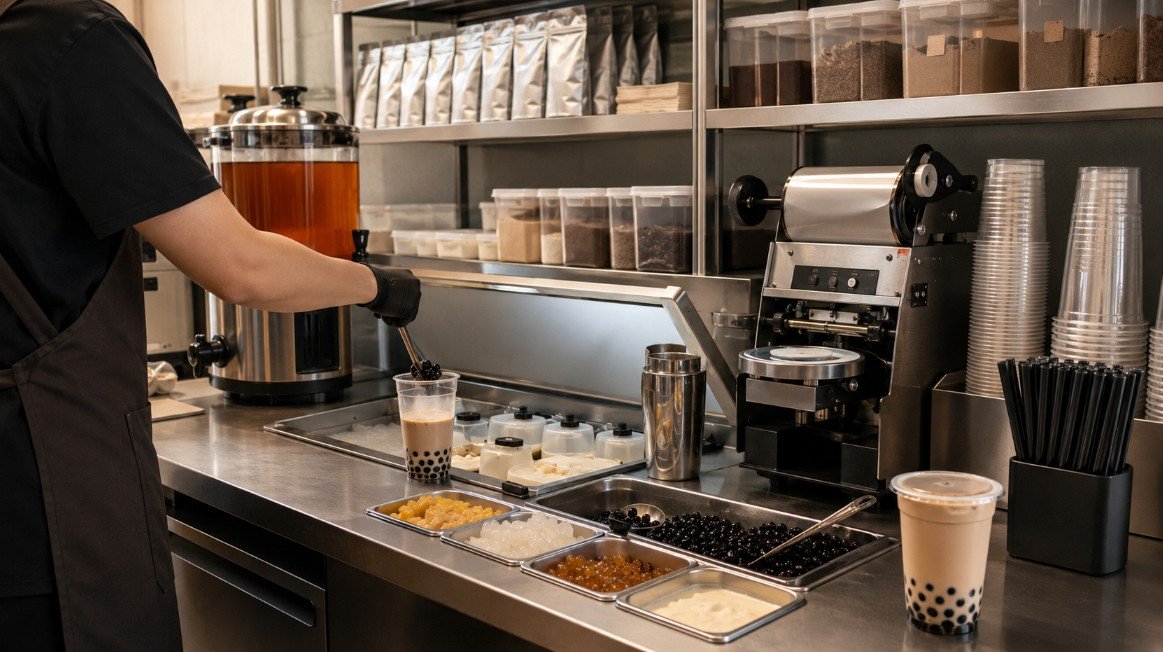
A boba shop can look deceptively simple from the customer side of the counter. Tea, milk, sugar, ice and tapioca go into a cup, the cup gets sealed, and a few minutes later someone walks away with a drink. The business behind that cup is much more complicated. A commercial operation has to buy ingredients at the right quantities, control waste, schedule labor, brew and hold products correctly, manage customization, keep service moving during rushes, maintain equipment, pay rent and other overhead, and still produce a drink customers want to buy again.
That is why this is not a promise that opening a bubble tea shop is easy, cheap or automatically profitable. There is no universal startup cost, no guaranteed profit margin and no single store format that works everywhere. An independent shop in a university district, a mall kiosk, a franchise unit, a dessert café and a mobile catering operation all have different economics. The useful starting point is to understand the system before choosing the storefront.
This guide explains the operating logic behind a boba business: business models, menu economics, contribution margin, throughput, customization, site selection, supply chain, freshness, staffing, equipment, food-safety responsibilities, franchise due diligence, startup-cost categories, working capital, pricing, delivery, customer retention and scaling. It is educational rather than legal, tax or investment advice; the numbers and obligations for a real business must be built from the specific location, concept and agreements involved.
The first business lesson
A Boba Shop Is a System, Not a Cup
A recipe can be excellent and still fail as a business. Commercial success requires the recipe to work inside a repeatable system. The shop needs enough ingredients without drowning in inventory. Employees need to understand the recipes without stopping to ask questions every two minutes. Tea and toppings have to be ready when demand arrives. The ordering process needs enough flexibility to satisfy customers without making every transaction painfully slow.
Thinking in systems changes the questions you ask. Instead of starting with “Which taro powder should I buy?” you start with “What kind of shop are we trying to operate?” Instead of asking only whether a drink tastes good, you ask whether the team can reproduce it during a rush, whether the ingredients create excessive waste, whether the selling price supports the real cost of making it and whether the customer has a reason to return.
Demand enters the shop
Customers arrive through foot traffic, repeat visits, delivery, social discovery, a nearby university, a mall, an office district or a destination food area. The business model has to match the kind of traffic that actually exists.
Orders become production instructions
The menu, point-of-sale system and staff communication convert a customer’s choices into a build: tea base, milk, sweetness, ice and toppings. Every extra option increases the number of possible combinations the team must execute accurately.
Ingredients become a drink
Brewing, batching, cooking pearls, portioning, shaking, blending, sealing and pickup all consume labor and equipment capacity. A bottleneck in one station can slow the entire line.
The transaction has to cover the business
Revenue must support ingredients, packaging, payroll, occupancy, utilities, maintenance, fees, insurance, waste and other operating expenses. A high selling price does not automatically mean a high profit.
The customer decides whether to return
Repeat behavior is where consistency matters. A viral opening can create traffic, but long-term economics depend on customers believing that the next cup will still be worth buying.
Choose the operating model first
Different Boba Business Models Create Different Economics
Before choosing equipment or signing a lease, decide what business you are actually building. The physical footprint, menu, labor model, customer expectations and capital needs change substantially across formats.
An independent shop can build a focused tea identity, react quickly to local preferences and create signature drinks without waiting for a corporate approval cycle. It also carries the burden of recipe development, purchasing, staff training, brand building and quality control.
This model is strongest when the operator has a clear reason to exist beyond “there is demand for boba.” A neighborhood does not need another interchangeable menu. It may need better tea, later hours, faster service, stronger fruit drinks, a more premium room, better value or simply a well-run shop in an underserved pocket.
The important question is not whether a franchise name is famous. It is whether the economics and contractual structure make sense for the specific operator and territory. Required suppliers, royalties, marketing contributions, build-out standards, renewal terms and territorial rights can materially change the business.
Franchise evaluation deserves its own due-diligence process, discussed later in this guide. A recognizable cup can reduce some marketing friction, but it cannot rescue an expensive lease, weak unit economics or poor local demand.
A kiosk or compact takeaway store can work well where customers already pass in volume: malls, transit-oriented areas, campuses or dense commercial centers. The limitation is space. Every menu item competes for refrigeration, dry storage, work surface and equipment access.
This can force useful discipline. A compact shop that knows its best sellers may outperform a larger room burdened with underused seats and a sprawling menu. But a small footprint is not automatically cheap once rent per square foot, mall charges, utilities and build requirements are considered.
The hybrid model is attractive because a group may buy more than drinks, and the shop can serve customers who are not specifically looking for boba. The tradeoff is operational complexity. A menu that combines tea, blended drinks, hot food and fresh desserts is not simply “more opportunity”; it is several production systems sharing one room.
Every added category should justify its equipment, prep, storage and training burden. Revenue diversity matters only if the additional revenue contributes more than the added complexity consumes.
Catering can be an extension of an existing shop or a business model of its own. It changes production planning because demand is scheduled rather than spontaneous. Large orders can be attractive, but the operator has to protect drink quality during transport and deliver enough throughput during a narrow service window.
Our boba parties guide looks at the event experience from the host side. From the business side, catering is valuable only when pricing covers transport, setup, staff time, serviceware, ingredient risk and cleanup rather than treating a large order as simply many retail drinks placed at once.
Do not confuse sales with earnings
Revenue Is Not Profit, and Ingredient Cost Is Not the Whole Cost
A seven-dollar drink does not create seven dollars of profit. The transaction has to carry its share of ingredients, packaging, labor and the larger operating structure around the shop. That includes occupancy, utilities, insurance, repairs, cleaning, payment processing, software, marketing, permits, taxes, waste and any financing or franchise obligations that apply.
If it is slow to produce, creates unusual waste, requires expensive equipment or causes errors during a rush, its real contribution may be weaker than the ingredient cost suggests.
Operators often use contribution thinking to understand what remains from a sale after the costs that rise directly with that sale. The exact accounting treatment depends on the business, but the management lesson is straightforward: two drinks with similar ingredient cost can behave very differently when labor, packaging, preparation and throughput are considered.
Imagine one drink that uses a brewed tea base, milk, pearls and a quick shake. Now compare it with a drink that requires fresh fruit preparation, a blender, a separate foam, two toppings and longer cleaning. Even before assigning exact dollar values, you can see that the second drink occupies more of the system. If its price and demand do not compensate for that burden, popularity alone may not make it a strong menu item.
The rush-hour test
Throughput Determines Whether a Good Menu Survives a Busy Store
A boba business is tested hardest when several customers order at once. A drink that is easy to make in an empty shop may become a problem at 5:30 p.m. when the register, delivery tablets and pickup shelf are all active. Throughput is the ability of the system to move orders through without letting one step choke the rest.
Order entry
If customers need long explanations or staff must repeatedly correct customizations, the queue slows before production even begins. Menu clarity has an operational value.
Tea and base readiness
If popular bases are brewed or batched poorly, the entire line waits. Forecasting demand matters because excessive prep creates waste while insufficient prep creates service delays.
Toppings and assembly
A missing topping scoop, an empty pearl container or poorly organized station can turn seconds into minutes across dozens of orders.
Shared equipment
Blenders, sealing machines, shakers and ice access are common bottlenecks. The menu should be designed with the capacity of these tools in mind.
Pickup and delivery handoff
Finished drinks still need to reach the right customer. Poor labeling or a crowded pickup area can create mistakes after the production work is already complete.
The lesson is not to maximize speed at the expense of quality. It is to understand where the queue is likely to form and design the menu, station and staffing around that reality.
Customization is part of the product
Meaningful Choice Is Valuable Until It Starts Breaking the Operation
Customization is one of boba’s defining advantages. Customers expect to change sweetness, ice and toppings, and many shops also offer milk choices or other modifications. That flexibility creates attachment because the drink can become “my order” rather than just a product name.
Operationally, every choice also creates branches. A 50% sugar drink needs to be distinguishable from a 100% sugar drink. A dairy-free substitution must reach the correct cup. Topping counts affect inventory. Extreme customization can slow ordering and increase remakes.
The strongest system offers choices customers actually value while limiting meaningless complexity. A shop does not need seven sweetness levels merely because another brand has them. It needs a customization structure that its recipes tolerate and its staff can execute accurately.
Location is an economic equation
High Foot Traffic Is Not Enough to Make a Boba Location Good
Location advice becomes useless when it stops at “find a busy area.” A busy street with expensive rent, poor parking and customers who do not fit the concept may be worse than a less obvious site near a university, Asian food corridor or evening restaurant district.
Who is nearby, and when are they there?
A daytime office district, an evening restaurant corridor and a university neighborhood can all generate traffic, but not at the same hours or with the same purchasing behavior.
Walking, parking and delivery all shape demand
A suburban shop may need easy parking. A dense urban shop may depend on foot traffic and transit. Delivery economics add another radius that does not always match the pedestrian market.
Nearby food businesses can create destination traffic
Boba benefits from being part of a broader eating occasion. Restaurants, dessert shops and grocery centers can create reasons for customers to be in the area before they ever see the tea shop.
A famous address has to earn its premium
Visibility is valuable only if the sales opportunity is strong enough to support the occupancy cost. The most impressive corner is not automatically the most sustainable one.
Competition also needs nuance. Several nearby boba shops can signal real demand and customer familiarity. The question becomes whether the new concept has a reason to exist inside that market. Our boba by city guide explains how local scenes concentrate around particular neighborhoods; business planning has to translate that geography into actual site economics.
Supply chain becomes customer experience
Tea, Pearls, Milk and Packaging Are Business Infrastructure
A boba shop depends on a chain of ingredients and consumables that customers rarely think about. Tea, tapioca, sweeteners, milk, jellies, fruit, cups, lids and straws all need reliable sourcing. When one critical item disappears, the problem can travel straight to the menu.
Depending on one supplier can simplify purchasing but increases exposure when a product is delayed or discontinued. Backup options matter most for ingredients that are difficult to substitute without changing the drink.
Imported or specialized ingredients can require more planning than locally available milk or sugar. Ordering too late risks stockouts; ordering too aggressively ties cash up in inventory.
A low unit price is not automatically attractive if the shop has to buy more than it can reasonably sell before quality declines.
Dry storage, refrigeration and freezer space are finite. A menu that looks profitable on paper can become awkward when the physical store cannot hold its ingredients efficiently.
Cups and lids are not decorative details. Fit, seal reliability, straw compatibility and storage volume affect daily operations and customer complaints.
Equipment and supplies should follow the concept instead of leading it. Our boba supplies guide covers the physical tools and consumables in more detail; from a business perspective, the key is to buy only what the menu and expected volume actually justify.
Quality has a cost structure
Freshness Creates Both Customer Value and Operational Pressure
Fresh pearls, brewed tea and fresh fruit can improve a drink, but freshness is not free. It creates shorter holding windows, more frequent prep, more forecasting decisions and potentially more waste. This is one of the central tensions in a boba business: protecting quality while avoiding unnecessary overproduction.
A shop that cooks too much tapioca may throw product away or serve declining texture. A shop that cooks too little may run out during the rush. Fresh fruit can support a premium menu but adds washing, cutting, cold storage and spoilage. Freshly brewed tea needs enough volume to stay available without becoming an uncontrolled batch.
This is where operations and product quality become the same conversation. A shop cannot sustainably promise “fresh” unless its staffing, demand forecasting and prep schedule support that promise. Our boba quality guide looks at what the customer experiences in the cup; the operator’s challenge is building a system that can produce that quality repeatedly.
Food safety belongs in the operating model
A Commercial Boba Shop Has Regulatory and Food-Safety Responsibilities
A retail beverage business is a food-service operation, not simply a creative drink project. Ingredient storage, employee hygiene, cleaning, allergen communication and time or temperature controls can all become regulatory issues depending on the product and jurisdiction.
In the United States, the FDA Food Code serves as a model for retail and food-service safety, while actual requirements are adopted and enforced through state, local, tribal or territorial authorities. That means a national article cannot tell a prospective operator exactly which permit, inspection schedule or food-handling rule applies to a specific storefront.
The business implication is simple: food safety must be designed into the workflow before opening. It affects sinks, refrigeration, storage, cleaning procedures, employee practices, ingredient labeling and sometimes the physical build-out. Treating compliance as paperwork to solve at the end can create expensive redesigns or delays.
A real operator should confirm requirements with the authorities responsible for the exact location and obtain qualified professional advice where needed.
Labor is production capacity
Staffing a Boba Shop Means Managing Bottlenecks, Not Just Headcount
One employee can take orders, another can assemble drinks and another can handle prep—but actual staffing needs change throughout the day. A quiet afternoon may require a small cross-trained team. A sudden rush can overload the same team even when average daily sales look manageable.
Good ordering reduces production mistakes
Employees need enough menu knowledge to answer questions quickly and enter customizations accurately without turning every order into a consultation.
Assembly speed depends on station design
Cross-training matters because one absent or overwhelmed employee should not stop a critical station entirely.
The work starts before the doors get busy
Tea, toppings, syrups, milk systems and cleaning all require labor outside the moment when a customer is visibly waiting.
Someone has to watch the whole system
Scheduling, ordering, cash controls, maintenance, quality checks and staff development are different responsibilities from simply making drinks well.
Labor productivity should never become an excuse to understaff dangerously or ignore food-safety practices. The goal is to understand which tasks create the customer experience and organize the team so that speed does not destroy accuracy or quality.
Build the equipment list from the menu
The Right Equipment Depends on What You Actually Plan to Sell
Buying every piece of boba equipment before the menu is finalized is backwards. A tea-forward shop, a fruit-slush shop and a dessert-heavy concept use their workspace differently. Equipment should solve a production requirement, not simply make the back counter look professional.
Tea brewers or holding systems support volume. Refrigeration protects ingredients that need cold storage. Ice capacity has to match peak demand. Blenders matter if blended drinks are important. A sealing machine can improve service and portability, but it also occupies counter space and creates a single point that many drinks may need to pass through.
The most important question is not “What equipment do boba shops normally buy?” It is “What sequence of work does our menu create, and what tools are required to execute that sequence at the expected volume?” That framing prevents expensive equipment from becoming underused decoration.
Ownership structure changes the deal
Independent and Franchise Shops Trade Freedom for Different Kinds of Support
An independent operator has broad control over branding, recipes, suppliers and pricing, subject to legal and commercial constraints. A franchisee enters a system where many of those decisions may already be defined. Neither structure is automatically safer.
The operator controls more of the upside from creating a distinctive concept and can change direction quickly. But the business has to earn customer trust from zero and solve procurement, recipes, training and quality control independently.
The tradeoff can include franchise fees, royalties, marketing contributions, approved suppliers, design rules and contractual restrictions. The exact obligations belong to the specific franchise documents, not to general assumptions about the brand.
In the United States, the FTC Franchise Rule requires franchisors covered by the rule to provide prospective franchisees with a Franchise Disclosure Document containing 23 specified disclosure items. The federal framework also generally requires the disclosure document to be furnished at least 14 calendar days before the prospect signs a binding agreement with or makes a payment to the franchisor or its affiliate.
The business decision lives in the disclosure document, contract, economics, territory, required purchasing, operator conversations and professional review.
Important areas to examine include the initial investment disclosures, fees, litigation history, territory, required suppliers, renewal and transfer provisions, franchisee contacts, closures or transfers, and any financial performance representations the franchisor chooses to make. Under the FTC framework, financial performance representations belong in Item 19 when they are provided. A prospective buyer should read the full current disclosure, speak with existing and former franchisees where possible, and use qualified legal and accounting professionals before committing capital.
Build the budget from categories
There Is No Honest Universal Startup Cost for a Boba Shop
Generic articles often publish one broad dollar range as if every boba business requires the same capital. That is rarely useful. A mall kiosk, a franchise, a second-generation restaurant space, a new build-out and a mobile operation can have radically different startup needs.
A better method is to estimate the actual categories for the specific concept and location. The U.S. Small Business Administration provides startup-cost planning tools for exactly this reason: the operator has to identify one-time costs, recurring expenses and the money required to support the business before it reaches a stable operating level.
Security deposits, advance rent and other occupancy-related payments can consume cash before the store produces a dollar of revenue.
Plumbing, electrical work, counters, flooring, sinks, accessibility work and local code requirements can make the physical space one of the largest cost variables.
Brewing, refrigeration, ice, sealing, blending, cooking, dishwashing and storage needs depend on the menu and the site.
Legal, accounting, design, licensing, inspection and professional services vary widely by structure and jurisdiction.
Exterior signs, menus, graphics and launch materials can range from modest to highly customized.
Ordering, payment processing, delivery integration, scheduling, inventory or loyalty tools may create both initial and recurring costs.
Tea, toppings, milk, sweeteners, fruit, cups, lids, straws and cleaning supplies all require opening stock.
Employees may need paid training before opening, while the business may require heavier staffing during launch than it will later.
Coverage and administrative costs depend on the operation and local requirements.
If applicable, include franchise fees, required design packages, approved equipment or other obligations from the current franchise documents.
Opening the doors is not the finish line
Working Capital Is Different From the Cost of Building the Store
A business can afford the build-out and still be underfunded. The weeks after opening continue to require payroll, rent, utilities, replenishment, repairs, software, insurance and marketing even if customer traffic grows more slowly than expected.
Working capital is the financial buffer that lets the operation survive while revenue and expenses find their real pattern. This is why startup planning should include more than equipment invoices and contractor bids. A beautiful shop that opens with almost no cash left has very little room for a slow launch, an equipment failure or a purchasing mistake.
The amount of working capital required cannot be responsibly reduced to one universal number. It depends on fixed expenses, staffing, debt, sales expectations and the owner’s risk tolerance. What matters is that it is modeled deliberately instead of being whatever money happens to remain after construction.
Price the system, not just the tea
Drink Pricing Has to Support Ingredients, Labor, Overhead and Positioning
Simple ingredient markup can be a useful starting calculation, but it does not tell the whole story. A business price has to live inside local willingness to pay, competitor positioning, portion size, packaging, labor, waste and fixed costs.
Know the recipe cost with realistic portions
Recipe costing should use the amounts the team actually serves, not idealized portions that exist only in a spreadsheet.
The cup leaves with the customer
Cups, lids, seals, straws, carriers and bags can be meaningful variable costs and deserve to be counted.
Complex drinks occupy more staff time
A drink that uses multiple stations and creates more cleanup may deserve different pricing logic from a simple tea even when the ingredient cost looks similar.
The customer still has to accept the price
Cost does not create demand by itself. A premium shop has to provide an experience and product strong enough to justify a premium position.
Toppings also need disciplined pricing. A topping price should reflect product cost, portion size, waste and operational impact. If staff routinely over-scoop a topping, a carefully calculated menu price will not protect the economics.
Convenience changes the economics
Delivery Can Expand the Customer Radius and Still Weaken a Drink
Delivery can create additional demand from people who would never walk or drive to the store. It can also add platform costs, packaging requirements, order-management complexity and quality problems during travel. A drink that is excellent across the counter may not be excellent after a long car ride.
Tapioca texture changes with time. Ice continues to dilute the drink. Foams can collapse or mix. A delivery menu may therefore need different thinking from the in-store menu. Some operators benefit from limiting fragile items, changing packaging or adjusting how certain components are assembled.
The operator should evaluate delivery as its own channel rather than assuming every incremental order is equally valuable. Sales that overload the drink line during an in-store rush or produce frequent quality complaints can create costs beyond the platform statement.
Repeat behavior matters
Loyal Customers Usually Matter More Than One Viral Weekend
Boba is naturally suited to repeat purchasing. Customers develop habitual orders, visit with friends and rotate through seasonal drinks. That creates an attractive business characteristic: the shop does not need to sell a once-in-a-lifetime product. It needs to remain worth revisiting.
Virality can still be useful. A visually distinctive drink, opening event or local creator can introduce the shop to thousands of people. But viral attention becomes economically valuable only when the operation converts first visits into return behavior.
That conversion comes from fundamentals: consistent drinks, reliable hours, convenient ordering, a comfortable price-value relationship, accurate customization and enough menu change to stay interesting without rebuilding the entire operation every month.
Marketing channels such as local search, short-form video, university partnerships, community events and loyalty programs can all fit boba. The strongest channel depends on the location and audience. Marketing should amplify a functioning product, not become a substitute for one.
Failure usually has a mechanism
Boba Businesses Struggle When the Operating Model Stops Making Sense
There is no responsible universal failure rate for boba shops, and dramatic statistics without a clear source should be treated skeptically. It is more useful to understand the mechanisms that can weaken an individual business.
The shop has no reason to exist beyond selling boba
In a competitive market, a generic menu and generic room make customer loyalty difficult when several nearby operators offer similar drinks.
Complexity grows faster than demand
Too many low-volume ingredients create waste, training burden and slower service without adding enough sales.
The first good cup does not predict the second
Customers lose trust when sweetness, tea strength or topping texture changes unpredictably between visits.
The location costs more than its demand can support
A beautiful lease can become a permanent burden when sales volume or average transaction value cannot carry it.
The business runs out of flexibility after opening
Weak working capital leaves little room for a slow launch, repair, hiring problem or unexpected inventory need.
The system cannot handle the customers it worked hard to attract
Long waits, order errors and poor drinks during peak demand can turn successful marketing into negative repeat behavior.
Replication comes after stability
A Second Boba Shop Multiplies the First Shop’s Systems—Good or Bad
Opening another location is not simply copying the décor and buying another sealing machine. Scaling requires the first store’s knowledge to become transferable. Recipes need documentation. Training needs structure. Supplier ordering needs predictable standards. Managers need enough information to make decisions without the founder standing in the room.
Document the product
Recipes, portion standards, preparation methods and quality checks need to exist outside one experienced employee’s memory.
Document the operation
Opening, closing, prep, cleaning, ordering, cash handling and maintenance routines need enough consistency to survive a second team.
Build management capacity
The owner cannot be the only person who understands scheduling, inventory and quality. Scaling without managers often creates two stores that both require constant rescue.
Standardize what needs consistency
Suppliers, cup sizes, recipes and core systems may need tighter control, while local marketing or limited specials may still allow some flexibility.
Prove the economics before multiplying them
A second unit does not repair a first unit with weak margins, unreliable demand or broken operations. It usually multiplies those problems.
Scale should therefore be the result of repeatable economics and operational maturity, not a substitute for them.
Keep the customer-side view in the model
The Business Still Has to Feel Like a Good Boba Shop
Operational efficiency is important, but a shop cannot optimize itself into a joyless beverage factory. Customers experience the result through menu clarity, service, drink quality, speed, atmosphere and whether the price feels justified.
That customer-side perspective is covered more fully in our boba shops guide, which explains how people evaluate chains, independents, tea-first shops and dessert-first concepts. For an operator, that perspective is valuable because every internal efficiency decision eventually becomes part of the customer experience.
The strongest business systems are mostly invisible. Customers do not need to know how carefully the prep schedule was designed. They only need the pearls to have good texture, the drink to arrive correctly and the line to move.
FAQ
Common Questions About the Boba Business
Is a boba shop profitable?
It can be, but there is no reliable universal profit margin. Profitability depends on pricing, transaction volume, rent, labor, waste, ingredient costs, financing, franchise fees where applicable, delivery mix and local competition. A high menu price or inexpensive tea base does not guarantee a profitable store.
How much does it cost to start a boba shop?
There is no honest single startup number because a kiosk, franchise, second-generation restaurant space and full custom build-out have very different costs. Build a location-specific budget for lease deposits, construction, equipment, permits, professional fees, opening inventory, technology, signage, training and working capital.
Is a boba franchise better than an independent shop?
Neither model is automatically better. A franchise may provide brand recognition, training and established systems, while an independent offers more control over menu, branding and suppliers. Franchise buyers also need to evaluate the disclosure document, contract, fees and actual franchisee experience rather than relying on the brand name alone.
What equipment does a boba shop need?
The menu determines the equipment. Common needs can include tea-brewing or holding systems, refrigeration, ice capacity, pearl-cooking equipment, shakers, sealing equipment, storage and sometimes blenders. A shop should not buy equipment for categories it has not decided to sell.
How many drinks should a boba shop menu have?
There is no ideal universal count. A better target is a menu large enough to cover distinct customer needs but modular enough that ingredients and production steps are shared efficiently. Twenty focused drinks can be harder to run than forty if the twenty require more unique prep and ingredients.
What are the biggest costs in a boba business?
The major categories can include occupancy, labor, build-out, equipment, ingredients, packaging, utilities, insurance, technology, professional costs, marketing, waste and financing or franchise obligations. Which category dominates depends heavily on the store model and location.
How do boba shops keep pearls fresh?
Good operations match batch size and timing to demand rather than assuming one large batch will remain ideal all day. The exact method depends on the product and recipe, but forecasting, batch discipline and quality checks are essential because tapioca texture changes with holding time.
What makes a good location for a boba shop?
A good location matches the target customer, traffic pattern, rent burden and service model. Universities, Asian food districts, malls, restaurant districts and dense mixed-use areas can all work, but the economics depend on when customers are present, how they arrive and how much occupancy cost the projected sales can support.
Can one boba shop scale into multiple locations?
Yes, but scaling becomes much easier when the first store has documented recipes, stable suppliers, clear training, reliable management and proven unit economics. Expanding before those systems work usually multiplies the original problems.
The boba business looks simple only when the operation is working. Behind a good cup is a chain of choices about menu design, labor, supply, equipment, location, pricing, quality and cash. The strongest operators make those choices fit together before they try to make the concept bigger.