
Boba Textures: Chewy Pearls, Jellies, Popping Boba and More
Boba texture is the reason one drink feels comforting, another feels playful, another feels refreshing and another feels too heavy for your taste. This guide explains how chewy pearls, crystal boba, jelly, pudding, popping boba, aloe, foam and frozen drink textures actually feel in the cup, how the drink base changes the experience, how to choose the texture that fits your mood and how to tell when a texture is done well or badly.
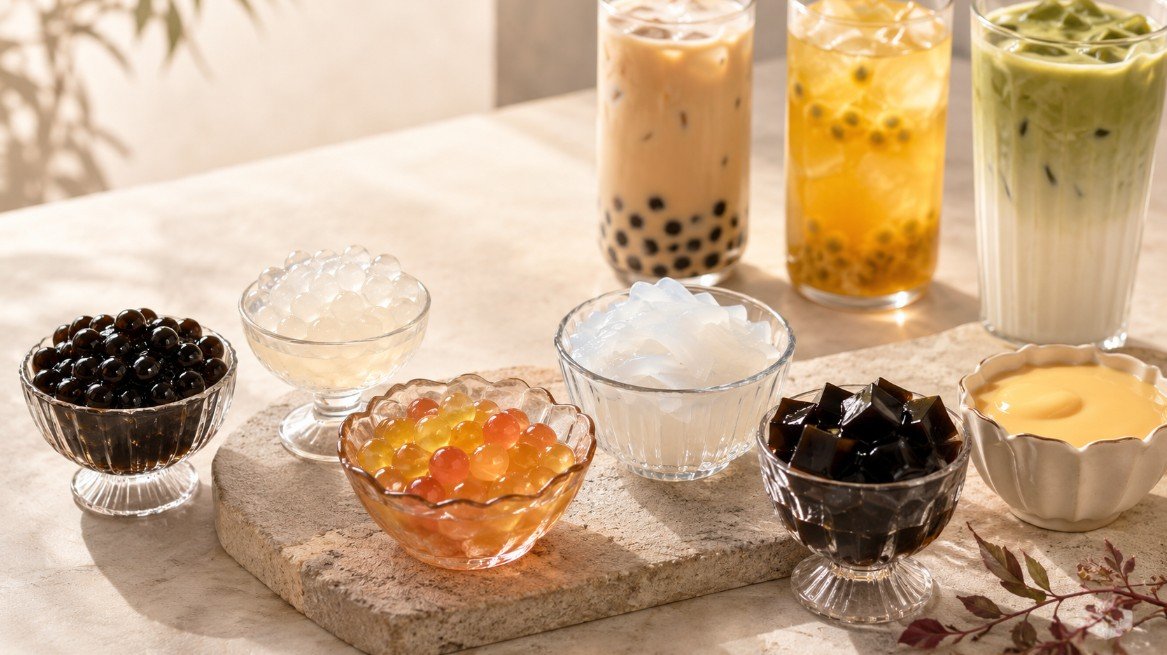
If you only need the short version, start here: tapioca pearls are dense and chewy, crystal boba is lighter and bouncier, popping boba bursts, jellies feel slippery or softly elastic, and pudding gives a creamy spoonable softness. The best topping is not the most famous one. It is the one whose mouthfeel makes sense with the drink base, sweetness level and your own tolerance for chew, weight and contrast.
What Does “Boba Texture” Actually Mean?
Texture in boba is not just about whether a topping is soft or chewy. It includes density, resistance, bounce, surface slipperiness, how the topping breaks down while you chew, how long it stays pleasant in the drink and whether it creates harmony or friction with the liquid around it.
Many people first approach bubble tea through flavor: brown sugar, matcha, peach, taro, passion fruit or roasted oolong. But flavor alone does not explain why two drinks with similar sweetness can feel completely different. Texture is the second half of the experience. It decides whether a drink feels snack-like, smooth, light, substantial, refreshing, dessert-like or tiring by the halfway point.
That is why a texture guide is useful even if you already know the names of the toppings. A topping list tells you what exists. A texture guide tells you how it will feel in your mouth and whether it fits your preferences. Someone who dislikes dense chew may wrongly assume they dislike all boba after one poorly chosen tapioca drink. Someone who wants a more interactive drink may find plain fruit tea too simple until they discover aloe, jelly or crystal boba. The right texture often changes a person’s entire relationship with the category.
Texture also helps explain why the same topping can feel better in one drink than another. Tapioca pearls in a full-bodied black milk tea can feel comforting and balanced, while the same pearls in a delicate floral jasmine fruit tea may feel too heavy. Popping boba in a bright fruit tea can feel lively and juicy, but in a roasted creamy milk tea it may feel disconnected. Good pairings are not random. They depend on weight, contrast and how much attention the topping pulls away from the drink itself.
For practical purposes, the best way to understand texture is to think in layers: chew, bounce, slip, burst, creaminess and cold thickness. Most boba toppings and drink formats fit somewhere on that map. Once you know where a topping sits, you can order more confidently and avoid textures that simply are not for you.
The Boba Texture Spectrum From Dense Chew to Creamy Softness
Boba textures are easier to understand when you group them by physical sensation instead of by menu category. These six bands cover the textures most readers encounter in real shops.
Dense chewy
Tapioca pearls are the anchor here: springy, resistant and filling, with a real bite that stays present through the entire sip.
Lightly bouncy
Crystal boba and some softer pearls give a gentler resistance that feels less heavy and less starchy than tapioca.
Slippery or elastic
Coconut jelly, grass jelly and aloe often feel smooth on the surface, with a cut, cube or strip shape that changes the sip differently from pearls.
Juicy and bursting
Popping boba offers almost no extended chew. Instead, it pops quickly and releases liquid flavor into the mouth.
Soft and creamy
Pudding, red bean and some foam-based add-ons soften the drink and create a spoonable or custard-like feel.
Frozen and thick
Slushes and smoothies create texture from ice and body rather than from toppings alone, which changes how every add-on behaves.
The Main Families of Boba Texture
These families are not just ingredient groups. They are the main ways texture enters the cup. Thinking in families helps readers understand why two toppings may look small but change a drink in completely different ways.
Chewy pearl textures
This is the iconic boba experience. Tapioca pearls are made to be bitten, not swallowed whole, and they bring weight, repetition and a snack-like rhythm to the drink. Good chewy texture feels resilient and springy without being hard at the center, dry on the outside or sticky in an unpleasant way. Pearls are usually the most filling topping and the one most likely to dominate the cup if the drink itself is delicate.
Light bounce textures
Crystal boba and similar translucent pearls sit between chew and softness. They still give resistance, but they are usually lighter, cleaner and less dense than tapioca. This makes them useful for people who want a more playful mouthfeel without turning the drink into a heavy snack. Because they do not pull as much attention as tapioca, they often suit floral tea and fruit tea better.
Slippery and jelly textures
Jelly changes the sip differently from pearls because it slides and folds instead of resisting with a full chew. Coconut jelly, grass jelly and aloe usually feel more refreshing, more fragmented and less starchy than tapioca. They can make a drink feel lighter, especially in fruit tea, but they may also feel too disconnected for people who want a classic boba chew.
Bursting and creamy textures
Popping boba and pudding sit in different physical categories, but both are useful because they shift attention away from classic chew. Popping boba gives a fast burst of flavored liquid and very little sustained bite. Pudding softens the drink and adds custard-like body. They are ideal for people who do not want the dense chew of tapioca but still want the drink to feel more dimensional than plain tea.
How the Most Common Boba Toppings Actually Feel
Names on menus are useful, but people order better when they can imagine the physical feel of each topping before taking the first sip. These comparisons focus on mouthfeel, not on ingredients alone.
Tapioca pearls
Tapioca pearls are the classic chewy texture. When they are good, they feel elastic, springy and cohesive, with enough resistance to be satisfying but not so much that they feel hard or gummy. The surface is usually glossy, the interior is uniformly soft and the overall experience is substantial enough to make the drink feel closer to a light snack.
Crystal boba
Crystal boba is more delicate. It usually has a cleaner bounce, a lighter resistance and a less starchy impression. People who find tapioca too heavy often prefer crystal boba because it adds texture without overwhelming the base drink. In floral tea and fruit tea, that lighter tension often feels more elegant.
Popping boba
Popping boba does not ask you to chew for long. The shell gives way quickly and releases flavored liquid, so the sensation is brief, juicy and highly noticeable. It works well in bright fruit-driven drinks because the burst reinforces the drink’s playful direction. In roasted or creamy tea, it can feel too loud or too sweet unless the recipe was built for it.
Coconut jelly and similar jellies
Jelly can be cubed, stripped or irregular, but the key impression is smoothness with a mild bite. It slips more than it resists. Coconut jelly often feels slightly firmer and more elastic, while grass jelly can feel softer and more fragile. Aloe sits somewhere between jelly and fresh watery softness. These toppings make a drink feel cool and refreshing rather than dense.
Pudding
Pudding brings a very different texture logic. It softens into the drink and creates creamy contrast rather than distinct chew. That makes it useful for matcha, taro, milk tea and dessert-leaning profiles. Some people love how it rounds out the cup; others find it too rich if the base is already heavy. It is usually a better choice for people who want comfort without the repetitive bite of pearls.
Foam and milk cap textures
Foam changes the sip from the top rather than from the bottom of the cup. Instead of chewing, you get a creamy layer that softens the first contact and adds weight to the aroma. Foam is more about surface contrast than about a separate snack-like element. It can be wonderful with straight tea or fruit tea, but it is less about “topping texture” in the classic boba sense than pearls or jelly are.
The Drink Base Changes How Texture Feels
Texture never exists in isolation. The same topping feels different in black milk tea, green fruit tea, matcha fresh milk and a frozen taro slush because the liquid body changes how the topping is perceived.
Milk tea makes textures feel rounder and heavier. Because milk tea has more body than clear tea, it often supports substantial toppings well. Tapioca pearls feel most natural here because the liquid has enough weight to keep the topping from feeling disconnected. Pudding also works especially well because the creamy base can absorb its softness instead of turning it into a strange interruption.
Fruit tea makes textures feel clearer and more separate. In a transparent or lightly opaque fruit tea, every topping stands out more. Popping boba feels brighter. Aloe and jelly feel especially refreshing. Tapioca pearls can still work, but they will pull much more attention than they do in milk tea, so the drink can feel less unified unless the base is strong enough to support them.
Fresh milk drinks turn texture into a dessert experience. Brown sugar fresh milk, matcha fresh milk and similar builds often make pearls feel softer and more indulgent because the drink itself is creamy and sweet. This is where many people discover they like pearls, because the chew is cushioned by milk and sugar rather than pushed against the tannic edge of tea.
Frozen drinks exaggerate thickness and resistance. Slushes and smoothies already require more effort through the straw. That means heavy toppings can make them tiring if the recipe is not balanced. In frozen drinks, lighter jellies or small popping boba often work better than very dense pearls. The best frozen-texture combinations keep the sip enjoyable instead of turning it into constant effort.
Black milk tea
Best for classic chew, pudding or a balanced one-topping build.
Jasmine fruit tea
Best for crystal boba, aloe or jelly that keeps the drink bright.
Matcha fresh milk
Best for red bean, pudding or soft pearls that support a dessert profile.
Slush or smoothie
Best for lighter add-ons that do not make the straw work too hard.
How to Tell Good Texture From Bad Texture
Many people think they dislike a topping when the real issue is that the topping was old, badly cooked, poorly stored or mismatched with the drink. Texture quality is one of the easiest ways to judge whether a boba shop is doing the basics well.
Signs the texture is good
Good tapioca pearls feel elastic from edge to center. Good crystal boba feels light and springy. Good jelly has a clean cut and a fresh slippery finish rather than a dull rubbery drag. Good popping boba bursts instead of collapsing into mush. Good pudding feels smooth and soft without graininess. Across all categories, the best textures feel intentional, fresh and integrated with the drink.
Signs the texture is off
Hard pearl centers, mushy exteriors, stale jelly, gritty pudding, watery foam, thick collapsing slush or popping boba that feels sticky rather than juicy all suggest quality problems. Another warning sign is mismatch: a topping may be individually fine but wrong for the drink, making the whole order feel clumsy.
Hard-center pearls
This usually means undercooking, old holding time or poor temperature control. The best pearls should not surprise you with a raw-feeling center.
Mushy pearls
If pearls collapse without resilience, they may be overcooked, overheld or diluted by time in the drink. Chew should soften, not disappear.
Rubbery jelly
Jelly should be clean and refreshing. If it feels dense, tired or oddly squeaky, it often signals quality issues or age.
Over-sweet popping boba
The burst should add brightness. If it tastes like pure syrup without freshness, it can overwhelm a drink immediately.
Heavy straw struggle
If every sip feels like work, the drink may be too thick, too full of toppings or poorly balanced for the straw and topping size.
How to Choose the Right Boba Texture for Your Taste
The easiest way to choose a texture is not to memorize every ingredient. It is to match the mouthfeel to your real preference: comforting chew, light bounce, refreshing slip, playful burst or creamy softness.
If you like foods with satisfying resistance, such as chewy mochi, firm noodles or al dente bite, you will probably enjoy classic tapioca pearls. They bring the most tactile involvement and the strongest identity. If you want something interactive but less heavy, crystal boba is often a safer first step because it still moves with the sip but does not dominate the drink.
If you dislike chew but still want texture, start with aloe, jelly or pudding. Jelly keeps a drink feeling cool and clean. Aloe is especially good for fruit tea drinkers who want freshness. Pudding is better if your instinct leans toward comfort, softness and dessert-like drinks rather than bright refreshment. If what you want is pure playfulness, choose popping boba, especially in a fruit tea or sparkling-style drink.
The other important question is how much texture attention you want. Some people want the topping to be the main event. Others want the topping only to decorate the drink. Dense pearls and multiple add-ons create a high-attention experience. Crystal boba, aloe and lighter jellies create lower-attention texture that supports rather than leads. This is especially useful for tea drinkers who want to taste the base clearly.
It also helps to think about mood. On some days you may want a filling, comforting drink that behaves almost like a light dessert. On other days you may want something cold, clean and easy. Texture preference changes with weather, appetite and context, which is one reason boba remains so flexible as a category.
Tapioca pearls
Choose with black tea, roasted oolong milk tea or brown sugar fresh milk if you want the most iconic chew.
Crystal boba
Choose with jasmine tea, peach tea or a lighter milk tea if you want bounce without heaviness.
Aloe or jelly
Choose with fruit tea or green tea when you want texture that feels cool rather than dense.
Popping boba
Choose with passion fruit, mango or berry drinks when you want a burst effect.
Pudding
Choose with taro, matcha or milk tea if you want soft creamy texture instead of chew.
No topping or one light topping
Choose this when you care most about the tea base and only want texture in the background.
Which Textures Pair Best With Which Drinks?
Texture pairings work best when the topping either supports the drink’s weight or creates a deliberate contrast that still feels coherent. The question is not “what can I add?” but “what feels right in this particular base?”
Best pairings that usually work
Black milk tea + tapioca pearls remains the benchmark because the tea and chew stand at the same volume. Jasmine fruit tea + crystal boba works because both are bright and relatively light. Passion fruit tea + popping boba feels natural because the burst extends the fruity profile. Matcha fresh milk + pudding works because both are soft and dessert-like. Brown sugar fresh milk + warm pearls succeeds because the dense chew belongs inside the rich creamy frame.
Pairings that can feel awkward
Dense pearls in a very delicate tea can overpower the base. Popping boba in a roasted creamy tea can feel too loud and juvenile unless carefully designed. Too many textures in one cup can make the sip exhausting. Heavy toppings in a thick slush can also make every sip feel like work. None of these combinations are impossible, but they need more intention than the average menu customization suggests.
Milk tea
Best with tapioca, pudding or one clean supporting texture.
Fruit tea
Best with crystal boba, aloe, jelly or popping boba.
Fresh milk
Best with pearls, pudding or red bean depending on sweetness and body.
Frozen drinks
Best with lighter add-ons that do not fight the thickness of the base.
How Time, Temperature and Storage Affect Boba Texture
Texture is more fragile than many people realize. A topping can go from excellent to mediocre faster than the drink’s flavor changes, which is why timing matters so much in bubble tea.
Tapioca pearls are the most time-sensitive texture most people encounter. Fresh pearls usually feel springy and alive. As time passes, they may harden, lose elasticity or become mushy, depending on how they were held and what drink they were placed into. Refrigeration helps with food safety, but it rarely helps with pearl quality. This is why pearls are often best treated as a same-day texture, ideally enjoyed soon after preparation.
Crystal boba and jellies often hold up slightly better, but they are not immune to decline. Jelly can become dull or less appealing when it sits too long, especially in very cold drinks. Popping boba may lose some of its clean burst if the shell sits in liquid for too long or if the product quality was weak to begin with. Pudding can remain edible, but the cup may lose its original clean contrast and become overly blended.
Ice level also matters. In a drink with a lot of ice, dilution slowly changes the balance between topping and liquid. A topping that felt well matched at the beginning may feel too heavy after the drink thins out. In a no-ice drink, sweetness and body may stay stronger, which can help some toppings but make others feel cloying. Temperature affects perception: colder drinks mute sweetness and can make jelly feel more refreshing, while warmer textures can make pearls feel softer and more aromatic.
The practical rule is simple: if texture is the reason you ordered the drink, do not plan to treat it like a standard take-home beverage. The longer it sits, the more likely the mouthfeel is to drift away from what the shop intended.
Best same-day textures
Tapioca pearls, foam and frozen drinks usually give their best performance closest to preparation. They are the least forgiving if you delay drinking.
More forgiving textures
Some jellies, aloe and crystal boba may remain pleasant a little longer, but they still lose something when they sit too long in the cup.
Boba Texture Questions, Answered Clearly
These quick answers summarize the practical guidance from the page in a form that is easy to use while ordering.
What is the chewiest boba texture?
Classic tapioca pearls are usually the chewiest and densest texture in standard boba drinks. They provide the most resistance and the strongest snack-like feel.
What texture is lighter than tapioca pearls?
Crystal boba is a common lighter alternative. It still has bounce, but it usually feels less dense, less starchy and less filling than tapioca.
What is the difference between jelly and boba pearls?
Pearls are usually built around chew and bounce, while jelly tends to feel smoother, more slippery and less dense. Jelly changes the sip without creating the same heavy bite.
Which texture is best for fruit tea?
Crystal boba, aloe, coconut jelly and popping boba usually work especially well in fruit tea because they keep the drink bright and refreshing.
Which texture is best for milk tea?
Tapioca pearls are the classic choice for milk tea, while pudding also works well if you want a softer, creamier dessert-like feel.
What does popping boba feel like?
Popping boba feels smooth at first and then bursts quickly, releasing flavored liquid. It offers a brief juicy sensation rather than a prolonged chew.
What if I dislike chewy textures?
Start with aloe, jelly, crystal boba or pudding. These options usually feel easier and less demanding than classic tapioca pearls.
Can one drink have too many textures?
Yes. Multiple textures can be fun, but they can also make a drink feel cluttered. One or two well-matched textures usually create a clearer and more enjoyable result than an overloaded combination.
Why do tapioca pearls sometimes taste hard?
Hard pearls often suggest undercooking, age, poor holding conditions or a drink that sat too long before being consumed.
Do boba textures stay the same after refrigeration?
No. Texture quality often declines in the fridge even when the drink remains safe to consume. Pearls are especially sensitive and are usually best enjoyed fresh.
The Best Boba Texture Is the One That Fits the Drink and Fits You
Texture is not a small detail in boba. It is one of the core reasons the category feels so distinctive and so customizable. Once you learn the difference between dense chew, light bounce, cool slip, juicy burst and creamy softness, menus become easier to read and disappointing orders become much easier to avoid.
The simplest rule is also the most useful one: do not choose toppings by trend alone. Choose the texture that makes sense with the drink base and with the way you actually like to eat and drink. A well-matched texture makes boba more memorable. A poorly matched one can make even a good flavor feel wrong.