
What Are Boba Pearls? What They’re Made Of and Why They’re Chewy
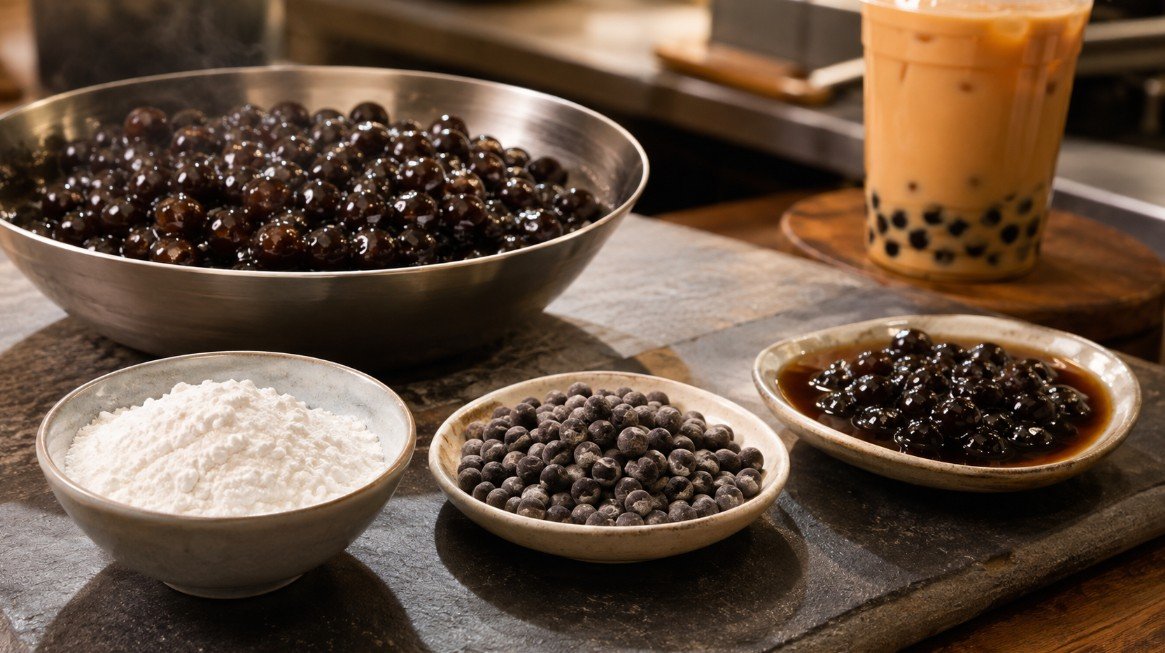
Boba pearls are small, chewy balls most commonly made from tapioca starch, a starch extracted from cassava root. They are shaped from a starch-based dough, cooked in hot water and often sweetened after cooking. The result is the springy, elastic topping that sits at the bottom of classic pearl milk tea.
The word boba can describe both the pearls and, in everyday English, the broader drink category. That is why a menu can say “boba” when it means tapioca pearls, while someone else can use the same word for an entire bubble tea drink. If that naming overlap is what brought you here, our guide to what boba means explains the broader term.
This page stays focused on the pearls themselves: what is inside them, how starch turns into a chewy food, why black pearls are dark, what they actually taste like, how they differ from popping and crystal toppings, and why a pearl that feels excellent when fresh can become noticeably firmer later.
A boba pearl is a cooked starch ball, not a bubble of liquid
Usually large enough to create an obvious chew through a wide straw.
Traditionally associated with cassava-derived starch rather than wheat flour.
A properly cooked pearl yields to the bite but still pushes back gently.
Much of the familiar sweetness comes from syrup or sugar added after cooking.
Boba pearls are sometimes described as “tapioca balls,” “tapioca pearls,” “black pearls” or simply “pearls.” Those names overlap, but they are not always perfect synonyms in every shop. A modern menu may offer mini pearls, golden pearls or a house formulation with a slightly different color, size or texture. The useful idea is simpler: traditional chewy boba belongs to the family of cooked starch pearls.
They are different from the bubbles in carbonated drinks and different from liquid-filled spheres. When you bite a tapioca pearl, there should not be a juice center that bursts. The pleasure comes from resistance, elasticity and repeated chewing.
What are boba pearls made of?
The defining ingredient is tapioca starch. Tapioca is the purified starch obtained from cassava, a starchy root crop. Cassava root and tapioca starch are therefore related, but they are not the same thing: the root is the agricultural ingredient, while tapioca starch is the refined starch used to build the pearl dough.
Commercial and homemade recipes can contain more than starch and water. Sugar, caramel coloring, brown sugar, food coloring or other permitted formulation ingredients may be used depending on the product. That is why it is safer to say that boba pearls are primarily starch-based rather than claim that every pearl everywhere follows one identical recipe. Our broader guide to what boba is made of separates the pearl ingredients from the tea, milk, sweeteners and other parts of a finished drink.
Water is not just there to make the dough workable. It becomes part of the texture story. Starch needs sufficient moisture and heat to change from a dry granular material into the cooked structure that gives a pearl its characteristic bite.
Dry starch
Pale, fine tapioca starch is the structural starting point.
Pearl dough
Moisture and formulation ingredients turn the starch into a dough that can be shaped.
Cooking
Heat and water transform the starch structure while the pearl softens and swells.
Sweetening
Cooked pearls are commonly held or coated in a sweet syrup that adds flavor and gloss.
Why are boba pearls chewy?
Boba becomes chewy because tapioca starch changes when it is heated with water. Starch granules absorb water, their ordered internal structure is disrupted, and the mixture becomes much more cohesive and viscous. In food science this transformation is described as starch gelatinization. In a pearl, that process helps turn a firm raw piece of dough into a soft, elastic cooked structure.
The ideal result is not simply “soft.” Good tapioca pearls usually combine tenderness with enough resistance to make each bite noticeable. If the center remains too firm, the pearl can feel undercooked. If the structure becomes excessively soft, the pearl can lose definition and feel mushy.
Cooling changes the experience again. Cooked starches can reorganize over time in a process known as retrogradation. In practical terms, that is one reason a pearl can become firmer as it sits or chills. Sugar and the exact formulation can influence how quickly those changes are perceived, so two shops can serve pearls that age differently even when both started with tapioca starch.
Texture is important enough that it deserves its own vocabulary. Taiwanese food culture often values springy, satisfyingly resilient textures described with the idea of Q or QQ. Boba is a particularly easy example to understand: the pearl should not disappear like pudding, but it also should not fight your teeth like a hard candy. If texture is what you are trying to choose on a menu, see our guide to boba textures.
The chemistry can go much deeper than a practical definition page needs. Readers interested in starch behavior, temperature, water and other mechanisms can continue with our boba science guide.
Why are boba pearls black, and what do they taste like?
Color
Pure tapioca starch is pale, so the familiar dark appearance of “black boba” does not come from tapioca naturally being black. Darker pearls can get their color from ingredients such as brown sugar, caramel coloring or other formulation choices. The exact recipe varies by manufacturer or shop.
Flavor
Tapioca starch itself is relatively mild. The recognizable brown-sugar, caramel-like or syrupy character of many pearls is largely created during or after preparation. Freshly cooked pearls are often transferred into a sweet syrup so the topping contributes flavor instead of tasting like plain cooked starch.
Experience
For most people, texture matters at least as much as flavor. A pearl can be deliberately sweetened, yet its identity still comes from the chew. This is why the same milk tea can feel substantially different with tapioca, jelly, popping spheres or no topping at all.
Boba pearls, popping boba and crystal boba are different foods
Modern bubble tea menus use several round or pearl-like toppings, which makes the terminology confusing. Their shapes may look related through a clear cup, but their ingredients and eating experiences can be very different.
Tapioca boba pearls
Chew rather than burst. These are the traditional starch-based pearls discussed on this page. Their appeal is springiness, softness and resistance.
Explore the full tapioca pearl guide →Popping boba
Thin shell, liquid center. Instead of a starch chew, these spheres are designed to rupture and release flavored liquid.
See how popping boba differs →Crystal boba
Translucent and differently textured. Formulations vary, and it should not automatically be treated as clear tapioca just because it is pearl-shaped.
Understand crystal boba →A useful menu-reading rule: shape is not enough to identify a topping. If ingredients, allergens or dietary restrictions matter to you, check the specific shop or packaged product rather than assuming every sphere uses the same formula.
Why fresh boba pearls feel different from old or chilled pearls
Cooked tapioca pearls are unusually time-sensitive because their quality depends so heavily on texture. A freshly prepared pearl can feel soft, elastic and moist; later, the same batch may become firmer, drier at the surface or less pleasant to chew. Refrigeration can accelerate the perception of firmness because starch structure changes as the cooked pearls cool.
Soft exterior, resilient center, glossy surface and a distinct but comfortable chew.
A center that feels noticeably hard, chalky or much firmer than the outside.
Too little structure, excessive softness or pearls beginning to lose their clean individual shape.
Increasing firmness, duller texture or a bite that no longer feels evenly elastic.
These are sensory descriptions, not a universal clock for food safety. Recipes, pearl sizes, holding conditions and commercial formulations vary. Texture quality and microbiological safety are also separate questions, so a pearl should not be judged safe merely because it still feels soft.
How to recognize traditional boba pearls in a drink
If a menu simply lists boba, pearls or tapioca as a topping, traditional chewy tapioca pearls are often what the shop means. Visually, they are commonly dark brown to black and sit at the bottom of the cup, although lighter or differently colored starch pearls also exist.
The more reliable clue is the promised texture. Terms such as chewy, tapioca or pearl usually point toward a solid starch-based bite, while “popping” signals a liquid-filled sphere. “Crystal” should be treated as its own topping description rather than assumed to mean standard tapioca.
Chewy? Likely a starch pearl.
Bursts? Think popping boba.
Translucent? Ask what “crystal” means at that shop.
If you want to move beyond definitions and compare the whole topping landscape by texture and pairing, the boba toppings guide is the better next stop.
The pearl changed how a drink could be experienced
Modern bubble tea developed in Taiwan in the 1980s, and chewy tapioca pearls became one of the category’s most recognizable features. Several businesses are associated with competing origin stories, so it is more accurate to describe the drink as emerging from Taiwan’s hand-shaken tea culture than to present one disputed invention story as settled fact.
The important contribution of the pearl is sensory. Tea was no longer only something to sip. A wide straw could deliver liquid and a chewy topping in the same mouthful, turning texture into part of the drink’s identity. That logic is still visible in contemporary boba shops, even when the cup contains fruit tea, fresh milk, matcha, coffee or another base.
That is also why “boba” eventually became bigger than one recipe. The original tapioca pearl remains an anchor, but modern menus now treat texture as a customizable layer alongside tea, milk, flavor, sweetness and ice.
Understanding pearls is easier than making excellent pearls
The basic idea sounds simple: make a tapioca-starch dough, shape it, cook it and sweeten it. In practice, hydration, dough temperature, pearl size, cooking time and post-cooking handling can all affect whether the center becomes evenly cooked and whether the finished pearl stays pleasantly elastic.
That preparation process deserves instructions rather than a compressed recipe inside a definition article. When you are ready to cook rather than just understand the ingredient, use our step-by-step guide to making boba pearls.
Questions about boba pearls
Are boba pearls the same as tapioca pearls?
In classic bubble tea, “boba pearls” commonly means tapioca pearls. However, modern menus also use the word boba more broadly, and not every round topping is made from tapioca. Popping boba and crystal-style pearls are different products.
Are boba pearls made from cassava?
They are commonly made from tapioca starch, which is extracted from cassava root. Saying “made from cassava” is broadly understandable, but “made from cassava-derived tapioca starch” is more precise.
Why are tapioca pearls black?
Tapioca starch itself is pale. Dark pearls get their color from the formulation, which can include brown sugar, caramel coloring or other coloring ingredients. Recipes vary, so darkness alone does not reveal the exact ingredient list.
Do boba pearls have flavor on their own?
Plain tapioca starch is mild. Much of the flavor people associate with classic pearls comes from sweetening during or after cooking, especially when the pearls are held in brown sugar or another syrup.
Why does boba get hard in the refrigerator?
Cooling changes the structure of cooked starch. As starch molecules reorganize after gelatinization, the texture can become firmer. The exact rate depends on formulation, sugar, moisture, temperature and other preparation variables.
Are boba pearls supposed to be hard in the middle?
A pronounced hard or chalky center usually is not the texture people are seeking from classic boba. Properly cooked pearls are generally soft and cohesive with an elastic bite rather than a distinctly raw, hard core.
Are boba pearls hollow?
Traditional tapioca pearls are solid cooked starch structures, not hollow shells. That is one of the simplest ways to distinguish their eating experience from popping boba, which is designed around a thin outer membrane and liquid center.
Can every boba shop use a different pearl recipe?
Yes. Shops may buy different commercial products or prepare pearls using different recipes, sweeteners and holding methods. Pearl size, color, sweetness and firmness can therefore vary noticeably from one shop to another.
REMEMBER THE SIMPLE VERSION
Boba pearls are tapioca-starch spheres transformed by heat and water into a chewy topping, then commonly sweetened for flavor. Their defining feature is not the black color. It is the bite.