
Boba Science: Why Texture, Tea Strength and Temperature Change the Drink
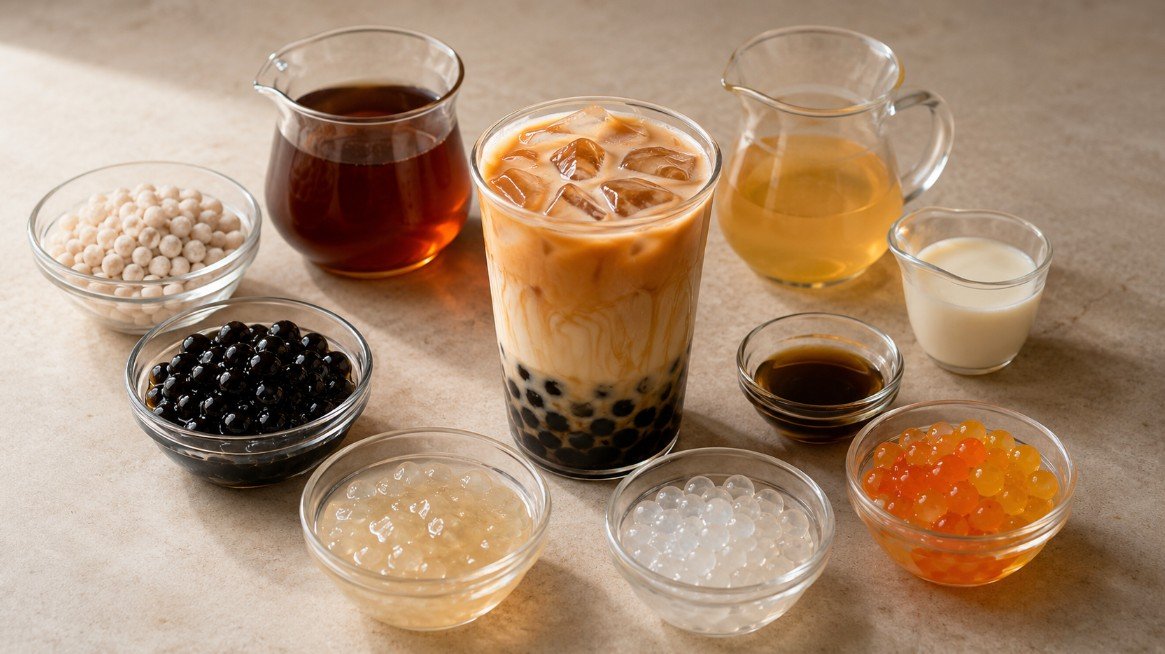
Boba is food science you can taste. Traditional tapioca becomes chewy because starch changes when it meets water and heat. Tea becomes stronger, weaker, more bitter or more aromatic depending on extraction. Ice cools the cup while also diluting it. Milk changes body and flavor perception. Sugar can support a recipe or flatten it. And toppings that look similarly round may be built from completely different physical structures.
Those interactions explain why two drinks with nearly identical menu names can behave very differently. One shop may brew a tea base concentrated enough to remain recognizable after milk and ice are added; another may let sweetness dominate. One batch of pearls may be elastic and clean through the center; another may be hard-centered, sticky or tired from holding. The finished cup is not determined by a single ingredient. It is the result of several processes meeting at the same time.
This guide focuses on those processes in practical terms. The goal is not to turn bubble tea into a laboratory exercise. It is to explain why a cup changes, what a texture problem usually means, why some recipes survive dilution better than others, and how science can help you recognize a more coherent drink.
Why Tapioca Turns Chewy Instead of Staying Powdery
The classic black pearl begins with tapioca starch, not with a naturally chewy ingredient. Dry starch is structured very differently from a cooked pearl. When starch is mixed with water and heated, its granules hydrate, swell and lose much of their original ordered structure. The mixture becomes more viscous and gel-like. In practical terms, this transformation is what makes it possible to move from a pale dry powder to the hydrated, elastic texture people expect from boba.
This process is often described as starch gelatinization. It does not mean every pearl behaves identically. Pearl size, dough formulation, water availability, heating rate, cooking time and the way the pearls are rested or sweetened can all influence the final texture. But the central mechanism is the same: heat and water reorganize the starch structure. If the center is not hydrated enough, the pearl can remain chalky or firm inside. If the network is pushed too far or then held badly, the texture can drift toward softness and collapse.
That is why the ingredient list alone cannot tell you whether tapioca will be pleasant. Our guide to what boba is made of explains the raw ingredients; science explains what happens to those ingredients during preparation. A good pearl is partly an ingredient choice, but just as importantly it is a process outcome.
Potential texture, not finished texture
Before adequate hydration and heating, tapioca starch does not yet have the elastic resistance associated with a cooked pearl.
The internal structure begins to change
Water penetrates the starch system while heat increases molecular movement, allowing the granules and surrounding matrix to swell and reorganize.
Chew comes from a hydrated network
The ideal result is neither raw and hard nor weak and mushy. It is a hydrated structure with enough resistance to feel elastic through the bite.
Why Tapioca Pearls Keep Changing After They Leave the Pot
Cooking does not freeze a pearl at one perfect texture forever. Starch systems continue to change as they cool, sit in syrup, lose heat and spend time in the finished drink. That is why a pearl can look glossy and perfectly round but still feel stale. Visual appearance is mostly surface information; chew depends on what has happened throughout the pearl.
Time and temperature matter because starch molecules continue reorganizing after cooking. Cooling can make the structure feel firmer. Extended warm holding can push the opposite direction and weaken the texture. Syrup can keep the surface sweet and glossy, yet it cannot guarantee that the center still has the same pleasant resistance it had shortly after cooking.
This is one reason high-volume shops often think carefully about batch size and holding rhythm. Making an enormous batch may be efficient only if the pearls are served while their texture remains useful. A shop that repeatedly serves clean, elastic pearls is managing more than a recipe; it is managing time.
The pearl may not have hydrated evenly, or the center may have firmed more than the exterior. The result is a noticeable core instead of one continuous chew.
The network has weakened too far. Extended cooking, prolonged warm holding or an unsuitable formulation can all move the pearl away from elastic resistance.
Surface starch and syrup can create tackiness as pearls sit. A little cling is not automatically a failure, but a gummy coating often signals that texture is moving away from its best point.
Tea Strength Is Really an Extraction and Dilution Problem
A tea-based boba drink asks more from brewed tea than a plain cup does. Once brewing is finished, the tea may still have to survive milk, syrup, fruit, foam and melting ice. A delicate infusion that tastes elegant by itself can become almost invisible after assembly. That is why a strong boba recipe is not simply “more tea.” It is tea extracted with enough character to remain recognizable in the environment where it will actually be consumed.
Temperature and time change what moves from tea leaf into water. Aroma compounds, caffeine, polyphenols and other soluble material do not all extract in exactly the same way or at the same rate. Push extraction too little and the tea can feel thin. Push it too aggressively and bitterness or astringency can overwhelm the cup. The useful target is not maximum extraction; it is enough concentration and balance for the final recipe.
Our full boba tea-base guide compares the major tea families in more detail. From a science perspective, the important point is that the same milk, sugar and ice will not interact identically with every tea.
Often easier to keep visible under milk
Black tea can bring enough body, briskness, malt or tannic structure to remain identifiable after richer ingredients are added.
A broad sensory range rather than one flavor
Darker styles can contribute toast and warmth; lighter styles may emphasize perfume and floral character. Extraction choices determine how much of that range survives the rest of the cup.
Fragrance can matter more than weight
Jasmine works well when aroma is meant to remain visible beside fruit or milk, but excessive sweetness can easily bury that advantage.
Refreshing when extraction stays controlled
Green tea can support bright fruit and lighter drinks, but harsh extraction can turn a clean base into bitterness that competes with the rest of the recipe.
Milk, Sugar and Ice Change More Than Flavor
Milk changes body, aroma release and the way bitterness or astringency is perceived. A base that feels sharp and lean by itself may become smooth and complete once milk is added. But the same effect can also hide a tea that was too delicate for the recipe. This is why “strong tea” in boba should not automatically mean harsh tea. The better target is a base with enough concentration to remain itself after dilution and softening.
Sugar is similarly more complicated than a percentage on an ordering screen. Sweetness can make fruit feel riper, bitterness feel softer and a dessert-style drink feel more complete. It can also flatten distinctions between different bases when the cup becomes dominated by syrup. Prepared fruit bases, powders, brown sugar mixtures and toppings may already contain sugar before the customer-selected sweetener is added. Understanding the ingredient side of that equation is easier when you also understand the ingredients used across boba drinks.
Ice connects temperature with concentration. The first effect is obvious: the drink gets colder. The second is slower: melting water lowers the concentration of tea, sugar and flavoring. This means the cup has a dilution curve. A recipe that tastes perfect immediately but watery ten minutes later may have been balanced only for the first sip. A stronger base may be deliberately designed to arrive at its best point after some melting.
Softens and adds body
Milk can round bitterness and add weight, but it can also mute delicate tea aroma when the base was not concentrated enough.
Changes emphasis, not only sweetness
Sweetness can support fruit and roast or push very different recipes toward the same generic syrupy finish.
Cools and dilutes at the same time
Every gram of melted ice becomes water inside the recipe, so temperature control and concentration control are linked.
Water Controls Hydration, Heat Transfer and the Way a Pearl Cooks Through
Water is easy to overlook because it does not appear as a dramatic flavor on the menu, yet it is doing several jobs at once. During pearl cooking, water is the medium that transfers heat to the starch and supplies the moisture needed for hydration. A pearl is not heated uniformly from every direction at the same instant; heat must move inward while water penetrates the structure. That is why size and cooking conditions matter. A small pearl has a shorter distance between its surface and center than a large pearl, while a larger pearl needs enough time for the middle to catch up without the outside losing too much structure.
The amount of water in the pot matters too. If there is too little, adding a large quantity of cool pearls can drop the temperature sharply and create a crowded environment where the cooking process becomes less predictable. A generous volume of actively heated water gives the system more thermal stability. This is one reason home cooks sometimes struggle when they scale a pearl recipe without scaling the water and pot size at the same time.
Water also matters after cooking. Rinsing, resting and transferring pearls into syrup all change the environment around the starch. These steps can influence surface tackiness, temperature and how quickly the pearl moves toward its served state. There is no single universal method because commercial pearls are formulated differently, but the principle is consistent: water is an active part of texture development, not just a background liquid.
Changing diameter changes the distance heat and moisture must travel. Larger pearls generally need more care to achieve an even center without over-softening the outside.
Water volume, agitation and temperature stability affect how consistently a batch cooks. Crowding makes the system harder to control.
Cooling and syrup transfer continue changing the pearl. The moment it leaves boiling water is not the end of the texture story.
Sugar Can Affect Texture and Water Behavior, Not Only Perceived Sweetness
Sugar is usually discussed as a flavor choice, but in starch-based foods it can also influence how water is available and how the system behaves during heating and cooling. In practical pearl preparation, that does not mean “more sugar equals better texture.” It means sugar is part of the environment surrounding the starch, and changing that environment can shift the way the finished product behaves.
This matters in two different places. The first is formulation: some pearl recipes or commercial products already contain sweeteners or other ingredients before cooking. The second is holding: cooked pearls are often transferred into syrup so the surface absorbs sweetness and remains appealing. That syrup changes flavor immediately, but it also creates a different water environment from plain water. The pearl is therefore continuing to interact with its surroundings while it waits to be served.
The important reader takeaway is restraint. A sweet syrup can make a tired pearl taste more attractive, but it cannot repair a fundamentally poor internal texture. Likewise, a lower-sugar pearl can still be excellent if hydration and cooking were well controlled. Sweetness and texture overlap, but they are not the same variable.
What sugar can do in the cup
Sweetness changes contrast. It can soften bitterness, make fruit seem riper and make milk feel richer. That can be useful, especially in dessert-style drinks, but it also makes weak tea and mediocre pearls harder to judge because the strongest signal in the cup becomes sweetness itself.
Foam Changes What Reaches Your Tongue Before the Drink Underneath Does
Milk foam, cheese foam and other creamy toppings create a different kind of structure from pearls or jelly. Instead of a dense solid sitting at the bottom of the cup, foam is a dispersed system containing air and liquid, often stabilized by proteins, fats, thickeners or other ingredients depending on the recipe. That changes the first contact between the drink and the mouth.
A salted or creamy foam can soften acidity, add fat and create a richer first impression before the tea or fruit underneath becomes dominant. The effect can be intentional: a sharp fruit tea may feel rounder through a creamy layer, while a roasted tea may feel more dessert-like. But foam can also become the loudest part of the cup. If the topping is extremely sweet, salty or thick, it can hide the base rather than complement it.
This is a useful example of why “balance” is not an abstract tasting word. The physical order of ingredients matters. What touches the tongue first can frame what comes next. A drink served through foam is experienced differently from the same liquid mixed completely smooth, even if the ingredient list is similar.
Science Can Explain a Good Cup Without Pretending There Is One “Perfect” Boba
Science can explain why a pearl firms, why ice dilutes, why tea disappears under milk or why a liquid-filled topping bursts. It cannot decide whether every person should prefer chewy tapioca, light crystal boba, strong roasted tea or a sweeter dessert drink. Preference remains personal. What science can do is separate preference from failure.
The base should remain identifiable
If a drink is meant to be tea-led, tea aroma and structure should still be detectable after the rest of the recipe is assembled.
Resistance should feel intentional
A tapioca pearl can be soft or quite chewy, but a dry center, collapsing exterior or stale rubberiness is different from a deliberate style choice.
Sweetness should support the identity
A dessert drink may be very sweet by design. The quality question is whether sweetness creates the intended profile or simply hides everything underneath it.
The recipe should survive the moment of drinking
A cold cup should still make sense after some ice melts, and a delivered drink should not depend on being consumed seconds after assembly.
Tapioca, Crystal Boba, Popping Boba and Jelly Do Not Create the Same Mouthfeel
Menus often group many toppings under one familiar category, but the underlying structures can be very different. Traditional tapioca is a starch-based chew. Popping boba is designed around a liquid center enclosed by a thin gel membrane. Jellies rely on gelling agents that create a cuttable or springy network. Commercial crystal boba formulations vary, but they are generally built to feel lighter and more translucent than traditional black tapioca. The important lesson is not to memorize one universal formula for every topping; it is to recognize that the physical system determines the mouthfeel.
That is also why topping choice changes flavor perception. A dense scoop of warm tapioca adds syrup and slows drinking. Popping boba gives short bursts instead of sustained chew. Jelly can move more quickly through the straw and create a cleaner bite. Pudding adds softness and body. Toppings are not accessories placed on top of a finished flavor; they change the rhythm of every sip.
Our boba texture guide focuses on mouthfeel, while the toppings guide helps match those textures to actual drink styles. Here, the useful science is the connection between structure and experience.
Dense resistance comes from a cooked hydrated starch network. The pearl asks you to chew rather than simply swallow the topping.
Commercial formulas vary, but the intended experience is usually more translucent and lighter than classic tapioca.
The sensory event comes from rupture: a thin outer layer gives way and releases liquid rather than asking for a long chew.
Jellies can be springy, slippery or clean-cut depending on formulation, but their bite is mechanically different from a starch pearl.
What Common Boba Problems Usually Point To
Once the cup is treated as a system, disappointing drinks become easier to diagnose. The point is not to pretend you can reverse-engineer a commercial recipe from one sip. It is to identify the most likely category of failure so you know what to change next time.
The base may have been too weak for the amount of ice, or the recipe may not have been designed around the expected dilution during drinking.
The surface tells you little about the center. Uneven hydration, insufficient cooking or later firming can all create a hard core.
The tea extraction may be too light for the amount of milk and sweetener, leaving body without a recognizable base.
High sweetness can create intensity without structure. Tea, acidity and fruit character may not be balanced well enough to remain distinct.
The problem may be pairing rather than quality. Dense chew can overwhelm a delicate drink, while a very light topping can disappear in a heavy dessert-style cup.
Home preparation makes these mechanisms easier to feel because you can change one variable at a time. Brew the same tea at two strengths, taste pearls immediately and later, or compare one drink before and after ice melts. The boba recipes section is where those principles become practical.
Food Science Is Useful Only When the Claim Matches the Ingredient and the Situation
Commercial boba products are not chemically identical just because they share a menu label. Crystal boba, jelly, foam, powders and fruit bases can use different formulations from one manufacturer or shop to another. That is why this guide avoids assigning one universal recipe to every commercial topping. When exact ingredients matter for allergies, dietary restrictions, storage or choking risk, the specific product disclosure and preparation context are more useful than visual assumptions.
The same applies to storage and serving. A texture observation is not automatically a food-safety judgment. A pearl becoming firmer tells you something about texture; it does not by itself tell you whether the food is safe. Those questions belong in the dedicated boba safety guide, where storage, allergens and age-related considerations can be treated separately from sensory quality.
Boba Science FAQ
Why are tapioca pearls chewy?
Heat and water change tapioca starch into a hydrated, gel-like structure with elastic resistance. The exact chew depends on formulation, pearl size, cooking and holding.
Why do tapioca pearls get hard in the center?
A hard center can come from uneven hydration or insufficient cooking, and texture can also firm as cooked starch cools and reorganizes. Surface softness does not guarantee an evenly hydrated center.
Why does boba tea sometimes taste watery after a few minutes?
Melting ice adds water to the recipe. If the original tea and flavor base were not concentrated enough for that dilution, the cup can lose definition as you drink it.
Why does some milk tea barely taste like tea?
The tea may have been extracted too lightly for the amount of milk, syrup and ice, or the recipe may intentionally prioritize creamy sweetness over tea character.
Is popping boba made the same way as tapioca pearls?
No. Traditional tapioca is starch-based and chewy. Popping boba uses a thin gel membrane around a liquid center, so its defining texture is rupture rather than sustained chew.
Does more sugar always make boba taste better?
No. More sugar increases sweetness, but the best level depends on the tea, fruit, milk and topping. High sweetness can support some dessert drinks and overwhelm more delicate tea-led recipes.
The useful idea to remember: a boba drink is not one recipe and not one ingredient. It is a moving balance between extraction, hydration, sweetness, dilution, temperature and texture. Once those pieces become visible, both good cups and bad cups become much easier to understand.