
Where to Buy Boba Supplies: Online, Local Stores and Specialty Suppliers
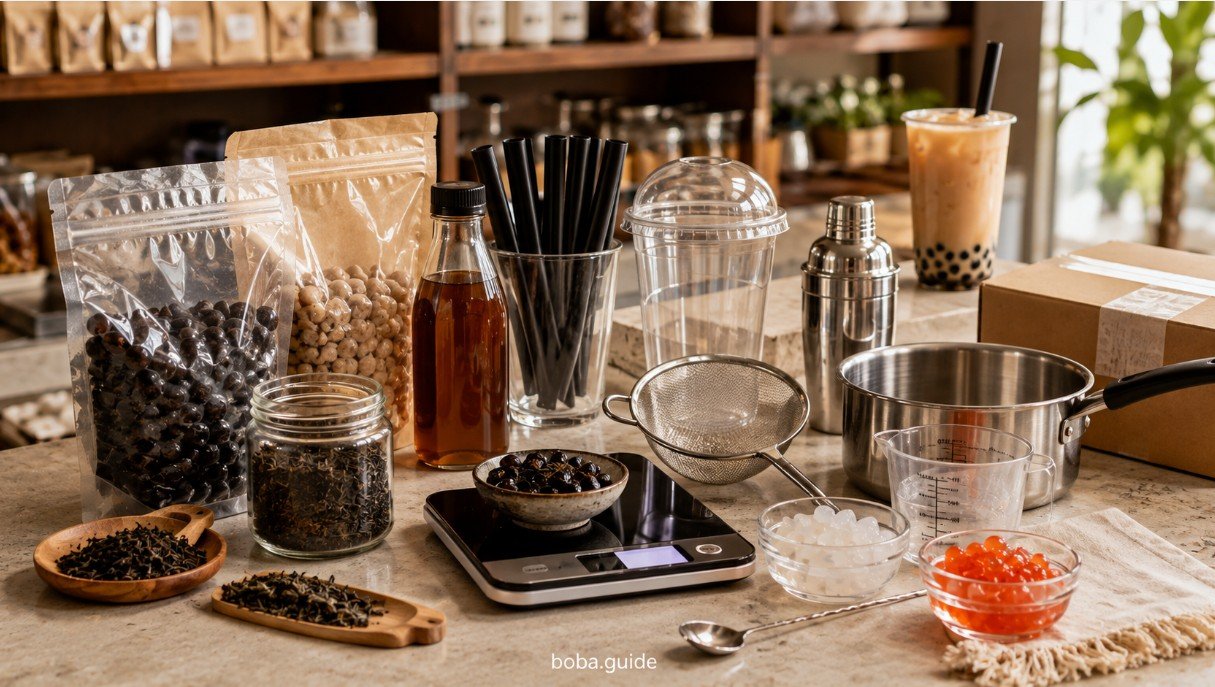
The best place to buy boba supplies depends on what you need. Specialty bubble-tea suppliers are strongest when you want a broad range of pearls, syrups, toppings, cups and shop equipment. Asian grocery stores are often the easiest local source for tea, tapioca pearls and familiar pantry ingredients. Restaurant-supply sellers become more useful for cups, lids, straws, storage and higher-volume equipment. Large online marketplaces are convenient when you want fast comparison and small mixed orders.
Before choosing a store, separate the purchase into ingredients, serving supplies and equipment. The seller that is best for a bag of tapioca pearls may not be the best place to buy a case of cups or a sealing machine.
Match the seller to the type of boba supply
No single store is automatically best for every part of a bubble-tea setup. Start with the category you need, then compare sellers that specialize in that job.
Specialty bubble-tea supplier
Look here for: tapioca pearls, popping boba, jellies, syrups, powders, tea, wide straws, cups and dedicated boba equipment.
Why choose it: the catalog is built around bubble tea, so ingredient formats and serving pieces are more likely to be compatible with each other.
Asian grocery store
Usually strongest for: tea, tapioca pearls, brown sugar, milk products, canned ingredients and some jellies or drink mixes.
Why choose it: local availability, smaller purchases and the chance to inspect packaging before buying.
Restaurant-supply store
Good choice for: cups, lids, straws, pitchers, storage containers, measuring tools, blenders, sealing equipment and case quantities.
Why choose it: food-service packaging and equipment are the main business rather than an afterthought.
Large online marketplace
Makes sense for: mixed small orders, reusable cups, hand shakers, strainers, measuring tools and trying a few widely available ingredients.
Why choose it: convenience and broad comparison, provided you check seller details, package size and product specifications carefully.
If you are still deciding what belongs in your setup, start with our boba supplies overview before choosing a retailer.
Where to buy each category of boba supplies
Start with the item you need, then compare the sellers that handle that category well.
Compare tapioca pearls, boba straws and reusable boba cups before choosing a specific product.
Choose a bubble-tea supplier when compatibility matters most
Specialty suppliers are built around the drink category itself. They commonly group tapioca pearls, crystal boba, tea, syrups, cups, lids, straws, tools and machines in one place, which makes them especially practical when several boba-specific items need to work together.
Why this route works
You can often compare pearl types, topping formats, cup systems and equipment without translating everything from unrelated food-service categories.
It is also easier to find supplies made specifically for bubble tea, such as extra-wide straws, cup-sealing film and dedicated scoops.
What to watch
Specialty catalogs may lean toward commercial package sizes. Before ordering, compare the amount you will actually use, shipping weight and the storage requirements after opening.
Home users do not automatically need the same case quantity a café buys.
Specialty bubble-tea sellers commonly separate pearls, straws, cups, kitchen tools and equipment into clear product categories, making it easier to compare components that need to work together.
Local Asian markets can be excellent for the ingredient side of boba
For home boba, an Asian grocery store can cover more of the recipe than people expect. The strongest categories are usually pantry ingredients rather than commercial serving equipment.
Look first in the tea aisle
Black tea, jasmine tea, oolong and other Asian tea styles may be available in bags or loose-leaf formats. Choose the tea for the drink you intend to make rather than simply buying the largest package.
Check dry goods for tapioca pearls
Packaging and cooking instructions vary. Read the label before assuming one pearl product cooks like another. If you are comparing products specifically, compare pearl size, cooking method and package quantity before choosing.
Explore refrigerated and canned ingredients carefully
Milk products, grass jelly, canned fruit and other ingredients may work in particular boba styles. Buy around recipes you plan to make rather than treating every sweet Asian ingredient as a bubble-tea topping.
Do not expect a complete shop setup
A grocery store may have pearls and tea while offering no compatible wide straws, cups or café equipment. That is normal; combine shopping channels when needed.
Restaurant-supply sellers become more attractive as volume increases
Food-service suppliers are especially strong when the purchase is about serving, storage or equipment rather than a specialty flavor.
Case quantities can make sense for parties, events or businesses, but verify that the lid and straw system matches the cup before ordering large quantities.
Containers, pitchers, scoops and prep tools are often easier to compare in a restaurant-supply catalog because capacity and material specifications are central to the listing.
This route is stronger when durability and repeated service matter. A commercial blender or sealer should be evaluated as equipment with workload, cleaning and support needs.
The tradeoff is scale. A case that works for a café can be absurd for a person making two drinks on Saturday afternoon.
Restaurant-supply sellers often carry wide beverage straws, tapioca, cup-sealing film, storage containers and beverage equipment alongside general food-service supplies, making this channel especially relevant for higher-volume packaging and preparation.
Convenience is the advantage; listing quality is the variable
An online marketplace can be convenient when you want a shaker, reusable cup, strainer and a small ingredient order from one checkout. The tradeoff is that products from unrelated sellers may use inconsistent terminology and specifications.
Seller and brand identity
Know who is actually selling the product. The marketplace name alone does not tell you who made or packed the tea, pearls or topping.
Exact package quantity
Photos can make small packs look large and bulk cases look manageable. Read the net weight, count and number of units.
Dimensions
For straws, cups, lids and shakers, dimensions are functional information. “Boba straw” means little if the diameter is not suitable for your topping.
Storage instructions
Pay particular attention to toppings and syrups that may have different requirements before and after opening.
Choose local when inspection and immediacy matter; choose online when selection matters
Local shopping is stronger when…
You need the ingredient today, want to inspect package size, prefer a small quantity, or are testing whether you even like a tea or pearl product.
It also avoids shipping a heavy order across the country just to try one basic ingredient.
Online shopping is stronger when…
You need a specific straw width, unusual topping, compatible cup system, dedicated equipment or a broader range than local shelves can offer.
Online comparison also makes it easier to evaluate several sizes and formats before buying.
Looking for a physical store nearby? See boba supplies near me for local shopping options.
Six checks prevent most bad boba-supply purchases
Confirm what the product actually is
“Boba” can refer to tapioca pearls, popping boba, crystal boba or the drink itself. Make sure the listing matches the texture and preparation method you expect.
Read the package size in real units
Do not judge by the photo. Compare ounces, pounds, grams, unit count and number of packages.
Check compatibility
Cup, lid and straw dimensions need to work together. Shakers need enough capacity for the drink plus ice. Sealing film needs to fit the machine and cup system.
Check how the ingredient is prepared
Traditional tapioca pearls, quick-cook pearls, instant mixes and ready-to-serve toppings create very different workflows.
Check storage after opening
A large container is only economical if you can store and use it appropriately.
Calculate the whole order, not the sticker price
Shipping, case quantity and unused product can matter more than a small difference in unit price.
Bulk boba supplies make sense only when your usage is predictable
Buying larger quantities can reduce unit cost, but it also commits storage space and money to one product.
Buy smaller first when
You are testing a new pearl, tea, powder, syrup or topping. A small pack lets you learn whether you actually like the product and whether it fits your routine.
Consider bulk when
You repeatedly use the same product, understand its storage needs and know roughly how quickly you finish it.
Case quantities make more sense when
You are serving events, groups or customers and the packaging or ingredient turns over fast enough to justify the volume.
If you would rather start with a coordinated bundle than build the cart piece by piece, compare boba kits before buying large individual packages.
Heavy liquids and bulky packaging can change which seller is actually cheaper
A bottle of syrup, a tub of topping and a case of cups behave very differently in a shipping cart. Compare the complete delivered order instead of assuming the lowest item price wins.
Relatively compact, but larger sacks still add weight. Check the package amount rather than comparing headline prices between different sizes.
Liquids are heavy and containers can be large. Shipping can erase a unit-price advantage on small orders.
Light but bulky. Case dimensions and storage space can matter almost as much as weight.
Check delivery conditions, electrical requirements, warranty terms, replacement parts and return policies before treating equipment like an ordinary kitchen purchase.
Skip listings that hide basic product information
You should not have to guess the size, quantity or identity of a supply that needs to fit into a recipe or serving system.
No clear net weight or unit count
If the quantity is hidden behind vague photos, you cannot compare value accurately.
No dimensions for cups, lids or straws
Compatibility depends on measurements. Generic labels such as “large” or “wide” are not enough.
No preparation information for pearls
Cooking method is central to how a tapioca product fits your routine.
No meaningful seller or manufacturer information
Be more cautious with food ingredients when you cannot tell who packed, imported or sold the product.
A price that only looks low because the pack is tiny
Compare equivalent quantities before deciding that one listing is a bargain.
Build the order from the drink backward
Pick the drink family
Classic milk tea, fruit tea, matcha, fresh milk and slush drinks do not require identical ingredients.
Choose the topping
The topping affects pearls or jelly, straw width, cup capacity and sometimes storage.
List only the missing supplies
A saucepan, scale or strainer already in your kitchen does not need to be purchased again with a boba label.
Choose the seller by category
Buy ingredients where the ingredient selection is strongest and serving supplies where dimensions and compatibility are easiest to verify.
Found a store with a genuinely good boba-supply selection?
Tell us what kind of store it is, what you found there and the city or region at info@boba.guide. Local discoveries are especially helpful when a store carries supplies that are normally hard to find nearby.
Where to buy boba supplies: common questions
Answers about local stores, online shopping, tapioca pearls, cups, equipment and bulk orders.
Where is the best place to buy boba supplies?
The best seller depends on the item. Specialty bubble-tea suppliers are strong for pearls, toppings, syrups and dedicated boba supplies; Asian grocery stores can be convenient for tea and tapioca pearls; restaurant-supply sellers are strong for cups, straws, storage and equipment; and online marketplaces are convenient for mixed small orders.
Can I buy boba supplies at an Asian grocery store?
Often, yes. Asian grocery stores may carry tea, tapioca pearls, brown sugar, milk products, canned ingredients, jellies or drink mixes. Selection varies by store, and you may still need another source for wide straws, compatible cups or specialized equipment.
Where can I buy tapioca pearls for boba?
Check specialty bubble-tea suppliers, Asian grocery stores and reputable online sellers. Compare pearl size, cooking instructions, package quantity and ingredient information rather than assuming every black tapioca pearl cooks the same way.
Where should I buy boba cups and wide straws?
Specialty bubble-tea suppliers and restaurant-supply stores are strong places to compare cups, lids and extra-wide straws. Check exact dimensions so the cup, lid, straw and toppings work together.
Is it better to buy boba supplies online or locally?
Local shopping is convenient when you want a small quantity, need an ingredient immediately or want to inspect the package. Online shopping offers broader selection and is stronger for specific cup systems, straw widths, unusual toppings and specialized equipment.
Should I buy boba supplies in bulk?
Buy bulk quantities when you already know the product, use it consistently and have appropriate storage space. Smaller packages are usually safer when testing a new tea, pearl, syrup, topping or powder.
Can restaurant-supply stores sell bubble tea equipment?
Yes. Restaurant-supply sellers may carry wide beverage straws, cups, sealing film, storage containers, blenders and other equipment used for bubble tea service. Product ranges vary, so verify specifications and compatibility before ordering.
What should I check before buying boba supplies online?
Check the exact product type, net weight or unit count, seller identity, dimensions, preparation method, storage instructions and the total delivered cost. For cups, lids and straws, compatibility measurements are especially important.
Are boba starter kits a good way to buy supplies?
A starter kit can be convenient when you want a coordinated first order and do not need to choose every ingredient separately. Individual purchases give you more control over tea quality, pearl type, serving supplies and tools.
What is the cheapest way to buy boba supplies?
There is no single cheapest source for every item. Compare equivalent quantities and include shipping, package size and how much product you will actually use. A lower unit price can cost more overall when the package is too large or shipping is expensive.