
Reusable boba cup buyer’s guide
Best Reusable Boba Cups: Size, Lid, Straw and Material Guide
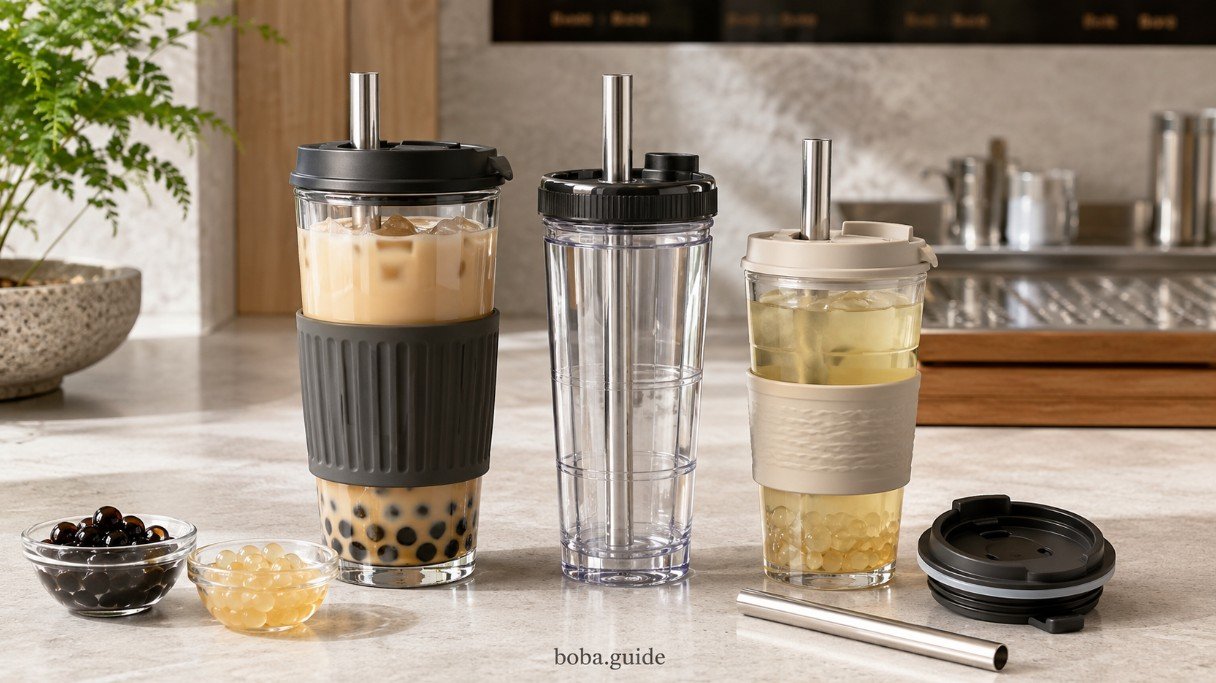
A reusable boba cup has to do more than hold tea. It has to leave enough room for ice and toppings, accept a genuinely wide straw, keep that straw usable with the lid, survive cleaning, travel without becoming annoying, and still let you reach the last tapioca pearls at the bottom. A beautiful tumbler can fail at any one of those jobs.
That is why the best reusable boba cup is better judged as a system than as a container. Capacity affects how much ice and topping fit. The lid determines how the cup travels. Straw diameter determines whether pearls pass cleanly. Material changes weight and breakage risk. Gaskets and replacement parts determine whether the cup is still pleasant to own a year from now.
This guide focuses specifically on that reusable cup system. For the wider setup around cups, straws, sealers, shakers and other tools, use our boba supplies guide.
Start here
A Good Boba Cup Is a System, Not Just a Tumbler
A normal reusable cold cup only needs to hold a beverage comfortably. A reusable boba cup has one extra requirement that changes almost everything: solid toppings must travel through the lid and straw as reliably as the liquid does.
That means the cup, closure and straw should be evaluated together rather than purchased as unrelated accessories.
If any one part is badly matched, the whole system becomes less useful. A large cup with a narrow lid opening is not a good boba cup. A 12 mm straw is not useful if the lid only accepts a smaller straw. A leak-resistant lid is less useful if the straw remains permanently exposed during transport.
What Size Reusable Boba Cup Should You Buy?
Reusable boba cups currently appear across a surprisingly wide capacity range. Smaller formats around 12–16 oz can be excellent for moderate drinks, while 20–24 oz cups more closely resemble many large takeaway bubble-tea orders.
| Capacity | Approx. volume | Useful for | Main trade-off |
|---|---|---|---|
| 12 oz | ≈355 ml | smaller tea, lighter milk tea, modest topping portion | ice and pearls consume a larger share of available volume |
| 16 oz | ≈473 ml | balanced everyday drinks | may feel small if you regularly order large shop drinks |
| 20 oz | ≈591 ml | larger iced tea and milk tea | more bulk than a standard travel cup |
| 24 oz | ≈710 ml | large boba, heavy ice and generous toppings | weight and portability, especially in glass |
Capacity is not simply the amount of tea you want to drink. Ice displaces liquid. Tapioca occupies the bottom of the cup. Foam, fruit pieces or popping boba can consume additional space. A 16 oz vessel therefore does not necessarily produce a finished drink that feels equivalent to a 16 oz topping-free beverage.
Taiwan market signal
Why 700 ml Keeps Appearing in Reusable Pearl-Tea Cups
Reusable pearl-tea products sold in Taiwan provide a useful clue about practical capacity. Current examples use approximately 700 ml cups paired with a 12 mm wide straw.
Seven hundred milliliters is about 23.7 U.S. fluid ounces—effectively the same capacity class that the U.S. market usually calls 24 oz.
That pairing is revealing because it treats the drink as a complete bubble-tea system rather than a standard tumbler with a decorative wide straw added later.
This does not mean 700 ml is the universal ideal. It does mean there is a mature-market reason large reusable pearl-tea cups frequently cluster around this volume: the cup has room for a substantial cold drink, ice and toppings without forcing all three into a small vessel.
Glass vs Tritan: The Better Material Depends on How You Carry It
Borosilicate or tempered glass makes the drink easy to see and gives reusable boba cups a clean, substantial feel. Pearls, tea layers and fruit remain visually clear, and glass generally resists odor retention well.
Why people like it
- excellent visual clarity;
- pleasant mouthfeel when drinking without a straw;
- does not rely on a clear plastic body;
- works well for home and desk use;
- often paired with protective silicone or plastic sleeves.
Where it becomes less convenient
Glass is heavier before the drink is added and remains breakable even when a sleeve reduces the risk. A 24 oz glass vessel filled with approximately 700 ml of liquid, ice and toppings can become a substantial object to carry around all afternoon.
A clear Tritan-style cup can preserve much of the transparent boba aesthetic while reducing the concern that one drop will end the life of the cup.
Why it works well
- lighter than a comparable glass vessel;
- more forgiving during commuting or travel;
- transparent enough to see toppings;
- often dishwasher compatible;
- sensible for people who regularly carry the cup outside the home.
The trade-off
Clear plastic can accumulate cosmetic wear differently from glass, and the feel is not identical. The useful question is not whether glass is more premium—it is whether that premium feel is worth the added weight and breakage risk for your routine.
Current products illustrate both directions. Teaboco’s 24 oz system uses borosilicate glass, while Dodoko’s 24 oz cup uses Tritan for a more impact-resistant travel-oriented design.
The Straw Opening Can Make or Break the Cup
A reusable cup can include a wide-looking straw and still provide disappointing topping clearance. The important dimensions are the usable straw bore and the opening through the lid.
Dodoko’s current shatter-resistant cup provides a useful engineered example: its stainless straw is approximately 0.53 inch wide, about 13.5 mm, while the lid opening is approximately 0.55 inch, about 14 mm.
That is a better system than taking a generic travel mug and discovering afterward that a proper boba straw does not pass through the lid.
The required straw width also depends on what goes into the cup. Standard tapioca pearls are one case; larger popping boba, jelly and irregular toppings can require more forgiving clearance. Our boba straw guide covers diameter in more detail.
“Leakproof” Is Not One Test
Reusable drink products often use words such as leakproof, splashproof and spill-resistant, but those labels can describe very different real-world conditions.
For boba, evaluate the cup in four distinct states.
Closed, with the straw removed
This is the strongest transport state. A plug or sealed port should keep liquid inside when the cup is carried upright or briefly tilted.
Closed, with the straw stored inside
Some reusable boba cups let the straw collapse or store inside the vessel. That can make transport easier because the drinking opening can be closed separately.
Straw inserted
Once a straw passes through the lid, the system normally has an open pathway. A product can still resist splashes without being something you should throw sideways into a backpack.
Bag transport
This is the most demanding everyday test. The cup can rotate, press against other objects and remain tilted longer than it would in a cup holder.
When portability matters, look for a cup with a closure that can be genuinely sealed when the straw is not in use. Treat any claim made with the straw permanently inserted as a different category of protection.
Lid Design Matters More Than It Looks
The lid controls how the cup transitions between drinking, transport and cleaning. Several design details are worth checking before purchase.
Wide enough for the intended boba straw without forcing it through a small silicone opening.
Useful if the cup needs to travel with the straw removed.
Helps control leakage but also creates another surface that needs cleaning.
A screw lid can feel more secure for transport, while a well-designed press-fit lid can be quicker to open and clean.
Pay attention to how the lid behaves after months of use. A complicated closure with several tiny components may offer excellent sealing when new while becoming frustrating if replacement gaskets or plugs are impossible to obtain.
The Best Reusable Cup Is One You Will Still Clean Properly
Boba creates more cleaning challenges than plain water or iced coffee. Milk residue can sit beneath gaskets. Fruit pulp can collect around a straw port. Tapioca starch and syrup can dry inside a wide reusable straw.
Cleaning path
- Empty the toppings promptly. Dried tapioca and syrup become much harder to remove.
- Remove the straw. Rinse before residue dries inside the bore.
- Disassemble the lid. Remove accessible silicone plugs and gaskets when the manufacturer permits it.
- Brush the full straw interior. A quick rinse is not enough after milk tea or sweet toppings.
- Dry components separately. Trapped moisture around a gasket or stored straw can create odor.
A dishwasher-safe claim is useful, but it does not remove the need to inspect narrow channels and removable seals. Follow the specific care instructions for the exact cup you buy.
Cup-Holder Fit and Portability Deserve Their Own Check
A 24 oz cup can be comfortable at a desk and irritating in a car if the base is too wide for the holder. Product width matters independently of capacity.
Dodoko currently lists its 24 oz cup at approximately 3.54 inches wide and 7.6 inches high. Its extended straw is approximately 9.69 inches. Those dimensions help explain why a product can hold a large boba serving while still being designed around travel.
Do not assume every 24 oz reusable cup has the same footprint. Tall and narrow can behave very differently from short and wide even when both hold the same amount.
Think about where the cup spends its day
If it mostly moves between kitchen and desk, extra glass weight may not matter. If it travels on public transit, sits beside a laptop or gets carried to the gym, impact resistance and closure design become much more important.
Reusable Boba Cups Do Not All Manage Condensation the Same Way
Bubble tea is usually cold, and large cups can hold ice for a long time. A single-wall glass or plastic cup can develop visible condensation depending on the drink temperature and room humidity.
A silicone sleeve can improve grip and reduce the amount of cold, wet surface touching your hand, but it does not magically turn a single-wall cup into a vacuum-insulated bottle.
Excellent visibility, but condensation can be noticeable with heavily iced drinks.
Lighter and less breakable, but still subject to exterior condensation.
Improves grip and handling while partially separating your hand from the cold surface.
If long-term temperature retention is your highest priority, a standard clear reusable boba tumbler may not be the optimal category. Transparency, topping visibility, low weight and insulation pull cup design in different directions.
When a 24 oz Reusable Boba Cup Is Too Much
The popularity of 24 oz and 700 ml formats can make them look like the obvious default. They are not.
- you normally make 12–16 oz drinks;
- you use relatively little ice;
- you want a lighter glass cup;
- cup-holder compatibility matters more than maximum volume;
- you mainly drink tea without large topping portions.
- your usual shop order is already large;
- you use plenty of ice;
- you want generous tapioca or popping boba portions;
- you make fruit tea with fruit pieces;
- you prefer one vessel that also handles smoothies and large cold drinks.
A smaller cup filled correctly is better than a giant cup that encourages every homemade drink to become oversized simply because empty space remains.
Current Reusable Boba Cup Price Examples
Reusable boba cups span enough price points that it is useful to compare what the extra money is actually buying.
Tritan body, stainless wide straw, travel-oriented lid system.
Glass cup with protective outer layer, reusable cold-drink system and replaceable components.
Mid-size option for users who do not need a 24 oz vessel.
Borosilicate glass, silicone protection, reusable wide straw accessories and cleaning tools.
These are current August 2026 examples rather than a universal price range. Promotions, colors, bundles and inventory can change. More importantly, the cheapest cup can become poor value if its lid or straw is difficult to replace.
Which Reusable Boba Cup Type Fits You?
Mostly at home
Glass can make excellent sense
You get clarity, a premium feel and less concern about drops during commuting. A 16–24 oz glass cup with a removable silicone sleeve and wide straw is a strong setup.
Daily commute
Prioritize closure and impact resistance
A Tritan-style cup with a closable straw system can be more practical than heavy glass. Check cup-holder width before buying.
Large boba orders
24 oz / ~700 ml is the natural zone
It gives ice, liquid and toppings enough room without turning every drink into a tightly packed cup.
Smaller tea drinker
12–16 oz avoids unnecessary bulk
You can still use a full-size boba straw while keeping the vessel lighter and easier to carry.
Lots of toppings
Investigate the straw opening first
Do not buy based on capacity alone. Confirm approximately 10–12+ mm compatibility depending on the toppings you normally use.
Long-term ownership
Replacement components matter
A cup with replaceable plugs, lids or seals can remain useful long after a one-piece product would have been discarded.
If you are building your first complete home setup rather than upgrading only the cup, continue with our boba starter kit guide.
One important distinction
Reusable Cup for Yourself Is Different From a Shop Reuse Program
A personal reusable cup is straightforward: one person owns it, cleans it and brings it back. A shop-operated reuse program introduces a different level of sanitation, return logistics, storage and local regulatory considerations.
If you operate a boba shop, do not assume that a consumer reusable cup is automatically appropriate as standardized commercial serviceware. Check local food-service requirements and build a proper washing and handling process for any reusable system under business control.
For commercial sourcing of cups, straws and other service items, use our guide to where to buy boba supplies.
How to Compare Two Reusable Boba Cups Without Guessing
Choose your real capacity
Start with the finished drink size you make most often, including ice and toppings.
Identify your largest regular topping
A cup for plain milk tea has different straw requirements from one used with large popping boba or jelly.
Verify the straw bore and lid opening
Do not assume that “boba straw included” guarantees comfortable clearance.
Choose material for your actual routine
Glass is excellent when clarity and feel matter most. Tritan can be better when drops and commuting are normal.
Understand the closed state
Check whether the straw hole can really be sealed before calling the cup suitable for transport.
Inspect the cleaning path
Look for removable gaskets, accessible channels and a brush that reaches the entire reusable straw.
Measure where the cup has to fit
Check car cup holders, backpack pockets, refrigerator shelves and any other space that matters to you.
Look for replacement parts
A replaceable lid or plug can extend useful life far more than a decorative accessory bundle.
For frequent large boba, a 20–24 oz cup with roughly 10–12+ mm topping clearance, a genuinely closable lid and an easy-to-clean reusable straw is a strong starting point. Choose glass when feel and clarity matter most; choose a durable clear plastic such as Tritan when lower weight and breakage resistance matter more.
Found a Reusable Boba Cup That Solves a Real Problem?
We are interested in details that ordinary product listings often miss: whether the cup really fits a car holder, whether large pearls clear the included straw, whether the plug still seals after months of use, whether the gasket is easy to remove, and whether replacement parts are actually available.
If you manufacture reusable bubble-tea drinkware or have long-term experience with a cup worth investigating, send specifications or corrections to info@boba.guide. Product submissions do not guarantee inclusion or a favorable recommendation.
Questions About Reusable Boba Cups
These are the practical details worth checking before a reusable cup becomes part of your daily boba routine.
What size reusable cup is best for boba?
A 20–24 oz cup is a practical choice if you usually make large bubble tea with plenty of ice and toppings. A 12–16 oz cup can be better for smaller tea or milk-tea servings because it is lighter and easier to carry. Current reusable pearl-tea products in Taiwan commonly use about 700 ml, roughly 23.7 oz, which helps explain why the 24 oz size works well for large hand-shaken drinks.
Is a 24 oz reusable boba cup too large?
Not if your normal drink is already large. A 24 oz cup leaves room for ice, tapioca pearls and liquid without packing everything tightly together. It can be unnecessarily bulky if you usually drink 12–16 oz servings, use little ice or want the lightest possible glass cup. Choose capacity from your normal drink rather than from the largest size available.
Is glass or Tritan better for a reusable boba cup?
Glass is excellent for clarity, feel and home or desk use, while Tritan-style clear plastic can be lighter and more forgiving when the cup is carried every day. Neither material is universally better. A commuter may value impact resistance more than glass weight and appearance, while a home user may prefer the feel and visibility of borosilicate or tempered glass.
How wide should the straw be in a reusable boba cup?
Around 10–12 mm is a useful starting range for many classic boba drinks, but large toppings may benefit from more clearance. Some current reusable boba systems use even wider straws; Dodoko, for example, lists a stainless straw around 13.5 mm with a lid opening around 14 mm. Always test the cup against the largest topping you regularly use.
Are reusable boba cups really leakproof?
It depends on what state the cup is in. A cup can seal very well with the straw removed and its port closed yet become only splash-resistant when the straw is inserted. Before carrying a cup in a bag, check whether the straw opening can be fully closed and whether the manufacturer intends the product for tipped or upright transport.
How do you clean a reusable boba cup and straw?
Remove leftover toppings before they dry, rinse the wide straw promptly, disassemble removable lid seals according to the manufacturer’s instructions and use a brush that reaches the full straw interior. Milk tea, syrup and tapioca residue can remain inside wide straws and around gaskets even when the cup looks clean after a quick rinse. Dry the components separately before reassembly.
Can a reusable boba cup fit in a car cup holder?
Some can, but capacity alone does not tell you the base width. For example, Dodoko currently lists its 24 oz cup at about 3.54 inches wide and 7.6 inches high. Measure the cup holder you actually use before buying, especially when choosing a large 24 oz glass or Tritan cup.
How much does a good reusable boba cup cost?
Current August 2026 examples range from about $19.99 for a 24 oz Tritan Dodoko cup to around $33–$35 for current KeepCup boba-oriented sizes and $39.99 for the 24 oz Teaboco glass set. Prices change, and included straws, sleeves, cleaning tools, lid design and replacement parts can matter more than the lowest initial price.
What should I look for before buying a reusable boba cup?
Check capacity, cup width, material, lid closure, straw diameter, lid opening, straw length, ease of cleaning and whether replacement parts are available. Then test those specifications against your real use: the drink size you make, the toppings you use, the cup holder or bag you carry and whether the cup needs to remain sealed during transport.