
Lychee Jelly: What It Is, Taste, Ingredients, Prices & How to Use It
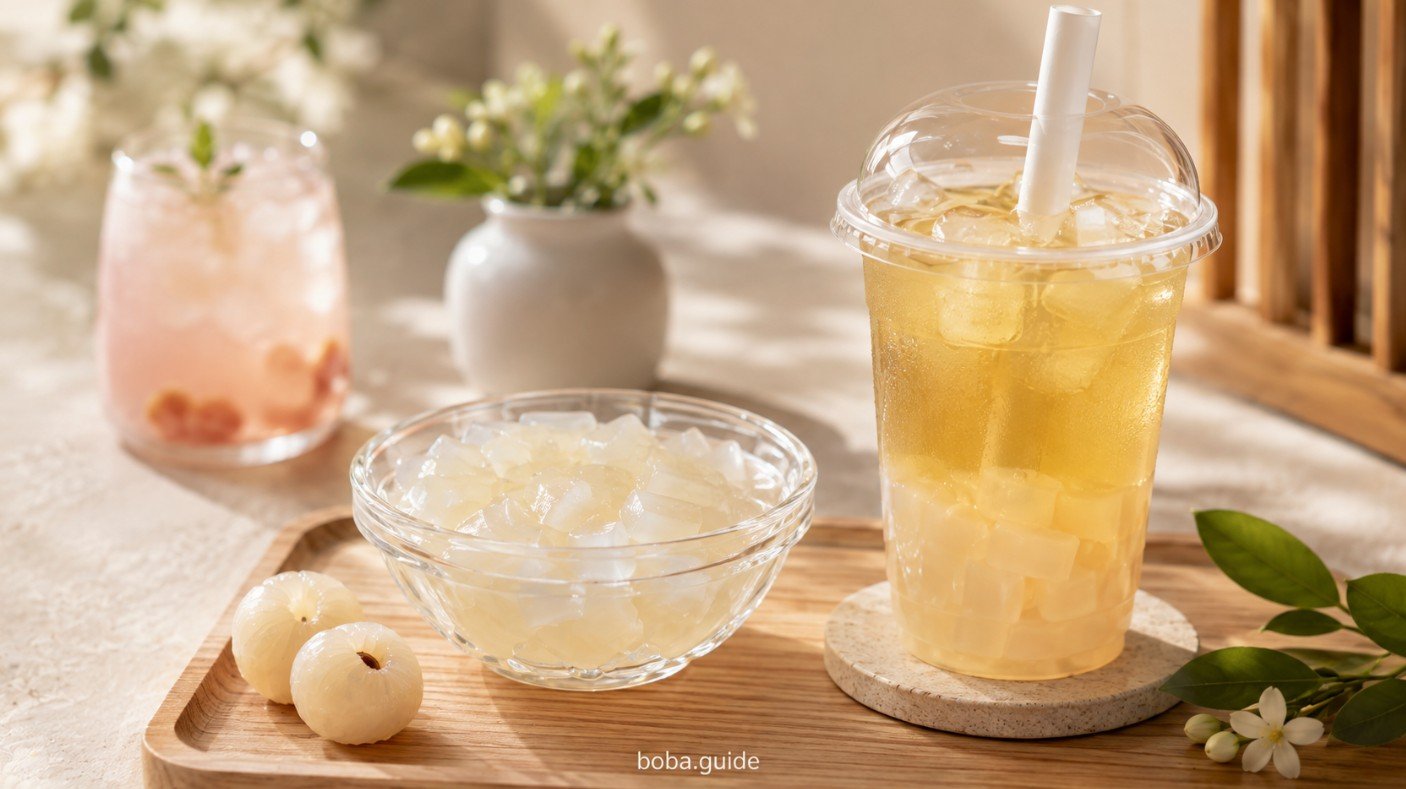
Lychee jelly is a sweet, translucent, chewy topping used in bubble tea, fruit tea and desserts. In many U.S. boba-supply products, “lychee jelly” is lychee-flavored nata de coco rather than a conventional gelatin dessert. That distinction matters because it explains the firmer, springier bite, the cube-like shape and why many commercial versions are plant-based.
The topping is usually served ready to eat from syrup, with a pale clear-to-white appearance and a floral, tropical lychee flavor. It pairs especially well with jasmine tea, green tea, passion fruit, peach, citrus and other bright fruit drinks.
What is lychee jelly?
Lychee jelly is a fruit-flavored chewy topping served in bubble tea, fruit drinks, smoothies, shaved ice, frozen yogurt and desserts. Commercial boba versions are commonly pale, translucent pieces stored in sweet syrup and served without cooking.
The boba-shop version is usually not a soft dessert gelatin
When people search for “lychee jelly,” they can mean several foods: soft gelatin-style cups, konjac jelly snacks, homemade fruit jelly, or the firmer topping scooped into bubble tea. The boba-shop version is often nata de coco flavored with lychee syrup or lychee flavoring.
That is why the topping can feel firmer and more resilient than a spoonable gelatin dessert. It is designed to survive mixing, ice, a wide straw and time in a cold drink.
Lychee jelly belongs to the larger family of chewy and jelly-style add-ons. Compare it with pearls, pudding, popping boba and other options in our boba toppings overview.
What does nata de coco have to do with lychee jelly?
Nata de coco is an edible bacterial-cellulose gel traditionally produced by fermenting coconut water. It is then processed into chewy pieces and can be sweetened or flavored for beverages and desserts.
Coconut water becomes the fermentation medium
The gel is not simply chopped coconut meat. Bacterial cellulose is produced during fermentation in a coconut-water-based medium.
A firm cellulose gel forms
This creates the characteristic resilient texture that makes nata de coco noticeably firmer than many gelatin desserts.
The gel is cut into small pieces
Commercial beverage toppings are typically portioned into cubes, strips or small morsels that can travel through a wide straw.
Lychee flavor and syrup create the finished topping
The tropical fruit character generally comes from added lychee flavor, syrup or juice ingredients rather than from the coconut-water fermentation itself.
荔枝椰果 — lychee nata de coco
Taiwanese bubble-tea suppliers commonly list the product as 荔枝椰果. The second part, 椰果, refers to nata de coco. A current Taiwanese manufacturer describes its product as 62% nata de coco with a springy Q texture, and positions it for bubble tea, fruit tea, slushes and desserts.
Lychee jelly is often sold internationally as lychee nata de coco or lychee coconut jelly
The wording changes by market. In Taiwan, the most useful term is 荔枝椰果 — lychee nata de coco. In Japan, ナタデココ is already a familiar texture category in drinks and desserts. Korean retail listings commonly use 나타드코코 and 코코넛젤리 for beverage toppings, including lychee-flavored products.
荔枝椰果
This is the clearest supplier term for lychee-flavored nata de coco. Taiwanese manufacturers position it as a bubble-tea, fruit-tea, slush and dessert topping rather than a soft spoon dessert.
ナタデココ
Nata de coco is treated as its own chewy texture category. Japanese beverage products emphasize the crisp, resilient bite rather than grouping it with ordinary gelatin jelly.
나타드코코 · 코코넛젤리
Retail listings use both nata-de-coco and coconut-jelly terminology for small beverage topping pieces. Lychee-flavored 5 mm products are sold specifically for drinks.
If a package says “lychee coconut jelly,” “lychee nata de coco,” or an Asian-language equivalent, it may be the same broad style of topping Americans call lychee jelly. Shape, ingredients and serving directions still matter more than the English front-label name.
What does lychee jelly taste like?
Lychee jelly is usually sweet, floral and lightly tropical. Good versions suggest the perfumed character of lychee fruit without tasting aggressively candy-like.
Floral, fruity and gently tropical
Lychee has a distinctive perfumed sweetness that can feel more delicate than mango or passion fruit.
Firm, springy and chewy
Nata-de-coco-based pieces resist the teeth more than soft gelatin, with a light snap before they yield.
The syrup can matter as much as the jelly
Commercial toppings are often packed in sweet syrup, so the same base can taste very different across brands.
Lychee works best when the drink leaves room for it
Jasmine, green tea and light fruit bases let the floral aroma show more clearly than very rich chocolate or coffee drinks.
About “Q” texture: Taiwanese food language often uses Q or QQ for a pleasantly springy, resilient chew. Nata de coco fits naturally into that texture vocabulary, although it does not chew exactly like tapioca pearls.
What is lychee jelly made of?
There is no one universal recipe. A commercial U.S. bubble-tea supplier may start with nata de coco pulp, then add sweeteners, lychee flavor, acids, stabilizers, preservatives and sometimes colors.
Provides the chewy cellulose structure in many boba-shop lychee jellies.
Sugar, fructose or syrup creates the sweet packed-liquid environment and finished flavor.
Commercial products may use flavoring, syrup, juice or a combination depending on the manufacturer.
Ingredients such as malic acid and sodium citrate can help shape acidity and product stability.
Some shelf-stable products use preservatives such as potassium sorbate.
These vary. Never assume every clear-looking lychee jelly has the same ingredient profile.
Does lychee jelly contain gelatin? Many commercial boba-shop versions made from nata de coco do not need gelatin. For example, Bossen identifies its lychee jelly as nata de coco and labels that specific product vegan. That does not prove every product called “lychee jelly” is gelatin-free, so check the exact ingredient label if this matters to you.
Lychee jelly vs crystal boba, popping boba and tapioca
These toppings can all add chew or texture to a drink, but they are not interchangeable.
Lychee jelly vs lychee crystal boba
Both can be translucent and lychee-flavored, which causes confusion. The easiest visual clue is shape: lychee jelly is generally sold as cut pieces, while lychee crystal boba is sold as round pearls. The texture can also differ because crystal-boba formulations may use konjac, carrageenan, alginate, agar or other gelling systems rather than nata de coco.
For the broader pearl category, see our crystal boba guide.
Best drinks for lychee jelly
Lychee jelly works best when its floral fruit character complements the drink rather than fighting a very heavy base.
Jasmine green tea
One of the cleanest pairings. Jasmine echoes lychee’s floral aroma while the jelly adds sweetness and chew.
Passion fruit tea
The sharp tropical acidity balances lychee’s sweetness. Fanale specifically recommends lychee with passion fruit.
Peach or white-peach tea
Soft stone-fruit sweetness keeps the drink fragrant without becoming overly acidic.
Citrus tea
Lemon, grapefruit, yuzu-style or orange drinks can benefit from a sweet chewy counterpoint.
Lychee green tea
Using lychee jelly in an already lychee-flavored drink creates a deliberate fruit-on-fruit profile.
Slushes and smoothies
The firmer pieces stay texturally distinct against a frozen drink better than a very soft jelly would.
Shaved ice
Nata-de-coco-style jelly works naturally with fruit, condensed-milk-style desserts and cold toppings.
Frozen yogurt or ice cream
Its chew gives a cold dessert a contrasting texture without needing fresh fruit preparation.
How to serve and store lychee jelly
Ready-to-serve commercial jelly is one of the easiest toppings to add to a boba menu, but storage after opening still matters.
Open and check the label
Confirm whether the product is ready to serve and how the manufacturer wants the opened container stored.
Use a clean scoop
Keep the product and syrup clean rather than repeatedly introducing drink residue into the container.
Portion roughly 50–80 g as a starting reference
A Taiwanese manufacturer lists 50 g per 500 ml drink, while Bossen suggests 60–80 g. Your ideal amount depends on cup size and how topping-heavy you want the drink.
Add the drink over the jelly
Serve with fruit tea, jasmine tea, smoothies or dessert drinks and a sufficiently wide straw.
18-month unopened shelf life; cool, dry storage; refrigerate after opening and use within 2 weeks.
12-month shelf life for its Taiwanese lychee nata-de-coco product; 3.7 kg container, 4 containers per case.
These are manufacturer-specific examples, not one universal storage rule. Always follow the package you actually bought.
How much does lychee jelly cost in the U.S.?
Among two major U.S. bubble-tea suppliers we checked, large single containers came out to roughly $2.13–$2.38 per lb. The simple two-supplier average is about $2.26/lb. That is an observed specialty-supplier benchmark, not a national average.
Bossen 8.38 lb bottle + Fanale 8.8 lb jar.
A useful reference, not an official U.S. market average.
8.38 lb bottle
single-container benchmark
8.8 lb jar
single-container benchmark
33.4 lb case
case-price example
35.2 lb total
promotional multi-jar example
Prices change. These listings were checked on August 19, 2026. Shipping, tax, promotions, flavor, seller and regional availability can materially change the final cost.
Lowest single-container cost in our sample
Bossen and Fanale both sell large ready-to-serve containers in this range. They are easy to portion in a busy shop but can be excessive for occasional home use.
Higher price per pound, easier inventory rotation
Fanale lists this case at $144, roughly $4.08/lb. Smaller sealed units can reduce the amount exposed each time a package is opened.
Much higher unit cost, much smaller open pack
Fanale lists this case at $179.95, roughly $5.83/lb. The premium buys smaller individually sealed portions rather than cheaper raw product.
What does one serving cost?
Using the average of the Bossen and Fanale single-container prices, a 50 g portion is about $0.25, a 60 g portion about $0.30, and an 80 g portion about $0.40 before shipping, tax, waste and labor.
For a shop
Bossen suggests 60–80 g per serving. An 8.38 lb bottle therefore holds roughly 48–63 reference servings. Because Bossen also says to refrigerate after opening and use within 2 weeks, a shop using that product would need only about 3–5 servings per day to finish one bottle inside that window.
For home use
A cheaper price per pound can be misleading. If a household only uses one or two servings per week, smaller sealed packages may be more economical even when the listed price per pound is higher.
Why lychee jelly can be operationally attractive
There is no cooking cycle, no warm holding period and no same-day cooked-tapioca texture decline. A shop can scoop a standardized portion directly from a refrigerated opened container, which can reduce preparation labor. The trade-off is that the syrup-packed product is heavy to ship and still has an after-opening use window.
How many calories are in lychee jelly?
There is no trustworthy single calorie number for every product called lychee jelly. The base, syrup concentration, serving weight and formulation all affect the final nutrition.
Nata de coco itself is only part of the product
Commercial boba jelly is usually packed in sweet syrup, so calories cannot be estimated from bacterial cellulose alone.
Serving weight matters
A 50 g shop scoop and an 80 g scoop differ by 60% in weight before you even compare brands.
Flavoring and sweeteners vary
Some ingredient lists include sugar, fructose or high-fructose syrup alongside fruit flavoring and acids.
Use the exact product label
If sugar, calories, allergens or dietary restrictions matter, the nutrition and ingredient panel on the product in your hand is the reliable reference.
Do not confuse lychee jelly with popping boba when comparing nutrition. The products have different structures, ingredient systems and typical serving densities.
Seven things to check when buying lychee jelly
The cheapest food-service jar is not always the best purchase. Compare the exact product against how you plan to use it.
Chewy jelly pieces can be a choking risk for young children
Bossen places a choking warning on its lychee jelly and says children under 5 should be supervised while eating. The product’s firm, slippery chew and straw-served format are good reasons to take the warning seriously.
Do not treat chewy jelly pieces like ordinary juice. Supervision, smaller pieces and age-appropriate serving matter.
Keep the manufacturer’s package warning available to staff and avoid making broad safety claims that go beyond the exact product instructions.
Sell Lychee Jelly? Get Listed on Boba.guide
If your business manufactures, imports, distributes or sells lychee jelly or lychee nata de coco, send the details buyers and boba shops need to compare products.
Brand and product name
Nata de coco, konjac or other base
Retail, wholesale or both
Package and case sizes
Current U.S. pricing
Countries or states served
Shipping or local pickup
Ingredient and specification sheets
Information is reviewed before inclusion. Editorial inclusion is not guaranteed, and paid placements must be clearly marked as sponsored.
Help us compare real lychee jelly across the U.S.
If you find a lychee jelly with an especially good texture or a shop pairing worth trying, send the brand, city, drink, topping texture and a photo to info@boba.guide. Specific details help us distinguish a soft jelly from true nata-de-coco chew and make the guide more useful for other boba drinkers.
Lychee jelly: common questions
Quick answers about nata de coco, gelatin, flavor, serving, storage, pricing and how lychee jelly differs from other boba toppings.
What is lychee jelly?
Lychee jelly is a sweet, chewy fruit-flavored topping used in bubble tea and desserts. Many commercial boba-shop versions are lychee-flavored nata de coco rather than conventional gelatin jelly.
Is lychee jelly made from coconut?
Many commercial boba-shop versions are made with nata de coco, an edible bacterial-cellulose gel produced through coconut-water fermentation. The finished topping is then sweetened and flavored with lychee.
Does lychee jelly have gelatin?
Not always. Nata-de-coco-based lychee jelly can be made without gelatin, and some commercial products are specifically labeled vegan. Check the exact ingredient list because other foods sold as lychee jelly may use different gelling systems.
What does lychee jelly taste like?
It is usually sweet, floral and lightly tropical, with the perfumed fruit character associated with lychee. The syrup and flavoring strength vary by brand.
Is lychee jelly the same as crystal boba?
No. Lychee jelly is commonly sold as cut nata-de-coco pieces, while crystal boba is generally sold as round jelly-style pearls and may use konjac, carrageenan, alginate, agar or other gelling systems.
Is lychee jelly the same as popping boba?
No. Lychee jelly is chewy throughout. Popping boba has a thin gel shell surrounding a liquid center that bursts when bitten.
How much lychee jelly should go in one boba drink?
Supplier examples vary. A Taiwanese manufacturer uses 50 g for a 500 ml drink, while Bossen suggests 60–80 g. Treat those as reference points and adjust for cup size and desired topping amount.
How much does lychee jelly cost in the U.S.?
In our August 19, 2026 check, Fanale listed an 8.8 lb food-service jar at $20.95, about $2.38 per pound before shipping and tax. Case formats and smaller sealed bags have different per-pound economics.
How long does lychee jelly last after opening?
Follow the exact package instructions. Bossen currently recommends refrigeration after opening and use within two weeks for its lychee jelly. Other manufacturers may specify a different window.
What drinks pair best with lychee jelly?
Jasmine green tea, passion fruit tea, peach tea, citrus tea, lychee green tea and fruit slushes are especially natural pairings because they complement its floral tropical sweetness.