
Popping Boba: What It Is, How It Pops, Flavors, Prices & How to Use It
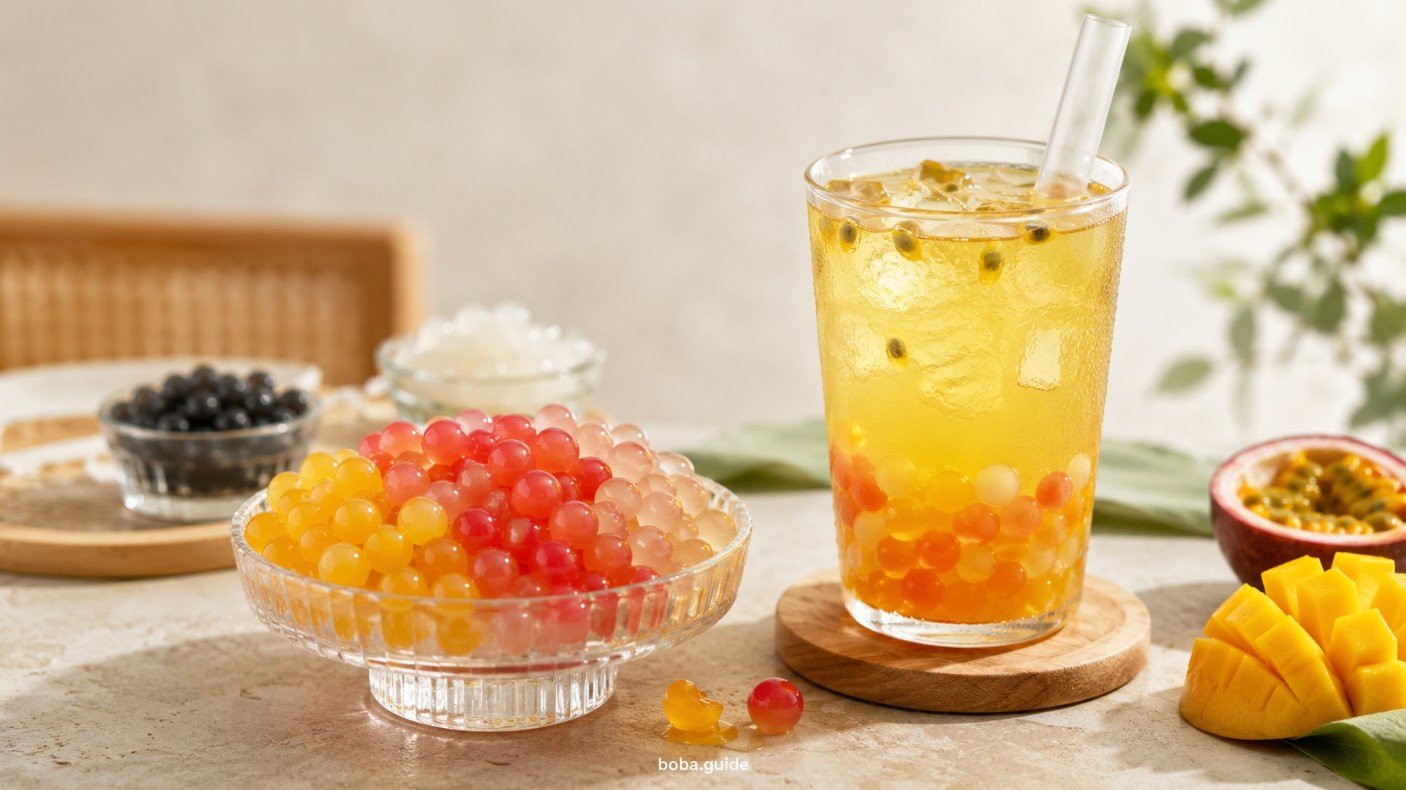
Popping boba is a ready-to-serve, liquid-filled bubble-tea topping with a thin edible gel membrane that bursts when bitten. Unlike tapioca pearls or crystal boba, the center is fluid rather than chewy all the way through. Commercial versions are commonly made with sodium alginate and a calcium salt to create the outer membrane, while the center carries fruit juice, flavored syrup or another sweet liquid.
That structure makes popping boba one of the easiest toppings to recognize: it looks like a glossy round pearl, but the eating experience is closer to a tiny juice capsule. It works especially well in fruit tea, lemonade-style drinks, slushes, yogurt and cold desserts.
What is popping boba?
Popping boba is a spherical drink topping with a very thin gel shell and a liquid center. Bite the shell and the center releases quickly, creating the “pop” that gives the topping its name.
The defining feature is the liquid center
A round shape alone does not make something popping boba. Crystal boba is also round, but it is jelly-like throughout. Tapioca is chewy throughout. Popping boba is built around a shell-and-liquid structure.
Current commercial products are typically sold fully prepared in tubs or bottles. They do not need boiling, soaking or a fresh-cook holding cycle before service.
Popping boba is one of several very different topping families. Compare it with tapioca, crystal pearls, jellies and pudding in our boba toppings overview.
How does popping boba get a liquid center?
Commercial popping boba uses controlled gel formation around a flavored liquid. Sodium alginate and calcium salts are common parts of that system because calcium can cross-link alginate into a thin gel membrane.
Start with a flavored liquid
The center may contain real fruit juice, flavored syrup or a combination of water, sweetener, acids and flavoring.
Use alginate and calcium chemistry
Commercial ingredient lists frequently include sodium alginate plus calcium lactate or calcium chloride. Those ingredients help form the gel structure.
Create a membrane around the liquid
The goal is a shell strong enough to survive packaging and scooping but thin enough to rupture easily when bitten.
Pack the finished spheres for ready-to-serve use
The pearls are sold fully formed, so a shop can scoop them directly into a cold drink or dessert.
Important: the simplified “sodium alginate + calcium” explanation describes the gel-forming principle, not one universal factory recipe. Commercial products can also contain modified starch, xanthan gum, cellulose gums, acids, preservatives, colors and other ingredients.
Popping boba has several names across Asian and international markets
The English labels “popping boba,” “bursting boba,” “juice balls” and “popping pearls” overlap heavily. Taiwanese suppliers use an even larger family of terms.
爆爆珠 · 爆漿珍珠 · 果汁球
Taiwanese manufacturers use these terms for thin-membrane spheres that release sweet liquid when bitten. ZArtisan also lists names such as 爆爆球 and 爆爆彈 within the same commercial category.
ポッピングボバ · コーティングジュース
Japanese retail and food media use “popping boba,” while “coating juice” is also used for similar juice-filled spheres sold as dessert and drink toppings.
팝핑보바
Korean retail listings use a direct transliteration of popping boba and sell fruit-flavored versions in large drink-service packs.
If a product says bursting boba, juice ball, popping pearl, 爆爆珠 or ポッピングボバ, compare the ingredient list and liquid-center description before deciding whether it is equivalent to another brand.
“Fruit-flavored” does not always mean the same amount of real fruit juice
Popping boba can look similar across brands while the liquid inside is formulated very differently. Current U.S. supplier listings show a meaningful spread in declared juice content.
Real fruit juice in its Pure25 fruit flavors.
Real juice claim for the Originals collection.
Real fruit juice stated for its popping boba.
Some products rely primarily on flavored syrup and do not state a fruit-juice percentage.
Why this matters: two mango popping bobas can have the same color and still taste very different. Juice percentage, sweetener system, acidity and flavoring all affect the center. A higher juice percentage is useful information, but it is not the only measure of quality.
What does popping boba taste and feel like?
The shell should feel delicate rather than rubbery. The first bite creates light resistance, then the membrane ruptures and the flavored liquid releases quickly.
Thin, soft and bouncy
A good shell survives the scoop and straw but does not require hard chewing.
Juicy and immediate
The center should release as a quick burst rather than behave like a solid gel.
Usually bright and fruit-forward
Mango, strawberry, passion fruit, lychee and peach naturally suit the format because their acidity keeps the sweet center lively.
Can be stronger than the tea itself
The topping contributes its own syrup and flavor, so a full drink may need less added sweetener.
Popping boba vs crystal boba, tapioca and jelly
They can all fit through a wide straw, but the structure and eating experience are completely different.
The two alternatives most often confused with popping boba are crystal boba and cut fruit jelly. Their key difference is structural: one stays chewy throughout, while popping boba is defined by a liquid center.
Popping boba flavors range from classic fruit to yogurt, coffee, soda and sour styles
Current supplier catalogs show how broad the category has become. The best flavor is the one that improves the drink rather than simply adding another sweet element.
Natural with passion fruit, green tea, lemonade-style drinks and tropical slushes.
Works with jasmine tea, strawberry milk, yogurt drinks and berry blends.
High-acid flavor that pairs well with citrus, mango and green tea.
Floral and delicate, especially good with jasmine and lighter fruit teas.
Useful when the topping should echo an existing fruit note in the drink.
A tangier dessert-style option used in tea, frozen yogurt and snow ice.
Designed around novelty, acidity or beverage-like flavor rather than natural fruit identity.
Proof that popping boba is now a texture platform, not only a fruit-topping category.
How to serve and store popping boba
Most commercial popping boba is designed for immediate use from the container. The main operational challenge comes after the package is opened.
Open and verify the product directions
Confirm refrigeration and after-opening guidance on the exact product.
Use a clean scoop
Avoid crushing the spheres or contaminating the packed liquid with tea, milk or other toppings.
Start around 20–25 g when using Bossen-style portions
Bossen recommends about 30–40 bobas, or 20–25 g, for its 10 mm Pure25 product. Other brands and shop formats may use larger portions.
Add to a cold finished drink
Popping boba works particularly well in fruit tea, iced tea, lemonade-style drinks and slushes.
Use a wide straw and avoid rough mixing
The membrane is designed to burst under pressure, so excessive mechanical abuse can break pearls before serving.
18-month unopened shelf life; refrigerate after opening; recommended use within 1 week.
18-month shelf life; store cool and dry; refrigerate after opening and consume as soon as possible.
How much does popping boba cost in the U.S.?
Across three current large single-container listings from Bossen, Possmei and Fanale, popping boba came out to roughly $2.84–$3.44 per lb. The simple three-supplier average is about $3.06/lb. This is a specialty-supplier benchmark, not an official national average.
Bossen, Possmei and Fanale single-container examples.
A practical reference before shipping, tax and waste.
7.05 lb tub
large single-tub example
7.04 lb tub
25% real-juice example
7.26 lb tub
single-tub example
28.16 lb case
case-price example
29.04 lb total
multi-tub offer
Possmei retail-size example ≈ $5.78/lb.
Why would anyone pay almost twice as much per pound?
Because a smaller package may be easier to finish after opening. Home buyers are often better served by lower total commitment than the lowest wholesale unit cost.
What does a 20–25 g serving cost?
A 20 g portion is roughly $0.13 and a 25 g portion roughly $0.17 before shipping, tax, waste and labor.
Bossen’s serving claims do not reconcile perfectly
Bossen lists a 7.04 lb tub as approximately 100 servings and also recommends 20–25 g per serving. Those figures are not mathematically identical: 7.04 lb is about 3,193 g, which would equal roughly 128 servings at 25 g or 160 servings at 20 g if every gram were usable topping. For cost calculations, the gram-based serving size is the safer reference.
The one-week clock still matters
Bossen recommends consuming the opened tub within 1 week. Using the gram-based 20–25 g reference, finishing a full 7.04 lb tub would require roughly 18–23 portions per day. Actual usable yield can be lower because the packed product includes liquid and shops may portion differently.
Prices change. Prices shown were verified on August 19, 2026. Flavor, juice content, seller, shipping, promotions and package format can materially change the final cost.
How many calories are in popping boba?
Calories vary with serving size, fruit-juice percentage, sweeteners and formulation. A product-level number is more useful than a generic estimate.
Fanale states approximately 30 calories per serving for its popping boba. The page does not specify the serving weight in the same visible product summary, so do not apply that number universally.
Why another brand may differ
Bossen Pure25 contains 25% fruit juice, while other products may use different juice levels, syrup systems and portion sizes. Those differences affect sugar and calorie content.
Juice content is not the same as sugar content
A higher fruit-juice percentage does not automatically mean a lower-sugar product.
Serving size changes everything
Twenty grams and fifty grams are very different topping portions.
Flavors may use different formulas
Fruit, yogurt, sour, soda and coffee styles do not necessarily share the same nutrition panel.
Use the exact label
For calories, sugar, allergens or dietary needs, check the specific tub you are serving.
Eight things to check when buying popping boba
Price per pound is only one part of the decision. The membrane, juice content and after-opening window can matter just as much.
Popping boba needs age-appropriate serving and supervision
Possmei places a warning on its popping boba not to feed the product to children under 3. Because popping boba is round, slippery and commonly consumed through a wide straw, follow the manufacturer’s warning on the exact product you buy.
Do not treat popping boba like ordinary juice. Round toppings can present a choking hazard, especially when sucked quickly through a straw.
Keep package warnings available and use age-appropriate judgment rather than assuming all pearl-style toppings are equally easy to swallow.
Sell Popping Boba? Get Listed on Boba.guide
If you manufacture, import, distribute or sell popping boba in the U.S., send the details buyers and boba shops need to compare products intelligently.
Brand and product name
Declared juice percentage
Flavors and pearl diameter
Package and case sizes
Current U.S. pricing
After-opening storage window
Shipping or local pickup
Ingredient and specification sheets
Information is reviewed before inclusion. Editorial inclusion is not guaranteed, and paid placements must be clearly marked as sponsored.
Tell us what actually popped, tasted fresh and worked in the drink
Send the brand or shop, city, flavor, drink pairing, texture and a photo to info@boba.guide. Notes such as “thin shell, tart passion-fruit center” or “very sweet mango syrup” are much more useful than a generic rating.
Popping boba: common questions
Quick answers about ingredients, juice content, storage, prices, calories and the difference between popping boba and chewy pearl toppings.
What is popping boba?
Popping boba is a round bubble-tea topping with a thin edible gel membrane surrounding a liquid flavored center. The shell bursts when bitten, releasing the liquid.
What is popping boba made of?
Formulas vary, but commercial products commonly use water, sweeteners, fruit juice or flavoring, sodium alginate, calcium lactate or calcium chloride, acids, stabilizers and preservatives. Check the exact ingredient label for the product you buy.
Does popping boba contain real fruit juice?
Some products do and some rely more heavily on flavored syrup. Current supplier examples range from about 12–14% real fruit juice to 25% in Bossen Pure25. A juice percentage should be verified on the specific flavor and product.
Is popping boba the same as tapioca boba?
No. Tapioca pearls are chewy starch-based pearls that usually require cooking. Popping boba has a thin gel membrane and a liquid center and is generally sold ready to serve.
Is popping boba the same as crystal boba?
No. Both can be round, but crystal boba is jelly-like throughout and meant to be chewed. Popping boba contains liquid that releases when its thin shell breaks.
Do you have to cook popping boba?
Most commercial popping boba is ready to serve and does not require cooking. Scoop it carefully into a cold finished drink or dessert and follow the storage directions on the package.
How much popping boba should go in a drink?
Bossen recommends approximately 30–40 bobas, or 20–25 g, for its 10 mm Pure25 product. Other brands and shops may use different portions depending on cup size and topping preference.
How much does popping boba cost in the U.S.?
In our August 19, 2026 check, large single tubs from Bossen, Possmei and Fanale worked out to roughly $2.84–$3.44 per pound before shipping and tax. Smaller retail tubs can cost significantly more per pound.
How long does popping boba last after opening?
Follow the exact manufacturer instructions. Bossen recommends refrigeration and use within one week after opening for its bursting boba, while Possmei says to refrigerate after opening and consume as soon as possible.
What drinks go best with popping boba?
Fruit tea, jasmine or green tea, lemonade-style drinks, slushes, smoothies and yogurt drinks are natural matches. Mango, passion fruit, strawberry, lychee and peach are especially easy flavors to pair.