
Ingredient field guide
Taro Powder for Boba: What to Buy and What’s Actually in It
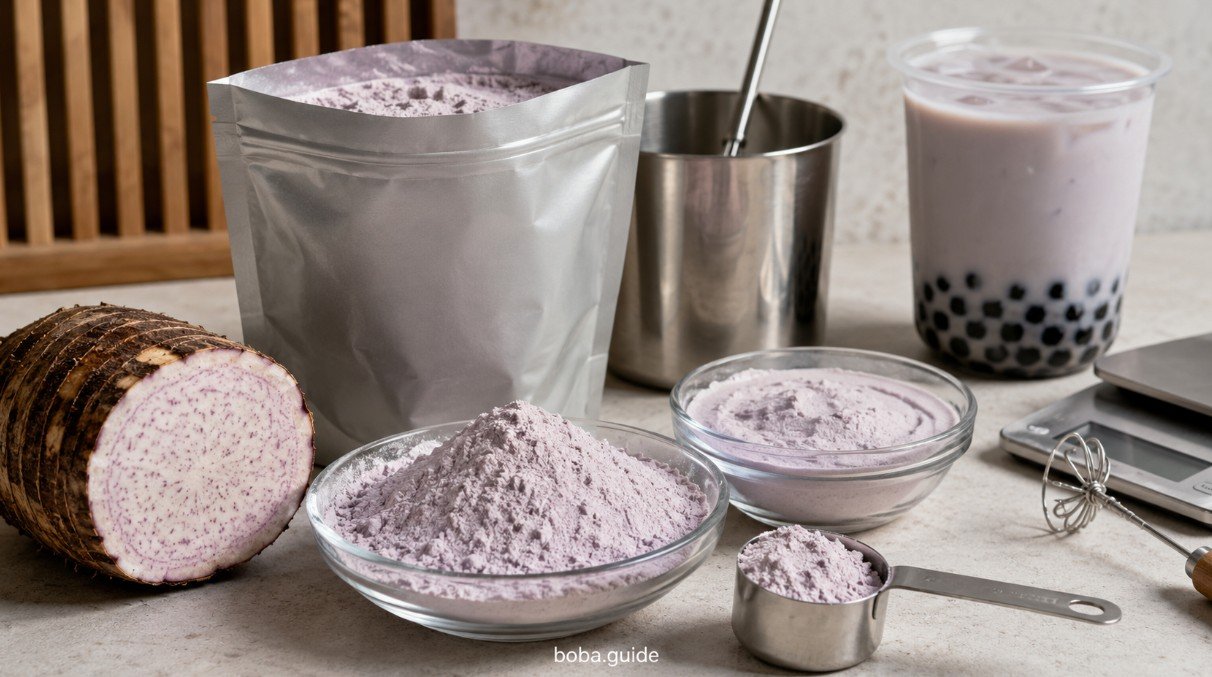
Two bags labeled “taro powder” can make very different drinks. One may be a convenient 3-in-1 mix with creamer and sugar already built in. Another may contain actual taro powder plus purple sweet potato. A third may lean heavily on flavoring, starches and color. The front of the bag rarely tells you enough.
This guide is about choosing taro powder as a boba ingredient: how to read the label, how premixes differ from more root-forward powders, what current food-service packages cost, and which format makes sense for a home kitchen versus a busy shop. If you want the finished drink rather than the ingredient system, start with our taro milk tea guide.
Taro Powder Is Not One Ingredient
On a boba menu, “taro” sounds like one flavor. On a supplier shelf, it is a family of products. Some powders are engineered as nearly complete drink bases. Others expect you to add creamer and sweetener separately. Some contain identifiable taro powder; others rely more heavily on flavoring systems. That difference changes how much control you have over the finished drink.
This is why a shopper should begin with the ingredient panel rather than the color of the bag or the intensity of the purple drink shown on the front. A vivid lavender powder may be convenient and consistent, but vivid color is not evidence of a high percentage of taro root.
3-in-1 premix
Often combines creamer, sugar or glucose, flavor and color. It is designed for speed and consistency rather than maximum recipe control.
Taro-containing mix
Contains actual taro powder but may still include creamer, sweeteners, flavor, stabilizers and added color.
Flavor-forward base
Can produce a recognizable taro-style drink even when the disclosed formula relies more heavily on flavoring than on taro root powder.
Real-taro system
Uses cooked taro, paste or prepared taro pieces and may use powder only as support—or not at all.
Our broader boba ingredients guide explains where powders fit alongside tea, milk, sweeteners, syrups, fruit bases and toppings. Here, the focus stays on taro powder itself.
Read the Ingredient List Before the Purple Color
Current commercial listings make the differences easy to see. One taro powder can begin with creamer and sugar before taro appears. Another can combine taro powder with purple sweet potato. Another may use creamer, glucose, taro flavor, maltodextrin, sweetener and colors without listing taro root powder at all.
That does not automatically make one product “real” and another “fake.” These products are designed for different workflows. What matters is knowing which type you are buying and whether its formula matches the drink you want to make.
Where does taro appear?
If taro powder appears prominently in the ingredient list, root-derived material is playing a visible role. If it appears after creamer and several sugars—or does not appear in the disclosed list—the product is relying on a different flavor system.
“Non-dairy creamer” means dairy-free
Some current taro powders use creamers containing sodium caseinate or whey. If milk matters for an allergy, intolerance, vegan choice or other dietary reason, read the current allergen statement and package label instead of relying on the words “non-dairy creamer.”
Four Ways Taro Gets Into a Boba Drink
The useful comparison is not “powder bad, fresh taro good.” Shops use different taro systems because each solves a different preparation problem.
Cooked taro root
Fresh or frozen taro is cooked until soft, then mashed, blended or served as pieces. It can provide strong root identity and a naturally starchy texture, but it adds preparation, storage and consistency challenges.
Taro paste or prepared taro
A pre-cooked or sweetened taro preparation reduces some labor while preserving more physical taro texture than a fully powdered beverage base.
Taro-containing beverage powder
A dry mix can contain taro powder alongside creamer, sugar, flavoring, starches and color. It is easy to portion and much easier to store than a batch of cooked root.
Taro-flavored premix
The manufacturer builds a recognizable creamy taro profile through flavor, sweetener, texture ingredients and color. This format is usually designed for predictable output and a short training curve.
Taiwanese food-service suppliers reflect this same variety: taro beverage powders, taro slush powders and prepared taro products are sold as different tools for hand-shaken drinks and desserts. A mature boba market does not treat every taro application as the same ingredient problem.
What Each Ingredient in Taro Powder Actually Does
A commercial powder is engineered to solve several jobs at once. Understanding those jobs makes an ingredient label much easier to decode.
| Component | What it does | What to watch |
|---|---|---|
| Taro powder | Adds root-derived solids, flavor and some natural starchiness. | Its position in the ingredient list helps show how central it is to the formula. |
| Creamer | Builds body, opacity and creamy texture quickly. | Some creamers contain milk derivatives such as sodium caseinate or whey. |
| Sugar or glucose | Adds sweetness and strengthens the dessert-like flavor profile. | A heavily sweetened base leaves less room for sweetness customization. |
| Flavoring | Keeps the recognizable taro profile consistent across batches. | A strong flavor system can dominate subtler root character. |
| Starches and gums | Control body, suspension and mouthfeel. | A very thick formula can move the drink toward a smoothie or dessert texture. |
| Color | Creates the lavender or purple appearance many customers expect. | Color intensity is not evidence of taro concentration. |
If you want to compare powder systems beyond taro, our boba powders guide covers the broader category.
Powder vs Real Taro: Choose by the Job
Real taro is not automatically the correct choice for every shop, and powder is not automatically inferior. A more useful question is: what are you optimizing for?
| Priority | Powder system | Real or prepared taro |
|---|---|---|
| Speed | Excellent. Weigh, dissolve, shake or blend. | Usually requires cooking, thawing, mashing or portioning. |
| Consistency | Very high when the powder and liquid are measured accurately. | Can vary with root moisture, cooking time and batch texture. |
| Ingredient control | Depends heavily on the specific formula. | Potentially much higher when the shop controls the recipe. |
| Root texture | Usually smooth and uniform. | Can preserve mashed, fibrous or chunky taro character. |
| Storage convenience | Strong advantage while dry, sealed and correctly stored. | Requires a more demanding refrigerated or frozen workflow. |
| Sweetness control | Limited when sugar or glucose is already a major part of the mix. | Greater control when sweetener is added separately. |
For the finished flavor rather than the ingredient itself, our taro boba guide explains how powder, paste and real taro can lead to very different drinks.
How Much Taro Powder Does a Drink Use?
There is no universal taro scoop. Manufacturer formulas vary because the powder itself varies. Some products already carry much of the creamer and sweetness; others expect those components to be added separately.
One current Bossen preparation uses 36 g of taro powder for a 16 fl oz drink. Other commercial formulas commonly work around roughly 30 g for a similar serving. Those numbers are useful for planning, but they should not be copied from one product to another without checking the manufacturer’s directions.
Weighing powder is more reliable than depending on an uncalibrated scoop. Even a 5 g difference repeated through a busy day can change flavor consistency and food cost.
When you want to turn the ingredient into a finished drink, use a dedicated taro milk tea recipe rather than assuming every commercial powder should be prepared identically.
What Taro Powder Currently Costs
Current U.S. listings checked in August 2026 show that several mainstream 2.2 lb food-service bags occupy a fairly tight but meaningful price band. This is an observed supplier snapshot, not a national U.S. average.
Across those listings, the observed range is approximately $5.72–$7.95 per pound. At a 30–36 g dose, powder alone works out to roughly $0.38–$0.63 per drink.
That is not the cost of a finished taro boba. A shop still has to account for tea if used, additional creamer or milk, sweetener, ice, cup, lid, straw, toppings, labor and waste.
If sourcing is your main question, continue to our guide to buying boba ingredients rather than treating this page as a supplier directory.
Home Bag or Shop Case?
A 2.2 lb bag sounds modest in food-service terms, but it is a lot of taro drinks for a household. At 30–36 g per drink, one bag can represent roughly 28–33 servings.
A home user making one taro drink per week could take months to finish a bag. That makes resealing, moisture control and realistic consumption more important than saving a few cents per serving.
For a shop, the same bag may disappear quickly. Current supplier formats show how different that buying problem becomes. Bossen lists a 44 lb case configuration for its standard powder. Possmei lists some 2.2 lb powders as 10 bags per case. Taiwanese suppliers may sell taro drink powders in formats such as 600 g × 30 bags or 1 kg × 20 bags depending on the product.
Prioritize manageable turnover
Look for a resealable package, a formula you actually like, clear preparation directions and a package size you can finish while quality remains good.
Prioritize repeatable economics
Compare case price, dose per drink, recipe yield, storage footprint, supplier reliability, staff workflow and how much customization the powder allows.
For the wider purchasing system around cups, ingredients, machines and preparation tools, see our boba supplies guide.
Shelf Life Is Product-Specific
There is no responsible universal answer to “how long does taro powder last?” Current manufacturer and supplier declarations vary significantly by formula and package.
Those are examples for specific products under their stated storage conditions, not interchangeable promises for all taro powders.
After opening, moisture becomes one of the biggest practical threats to dry powder quality. Use a clean, dry scoop, reseal the package, keep it away from steam and excessive heat, and follow the current package instructions.
How to Choose Taro Powder Without Guessing
A strong buying decision can be reduced to seven checks. They work whether you are comparing two home-use bags or deciding what belongs in a boba shop.
Decide what you want “taro” to mean
Do you want a fast, sweet purple drink, a more root-forward flavor, or a base that leaves room for actual taro? Start with the intended drink rather than the package design.
Read the first ingredients
They usually reveal whether the product is primarily a creamer-and-sugar premix, a taro-containing mix or a flavor-forward system.
Check milk and allergen information
Never assume a product is milk-free because the front says non-dairy creamer. Check the current ingredient and allergen declaration.
See how sweetness is built
If sugar and glucose already dominate the formula, you will have less room to reduce sweetness without also reducing the taro base.
Compare dose, not only bag price
A $13 powder used at a higher dose and a $17 powder used at a lower dose may be closer in per-drink cost than their shelf prices suggest.
Match package size to turnover
A shop can justify case quantities. A home user may gain more from freshness, resealability and a manageable bag than from nominal wholesale economics.
Judge the complete drink
Evaluate the powder in the actual recipe—with tea or water, milk or creamer, sweetness, ice and toppings. Dry powder aroma alone does not tell you what the finished boba will taste like.
If you are comparing taro with matcha, milk-tea bases and other commercial drink powders, continue to our best boba powders guide.
The most useful taro powder is not necessarily the brightest purple bag or the one with the longest ingredient list. It is the formula whose taro character, sweetness, creaminess, preparation time, package size and cost match the drink you are actually trying to serve.
Help Us Make This Taro Ingredient Guide Better
Taro powder formulas change, and commercial products are not all built the same way. If you manufacture, import or regularly use taro powder in a U.S. boba shop, send Boba.guide current package specifications, ingredient-label changes, case sizes or useful preparation observations at info@boba.guide.
We use submissions as leads for editorial review. Sending product information does not guarantee inclusion or an endorsement.
Questions About Taro Powder for Boba
The details below cover the practical uncertainties that most often matter when choosing, storing and using a taro powder.
What is taro powder for boba made of?
There is no single formula. Commercial taro powders can contain taro powder, creamer, sugar or glucose, flavoring, starches, stabilizers and added color in very different proportions. Some current products contain identifiable taro root powder, while others rely much more heavily on taro flavoring. Always read the current ingredient panel for the specific product.
Is taro powder the same as real taro?
No. Real taro is the cooked root itself. Taro powder is a dry ingredient, and commercial beverage powders often combine taro or taro flavor with other ingredients such as creamer, sugar, starches and color. Some boba shops use real taro, some use powder, and some combine more than one taro ingredient.
Why is taro powder purple?
Natural taro flesh is usually pale and does not automatically produce the intense purple associated with many taro drinks. Commercial powders may use added colors, anthocyanins, purple sweet potato or other coloring systems to create a consistent lavender or purple drink. A brighter purple color does not prove that a powder contains more taro.
Is taro powder dairy-free?
Not necessarily. Some powders use ingredients described as non-dairy creamer but still contain milk-derived ingredients such as sodium caseinate or whey, and some suppliers explicitly list milk as an allergen. Anyone avoiding milk should check the current ingredient and allergen information for the exact product rather than relying on the product name.
How much taro powder should I use for one boba drink?
It depends on the product. One current commercial recipe uses 36 g of powder for a 16 fl oz drink, while other formulations may use around 30 g or a different amount. A 2.2 lb bag can therefore yield roughly 28–33 drinks at a 30–36 g dose, but you should follow the recipe for the specific powder you buy.
How much does taro powder cost?
In an August 2026 snapshot of several U.S. supplier listings, common 2.2 lb bags ranged from about $12.59 to $17.50, or roughly $5.72–$7.95 per pound. That is an observed sample rather than a national average, and prices can change with supplier, quantity, shipping and product formula.
How long does taro powder last?
Shelf life is product-specific. Current manufacturer and supplier examples range from about 12 months to 24 months for unopened products under stated storage conditions. After opening, keep the powder dry, reseal it carefully and follow the current package instructions. An unopened shelf-life statement should not be treated as a guarantee for an opened bag.
Is taro powder better than fresh taro for bubble tea?
Neither is universally better. Powder is usually faster, easier to portion and more consistent. Fresh or prepared taro can provide stronger root character and more natural texture but requires more preparation and storage control. The better choice depends on the drink style, volume, ingredient goals and workflow.
What should I look for when buying taro powder for boba?
Check where taro appears in the ingredient list, whether creamer and sweetener are already included, milk or other allergen information, recommended dose, package size, shelf life and cost per usable serving. For a shop, also consider case size, recipe consistency, storage space and how easily staff can reproduce the drink.