
Tapioca pearl buyer’s field guide
Best Tapioca Pearls for Boba: What to Buy for Home or Shop Use
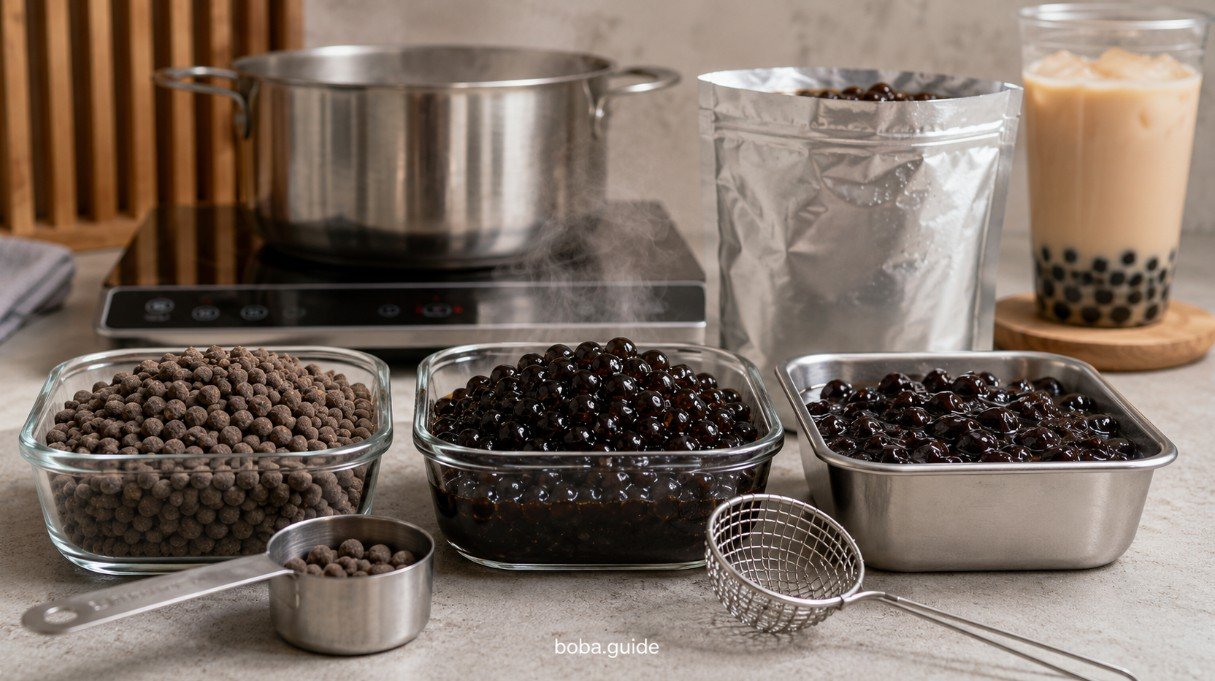
The best tapioca pearls are not simply the darkest bag, the most expensive brand or the pearls with the longest ingredient list. The right choice depends on what matters most in your kitchen: classic chewy texture, shorter cooking time, predictable batch size, low waste, easy storage or fast service.
For a home boba maker, a quicker format can be worth paying more per pound because it avoids a long cooking-and-resting cycle. For a busy shop, traditional food-service pearls can make more sense when demand is high enough to move a fresh batch quickly. And for low-volume service, labor and discarded pearls can matter more than the raw cost of the bag.
This guide compares the buying decisions behind commercial tapioca pearls rather than pretending there is one universal winner. If you first want to understand what pearls are, how they are made and why they become chewy, begin with our complete guide to tapioca pearls.
The Best Tapioca Pearls Depend on the Job
A bag of uncooked boba looks simple, but the buying decision is really a workflow decision. Before comparing brands, decide what problem the pearls need to solve.
| Your priority | Best starting format | Why |
|---|---|---|
| Classic shop-style chew | Traditional large tapioca pearls | They give you the familiar cook, rest, rinse and sweeten workflow used for fresh batches. |
| First-time home cooking | Quick or express-cook pearls | A shorter process reduces the amount of time you must manage boiling, resting and texture changes. |
| High-volume shop | Food-service traditional pearls | Large bags and full batches can make sense when enough drinks are sold to use the pearls while their texture remains good. |
| Low-volume counter | Faster-cooking or portion-controlled format | Reducing unsold cooked pearls may matter more than obtaining the lowest raw cost per pound. |
| Fastest possible preparation | Instant or frozen portioned pearls | Some Taiwanese products are built around heating individual portions instead of cooking a full dry batch. |
| Lowest shelf price | Large traditional bag | Traditional food-service pearls often have a low raw ingredient cost, but labor and waste still need to be counted. |
The deeper comparison between production methods belongs in our guide to quick-cook vs traditional tapioca pearls. Here, the distinction matters because it changes the economics of what looks like a simple bag purchase.
Current Tapioca Pearls Worth Comparing
We are not calling these products laboratory-tested winners. We did not blind-test every pearl on the U.S. market, and a supplier listing cannot tell us exactly how your batch will perform in your pot, with your water and your holding conditions.
What current listings can tell us is useful: price, package size, ingredients, manufacturer instructions, serving guidance and the intended workflow. That gives us a practical shortlist of products representing different buying decisions.
$7.25 / 6 lb
A low current bag price among the mainstream food-service listings checked. The disclosed formula includes tapioca, modified starch, potato starch, stabilizers, caramel color and flavor.
Best fit: shoppers prioritizing low raw ingredient cost in a conventional food-service format.
$10.18 / 6.6 lb
The current preparation instructions use a long traditional cycle: roughly 25 minutes of cooking followed by about 35 minutes of covered resting before rinsing and sweetening.
Best fit: cooks or shops that specifically want the traditional batch workflow and can plan production around it.
$11.01 / 6.6 lb
The preparation sequence is shorter: approximately 25 minutes of cooking followed by about 5 minutes of covered resting. The supplier lists 35–50 servings per bag at 60–80 g of cooked pearls for a 16 oz beverage.
Best fit: buyers who want a shorter traditional-style process without moving to individual frozen portions.
$11.99 / 6.6 lb
The supplier lists a 1:10 pearl-to-water cooking ratio, 6.6 lb bags packed six per case and a stated unopened shelf life of 10 months.
Best fit: shops already sourcing other Possmei drink ingredients or buyers comparing Taiwan-made conventional pearls.
$61.95 / 6 × 6.6 lb case
That listing works out to roughly $10.33 per 6.6 lb bag before shipping or quantity-specific adjustments. Fanale describes the cooked pearls as approximately 1 cm in diameter, although supplier size terminology is not perfectly standardized.
Best fit: buyers comparing full-case food-service economics rather than one-bag retail pricing.
Traditional vs Quick-Cook Is the Biggest Decision
If two bags of pearls cost almost the same amount, the cooking cycle can matter more than the sticker price.
A traditional Bossen example uses about 25 minutes of active cooking followed by roughly 35 minutes of covered resting. That creates a process of about an hour before rinsing and sweetening. The current Express Cook instructions reduce the resting period to approximately 5 minutes, bringing the main cook-and-rest cycle closer to 30 minutes.
Approximately 60 minutes before rinsing and sweetening.
Approximately 30 minutes before rinsing and sweetening.
That difference is meaningful at home because waiting an hour for one topping can make an otherwise easy drink feel like a weekend project. In a shop, it affects labor planning, when a new batch must start and how quickly staff can recover if demand unexpectedly exceeds the prepared amount.
But faster is not automatically better. Different formulas and processes can produce different bite, softness and holding behavior. Use the manufacturer’s directions as a starting point and judge the finished pearl after it has been sweetened and placed in the actual drink.
What Tapioca Pearls Currently Cost
The raw ingredient is surprisingly inexpensive relative to the retail price of a finished bubble tea. In the current sample, large food-service bags cluster around only a few dollars per pound.
The observed range in those listings is approximately $1.21–$1.82 per pound before shipping. That narrow range is one reason a buyer should not choose based on price per pound alone.
Bossen lists approximately 35–50 servings from a 6.6 lb bag when using 60–80 g of cooked pearls per 16 oz drink. Even before accounting for the weight gained during cooking, the supplier’s own yield illustrates why the topping itself can represent a relatively small part of a drink’s total selling price.
For a broader look at cups, strainers, sealers, ingredients and other operating purchases, see the Boba.guide supplies guide.
The Cheapest Bag Can Be the More Expensive Pearl
Raw ingredient price is only one line in the calculation. A shop buying pearls should think in terms of cost per usable serving, not cost per unopened pound.
Imagine two products. Pearl A costs a little less per bag but requires a long batch process and leaves a shop discarding a significant amount at slow periods. Pearl B costs slightly more but can be prepared in smaller or faster batches. Pearl B can be economically better even though its shelf price is higher.
The reverse can also be true. A high-volume shop selling hundreds of pearl drinks per day may have enough throughput to use traditional large batches efficiently. In that environment, paying a premium simply to reduce cook time may deliver little benefit.
Home economics are different
At home, your time has no formal payroll cost—but inconvenience is still real. If a faster pearl turns a one-hour topping project into a manageable half-hour process, paying an extra dollar or two for a 6.6 lb bag is hardly meaningful on a per-drink basis.
And if you only make boba occasionally, a huge food-service bag may be poor value regardless of its attractive dollars-per-pound figure. Storage conditions and how quickly you can use the open bag matter more.
Pearl Size Changes More Than Appearance
Large tapioca pearls are not merely a visual preference. Diameter affects the ratio between soft exterior and chewy center, how quickly heat reaches the middle, which straw works comfortably and how much pearl a drink delivers in each sip.
Bossen currently describes its cooked large pearls as about 8.5 mm in diameter and recommends a 12 mm boba straw. Fanale describes its regular large pearls as approximately 1 cm when cooked. Those numbers should not be interpreted as a universal industry specification; supplier naming and measuring practices vary.
A smaller pearl generally gives more individual pieces per spoonful and changes the chewing rhythm of a drink. A larger pearl creates a more substantial bite and needs enough straw clearance to travel comfortably with liquid.
If texture is your main concern, the broader boba toppings guide helps compare tapioca with jelly, crystal boba, popping boba and other topping families rather than treating every chewy addition as interchangeable.
What Is Actually Inside Commercial Tapioca Pearls?
The shortest possible explanation is “tapioca starch,” but commercial shelf-stable pearls often contain more than cassava-derived starch and water.
The exact additions vary by producer because manufacturers are trying to control shape, color, storage stability, hydration and chew after cooking.
| Ingredient type | Examples seen in current products | Why it may be present |
|---|---|---|
| Primary starch | Tapioca starch | Forms the elastic, chewy structure associated with classic pearls. |
| Additional or modified starch | Modified starch, potato starch | Can help manufacturers tune processing and finished texture. |
| Color | Caramel colors | Produces the familiar brown-to-black appearance before the pearls are sweetened. |
| Texture/stability ingredients | Xanthan gum, cellulose derivatives, alginate | Supports product structure and manufacturing consistency. |
| Preservatives | Potassium sorbate, sodium benzoate | Supports shelf stability of the packaged uncooked product. |
| Flavor | Brown sugar flavor, maple flavor | Adds background aroma even before the cooked pearls are soaked in syrup. |
Tea Zone Original, Bossen and Possmei currently disclose noticeably different formulas, even though all three products are sold as conventional tapioca pearls. The label therefore matters if you are trying to avoid a particular additive or reproduce the same product across multiple locations.
If you want the composition question without the buying comparison, use our dedicated guide to what tapioca pearls are made of.
The Four-Hour Quality Problem Matters More Than Shelf Life
An unopened bag of pearls can sit in dry storage for months. A cooked batch operates on a completely different clock.
Bossen recommends serving both its traditional and Express Cook pearls within about four hours after cooking. Taiwan manufacturer Andes independently describes cooked pearls soaked in a 1:1 sugar syrup as maintaining good texture at room temperature for up to about four hours.
That does not mean every pearl suddenly becomes unsafe or unusable at exactly four hours. It is a quality window from specific suppliers, not a universal legal deadline. But it reflects a central reality of fresh boba service: cooked tapioca texture changes quickly.
The center has cooked through while the pearl still has a springy bite.
Pearls continue interacting with syrup, moisture and ambient temperature.
The texture may become overly soft, sticky, dry at the center or otherwise less pleasant depending on the product and conditions.
This is why the “best” shop pearl is not simply the bag with the longest unopened shelf life. If your service volume cannot use a batch while it is at its best, you need a different batch strategy or a different pearl format.
For the practical post-cooking workflow, see our guide to storing cooked boba pearls.
Home Kitchen and Boba Shop Buyers Should Choose Differently
Convenience can beat wholesale economics
A home cook usually needs one or two drinks, not 35–50 servings. Your priorities are likely to be manageable cooking time, clear instructions, reliable texture and a package you can reseal properly.
A large food-service bag may have a spectacular cost per pound while still being the wrong purchase if you use pearls once a month.
Throughput decides the winner
A shop should model expected pearl orders by daypart. Large traditional batches make sense when sales volume can consume them. Slower locations need to pay closer attention to batch size, labor and waste.
Case size, distributor reliability and consistency between bags matter more when one recipe has to work across hundreds or thousands of drinks.
What about instant and frozen pearls?
Taiwan’s commercial pearl market extends well beyond dry shelf-stable bags. Andes describes instant 70 g pearl portions that can be reheated in roughly 80 seconds at 700–750 W or 30 seconds in a higher-powered 1800 W microwave, with a 4–5 minute hot-water method as another option.
PULY lists frozen boba portions designed around approximately 60 seconds of microwave heating at 750 W or about four minutes in boiling water. Its frozen products are stored at -18°C and include both individual portions and larger food-service formats.
That does not automatically make frozen pearls better. They trade dry-storage simplicity for freezer requirements and a different cost structure. But they demonstrate why the modern decision is no longer limited to “which dry black pearl brand should I buy?”
If you are deciding specifically between different preservation and convenience formats, continue to fresh vs instant boba pearls.
How to Choose Tapioca Pearls Without Guessing
Use this sequence before buying. It is more useful than relying on star ratings or a package photo.
Choose the preparation format
Traditional dry, faster-cooking dry, frozen portion or another instant system. This decision affects the rest of the workflow.
Check the full time, not just “cook time”
A package may advertise cooking time while the recipe also requires substantial covered resting. Add boiling, cooking, resting, rinsing and sweetening before comparing convenience.
Match the batch to your demand
The perfect batch is not the largest batch your pot can hold. It is the amount you can serve while the pearls still have the texture you want.
Check cooked size and straw clearance
Large pearls need a wide boba straw and change the chewing experience. Supplier size descriptions are useful, but do not assume every “large” pearl measures identically.
Read the ingredients
Tapioca starch is the foundation, but modified starches, color, gums, flavor and preservatives vary by product.
Calculate usable cost
Compare bag price, servings, labor and likely waste. A cheap bag that gets discarded after slow service is not cheap in practice.
Cook the product the way its manufacturer intended first
Do not judge one pearl using another brand’s recipe. Once you know the baseline, you can adjust sweetness or texture deliberately.
For the detailed cooking process—water ratio, boiling, stirring, resting, rinsing and troubleshooting—use our guide to cooking boba pearls.
And remember that the pearl coming out of the pot is only half the result. Classic tapioca is relatively neutral on its own; the syrup stage determines much of the flavor people associate with good boba. Our guide to sweetening boba pearls covers that step separately.
What Actually Works in Your Boba Kitchen?
Package directions are useful, but real kitchens reveal the details: how a pearl behaves after two hours, whether a smaller batch cooks differently, which size works best through your straws, and how much product is lost on a slow afternoon.
If you operate a boba shop, distribute tapioca pearls or regularly prepare commercial batches, send useful current package specifications, batch observations or correction notes to info@boba.guide. Editorial inclusion is never guaranteed, and product submissions do not buy a recommendation.
Questions About Buying Tapioca Pearls
These are the practical questions that matter after you have narrowed the choice to a few pearl formats.
What are the best tapioca pearls for homemade boba?
For many home cooks, quick-cook or express-cook tapioca pearls are the easiest starting point because they reduce preparation time. Traditional pearls can produce excellent texture too, but some require a long cooking and resting cycle that may be inconvenient when you only want one or two drinks.
Are quick-cook tapioca pearls as good as traditional pearls?
They can be very good, but they are not necessarily identical. Different formulations and cooking processes can change firmness, softness, chew and holding behavior. Quick-cook pearls are mainly valuable because they reduce preparation time. Traditional pearls remain useful when classic batch preparation and high-volume service are priorities.
How much do tapioca pearls cost?
In an August 2026 snapshot of several U.S. supplier listings, large food-service bags ranged from about $1.21 to $1.82 per pound before shipping. Individual bags in the sample ranged from $7.25 for 6 lb to $11.99 for 6.6 lb. These are observed listings, not a national average, and prices can change.
How many servings are in a 6.6 lb bag of tapioca pearls?
Bossen currently estimates approximately 35–50 servings from a 6.6 lb bag when using 60–80 g of cooked pearls for a 16 oz beverage. Actual yield depends on the product, cooking expansion, serving size, waste and how much pearl you use in each drink.
How long do tapioca pearls take to cook?
Cooking time depends on the product. One current traditional Bossen process uses about 25 minutes of cooking followed by roughly 35 minutes of covered resting. Its Express Cook product uses about 25 minutes of cooking and 5 minutes of resting. Instant and frozen systems can be much faster, so always follow the instructions for the exact pearls you buy.
How long are cooked tapioca pearls good for?
Texture changes much faster after cooking than the unopened product’s shelf life suggests. Bossen recommends serving its cooked traditional and Express pearls within about four hours, and Taiwan supplier Andes describes good room-temperature texture for up to about four hours after sweetening. Treat this as product-specific quality guidance, not a universal food-safety deadline.
What size tapioca pearls are best for bubble tea?
Large pearls are the classic choice for bubble tea because they create the familiar substantial chew, but size specifications vary by producer. Bossen currently describes its cooked large pearls as about 8.5 mm and recommends a 12 mm boba straw. Smaller pearls create a different drinking and chewing experience, so there is no single correct size for every drink.
What should I look for in the ingredient list?
Tapioca starch should be the structural foundation, but commercial pearls may also contain modified starches, potato starch, caramel color, gums, preservatives and flavoring. Ingredient lists differ by producer. Check the current package if you need to avoid a particular ingredient or keep recipes consistent between locations.
Are frozen instant boba pearls worth buying?
They can be useful when speed and portion control matter more than dry-storage convenience. Some Taiwanese frozen products can be heated in roughly one minute in a microwave or a few minutes in boiling water. The trade-off is freezer storage, different packaging and potentially different economics from a large dry food-service bag.