
Bubble tea shop equipment guide
Best Boba Sealing Machines: Cup Size, Film and Shop Guide
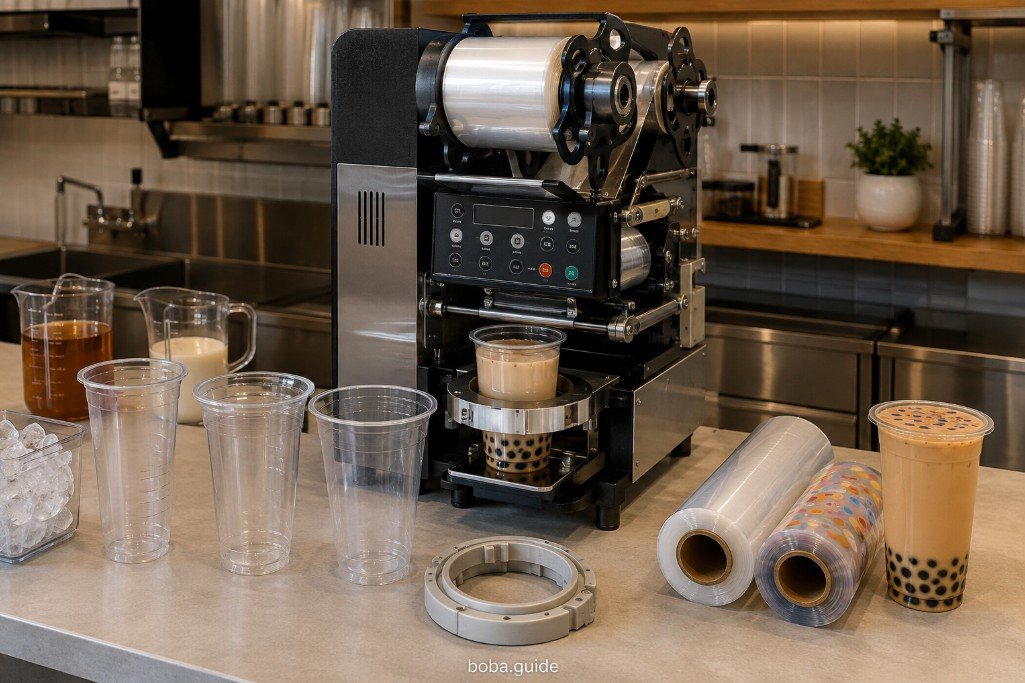
The best boba sealing machine is not automatically the fastest or most expensive machine. It is the machine that matches the cups, rim diameter, cup material, sealing film, counter space and service volume your shop actually uses. A 95 mm machine can be completely wrong for a 98 mm PET cup program, and a machine capable of hundreds of seals per hour does not make the rest of a slow drink line move any faster.
That makes cup sealing a system decision rather than a standalone equipment purchase. Before comparing brands, start with the cup. Confirm its rim diameter and material. Then choose compatible sealing film. Only after those two pieces are settled should you compare cutter rings, adapters, film sensors, operating speed, certifications and machine price.
This guide focuses specifically on commercial cup sealing equipment. For the wider cups, straws, preparation tools and machines used around a drink station, see our boba supplies guide.
The first decision
Start With the Cup, Not the Machine
A shop that buys a sealer first and cups second is reversing the decision. Cup format determines the physical and material requirements the sealing machine has to satisfy.
Changing the cup later can therefore affect more than inventory. It may require a different cutter ring, adapter, film roll, temperature setting or even a different machine.
This is especially important for shops that want to standardize around a distinctive wide cup. A visually attractive cup that does not fit the shop’s existing sealer can create a packaging system change rather than a simple disposable-supply change.
A Cup Sealer Is a Four-Part Compatibility System
The machine creates heat and pressure, but those alone do not guarantee a reliable seal. The cup rim has to physically fit the sealing station, and the film has to bond correctly to the cup material under the machine’s operating conditions.
Does the cup physically fit?
Check top diameter, rim profile, maximum cup height and any required tray or adapter.
What is the cup made from?
PP and PET cups may look similar from across the counter but can require different sealing-film systems.
Will the film bond correctly?
Film must match the cup material and operate within the machine’s approved setup.
Can it repeat the seal reliably?
Temperature control, film feed, cutter alignment and tray position all influence daily consistency.
90, 95, 98 and 120 mm Are Different Packaging Systems
Bubble-tea cup diameters are often described in millimeters because the machine has to center and cut around the rim. Current U.S. specialist suppliers sell separate 90, 95 and 98 mm machine configurations, while larger 120 mm equipment serves wide or jumbo cups.
smaller standard format used by some PP and paper cup systems
one of the most established standard bubble-tea cup formats
common reference for PET cold cups and universal-type setups
wide jumbo format requiring different machine geometry or adapters
Do not treat a few millimeters as irrelevant. A cutter ring is a physical component. A cup that does not sit correctly in the tray can prevent the film from landing and cutting around the rim as intended.
A useful shop policy is to document every approved service cup by capacity + rim diameter + material. “Large clear cup” is not a purchasing specification.
95 mm Does Not Mean Every 95 mm Cup Uses the Same Film
Diameter tells you whether the cup and machine can align physically. It does not tell you whether the film will form the correct seal.
Some modern machines are marketed for multiple material types, but that should not be interpreted as permission to run any film with any cup. The manufacturer or supplier should identify the approved cup-film combination and the operating settings required.
The Correct Sealing Film Is Part of the Equipment Purchase
Film is not an afterthought. A shop that changes from PP to PET packaging may need different rolls even if the machine can be adapted to the new rim size.
Clear film
Simple visual system
Clear film keeps the drink visible and reduces the design-alignment issue found with repeating printed graphics.
Generic printed film
Visual identity without custom production
Repeated printed patterns need consistent film advance so the design appears in a reasonable position over each cup.
Custom printed film
Brand system, not just consumable stock
Custom artwork introduces registration, lead-time and inventory considerations in addition to normal sealing performance.
Current U.S. supplier pricing also shows that the film remains a recurring operating expense. For one 95 mm PP system, current rolls are approximately $43.50 for clear film and $50 for a generic printed version. Current 98 mm PET examples are approximately $49.50 clear and $56.25 printed.
Those figures are supplier snapshots from August 2026, not universal film prices. Roll length, seals per roll, freight and custom-print quantities can materially change cost per sealed cup.
Automatic, Semi-Automatic and Manual Mean Different Operator Work
The words can be used inconsistently across suppliers, so look at the actual sequence instead of the marketing label.
The operator positions or advances more of the film and performs more of the cycle manually. Capital cost may be lower, but labor per cup is higher.
Part of the cycle is mechanized while cup placement, tray movement or film handling still requires operator action.
The operator typically places the cup into the tray and initiates the cycle while the machine advances film and performs the sealing sequence automatically.
For a busy shop, consistency is usually the stronger reason to automate—not the ability to claim a high theoretical cups-per-hour number.
What Does 450–500 Cups per Hour Actually Mean?
Current professional machines commonly advertise capacities around 450–500 sealing cycles per hour.
Those numbers describe machine capacity under favorable operating conditions. They do not mean one employee can prepare 500 complete milk teas in an hour.
The drink still has to be brewed or dispensed, flavored, shaken or stirred, topped, moved into the sealer, removed and handed off. Real throughput is determined by the slowest important step in that chain.
A Faster Sealer May Not Make Your Shop Faster
Imagine a sealing machine that can mechanically seal one cup every eight seconds. If drink preparation takes 45 seconds and tapioca portioning or shaker availability slows the line further, upgrading to an even faster sealer can produce almost no customer-facing improvement.
Is enough properly brewed tea available during peak periods?
Are toppings portioned quickly without slowing drink assembly?
Can staff finish the beverage phase faster than cups arrive at the sealer?
Is the pickup counter itself becoming congested?
Measure the real production line before spending more for sealing speed. This is also why the complete boba equipment checklist matters more than optimizing one machine in isolation.
Film Detection Matters More When You Use Printed Rolls
Automatic film advance has to know where one repeat of the roll ends and the next begins. Taiwan-made professional equipment may use micro-controlled film detection to position the film during the sealing cycle.
With plain clear film, exact graphic registration is less visible. With custom branding, poor film detection can become a presentation and waste problem even when the physical seal itself is technically intact.
Cup Height and Adapter Hardware Matter Alongside Rim Diameter
Machine listings frequently focus on cutter size, but the cup also needs to physically fit into the tray and underneath the sealing head.
Current Karat 90 mm equipment, for example, lists a maximum cup height of approximately 180 mm / 7.08 inches. A tall specialty cup can therefore create a fit issue even when its rim diameter sounds compatible.
Do not assume an unofficial adapter solves every combination. The machine supplier should confirm that the specific adapter, cutter, film and cup material are supported together.
The Machine Footprint Is Larger Than the Metal Box
A sealer needs working space around it. Staff need room to load the film roll, open the tray, insert cups, remove sealed drinks and access the machine for cleaning or service.
The Taiwan ET-999SN reference is approximately 340 mm wide × 360 mm deep × 610 mm high and weighs about 23 kg. Another current U.S. version of the same general equipment family is listed around 25 × 34 × 64 cm and 25 kg depending on configuration.
Place the sealer where a worker can move a filled cup into the tray without crossing a hot-tea station or reaching awkwardly over other equipment. The machine is part of line design.
Certification Can Matter More Than an Extra Feature
Commercial equipment in the United States can be subject to electrical, sanitation and local health-department requirements. Current specialist listings show combinations of UL, EPH and NSF-related classifications or compliance depending on model.
A label such as “UL certified” should not be copied from a related product and assumed to apply to every version. Certification is model- and configuration-specific.
If you are planning the whole store rather than replacing one machine, the broader guide to opening a boba shop is the better place to connect equipment decisions with permitting, workflow and business planning.
Current U.S. Specialist-Supplier Price Snapshot
Current August 2026 listings show a meaningful price spread even before moving into very large or multi-cup machinery.
500 cups/hour; 95 mm base with additional size configurations available.
Current UL/EPH-classified supplier listings.
450 cups/hour current product specification.
Higher-priced current compliance-oriented variant.
Current PET-specific supplier listing.
This is an observed specialist-supplier snapshot, not a national average. Shipping, certification option, cutter size, adapters, included film, warranties and promotions can change the delivered price significantly.
The Machine Price Is Only the First Cost
A cup sealer is a capital purchase attached to a consumable system. The shop continues buying film and may eventually need cutters, sensors, boards, heating components or other replacement parts.
Current BubbleTeaology listings illustrate the repair layer clearly: replacement PC boards, spare-parts packages and adapter rings are sold separately. That is useful information before purchase because a machine with accessible replacement components can be easier to keep operating than an inexpensive unit with no support path.
Film should also be modeled per drink. Even when the cost per individual seal is small, thousands of drinks turn packaging into a meaningful monthly operating line.
For sourcing cups, film and other consumables alongside equipment, see where to buy boba supplies.
Standard Cups and 120 mm Jumbo Cups Change the Equipment Strategy
A shop built around standard 90–98 mm cups can usually choose from a broad range of conventional sealers. A 120 mm cup program is different enough that dedicated jumbo equipment becomes relevant.
One current 120 mm automatic machine starts at approximately $1,679, seals up to 500 cups/hour and offers optional 95 and 98 mm adapter rings. That creates an interesting multi-format strategy: a shop can make the wide machine its base and adapt downward if the manufacturer explicitly supports those smaller cups.
Mostly standard cups
Buy for the 90–98 mm system
Do not pay for jumbo capacity that rarely enters the menu.
Wide cup is core to the brand
Start with 120 mm compatibility
Then verify whether approved adapter rings cover the smaller cups you genuinely plan to use.
The operational downside of multiple cup diameters is inventory complexity. Different cups can mean different films, adapters and staff procedures. Variety should solve a menu problem rather than exist only because the equipment can technically handle it.
When Is a Cup Sealing Machine Actually Worth Buying?
A sealing machine earns its counter space when sealed film solves a meaningful service problem: efficient takeaway packaging, a distinctive drink presentation, easier stacking or transport, or a standardized shop workflow.
- takeaway is a major part of sales;
- sealed cups are central to the store’s service style;
- drink volume justifies dedicated packaging equipment;
- cups and film are standardized;
- the machine can remain permanently installed at the line.
- volume is low;
- the menu changes cup formats frequently;
- counter space is extremely limited;
- the operation is temporary or mobile;
- the business has not standardized its packaging system yet.
For home boba, a $1,000+ commercial machine is almost never necessary. A reusable cup or conventional lid solves the actual drinking problem much more efficiently. Our reusable boba cup guide covers that use case.
Run This Compatibility Audit Before You Order a Machine
Write down every cup you intend to seal
Record capacity, rim diameter, height and material rather than relying on product names.
Confirm compatible film for every cup
Ask the supplier for the actual PP, PET, paper or other film specification required.
Confirm cutter and adapter configuration
Do not assume that another diameter is supported simply because an adapter exists for a related model.
Check maximum cup height
Measure specialty cups physically before placing a large equipment order.
Measure the counter and service clearance
Include film-roll loading, tray travel and access for maintenance.
Verify the exact certification variant
Check local requirements before deciding that the cheapest version is sufficient.
Ask what happens when the machine breaks
Check warranty length, parts availability, return shipping, service procedure and realistic downtime.
Calculate film as a recurring cost
Include clear or printed rolls, freight and any custom-film minimums in the packaging budget.
For most conventional U.S. bubble-tea shops, the strongest starting point is not a particular brand but a standardized cup system. Confirm whether your core service cup is 90, 95 or 98 mm, identify its material, lock in compatible film, then choose an automatic machine with the correct cutter or approved adapter, appropriate certification, replaceable parts and enough speed for the real drink line. If your signature menu depends on 120 mm wide cups, make that packaging architecture the starting point instead of forcing it into a standard-cup machine.
Help Us Track Real Boba-Shop Sealer Compatibility
Machine listings often provide headline specifications but leave out the details that matter after installation: which cup and film combinations seal reliably, how often sensors need adjustment, whether printed film registers cleanly, and which replacement parts are actually available in the United States.
If you operate a boba shop, distribute packaging or manufacture sealing equipment, send current cup dimensions, film specifications, machine documentation or long-term operating notes to info@boba.guide. Submitted information is treated as a research lead and does not guarantee inclusion or a favorable recommendation.
Questions About Boba Cup Sealing Machines
These are the compatibility and operating questions worth resolving before a commercial sealer arrives at the shop.
What size cup sealing machine is best for a boba shop?
There is no universal best diameter. Choose the machine around the cups your shop has standardized. Current commercial bubble-tea systems commonly use 90 mm, 95 mm and 98 mm configurations, while wide jumbo cups may use 120 mm equipment. Confirm rim diameter, cup material, cup height and compatible film before buying the machine.
Is 95 mm the standard bubble tea cup sealer size?
95 mm is one of the most common commercial bubble-tea formats and is widely supported by Taiwan and U.S. suppliers, but it is not the only standard. Current U.S. suppliers also sell 90 mm and 98 mm machines, while some wide cups use 120 mm equipment. Treat the actual cup specification as the source of truth.
Can the same sealing machine seal PP and PET cups?
Some machines are offered in configurations that support multiple cup materials, but matching diameter alone does not guarantee compatibility. PP and PET can require different sealing films and operating setups. Confirm the exact cup, film, cutter or adapter and machine configuration with the supplier before using a new material.
How fast is a commercial bubble tea sealing machine?
Current professional examples commonly advertise about 450–500 sealing cycles per hour. That equals roughly one machine cycle every 7–8 seconds under ideal conditions. It does not mean a shop can produce 450–500 complete boba drinks per hour because drink preparation, toppings, shaking and handoff can become the actual bottlenecks.
How much does a commercial boba sealing machine cost?
In an August 2026 specialist-supplier snapshot, conventional automatic machines checked ranged from about $1,379 to just over $2,000 depending on cup format, certification and configuration. Current Karat 90, 95 and 98 mm machines are listed around $1,440, while several Bossen variants are listed between about $1,726 and $2,049. These are observed listings, not a national average.
How much does sealing film cost?
Film is an ongoing consumable cost. In current August 2026 Karat examples, 95 mm PP film is listed around $43.50 for clear film and $50 for a generic printed roll, while 98 mm PET film is around $49.50 clear and $56.25 printed. Roll length, supplier, printing and freight affect the real cost per seal.
Do I need an NSF or UL certified cup sealing machine?
Requirements depend on the exact equipment and local jurisdiction. U.S. commercial listings include UL, EPH and NSF-related variants, but a certification on one model should not be assumed to apply to another. Check electrical and food-equipment requirements with the relevant local authority before ordering commercial equipment.
Can one machine seal both standard and jumbo boba cups?
Some larger machines support additional cup formats through approved adapter rings. For example, a current 120 mm commercial sealer offers optional 95 mm and 98 mm adapter rings. Compatibility still needs to be confirmed for the cup material, film, cutter and exact machine model rather than assuming an adapter solves every format.
Does a home boba setup need a cup sealing machine?
Usually no. Commercial sealing machines commonly cost more than $1,000 and are designed around repeatable takeaway packaging. For occasional home boba, a conventional lid or reusable boba cup is simpler, cheaper and easier to store. A sealer becomes useful when packaging volume and service workflow justify dedicated equipment.