
Jasmine Tea for Boba: How to Choose a Floral Tea Base
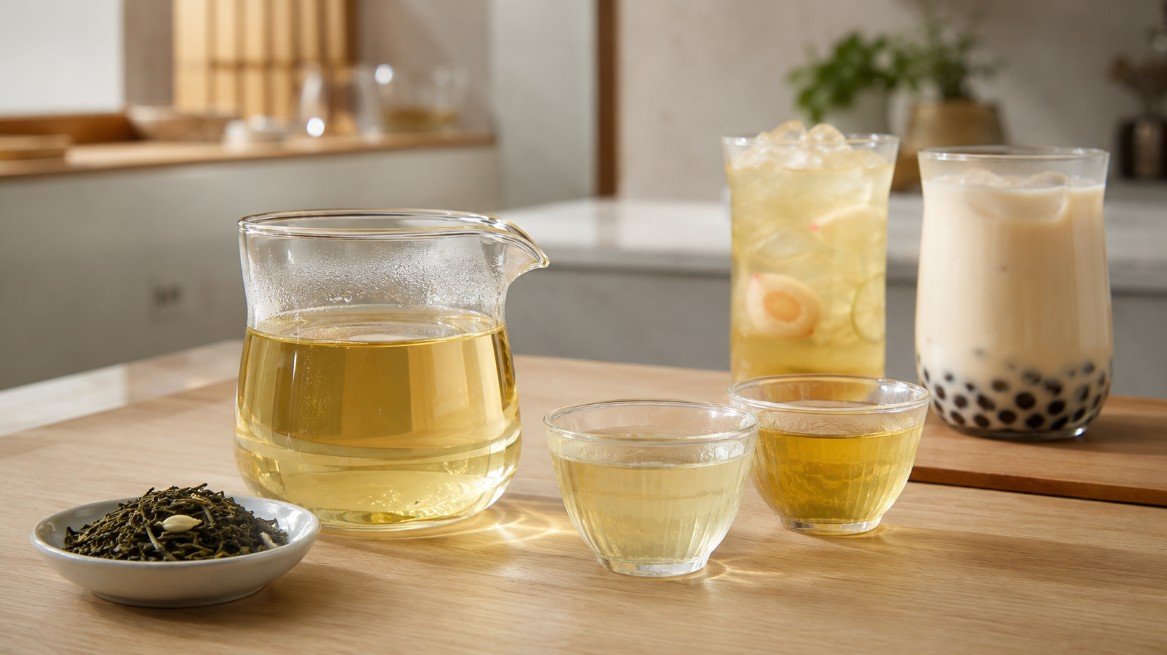
Jasmine green tea is one of the most useful boba bases when you want floral aroma without the heavier flavor of many black teas. It can work especially well in fruit tea, clear iced boba and lighter milk tea, but jasmine becomes much easier to lose when you add a large amount of milk, syrup, ice or strongly flavored toppings.
The useful way to choose jasmine tea is therefore not simply “strong or weak.” You need to think about the finished drink. A commercial jasmine base may be brewed around a 1:40 tea-to-water ratio for 8 minutes at 85°C, while the same supplier recommends moving toward 1:30 when the tea is intended for milk tea or a stronger-flavored drink. Another Taiwanese bubble-tea supplier uses 1:47 for 8 minutes for its jasmine green tea. Those numbers are not universal rules, but they show the scale of concentration actually used in commercial boba preparation.
Start with the base
What does jasmine tea mean in a boba drink?
In common bubble-tea use, jasmine tea is usually a green-tea base with a noticeable jasmine aroma. Commercial products sold specifically for boba describe jasmine green tea as green tea combined with jasmine flavor or jasmine material rather than as an unrelated category of drink.
That distinction matters because two things have to survive the complete cup. The green tea supplies the underlying tea body, freshness and finish. Jasmine supplies the floral top note. A drink can have plenty of jasmine aroma and still feel weak if the tea underneath disappears after fruit syrup, milk or melting ice is added.
Useful distinction
Green tea is the structural base; jasmine is the aromatic direction. A good jasmine boba drink needs both to remain understandable after the other ingredients are added.
If your real decision is between jasmine, plain green tea and other green-tea styles, continue with our guide to green tea for boba.
Useful commercial reference points
Real jasmine boba brewing numbers are more useful than “brew it strong”
There is no single universal jasmine brewing formula, but commercial bubble-tea instructions give useful quantitative reference points. They also show why blindly steeping green tea longer is not the same thing as deliberately increasing concentration.
Water temperature
Bossen specifies 85°C for both its loose-leaf jasmine green tea preparation and its jasmine tea-bag extract method.
Loose-leaf steep
Bossen uses an 8-minute covered steep for its loose-leaf jasmine base. POSSMEI also gives an 8-minute brew for its jasmine green tea.
One standard reference
Bossen’s Premium A2 instructions use 50 g tea leaves with 2,000 cc water, equivalent to a 1:40 tea-to-water ratio.
Stronger milk-tea reference
The same Bossen instructions recommend 1:30 when the goal is milk tea or a stronger-flavored tea base.
| Commercial example | Tea / water | Temperature | Time | Intended use |
|---|---|---|---|---|
| Bossen loose leaf | 1:40 | 85°C | 8 min | General jasmine tea base |
| Bossen stronger base | 1:30 | Same product method | Same product method | Milk tea / stronger tea flavor |
| POSSMEI jasmine | 1:47 | Hot water | 8 min | Refreshing bubble-tea base |
| Bossen tea bag | 1 bag + 7 oz water | 85°C | 5 min | Extract for a 16 oz drink |
That is much more actionable than saying “make the jasmine stronger.” For a full treatment of brewing variables across tea families, use our guide to brew tea for boba.
One tea, two jobs
Good jasmine boba needs tea structure and floral aroma
A jasmine base should still taste like tea. Strong floral aroma can make a cup memorable, but aroma alone cannot replace the underlying green-tea structure.
The green-tea layer
The green tea contributes freshness, body and a mild astringent structure. In a clear fruit drink, that prevents the result from tasting like fruit syrup diluted with water. In milk tea, it gives the creaminess an actual tea foundation.
If the base is stale, muddy or overly harsh, stronger jasmine aroma will not solve the structural problem.
The jasmine layer
Jasmine provides the floral aroma that separates the drink from plain green tea. It can complement soft fruit, create contrast with brighter tropical fruit and remain recognizable in a lighter milk tea.
More floral intensity is not automatically better. If jasmine becomes the only thing you notice, the drink can feel perfume-like instead of balanced.
Choose by finished drink
Where does jasmine tea work best in boba?
Jasmine performs best when the recipe leaves room for aroma. That makes it especially useful for fruit tea, lighter milk tea and tea-forward iced drinks.
Refreshing fruit tea
Jasmine adds aroma without the heavier malt character associated with many black teas. The result can stay fresh even when fruit syrup provides a large share of the sweetness.
Light jasmine milk tea
This is where concentration matters. A supplier that uses 1:40 for its standard jasmine base recommends 1:30 for stronger or milk-tea use, illustrating how milk changes the required tea presence.
Tea-forward iced boba
Bossen’s tea-bag method makes a 7 oz jasmine extract and then builds that into a 16 oz cold drink with ice. That is a practical reminder that the brewed tea can be only one part of the final cup volume.
Minimal aromatic drinks
Jasmine does not need five toppings to feel interesting. Tea, sweetness, ice and one texture can be enough when the tea itself has a clear aromatic identity.
Fruit without losing the tea
Which fruit flavors pair well with jasmine tea?
The best fruit pairing depends on how much of the jasmine you want to preserve. Softer aromatic fruits can complement the floral note, while passion fruit, citrus and mango create more competition.
| Fruit | Effect on jasmine | Practical direction |
|---|---|---|
| Lychee | Soft aromatic fruit can extend the floral character rather than sharply overpowering it. | Clear tea + restrained sweetness + crystal boba. |
| Peach | Adds rounded fruit aroma while leaving reasonable space for jasmine. | Iced jasmine peach tea with one light topping. |
| Passion fruit | Provides much brighter tropical intensity and therefore demands more noticeable tea structure. | More tea-forward base + aloe or jelly. |
| Citrus | Can sharpen and refresh the floral profile, but concentrated citrus syrup can dominate a light tea. | Keep the drink predominantly tea rather than syrup. |
| Mango | Adds richer sweetness and moves the drink farther from a delicate floral profile. | Use jasmine only when you still want a tea finish. |
A real commercial recipe shows how quickly fruit ingredients can become significant: one POSSMEI jasmine-based drink uses 200 mL jasmine green tea, 30 g non-dairy creamer, 5 mL dragon-fruit syrup, additional flavored syrup and 20 g popping boba. The point is not to copy that exact recipe; it is to see that tea flavor has to survive measurable quantities of other ingredients.
For a broader comparison across tea families, see our guide to tea for fruit boba.
Floral tea meets creaminess
Milk changes the concentration jasmine needs
Milk does not only change texture; it changes how easily you perceive the jasmine. That is why a tea that seems highly aromatic when served clear can become surprisingly quiet after creamer or milk is added.
1:40 reference
Bossen uses 50 g jasmine tea with 2,000 cc water as its standard loose-leaf commercial preparation.
1:30 reference
The same supplier recommends increasing concentration to 1:30 for milk tea or when a stronger tea flavor is required.
200 mL example
In one POSSMEI milk-tea recipe, 200 mL of hot jasmine tea is combined with 30 g non-dairy creamer before syrups and toppings are added.
16 oz final cup
Bossen’s jasmine tea-bag instructions use a 7 oz concentrated brew as the tea extract for a finished 16 oz drink.
These examples make the decision clearer: a milk tea is not simply “green tea plus a splash of milk.” The tea base may be deliberately concentrated because the final drink contains substantially more than brewed tea.
If you are comparing jasmine against black, oolong and other milk-tea bases, see our guide to tea for milk tea.
Texture without burying aroma
Which toppings pair best with jasmine tea?
Toppings should be judged by how much additional flavor they contribute, not only by texture. A topping that adds little flavor gives jasmine more room than one coated in a strong syrup.
Low competition
Crystal boba and aloe
These are useful when the objective is a clear jasmine or fruit-tea profile. They add chew or texture without automatically imposing a dark caramelized flavor.
Moderate competition
Light jelly and tapioca
Both can work, but syrup intensity matters. Traditional pearls become much more dominant when a substantial amount of brown-sugar syrup accompanies them.
High competition
Heavy foam and dessert toppings
Rich foam, cookies, taro mixtures or several toppings at once can turn jasmine into a background note. Use them when that richer result is intentional.
Two common failures
Why does jasmine boba become bitter or perfume-like?
These are different problems and should not be fixed in the same way.
The tea is harsh
One commercial jasmine method reaches useful boba strength at 85°C for 8 minutes. That is much more specific than assuming green tea must sit in near-boiling water indefinitely to become strong enough.
The same supplier increases strength for milk tea by changing the ratio from 1:40 to 1:30. That shows an important principle: concentration can be changed by the amount of tea, not only by extending extraction.
The jasmine feels perfume-like
Do not respond automatically by adding more milk or sugar. First determine whether the floral aroma is too strong relative to the tea itself. A cleaner or less aggressively scented jasmine base may produce a better drink than simply trying to mask the aroma.
Evaluate the complete iced drink, because sweetness, milk and temperature change what you notice compared with tasting the warm brewed tea alone.
Commercial boba reality
What kind of jasmine tea do boba shops use?
There is no one universal jasmine tea or one universal brewing specification. Commercial bubble-tea suppliers sell loose leaf, tea bags, ground tea and other beverage-oriented jasmine formats.
Loose leaf
Bossen’s published example uses 50 g tea in 2,000 cc water, an 85°C water temperature and an 8-minute covered steep.
Tea bag extract
Its tea-bag instructions use 1 bag + 7 oz water at 85°C for 5 minutes, producing extract intended for a 16 oz finished drink.
Different supplier
POSSMEI publishes a different jasmine reference: 1:47 for 8 minutes. That difference is exactly why product-specific instructions matter.
Service window
Bossen recommends its prepared loose-leaf jasmine tea be served within 4 hours. That is a useful commercial freshness benchmark, not a universal food-safety cutoff for every possible recipe.
Put the base into a real drink
Three jasmine boba directions that use the tea differently
Jasmine lychee tea with crystal boba
Keep the drink predominantly tea so the floral and fruit aromas can overlap. A clear tea base also makes it easier to judge whether additional syrup is actually improving the drink.
Best fit: refreshing, aromatic boba where milk is not required.
Jasmine milk tea with tapioca pearls
This is the build where a stronger tea ratio becomes most relevant. The commercial 1:30 reference is useful because it demonstrates that milk tea may require more tea material rather than simply a longer steep.
Best fit: a lighter floral alternative to classic black milk tea.
Jasmine passion fruit tea with aloe
Passion fruit contributes much more flavor competition than a subtle fruit pairing. Keep enough brewed tea in the cup that the finish remains recognizably jasmine rather than becoming only tropical syrup.
Best fit: strong fruit flavor with a tea finish rather than a fruit drink that happens to contain tea.
For finished-drink variations rather than selecting the tea base itself, continue to jasmine tea boba.
Jasmine is optional
When is plain green tea a better choice?
Choose plain green tea when you want freshness and tea structure without adding a strong floral note. Jasmine should be selected because its aroma improves the drink, not because every green-tea boba needs it.
The fruit is already highly aromatic. A simpler tea can prevent the cup from feeling overcrowded.
You prefer vegetal green-tea character. Jasmine deliberately moves the drink in a floral direction.
You are building a heavily flavored dessert drink. Jasmine’s aromatic advantage may contribute less than a fuller black or oolong base.
You simply dislike floral tea. No amount of recipe optimization changes that preference.
The practical choice
Choose jasmine by the finished cup, then set the strength deliberately
For fruit tea and clear iced boba, jasmine works especially well when its aroma remains easy to recognize without making the drink perfume-like. For milk tea, a more concentrated base can be useful because milk and sweetness reduce tea definition.
Commercial examples give a practical scale: roughly 1:47 to 1:40 for particular standard jasmine products, with one supplier moving to 1:30 for stronger or milk-tea preparation. Those ratios are starting references, not laws. Use the instructions for the tea you actually buy and judge the final drink after milk, fruit, ice and toppings are present.
Is jasmine tea good for boba?
Yes. Jasmine green tea works especially well in fruit tea, clear iced boba and lighter milk tea because it adds a distinct floral aroma to a relatively light tea base. The final recipe still needs enough tea concentration to remain noticeable after sweetness, ice or milk are added.
How strong should jasmine tea be for boba?
There is no universal ratio for every jasmine tea. Published commercial examples include 1:47 and 1:40 tea-to-water ratios for standard jasmine preparation, while one supplier recommends 1:30 for milk tea or a stronger tea flavor. Follow the instructions for your specific tea and judge the completed drink rather than the hot tea alone.
What temperature is used for jasmine tea in bubble tea?
One major bubble-tea supplier specifies 85°C for both its loose-leaf jasmine green tea and jasmine tea-bag methods. That is a product-specific commercial instruction rather than a universal temperature for every jasmine tea.
How long should jasmine tea steep for boba?
Commercial instructions vary. Bossen specifies 8 minutes for one loose-leaf jasmine green tea and 5 minutes for its tea-bag extract method, while POSSMEI specifies 8 minutes for its jasmine green tea. Leaf format and product instructions matter.
Can I use jasmine tea bags for boba?
Yes. One commercial jasmine tea-bag method uses one bag with 7 oz of 85°C water for 5 minutes, producing tea extract intended for a 16 oz finished drink. Tea bags are therefore a practical format when the tea itself is suitable for the drink.
Is jasmine tea better for fruit tea or milk tea?
It can work in both. Clear fruit tea leaves more room for jasmine aroma, while milk tea generally requires enough tea concentration to survive the added milk and sweetness. Some commercial instructions specifically increase tea concentration for milk-tea use.
Why does jasmine tea taste bitter in boba?
Bitterness can come from extraction that is too aggressive for the specific tea. A stronger boba base does not necessarily require an indefinitely longer steep; commercial methods may increase the tea-to-water ratio instead. Follow product-specific temperature and time guidance whenever possible.
How long can brewed jasmine tea be held for boba?
One Bossen commercial loose-leaf jasmine procedure recommends serving the prepared tea within 4 hours. Treat that as a product-specific freshness instruction rather than a universal storage or food-safety rule for every tea and recipe.