
Your first cup, decoded
Most Popular First Boba Order: What Should You Try?
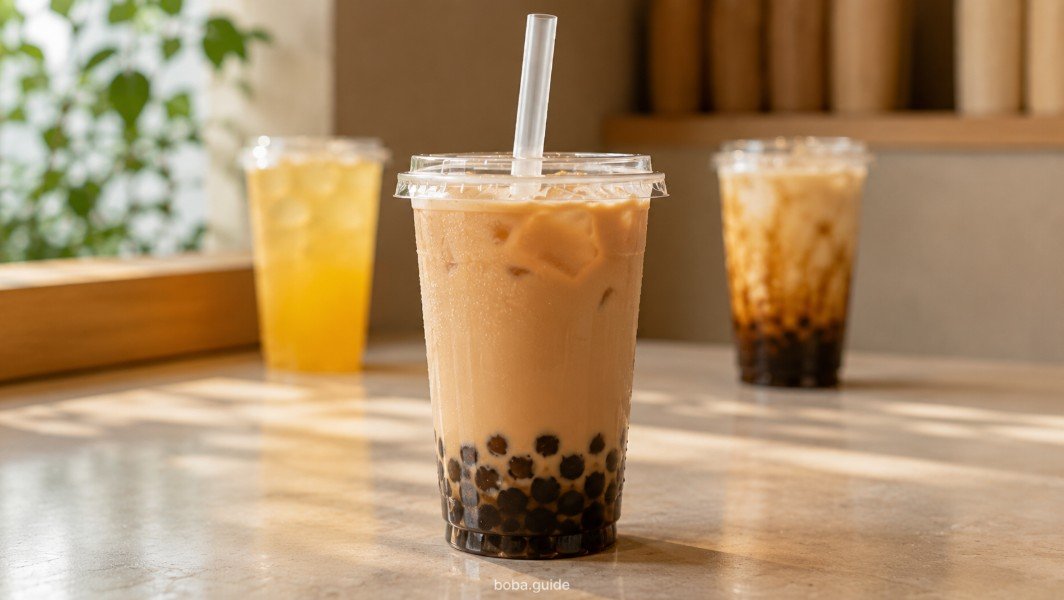
If you want one first boba order that shows you what the classic bubble tea experience is about, start with black milk tea and tapioca pearls. It puts brewed tea, creaminess, sweetness and the signature chewy texture into one relatively simple cup.
That is a more useful recommendation than pretending there is a universally proven “number one first-time order.” Boba shops do not share one global ordering database, menus vary enormously, and what is popular at a Taiwanese tea specialist may be very different from what sells at a dessert-heavy chain or a fruit-tea shop.
So this guide uses classic milk tea with tapioca as a reference order, not a command. The goal of your first cup is not to pass some imaginary boba authenticity test. It is to discover which parts of the experience you actually enjoy — tea, milk, sweetness, temperature, tapioca, or perhaps none of those in that particular combination.
And if you already know that you dislike milk, tea or chewy textures, there is no reason to force yourself into the classic order. A good first boba choice should be recognizable enough to teach you something and personal enough that you have a fair chance of enjoying it.
Classic black milk tea + tapioca pearls.
If a friend walked into a boba shop with me and said, “I’ve never tried this. Give me the cup that will help me understand what boba is,” this is the direction I would choose — provided they like tea, milk and chewy food textures.
Black tea gives the drink enough structure to remain recognizable after milk, sweetener and ice are added. Milk softens the tea’s tannic edge and creates the creamy body many people associate with bubble tea. Tapioca pearls introduce the unusual part: drinking and chewing at the same time.
Keeping the first cup relatively simple matters. If you begin with a highly flavored drink covered in foam and loaded with four toppings, you may enjoy it enormously, but you will have a harder time identifying why. A basic milk tea with one topping gives you a useful baseline.
Think of it less as “the winner” and more as a tasting reference. Once you know what this combination feels like, an intimidating menu becomes easier to read because you have something real to compare against.
“Classic,” “Popular” and “Best for Beginners” Are Not the Same Thing
This distinction matters because boba recommendations often collapse three different questions into one.
Classic describes a drink that represents an established style or recognizable part of bubble tea culture. Pearl milk tea fits naturally here.
Popular describes what people are buying. That can change by city, country, shop, season, social-media trend and customer base. Brown sugar drinks can dominate one menu while fruit teas or matcha dominate another.
Best for a beginner is personal. Someone who loves iced lattes may want a creamy drink. Someone who drinks unsweetened jasmine tea every day may prefer something much more tea-forward. Someone who hates dairy-like textures may be happier with fruit tea. Someone who loves gummy candy may care more about toppings than the drink base.
A classic first cup teaches you the category. A personalized first cup gives you the best chance of enjoying the category. Sometimes those are the same drink. Sometimes they are not.
This is why we do not treat “most popular first boba order” as a claim that every beginner should order exactly the same thing. Classic black milk tea with tapioca is useful because it exposes several defining variables at once without turning the cup into a complicated dessert.
If your priority is comparing several beginner-friendly choices rather than trying the reference cup, our guide to choosing boba for beginners takes the broader route.
Your First Sip Is Actually Five Decisions Hiding in One Cup
People often try one drink, decide “I like boba” or “I hate boba,” and stop there. That verdict is too broad. A single cup contains several variables, and separating them gives you a much better idea of what to order next.
Can you still recognize tea beneath the milk and sweetener? Black tea often works well in a classic first cup because its deeper flavor can remain noticeable after other ingredients are added.
A weak cup may taste mostly like sweetened milk. That does not necessarily mean you dislike milk tea; it may mean that particular recipe has very little tea character.
Notice what creaminess does to the drink. Does it make the tea rounder and more satisfying, or does it leave the cup feeling heavier than you want?
This is one of the most useful first-order discoveries because it immediately separates future milk-tea choices from lighter tea and fruit directions.
Sweetness should not automatically erase the underlying drink. If your first thought is simply “sugar,” remember that this may be adjustable next time.
Also remember that the pearls, syrups and flavored components can contribute sweetness of their own. Changing the menu’s sweetness setting does not always control every source of sugar in the finished cup.
This is usually the most unfamiliar part for a first-timer. Tapioca pearls are meant to be chewed. Their appeal comes from texture as much as flavor.
Pay attention to whether the chew feels playful and satisfying or distracting. If you are curious before ordering, our explanation of what boba feels like focuses specifically on the texture question.
Finally, stop evaluating the components separately. Does sipping cold milk tea and occasionally pulling chewy pearls through the wide straw feel enjoyable as one experience?
That combination is the real reason a classic first cup is informative. Ordinary iced tea does not ask you to chew. Tapioca alone does not give you the drink. Boba becomes distinctive when the liquid and texture work together.
Flavor can be confusing because people sometimes use “boba” to mean the pearls and sometimes the whole drink. If that is the part you are trying to understand, see what boba tastes like before deciding whether a menu description sounds appealing.
The Same “Classic Milk Tea” Can Taste Surprisingly Different From Shop to Shop
One reason first-time recommendations are difficult is that drink names are not standardized recipes. Two shops can sell something called classic milk tea and produce noticeably different cups.
One shop: assertive black tea remains obvious through the milk.
Another: the tea sits quietly behind creaminess and sweetener.
One shop: the drink may use fresh milk or a clearly specified milk option.
Another: a creamer or house milk-tea formulation may create a different body and flavor.
One shop: default sweetness may feel balanced to you.
Another: the standard recipe may taste much more dessert-like even before sweet toppings are considered.
One shop: warm, soft-chewy pearls can create a strong contrast with the cold drink.
Another: firmer, cooler or less fresh pearls can completely change your impression of tapioca.
One shop: the recipe may be calibrated around its normal ice level.
Another: ice quantity, cup size and preparation can shift the balance as the drink sits.
This is why “I tried boba once and didn’t like it” can mean several things. Maybe you dislike tapioca. Maybe you dislike milk tea. But maybe you simply had weak tea, a sweetness level that did not suit you or pearls whose texture was not at its best.
A useful first experience should help you distinguish those possibilities instead of treating every boba shop as if it produces an identical product.
The First-Boba Paradox: The Most Representative Cup May Not Be Your Best Cup
Classic milk tea with tapioca is valuable precisely because it is representative. But representation and personal preference are different jobs.
Choose the classic route if…
You already enjoy black tea or milk tea, creamy cold drinks sound appealing, chewy textures do not bother you, and you want to understand the traditional milk-tea-and-pearl experience before exploring newer variations.
It is also a sensible choice if you simply have no strong preference. A relatively straightforward reference drink gives you a clean starting point.
Skip the classic route if…
You strongly dislike milk, dislike tea, hate chewy food textures or know that rich creamy drinks make you uncomfortable. In those cases, forcing yourself through classic pearl milk tea mostly tests ingredients you already know you dislike.
Start with a different branch of the menu and learn from that instead.
The important rule: do not confuse “I disliked this build” with “I dislike every drink sold at a boba shop.” The category is much broader than one cup.
Four People I Would Not Automatically Give Classic Milk Tea
A beginner recommendation becomes much more useful when it starts with the person instead of the menu.
If your normal order is cold brew, an iced latte or another roasted coffee drink, you already have a flavor language you understand. Moving into boba through coffee can make more sense than jumping directly to a tea profile you rarely drink.
You can still experiment with tapioca and learn whether you enjoy the chew while keeping the liquid portion more familiar. Our boba choices for coffee drinkers follow that route.
If lemonade, iced fruit tea and bright refreshing drinks are your usual territory, a creamy black milk tea may be an unnecessarily large jump.
A fruit tea can introduce you to tea-shop customization and toppings while keeping the overall drink lighter. Start with our fruit tea options for beginners rather than choosing milk tea because someone told you it was mandatory.
If the very phrase “milk tea” makes you hesitate, listen to that preference. Boba does not require milk, and a boba shop is not just a milk-tea shop.
Fruit teas, straight teas and other non-milky drinks can provide a much fairer introduction. See our beginner choices for people who don’t like milk.
If chewy spheres in a drink sound genuinely unpleasant, a full serving of tapioca may dominate your first impression. You can order many drinks without pearls, and shops often offer other textures.
Jellies, popping boba, pudding and other toppings create very different experiences. Our beginner guide to boba toppings helps you choose by texture instead of assuming tapioca is compulsory.
The First Boba Order I Would Actually Build
This is not a universal recipe. Shops use different ingredients and ordering systems. The point is to keep enough variables near the shop’s normal preparation that your first cup gives you a useful baseline.
Classic black milk tea. If the shop uses another tea as its clearly identified house classic, asking what they consider their standard milk tea is reasonable.
Tapioca pearls. Use one topping rather than stacking several unfamiliar textures into the same first cup.
Regular or medium. There is little reason to buy the largest available cup before you know whether you enjoy the combination.
If the shop offers customization, a moderate setting is often easier to evaluate than automatically choosing maximum sweetness. But percentages are shop-specific, so do not treat “50%” as a universal formula.
Normal ice is a useful baseline unless you already have a strong preference or the shop recommends something different for that drink.
Skip them on the first reference cup. Foam, pudding, jelly and additional syrups can all be excellent; they simply make the first experiment harder to read.
Sweetness deserves special attention because menu percentages look more precise than they really are. One shop’s 50% is not guaranteed to taste like another shop’s 50%, and ingredients such as sweetened pearls or syrups may contribute sweetness independently. Our guide to boba sweetness levels explains how to read those controls without assuming false precision.
Why I Would Keep the First Cup Boring on Purpose
“Boring” is slightly unfair to a good classic milk tea, but the principle matters. When you are trying something unfamiliar, simplicity creates information.
Imagine ordering black milk tea with brown sugar syrup, tapioca, pudding, cheese foam and jelly. Suppose you love it. Great — but what did you love? The tea? The salty foam? The pudding? The brown sugar? The combination of five textures?
Now imagine you hate it. You have the same problem in reverse. One unpleasant component can make you reject an entire category.
With a simple milk tea and tapioca, the signals are clearer. If the drink is too sweet but you like everything else, reduce sweetness next time. If the pearls bother you but the milk tea tastes good, change the topping. If the milk is the problem, move to fruit or straight tea. If the tea is too mild, look for a more tea-forward drink.
This is the logic I want a beginner to take from the first order: change one meaningful variable at a time until the cup becomes yours.
Five First-Boba Mistakes That Make the Menu Harder Than It Needs to Be
Ordering the most complicated photo on the menu
A dramatic signature drink can be delicious, but it may contain several flavor and texture layers. It is not automatically the clearest introduction.
Assuming more toppings means more boba
Toppings are choices, not a score. Adding everything can make the drink crowded, heavy and difficult to evaluate.
Thinking 0%, 25%, 50% and 100% are universal measurements
They are menu controls within a shop’s own recipe system. Do not expect the same percentage to produce identical sweetness everywhere.
Choosing a giant size because it looks like better value
A regular cup is enough to learn whether you enjoy an unfamiliar drink. The first order does not need to become a commitment.
Judging every boba drink by one mediocre cup
Tea strength, ingredients, pearl preparation and recipe balance vary. If you can identify what went wrong, your second order can test whether the problem was the category or simply that build.
What I Would Tell Four Different First-Time Customers
“I’ve never had boba. I drink regular tea and I’m open to anything.”
This is the easiest case. Classic black milk tea with tapioca makes sense because none of its main components conflict with an existing preference.
I would keep one topping, avoid turning the drink into a dessert stack and use the shop’s regular size. If adjustable sweetness is available, I would choose a moderate level rather than assuming the sweetest setting is necessary.
Afterward, I would ask three questions: Was the tea strong enough? Was the milk pleasant? Did the tapioca improve the experience? Those answers practically design the second order.
“I love sweet desserts, caramel and creamy drinks.”
This person may enjoy the classic reference, but I would not be surprised if a brown-sugar-style drink feels more immediately appealing.
The important distinction is expectation. Brown sugar can push the experience toward richer, sweeter, more dessert-like territory. That may be exactly what this customer wants, but it is not the same tasting lesson as a simpler black milk tea.
If the goal is pure enjoyment, follow the dessert preference. If the goal is understanding the classic structure first, start simpler and save the richer direction for cup number two.
“I like tea, but I hate drinks that taste like liquid dessert.”
Here I would protect the tea rather than abandon boba. Look for a tea-forward option, ask how sweetness customization works and keep toppings restrained.
A beginner does not need maximum sweetness to have a legitimate boba experience. In fact, reducing sweetness may make the tea easier to appreciate — provided the recipe allows that adjustment and the other ingredients are not heavily sweetened on their own.
If classic milk tea still sounds too creamy, a fruit or straight-tea route may be a better first experiment.
“I want to try boba, but tapioca looks weird to me.”
I would not hide the texture issue. Tapioca is unusual if you have never had something chewy in a drink, and pretending otherwise does not help.
If curiosity outweighs hesitation, try it once in a simple cup. If the idea already feels strongly unpleasant, order a drink without tapioca or choose another topping. You can learn the beverage side first and explore texture later.
There is no rule that your first visit has to include pearls simply because the category is commonly called boba.
How to Tell Whether You Dislike Boba or Just Dislike That Particular Order
Suppose your first cup disappoints you. Before writing off the entire category, identify the strongest negative reaction.
“It tasted like sugar.” That points toward sweetness or recipe balance. Your next experiment should be less sweet or more tea-forward, not necessarily a completely different category.
“The milk made it heavy.” That points toward the base. Move to fruit tea or another non-milky drink.
“I hated chewing while drinking.” That points toward the topping. Keep a drink flavor you liked and remove or replace the tapioca.
“The pearls were hard or unpleasant.” Be careful with the conclusion. You may dislike tapioca, but pearl quality and holding time can affect the experience. One serving does not establish how every shop prepares them.
“It barely tasted like tea.” Look for a stronger tea base rather than assuming milk tea itself is flavorless.
“Everything was fine, but I just didn’t care about it.” That is also a valid result. Not every food category needs to become a hobby. But at least now your verdict is based on the parts of the drink rather than an undefined reaction to the word “boba.”
Your Second Boba Order Should Not Start From Zero
The biggest advantage of a simple first cup is that the second decision becomes easier. Keep what worked. Change what did not.
Knowing the Drink Is Different From Knowing How to Order It
You can understand exactly what you want and still freeze when the cashier asks three questions in quick succession.
That is normal because many boba menus combine the drink choice with several optional controls. Depending on the shop, you may be asked about size, sweetness, ice, milk options and toppings. At another shop, some of those choices may be fixed.
The easiest approach is to decide the drink and topping before you reach the counter. Then respond to the shop’s customization questions instead of trying to decode the entire menu while people wait behind you.
A perfectly reasonable order might sound as simple as: “A regular classic black milk tea with tapioca, please.” If sweetness and ice are customizable, the staff or ordering screen will usually take you through those choices.
If the ordering process itself is what makes you nervous, use our first-time boba ordering walkthrough. That page owns the actual ordering sequence; this one is about choosing the reference drink.
Do Not Ask Only “Did I Like Boba?”
The better question is: Which part did I like?
Maybe you discover that the pearls are exactly the playful texture you hoped for, but you want a brighter drink. Maybe the milk tea is perfect and the tapioca gets in the way. Maybe you love everything except the sweetness. Maybe you realize that tea itself is the interesting part and want something less creamy next time.
Those are much more useful conclusions than a single yes-or-no verdict.
Boba is unusually customizable, which means your first order does not need to be perfect. It needs to give you a reference point. Classic black milk tea with tapioca does that particularly well because its major components are easy to recognize and easy to change individually on later visits.
And if your tastes clearly point elsewhere from the beginning, follow them. The “right” first boba order is not the cup that makes you look experienced. It is the cup that helps you understand the menu better when you come back.
What Was the First Boba You Ever Ordered?
First-boba stories are much more interesting than a manufactured universal ranking. Some people start with classic milk tea and pearls. Others begin with taro because they like the color, mango because the name feels safe, brown sugar because a friend recommends it, or a completely chaotic topping combination because nobody warned them not to.
If you remember your first cup, tell us what you ordered, what surprised you, what you would change now and whether that first drink actually made you want a second one. Those real experiences help the Boba Guide Editorial Team understand where beginner menus are clear — and where they leave people guessing.
First Boba Order Questions
What is a good first boba order?
Classic black milk tea with tapioca pearls is a useful first reference if you already like tea, milk and chewy textures. It lets you experience the tea, creaminess, sweetness and signature tapioca texture without adding too many unfamiliar elements at once.
What is the most popular first boba flavor?
There is no reliable global dataset proving one universal first-time favorite across all boba shops. Classic milk tea with tapioca is better treated as a widely recognizable reference order than as a statistically proven number-one choice everywhere.
Should I get tapioca pearls the first time I try boba?
Tapioca is worth trying if you want the classic pearl milk tea experience and you are comfortable with chewy textures. If chewy foods already bother you, order the drink without tapioca or choose another topping rather than letting one texture ruin the whole first experience.
What sweetness level should a beginner choose?
There is no universal percentage because recipes and sweetness systems differ between shops. If customization is available, a moderate setting can make it easier to taste the tea, but remember that pearls, syrups and other ingredients may add sweetness independently.
Is brown sugar boba a good first order?
Yes, especially if you enjoy rich caramel-like and dessert-style flavors. It can be a very approachable first drink, but it gives you a different reference point from simpler classic black milk tea because brown sugar can become a major part of the flavor experience.
What should I order if I do not like milk tea?
Choose a fruit tea, straight tea, coffee-inspired drink or another non-milky option that fits flavors you already enjoy. You do not need to order milk tea to have a legitimate first boba experience.
Can I order boba without tapioca?
Yes. Many boba drinks can be ordered without tapioca, and shops may offer alternatives such as jelly, popping boba, pudding or other toppings. Availability varies by shop.
How many toppings should I get on my first boba?
One topping is a useful starting point because it keeps the drink easy to evaluate. Several unfamiliar toppings can make it difficult to tell which flavors and textures you actually enjoyed.
What should I try after classic milk tea?
Use your reaction to the first cup. Keep the parts you liked and change the part you did not. Try another milk tea if you loved the creamy base, fruit tea if it felt too heavy, another topping if tapioca was the problem, or a lower sweetness setting if the drink tasted too sweet.