
How to Tell If Boba Is Fresh
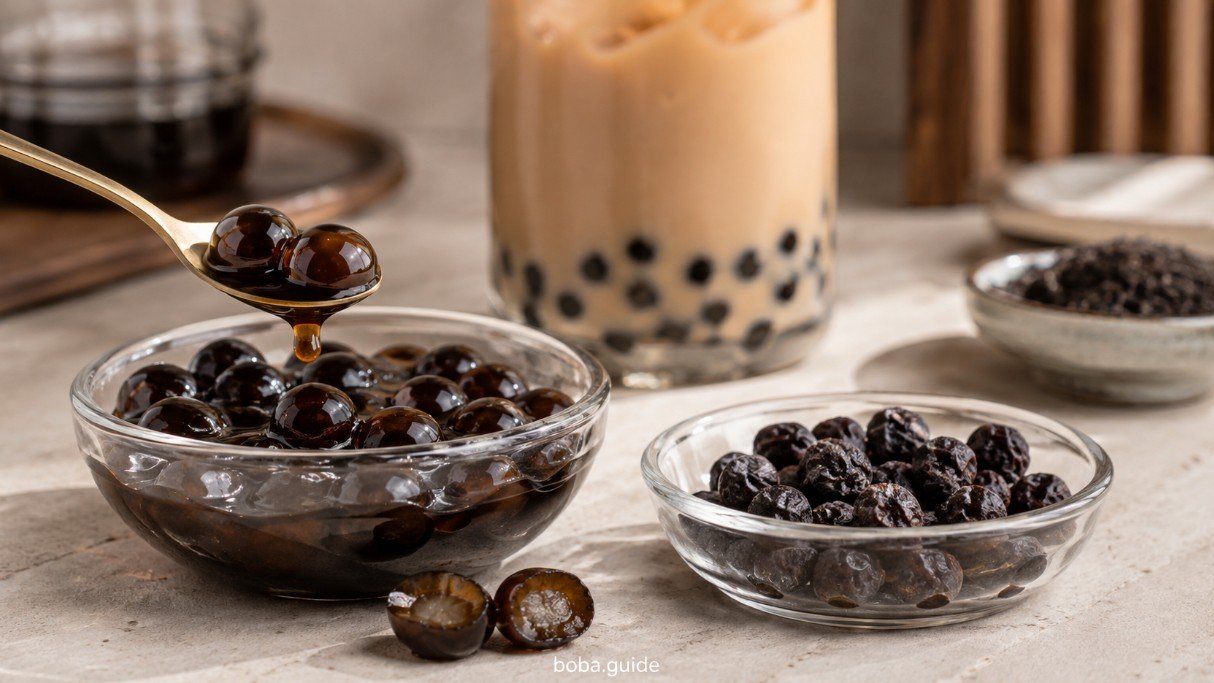
Fresh tapioca boba has four reliable signs: a soft-chewy center, a moist surface, even cooking from edge to middle, and pearls that separate easily instead of forming a stiff clump. Bite one pearl on its own. It should compress, chew evenly and rebound slightly without a hard, chalky or dry center.
Cooked tapioca pearls do not stay at peak texture for long. Commercial bubble-tea suppliers commonly recommend serving cooked pearls within about three to four hours and keeping them at room temperature rather than refrigerating them, because chilling can make the starch firm and lose its characteristic chew. The exact window depends on the pearl formula, batch size, syrup and shop conditions, so age alone is not enough; the pearl itself should still pass a simple texture check.
A 30-second test can tell you more than the pearl color
Black tapioca pearls are usually colored with caramel, brown sugar or other ingredients, so darkness is not a freshness meter. Use touch, bite and center texture instead.
Separate one pearl
Fresh pearls should lift or scoop apart with light syrup coating. A batch that has become a dense rubbery mass is already losing serving quality.
Press it gently
It should give under light pressure instead of feeling rigid. Extremely soft pearls that collapse into paste are also outside the ideal texture zone.
Bite through the center
The resistance should be fairly even from outside to middle. A hard, chalky or starchy center usually points to undercooking or texture deterioration.
Notice the finish
Good pearls feel elastic and pleasantly chewy, not dry, brittle, gummy on the surface or stubbornly stuck to the teeth.
Fresh boba should be soft, elastic and evenly cooked
Texture is the most dependable practical freshness signal because cooked tapioca is a starch gel. Once cooked, that gel continues to change as it sits. Temperature, moisture and time affect how firm or soft the pearls become.
A good pearl is not simply “soft.” It should have enough structure to feel distinct between the teeth, then yield into a springy chew. If the pearl is soft outside but noticeably firm in the center, the problem may be incomplete cooking rather than age. If it was once fully cooked and later becomes dense or rubbery, holding conditions are more likely involved.
Even resistance, hydrated surface, slight spring, no chalky core.
The chew becomes stubborn and the center may feel noticeably harder.
The pearl loses definition and may smear or collapse rather than bounce.
For the ingredient itself—how tapioca pearls are made, why they turn chewy and how they differ from other toppings—see our tapioca pearls guide.
Freshness and doneness are not the same thing
A pearl can be newly cooked and still be underdone, while a properly cooked pearl can lose its best texture after sitting too long. Diagnose the center first, then consider how long the batch has been held.
Soft outside, hard or chalky center
The batch may be recent, but the starch in the middle did not fully gelatinize. Freshness cannot fix incomplete cooking.
Even center, but firmer, drier or more rubbery
The pearl may have started with good doneness and then changed as it cooled, sat in syrup or spent time in a cold drink.
Gloss helps, but appearance alone cannot prove freshness
Freshly prepared pearls often look moist and glossy because they are hydrated and usually coated with syrup. But syrup can make an older batch look shiny too, so appearance should confirm the texture test, not replace it.
Moist, supple surface
The pearls look hydrated rather than leathery, cracked or crusted.
Individual pearls still visible
A little sticking is normal with starch. A dense mass that cannot be separated easily is less desirable.
Very dark color
Darkness mostly tells you about the formula, coloring or syrup—not how recently the pearls were cooked.
Wrinkling or drying
A dull, tightening surface can accompany moisture loss and a firmer chew.
Cooked tapioca pearls have a short peak-quality window
Two commercial bubble-tea suppliers currently recommend consuming cooked tapioca within roughly three to four hours, and both advise against refrigerating finished pearls because the texture can turn hard and less chewy.
Three to four hours is a quality window, not a universal spoilage deadline
The recommendation is about serving quality. A pearl does not suddenly become unsafe at a particular minute, and different formulations behave differently. For a customer judging a drink, the practical question is whether the pearl still has the texture it was intended to have.
The final drink exposes texture problems quickly
A pearl can feel acceptable in warm syrup and then become much firmer after sitting in an iced drink. That is why the most realistic test is the way the topping eats in the finished cup.
Take a few pearls with a normal sip through the boba straw. They should move easily, feel separate rather than fused into a lump, and remain chewable without forcing your jaw to work through a dense center. If the first pearls are noticeably better than the last ones after a long drink, cooling and time may be changing the texture.
Pearls stay pliable in the cold drink and still taste distinct from the tea or milk.
The outside is slick while the center feels hard, dry or oddly resistant.
Pearls clump, smear, split apart too easily or become unpleasantly rubbery.
Freshness is not the only reason boba texture goes wrong
Do not automatically call every bad pearl “old.” Cooking and holding mistakes can create similar symptoms.
The center never fully gelatinized. More holding time after cooking may have been needed.
Refrigeration or prolonged exposure to a very cold drink can firm cooked starch.
The batch may have started slightly underdone and become less pleasant as it cooled.
Starch naturally promotes sticking. Gentle stirring and proper syrup handling can matter.
The gel has lost too much structure for the desired boba chew.
The pearls may have been exposed without enough syrup or held too long in dry conditions.
When the main problem is keeping a cooked batch pleasant after it leaves the pot, see how to keep boba soft for holding and texture-preservation techniques.
A busy shop does not guarantee fresh boba
High turnover can help because a shop that sells many pearl drinks may cook smaller batches more often. But a long line does not prove anything about the pearl in your cup. Taste the topping itself: the center, elasticity, moisture and consistency are the more reliable clues.
What to notice in the first three sips
Temperature: pearls can be warmer than the drink, but they should not taste stale, crusted or refrigerator-firm.
Center: chew one slowly. The middle should not surprise you with a hard plug.
Consistency: several pearls from the same cup should have broadly similar doneness.
Separation: the straw should pick up individual pearls rather than one fused block.
Freshness is only one part of a good cup. For the broader sensory standard—tea balance, sweetness, aroma and topping texture—see what good boba should taste like.
Cook smaller batches when texture matters more than convenience
Fresh pearls are easiest to maintain when you cook roughly what you plan to serve during the next few hours. Large leftover batches create a storage problem that cooked tapioca does not handle especially well.
Keep cooked pearls at room temperature for short-term service
Supplier guidance for conventional tapioca pearls commonly recommends room-temperature holding after cooking instead of refrigeration.
Keep them lightly coated
Sugar, honey or syrup adds flavor and helps keep the surfaces moist. Avoid drowning the pearls in a huge syrup pool.
Stir gently if they begin sticking
Some sticking is normal. Aggressive mixing can damage very soft pearls.
Re-cook instead of saving a weak leftover batch
When the texture is already badly hardened or mushy, a fresh small batch usually gives a better result than trying to disguise it.
Judge boba by the center of the pearl, not by how black or shiny it looks
Good tapioca should be hydrated, elastic and consistently chewy from outside to center. A hard core usually signals undercooking or firming; a mushy pearl has lost too much structure; a dry or rubbery pearl has moved away from peak serving texture. Because cooked pearls change quickly, shops and home cooks generally get the best results from fresh, appropriately sized batches.
Know a shop that serves exceptionally good tapioca pearls?
Send the shop name, city and what stood out about the texture to info@boba.guide. Tell us whether the pearls were especially soft, springy, warm, consistent or simply memorable.
Fresh boba questions
Common questions about cooked tapioca pearl texture, holding time, hardness and storage.
How can you tell if boba is fresh?
Fresh tapioca boba should be moist, soft-chewy and fairly even in texture from the outside to the center. Bite one pearl by itself: it should compress easily and have a springy chew without a hard, chalky or dry middle.
How long do cooked boba pearls stay fresh?
Commercial bubble-tea suppliers commonly recommend using conventional cooked tapioca pearls within about three to four hours for best serving texture. The exact window varies with the product, syrup and holding conditions, so texture should still be checked directly.
Should fresh boba be hard in the middle?
No. A distinctly hard, chalky or starchy center usually means the pearl was undercooked or has become firmer during holding. A good pearl should have relatively even chew from edge to center.
Why does boba get hard in an iced drink?
Cooked tapioca starch firms as conditions change, and cold temperatures can make the effect more noticeable. That is one reason suppliers generally advise against refrigerating cooked pearls and why pearls may become firmer during a long stay in an iced drink.
Does shiny boba mean it is fresh?
Not necessarily. Fresh pearls often look glossy because they are hydrated and coated with syrup, but syrup can also make older pearls look shiny. Texture and the condition of the center are better freshness clues than gloss alone.
Is sticky boba old?
Not automatically. Tapioca starch naturally makes cooked pearls prone to sticking. A little clumping can happen even in a fresh batch; the bigger question is whether the pearls still separate easily and remain soft-chewy rather than forming a dense rubbery mass.
Should cooked boba pearls be refrigerated?
For conventional tapioca pearls intended for same-day service, major bubble-tea suppliers generally advise room-temperature holding and warn that refrigeration can make cooked pearls hard and less chewy. Follow the instructions for the specific product you use.
Can old boba become mushy instead of hard?
Yes. Texture decline is not always hardening. Pearls held too warm, overcooked or kept too long in some conditions can become overly soft, sticky or lose their shape. The target is a defined, elastic chew rather than either extreme.
What does undercooked boba feel like?
Undercooked boba often has a softer exterior with a noticeably firm, chalky or starchy center. That differs from a properly cooked pearl, where the resistance is much more even through the middle.
What is the best way to check boba quality at a shop?
Taste several pearls from the finished drink. Look for an even soft-chewy center, easy separation, consistent doneness and a texture that stays pleasant in the cold drink. Use those clues together with tea quality, menu fit and recent detailed reviews when choosing a shop.