
Boba Supplies: Ingredients, Tools, Cups, Straws and Equipment
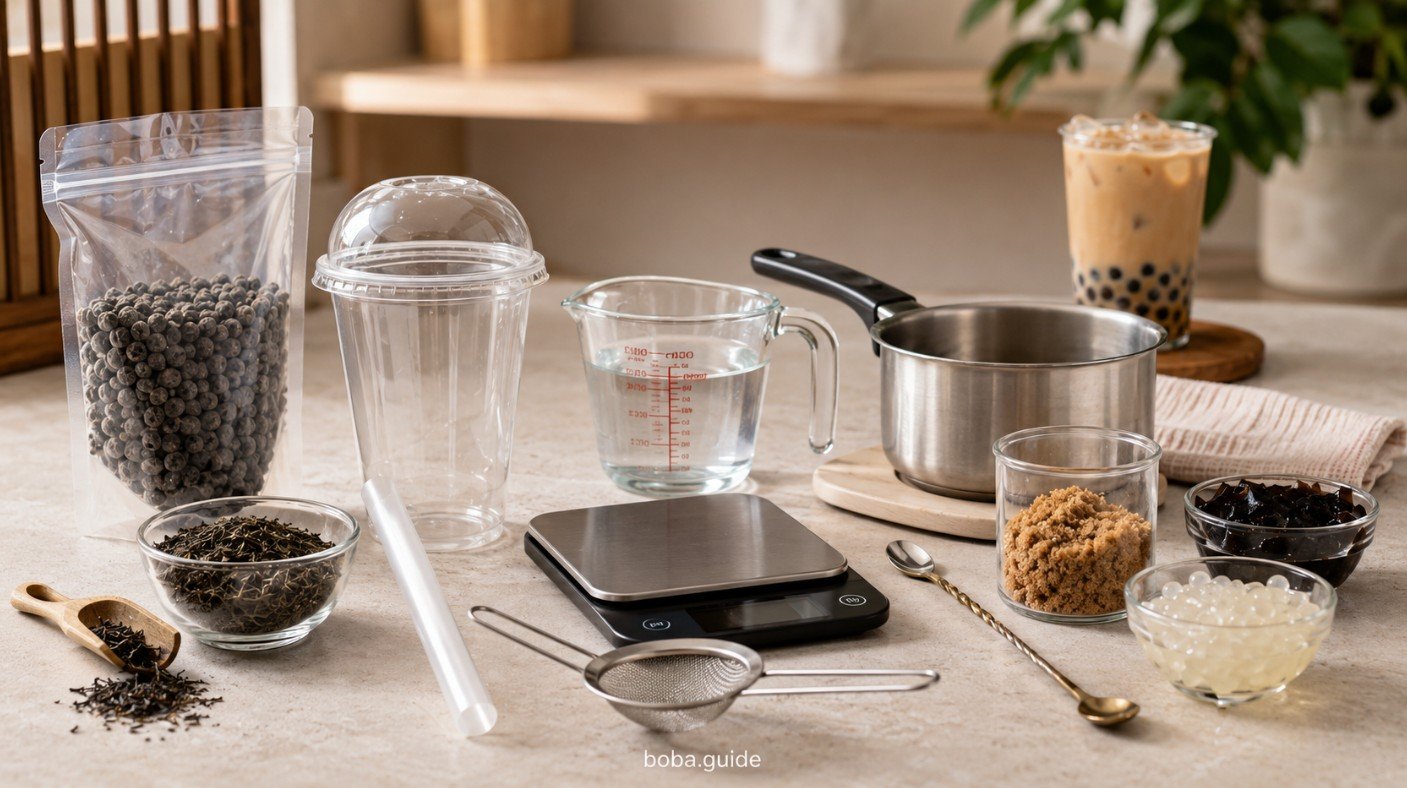
Boba supplies fall into four practical groups: ingredients, preparation tools, serving supplies and higher-volume equipment. A home setup may need only tea, tapioca pearls, sweetener, a pot, a strainer, measuring tools, a cup and a wide straw. A frequent home maker may add a shaker, better storage and dedicated portioning tools. A shop may also need sealing, dispensing and batch equipment.
The right supply list depends on the drink you make and the volume you serve. This page maps the whole category so you can see what each item does, which supplies are worth comparing, and when a specialized tool actually solves a problem.
Start with the job each supply performs
Bubble tea can look equipment-heavy because shops repeat the same steps all day. Strip away the volume, and most supplies are simply solving one of four jobs.
Ingredients
Tea, tapioca pearls, sweeteners, milk or milk alternatives, fruit, powders, syrups and toppings create the drink itself.
Preparation tools
Pots, strainers, scales, measuring cups, shakers, scoops and storage containers help you brew, cook, portion and mix consistently.
Serving supplies
Cups, lids and wide straws affect portability, topping compatibility and how easy the drink is to serve.
Higher-volume equipment
Sealers, automatic shakers, fructose dispensers and commercial pearl or tea equipment are designed mainly to improve speed, consistency and throughput.
Start with the ingredient and preparation supplies needed for one drink family. Add specialized serving or commercial equipment only when your actual routine gives you a reason.
What counts as a boba supply?
A boba supply is anything that helps create, prepare, portion, store or serve a bubble-tea drink. That includes obvious ingredients such as tea and tapioca pearls, but also less glamorous items such as scales, strainers, storage containers, lids and cleaning brushes. The useful boundary is practical: if an item consistently helps you make or serve the drink, it belongs in the setup.
That is also why a kitchen saucepan can be a perfectly good boba tool while a commercial cup sealer may be unnecessary. “Boba equipment” does not need to be branded for bubble tea; it simply needs to fit the task.
The ingredients determine what kind of boba you can make
Buying better tools cannot rescue ingredients that do not fit the drink. Tea, pearls, sweetener and toppings should be chosen around the style you want to serve.
Choose the base before the extras
Black tea supports classic milk tea, jasmine green tea works well for lighter milk or fruit builds, and oolong, hojicha, matcha and herbal bases create different flavor directions. If tea is the foundation of your setup, use the tea for boba section to compare styles before buying several bags at once.
Dry tapioca pearls are not all the same
Cooking time, size, texture and holding behavior vary by product. If pearls are central to the drinks you make, compare them in the best tapioca pearls comparison rather than choosing only by bag size or price.
Use the simplest sweetener that fits the recipe
Granulated sugar, simple syrup and brown sugar can cover a large share of home drinks. Syrups become more convenient when you make cold drinks repeatedly, but a commercial dispensing system is not required to control sweetness.
Add texture deliberately
Tapioca, jelly, pudding, crystal boba and popping boba create different textures and storage needs. The boba toppings section is the better place to compare those formats in detail.
Good tools make repeated steps easier to control
The most valuable tools are rarely the most specialized. They measure, strain, mix, drain or store something you already use frequently.
For product-specific comparisons, use the dedicated pages for boba strainers, measuring tools and boba shakers.
Cups and straws need to match the drink, not the aesthetic
Serving supplies matter most when toppings are involved. A narrow straw can make a perfectly good drink frustrating, while a secure lid matters more than whether the cup looks like a shop cup.
Wide straws
Large tapioca pearls and chunky jellies need enough clearance to move through the straw. Around 12 mm is a common commercial width for boba straws, but exact products and topping sizes vary.
Reusable cups
For home use, a secure reusable cup is often simpler than disposable shop packaging. Capacity, lid fit, cleaning and compatibility with wide straws matter more than decorative features.
Disposable cups, lids and sealing film
These become more relevant when you serve groups, transport drinks or operate a business. They solve packaging and service problems rather than improving the drink itself.
Commercial boba equipment is mainly about repetition and volume
A shop can justify equipment that saves seconds on every order. A household making two drinks usually cannot. Judge each machine by the bottleneck it removes.
Cup sealing machine
Seals disposable cups with film for takeaway service. It is a packaging tool, not a flavor tool.
Automatic drink shaker
Standardizes mixing and reduces repetitive manual work when many drinks are made in succession.
Fructose or syrup dispenser
Speeds up repeatable sweetness dosing. At home, a scale, spoon or measured syrup bottle can do the same job more simply.
Tea warmer or dispenser
Helps manage larger prepared tea batches during service. It matters when holding and serving volume becomes part of the workflow.
Commercial pearl cooker
Automates part of a repetitive cooking process. A saucepan remains enough for small batches unless pearl volume becomes a genuine constraint.
Use the boba equipment checklist when you need to evaluate a complete setup rather than one tool at a time.
The drink style changes which supplies matter most
A classic milk tea, a fruit tea and a frozen slush can share cups and straws while needing very different ingredients and preparation tools.
Classic milk tea
Core: black or oolong tea, milk or creamer, sweetener, tapioca pearls, pot, strainer, measuring tools and a shaker or mixing vessel.
What matters most: tea strength, pearl texture and repeatable ratios.
Fruit tea
Core: green or jasmine tea, fruit, syrup or puree, ice, a shaker, cup and a topping that suits a lighter drink.
What matters most: clean tea flavor, fast chilling and ingredient compatibility.
Matcha drinks
Core: matcha, a fine whisking tool or shaker, milk or water, sweetener and a cup large enough for ice and toppings.
What matters most: smooth dispersion and avoiding clumps.
Fresh-milk and brown-sugar drinks
Core: milk, brown sugar or syrup, pearls, a pot and a serving cup. Tea may not be part of the build.
What matters most: pearl freshness, syrup control and cup capacity.
Slush and frozen boba
Core: a blender strong enough for ice, fruit or flavor base, sweetener, cup and toppings that still work in a colder texture.
What matters most: blender capacity, ice handling and topping choice.
The next supply to buy should fix a specific limitation
Improve measuring first: scale, thermometer if needed, and a clearer brewing vessel.
Use a slotted spoon or dedicated boba scoop before buying larger equipment.
A better hand shaker may solve the problem without any automatic machine.
The serving problem is the straw diameter, not the pearl recipe.
Packaging, sealing and faster dispensing become more relevant because throughput has changed.
Supply size should match your normal batch, not your biggest imaginable batch
Oversized equipment takes more space, is harder to clean and can be awkward for one or two drinks. Undersized tools cause spills, poor mixing and cramped pearl cooking.
Pot size
Choose enough room for the water and pearls to circulate freely. Tapioca should not be packed into a shallow layer with barely enough water to move.
Shaker capacity
Leave headroom for ice and liquid to move. A shaker filled to the brim cannot mix efficiently and is more likely to leak when shaken.
Cup capacity
Remember that toppings and ice reduce the liquid volume available in the cup. A nominal cup size does not equal the amount of tea or milk inside the finished drink.
Straw width
Match the inner opening to the largest topping. Large pearls and chunky jelly need more clearance than crystal boba or a drink with no chunky topping.
A boba supply is only good if it fits the drink and the workflow
Brand names matter less than whether the pieces of the setup work together. Four compatibility checks prevent many unnecessary purchases.
The straw opening must comfortably pass the largest topping you serve. A premium narrow straw is still the wrong tool for large tapioca pearls or chunky jelly.
A cup is not a complete serving setup by itself. Check lid fit, opening size, capacity for ice and toppings, and whether your preferred straw actually fits the lid.
A shaker should leave enough headroom for ice and liquid to move. An oversized vessel is awkward for one drink; an undersized one leaks or mixes poorly.
Fine broken tea leaves need finer filtration than large whole leaves. Choose mesh and capacity around the tea you brew rather than buying the largest strainer available.
Compatibility is a better first filter than price. A cheap tool that fits the task can outperform an expensive product designed for a different topping, batch size or serving method.
Home, enthusiast and shop setups solve different problems
Make a few drinks well
Prioritize ingredients, a pot, strainer, measuring tools, a hand-mixing option, reusable cups and wide straws. Specialized machinery is rarely necessary.
Test more recipes with less friction
Add more precise measuring, better storage, a dedicated shaker, several tea bases and a small range of toppings only when you actually use them.
Serve repeatably at volume
Throughput, holding, food-safe storage, portion consistency and takeaway packaging become larger concerns, which is where commercial equipment starts to earn its cost.
If your goal is specifically a compact first setup for home use, the boba starter kit guide will narrow the list further. For preassembled options, use best boba kits.
Storage space is part of the supply decision
A boba setup expands quickly because ingredients and tools need different kinds of storage. A small kitchen benefits from supplies that earn their space.
Tea, unopened pearls and powders generally need dry storage away from excess heat and moisture. Large bulk packages take more room and are only worthwhile when you use them regularly.
These may have very different storage instructions after opening. Follow the manufacturer label rather than assuming every topping belongs in the same cabinet or refrigerator.
Shakers, strainers, cups, lids and wide straws need enough space to dry fully before storage. Stackability and simple shapes matter more over time than decorative design.
A sealing machine or automatic shaker also needs counter space, electrical access, cleaning access and room for the consumables it uses.
Bundle or buy individual supplies?
A bundle is convenient when you want a simple first experience and do not care about choosing every component. Buying individually gives you more control over tea quality, pearl type, cup size and tools. Neither approach is automatically cheaper once unused ingredients and duplicate tools are counted.
Go deeper only where you need a buying decision
Each page below owns a narrower supply question so this page can stay broad without turning into a giant product list.
The easiest way to overspend is to buy for an imaginary future setup
Buying bulk before you know your usage
A lower price per ounce is not a saving when half the ingredient sits unused.
Choosing a cup before checking the lid and straw
Serving pieces work as a system. A cup that does not fit your lid or straw creates a new problem instead of solving one.
Buying a machine to fix a recipe problem
A sealer will not improve weak tea, and an automatic shaker will not rescue badly cooked tapioca pearls.
Collecting toppings faster than you can use them
Variety looks appealing until several opened containers need storage and attention at the same time.
Ignoring cleaning before buying
A tool that is awkward to wash often gets used less, no matter how impressive it looked online.
Supplies are easier to live with when they are easy to clean and store
Syrup, milk, tea residue and starch can reach shaker seals, lids, strainers and reusable straws. Cleaning matters more than decorative features once the setup is used regularly.
Choose washable shapes
Wide openings and removable seals are easier to clean thoroughly than narrow cavities that trap milk or syrup.
Dry tools before storage
Strainers, reusable straws and cups should be fully dry before they are closed away.
Follow ingredient labels
Dry tea, unopened pearls, opened syrups and prepared toppings do not share one universal storage rule. Use the product instructions for the ingredient you actually bought.
Buy quantities you can finish
Bulk packaging only saves money when the ingredient is used while its quality is still good.
Found a boba tool that solved a real preparation problem?
Send the tool, what you use it for and what problem it solved to info@boba.guide.
Boba supplies: common questions
Answers about ingredients, tools, straws, cups, shakers and higher-volume equipment.
What are the main types of boba supplies?
Boba supplies can be grouped into ingredients, preparation tools, serving supplies and higher-volume equipment. Ingredients create the drink, preparation tools help brew and portion it, cups and straws serve it, and commercial equipment mainly improves speed and consistency at higher volume.
What boba supplies do I need at home?
A simple home setup can start with tea, tapioca pearls, sweetener, milk if the recipe uses it, a saucepan, strainer, measuring tools, a mixing vessel, a cup and a wide boba straw. Add specialized tools only when your routine gives you a reason.
Do I need a special pot for tapioca pearls?
No. A normal saucepan can handle small home batches if it is large enough for the water and pearls you cook. Commercial pearl cookers become more relevant when repeated batch volume justifies dedicated equipment.
How wide should a boba straw be?
Large tapioca pearls need a genuinely wide straw. Around 12 mm is a common commercial width for boba straws, although exact products and topping sizes vary. Chunky jelly may also require a wide opening.
Is a boba shaker necessary?
Not always. A hand shaker, cocktail shaker or tightly closing jar can mix and chill home drinks. A dedicated shaker becomes more attractive when you make boba often and want easier cleaning, a better seal or more consistent capacity.
Do I need a cup sealing machine for boba?
No. A sealing machine is mainly a packaging and service tool for takeaway drinks. It does not improve tea flavor or tapioca texture. A secure reusable cup is enough for most home use.
Which boba tool is worth upgrading first?
Upgrade the tool connected to your biggest repeat problem. If batches vary, improve measuring. If drinks leak while shaking, improve the shaker. If pearls jam, change the straw. Specialized equipment makes the most sense when it fixes a specific limitation.
Are reusable boba cups worth it?
For frequent home use, a reusable cup can be practical if it has a secure lid, enough capacity for ice and toppings, and an opening that fits a wide straw. Easy cleaning matters more than decorative features.
What equipment does a boba shop use that a home maker usually does not need?
Depending on volume, shops may use cup sealers, automatic shakers, syrup dispensers, tea warmers, storage systems and commercial pearl equipment. These tools are designed mainly for throughput, holding and repeatability.
Should I buy a boba starter kit or individual supplies?
A starter kit can be convenient when you want one bundled introduction. Individual supplies give you more control over tea, pearls, tools and serving pieces. The better choice depends on whether convenience or customization matters more to you.