
BERGAMOT BLACK TEA FOR MILK, PEARLS AND FRUIT
Earl Grey Boba: Bergamot Milk Tea, Fruit Pairings & Toppings
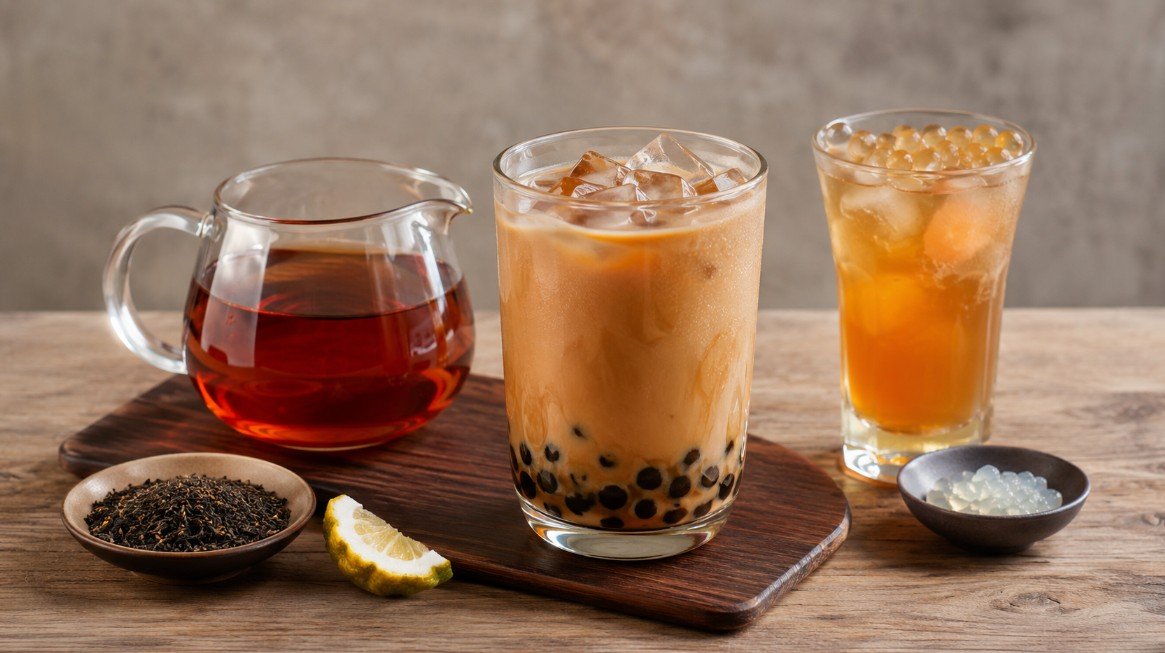
Earl Grey boba combines black tea with a distinct bergamot-citrus aroma, which makes it behave differently from a plain Assam or Ceylon milk tea. It still has the body of black tea, but the aromatic layer means the best milk, sweetness, fruit and topping choices are the ones that leave enough room for bergamot to remain recognizable.
That makes Earl Grey particularly useful when you want something between classic black milk tea and a lighter aromatic tea drink. It can support tapioca and creamer, but it also has enough citrus-floral character to work with peach and other fruit-forward combinations.
Commercial bubble-tea preparation also shows that Earl Grey is not automatically a delicate afternoon tea. One Taiwanese boba supplier recommends product-specific Earl Grey ratios of 1:41 or 1:29 tea-to-water with a 13–15 minute steep before creamer and sweetener are added. That is a much more concentrated context than simply brewing a normal drinking cup.
Start with the tea itself
What is Earl Grey boba?
Earl Grey boba is a bubble-tea drink built around Earl Grey tea, traditionally a black-tea style flavored or scented with bergamot citrus. In boba, that aromatic citrus character can remain part of a milk tea, pair with fruit, or simply make a black-tea drink feel more fragrant than a plain Assam-style base.
The important distinction is that Earl Grey is still fundamentally a tea base, not just a citrus flavor. A good Earl Grey boba should let you notice both the black tea and the bergamot after milk, sugar, ice and toppings are added.
Black tea provides body; bergamot provides aromatic lift. If the tea is too weak, the finished cup tastes like flavored milk or syrup. If the bergamot becomes too dominant, the drink can feel perfumed rather than balanced.
If you are comparing Earl Grey against Assam, Ceylon and other black-tea bases more generally, use our guide to black tea for boba.
Useful commercial reference points
Earl Grey boba needs more precise numbers than “brew it strong”
Boba preparation can require a much stronger Earl Grey base than an ordinary drinking cup. A commercial bubble-tea supplier gives two specific tea-to-water options for its Earl Grey product, both followed by a relatively long extraction.
Standard commercial reference
One published Earl Grey method uses roughly one part tea to forty-one parts water.
Stronger alternative
The same supplier also publishes a more concentrated option for a stronger tea base.
Product-specific steep
Both ratios are paired with a long commercial extraction window for that Earl Grey product.
Real fruit-boba application
A published Earl Grey peach recipe uses a 500 mL finished-cup format.
These are instructions for one commercial bubble-tea product containing Assam black tea and Earl Grey flavor. Leaf size, base tea, flavoring, equipment and the final drink all affect extraction. Use them as evidence of real boba concentration, not as a universal law.
The detailed science of adjusting temperature, time and concentration belongs in our guide to brewing tea for boba.
One tea, two sensory jobs
Earl Grey has to preserve both black tea and bergamot
The advantage of Earl Grey is not simply that it is “strong black tea.” Its usefulness comes from the combination of black-tea structure and an aromatic bergamot layer.
The black-tea layer
The black-tea base provides body and enough flavor weight to work with creamer, milk, sweetener and traditional tapioca pearls.
This is why Earl Grey can function as a true milk-tea base rather than only as a clear scented tea.
The bergamot layer
Bergamot adds the citrus-floral top note that separates Earl Grey from plain black tea. It can make milk tea feel brighter and can connect naturally with peach and other fruit directions.
But if syrup, vanilla, dark brown sugar or heavy foam becomes dominant, the bergamot can disappear even when the underlying black tea remains noticeable.
The most familiar boba use
Does Earl Grey work well as milk tea?
Yes. Earl Grey is a natural milk-tea base because the underlying black tea can support creaminess while bergamot gives the drink an aromatic edge. Bubble-tea suppliers explicitly sell Earl Grey for milk tea and lattes.
The important decision is how much richness to add before you stop tasting the bergamot.
Light milk
Bergamot remains prominent and the drink can feel almost like a creamy iced Earl Grey with boba.
Moderate milk
This is often the most flexible balance: enough creaminess for milk tea while the black tea and citrus aroma remain clear.
Heavy creamer
The tea becomes rounder and richer, but the bergamot may move into the background. A stronger product-specific tea concentration may be needed.
Heavy brown sugar
Dark caramel flavor can easily become the main identity of the drink. If brown sugar is supposed to dominate, a plain robust black tea may be the more logical base.
For the broader comparison between black tea, oolong, jasmine and other creamy bases, use our guide to the best tea for milk tea.
Bergamot opens another direction
Which fruit flavors pair with Earl Grey boba?
Fruit can work especially well with Earl Grey because bergamot already gives the tea a citrus-aromatic character. The easiest pairings are fruits that complement that brightness instead of replacing the tea entirely.
| Fruit | How it changes Earl Grey | Useful boba direction |
|---|---|---|
| Peach | Soft fruit aroma can connect with bergamot without making the drink sharply acidic. | Clear Earl Grey fruit tea, crystal boba or light foam. |
| Lemon | Pushes the drink toward a brighter citrus profile and can emphasize Earl Grey’s aromatic side. | Clear iced tea with restrained sweetness. |
| Orange | Creates a rounder citrus profile but can overpower bergamot if syrup is too concentrated. | Tea-forward fruit drink rather than thick syrup-heavy boba. |
| Passion fruit | Adds much stronger tropical acidity and aroma, increasing competition with Earl Grey. | Use when the tea is deliberately strong enough to remain present. |
| Lychee | Creates a floral-fruit direction that can complement the aromatic side of Earl Grey. | Lighter tea with crystal boba or jelly. |
Peach is more than a theoretical pairing. A commercial boba supplier publishes a complete Earl Grey peach build using substantial measured quantities of tea, syrup, fruit and toppings.
A real commercial example
What does a 500 mL Earl Grey fruit-boba build look like?
One published commercial recipe makes the competition inside an Earl Grey fruit drink very concrete. The tea has to remain recognizable beside fruit syrup, cane sugar, diced peach, crystal boba, ice and a separate flavored foam layer.
Earl Grey black tea.
Pink peach syrup in the shaken tea.
Cane sugar in the tea mixture.
Diced peach in the finished cup.
Crystal-style boba added to the drink.
Plus ice and a separate peach milk-foam layer.
The foam itself uses another 35 g foam powder, 120 cc fresh milk and 20 cc peach syrup. The recipe is intentionally elaborate, but it demonstrates a useful point: only 200 cc of the 500 mL drink begins as Earl Grey tea, while multiple other ingredients compete for aroma and sweetness.
That is why tea concentration matters. In a fruit-boba build this complex, a tea prepared merely as a mild drinking cup can become very difficult to identify.
Texture changes the balance
Which toppings work best with Earl Grey?
Earl Grey is flexible enough for both traditional tapioca and lighter toppings, but the topping should match the drink direction.
Black tapioca
Best for Earl Grey milk tea. Chewy pearls fit the black-tea body, but very heavy brown-sugar syrup can overpower bergamot.
Crystal boba
Excellent for fruit-forward Earl Grey. It adds chew without automatically bringing a strong caramel flavor.
Aloe
Useful in clearer citrus or peach drinks. The texture remains noticeable while the tea stays relatively light.
Fruit jelly
Good when the jelly flavor follows the fruit already in the drink. Several unrelated jellies can make the aromatic structure messy.
Milk foam
Works when creaminess is intentional. A thick foam layer adds another source of milk and flavor, so the Earl Grey base needs enough presence underneath it.
For the broader texture and topping decision, see the boba toppings guide.
Sugar changes aroma perception
How sweet should Earl Grey boba be?
Earl Grey usually benefits from enough sweetness to round the black tea without making bergamot disappear under syrup. There is no universal “50% sugar” recipe because shop percentages are relative to each shop’s own standard dose.
For perspective, POSSMEI sells peach syrup with a suggested serving of roughly 1–1.5 oz per beverage, while its Earl Grey peach recipe uses 30 cc — approximately 1 oz — of peach syrup plus another 10 cc cane sugar in the tea layer. Those are concrete commercial quantities, not universal sweetness targets.
Lower sweetness
More black tea and bergamot remain exposed. This is a strong choice for tea-forward Earl Grey milk tea.
Moderate sweetness
Usually the easiest balance for milk tea or peach Earl Grey because sweetness supports the drink without automatically becoming the main flavor.
Heavy sweetness
Works only when a dessert-like result is deliberate. Syrup, sweet tapioca and flavored foam can collectively reduce the role of bergamot.
For shop-specific percentage systems and how 0%, 25%, 50%, 75% and 100% settings should be interpreted, use our separate boba sweetness levels guide.
Three common failures
Why does Earl Grey boba sometimes taste wrong?
The most common problems come from losing either the black-tea structure or the bergamot balance.
The tea disappears after milk is added
A normal mild Earl Grey cup may not have enough concentration for milk, ice and tapioca. Commercial boba Earl Grey can be brewed around 1:41 or even 1:29 for a reason.
The drink tastes perfume-like
More bergamot is not always better. If citrus-floral aroma overwhelms the actual black tea, the drink can feel flavored rather than tea-forward.
Brown sugar hides the Earl Grey identity
Heavy dark syrup can dominate both bergamot and black tea. If brown sugar is the main goal, a simpler strong black-tea base may give you the same structural benefit without wasting Earl Grey’s aromatic advantage.
Choose the right black-tea direction
Earl Grey vs plain black tea for boba
Earl Grey is not automatically better than plain black tea; it is more specific. Choose it when bergamot improves the drink. Choose plain black tea when you mainly need body, maltiness or resistance to milk and strong syrup.
Choose Earl Grey
For aromatic milk tea, peach or citrus drinks, lighter toppings, or when you specifically enjoy bergamot.
Choose Assam
When a strong malty tea foundation is more important than floral-citrus aroma.
Choose Ceylon
When you want a cleaner, brighter black-tea profile without the distinctive Earl Grey perfume.
Choose oolong instead
When you want roast, floral complexity or a more tea-forward milk drink without bergamot.
The broader family-level decision belongs on our guide to choosing the best tea for boba.
Choose without overthinking it
When should you order Earl Grey boba?
The decision to remember
Choose Earl Grey when bergamot adds something useful to the boba
Earl Grey works best when you want the strength of black tea plus a citrus-floral aromatic layer. It can make a very good milk tea with tapioca, but it is also unusually flexible with peach and lighter fruit combinations.
The practical numbers show why strength matters. A commercial Earl Grey can be brewed around 1:41 or 1:29 for 13–15 minutes, while a real 500 mL peach build contains only 200 cc Earl Grey tea alongside syrup, sugar, fruit, boba, ice and foam. The tea must be strong enough for that environment without becoming unpleasant on its own.
If the bergamot remains recognizable after the complete drink is assembled, Earl Grey is doing a job that plain black tea cannot quite reproduce.
Is Earl Grey good for boba?
Yes. Earl Grey works particularly well in milk tea because the black-tea base can support milk and tapioca while bergamot adds a distinctive citrus-floral aroma. It can also work in fruit boba, especially with peach and lighter citrus directions.
What does Earl Grey boba taste like?
Earl Grey boba combines black-tea body with bergamot aroma. In milk tea it can taste creamy, brisk and citrus-floral; in fruit tea it feels lighter and more aromatic. The exact result depends heavily on milk, sweetness and toppings.
How strong should Earl Grey tea be for boba?
There is no universal ratio. One commercial Earl Grey product used for bubble tea publishes tea-to-water ratios of 1:41 or 1:29 with a 13–15 minute extraction. Those are product-specific commercial references rather than universal instructions for every Earl Grey tea.
What fruit goes well with Earl Grey boba?
Peach is one of the strongest practical pairings, and commercial bubble-tea recipes use Earl Grey with peach syrup and diced peach. Lemon, orange, lychee and some passion-fruit combinations can also work when the tea remains strong enough to be noticeable.
What toppings are best with Earl Grey?
Black tapioca works well with Earl Grey milk tea, while crystal boba, aloe and light fruit jellies are useful for clearer fruit-based drinks. Heavy brown-sugar toppings can overpower the bergamot character.
Can Earl Grey be used for milk tea?
Yes. Bubble-tea suppliers sell Earl Grey specifically for milk tea and latte preparation. The black-tea base provides body while bergamot gives the drink more aromatic character than plain black tea.
Is Earl Grey better than Assam for boba?
Neither is universally better. Assam is usually the simpler choice when you want strong malty black-tea body. Earl Grey is better when bergamot citrus aroma is supposed to be part of the finished milk tea or fruit drink.
How much Earl Grey tea can be in a fruit boba drink?
It varies by recipe. One published 500 mL commercial Earl Grey peach drink uses 200 cc Earl Grey black tea, along with 30 cc peach syrup, 10 cc cane sugar, 50 g diced peach, 30 g crystal boba, ice and a separate milk-foam layer.
Why does Earl Grey boba sometimes taste perfume-like?
The bergamot aroma can become too dominant relative to the underlying black tea, especially when the tea blend itself is highly aromatic or additional flavoring is used. A balanced Earl Grey boba should still taste clearly like tea.