
BLACK TEA BASES, BREWING & BOBA PAIRINGS
Black Tea for Boba: How to Choose the Right Tea Base
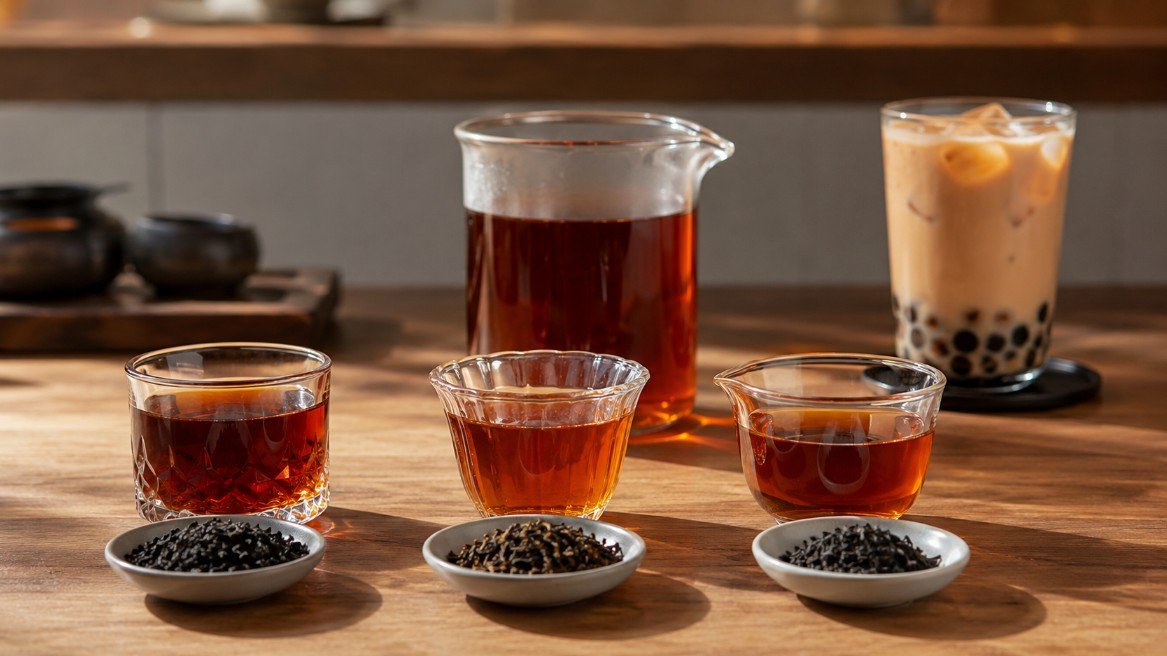
For classic boba milk tea, start with a black tea that remains easy to taste after milk, sweetener, ice and tapioca are added. Assam is a strong starting point when you want a deep, malty and full-bodied base. Ceylon can create a brighter, brisker impression, while a blend can combine body with a cleaner finish.
The best black tea for boba is therefore not automatically the most expensive or delicate tea. It is the tea that still performs once it becomes one ingredient inside a larger drink.
Choose for the finished drink
What Makes a Black Tea Good for Boba?
A good black tea for boba needs enough body and structure to stay recognizable after the rest of the recipe is built around it. Milk softens tea. Sweetener competes with subtle aroma. Ice lowers concentration as it melts. Tapioca may arrive coated in syrup.
Those effects explain why a black tea can taste powerful in a plain tasting cup and surprisingly quiet in milk tea. The selection test should happen in the finished drink, not only in hot water.
Fuller body is useful when milk and sweet toppings are important parts of the recipe.
A lively, defined finish can prevent milk tea from tasting flat or entirely sugar-led.
Aroma matters, but delicate high notes are easier to lose as the drink becomes creamier and sweeter.
The tea should remain identifiable without requiring enough extraction to make the drink unpleasantly rough.
This is why choosing tea for boba is different from selecting a tea only for plain drinking.
Numbers before adjectives
Start With 95–100°C Water and a 3–5 Minute Black-Tea Reference
Those numbers are useful reference points, not a universal recipe for every Assam, Ceylon or blend.
For boba, the goal is often more concentration than a casual plain cup because the finished drink may include milk and ice. But more concentration and longer extraction are not the same thing.
If your black tea tastes good before milk but vanishes afterward, try increasing leaf quantity or reducing the brewing-water volume before extending the steep far past the tea maker’s recommendation.
For the broader concentration question across tea families, see how strong tea should be for boba.
Three useful directions
Assam, Ceylon and Blends Do Different Jobs
Assam is an easy starting point for rich milk tea, while Ceylon can provide a brisker and cleaner tea impression. A blend is useful when you want body and definition at the same time.
Assam
Malty · full · milk-friendlyAssam is a practical choice for classic milk tea because its deeper body can remain noticeable once milk and sugar are introduced.
Try it first for: classic pearl milk tea, brown-sugar-forward drinks and recipes with a substantial milk component.
Ceylon
Brisk · bright · definedCeylon tea covers multiple regional styles rather than one fixed flavor, but brisk examples can be particularly useful when you want a cleaner black-tea finish.
Try it first for: tea-forward milk tea, lighter milk use or iced black tea with toppings.
Black tea blend
Balanced · adaptable · repeatableBlending lets you combine traits instead of forcing one tea to do everything. A fuller tea can provide body while a brighter component improves definition.
Try it first for: a balanced house-style milk tea or when pure Assam feels too heavy and pure Ceylon too lean.
Build backward from the cup
Choose Black Tea According to the Drink You Want
Start with Assam
Fuller body makes it easier for tea to remain present beside milk, sugar and black tapioca.
Try Ceylon
A brisker tea can keep the finish more defined when milk and sugar are restrained.
Try a blend
A blend can combine body, brightness and consistency without making one characteristic dominate.
Use Earl Grey intentionally
Bergamot changes the flavor direction significantly, so choose it because you want the citrus-floral aroma.
If you are still deciding among black, green, jasmine and oolong, compare them in the best tea for boba guide.
Dilution is part of the recipe
Milk and Ice Change How Strong the Tea Needs to Be
A tea base for a heavily iced milk tea has a harder job than tea served hot and plain. Milk lowers the perceived sharpness of the tea while ice gradually adds water.
That means you should taste the tea twice: once immediately after brewing and once again in the complete drink after several minutes.
Brew the tea
Taste a small amount before adding anything. It should be strong but still pleasant.
Add the planned milk
If the tea immediately disappears, the next test should change tea concentration before adding more sugar.
Add ice and wait 5–10 minutes
This gives you a practical dilution check. A drink that is balanced only during the first minute may become watery halfway through.
For the wider milk-specific comparison, see the best tea for milk tea.
Use measurable sweetness steps
30–50% Sweetness Keeps More Black-Tea Character Visible
A current Gong cha customization guide suggests roughly 30–50% sugar when you want tea flavors to shine and around 50–70% for balanced milk tea. Those percentages are useful ordering references, not universal sugar formulas: every chain can formulate its syrups differently.
A useful starting range when the black tea itself should remain a major flavor.
Useful when you want clear sweetness without immediately pushing the tea into the background.
Can work intentionally, but syrup, milk and sweet pearls compete more strongly with the tea.
Format comes after flavor
Loose Leaf, Tea Bags and CTC Black Tea Can All Work
The package format does not determine whether a tea can make good boba. Loose leaf gives more choice and control, tea bags are convenient, and finely cut or CTC-style black tea can extract quickly and produce the strong body many milk drinks need.
Loose leaf
Best when you want to control grams, water volume and brewing parameters precisely or compare several tea styles.
Tea bags
Convenient for repeatable home preparation. A robust black tea bag can outperform a delicate loose tea in a milk-heavy recipe.
CTC or finely cut tea
Smaller particles expose more surface area and can create a fast, assertive extraction. Watch the steep carefully so strength does not become roughness.
For the format question in more depth, see loose leaf vs tea bags for boba.
There is no single secret shop tea
What Black Tea Do Boba Shops Actually Use?
There is no universal tea used by every bubble tea shop. Current major-chain menus show black tea as a core boba base, and Gong cha’s Taiwan menu specifically identifies its black tea as Ceylon. Shops can also use blends or proprietary tea programs.
That means recreating a shop drink is usually a question of tea type plus concentration, milk, sweetness, ice and toppings — not simply finding one supposedly authentic package.
Use a reference, not a false exact number
Black Tea Boba Contains Caffeine, but the Amount Varies
The FDA lists about 71 mg of caffeine for a typical 12 fl oz black tea. That does not mean every 16 oz boba automatically contains about 95 mg or every 24 oz drink about 142 mg. A boba cup contains varying proportions of tea, milk, ice and toppings, and shops may brew tea at very different concentrations.
If caffeine matters to you, use the shop’s own published caffeine information when available rather than estimating only from cup size.
Concrete test recipes
Practical 16 oz and 24 oz Black Milk Tea Starting Builds
These are Boba.guide home-test formulations, not claims about a universal shop recipe. Ice and toppings occupy part of the cup volume.
16 oz / about 473 mL classic milk tea
200 mL
strong black tea
70–90 mL
milk
15–25 mL
sweetener
1/4 cup
cooked tapioca
Add ice to finish the cup. Start around the lower sweetener value when the pearls already carry syrup.
24 oz / about 710 mL scaled milk tea
300 mL
strong black tea
105–135 mL
milk
22–38 mL
sweetener
3/8 cup
cooked tapioca
This is approximately a 1.5× scale-up of the 16 oz test rather than a separate formula. Taste before assuming every ingredient should scale perfectly with cup volume.
Tea-forward 16 oz version
220 mL
strong black tea
50–70 mL
milk
10–20 mL
sweetener
0–1/4 cup
topping
Use this direction when you want briskness and aroma to remain more noticeable. Ceylon or a structured blend can be particularly useful here.
For the finished drink category rather than tea selection itself, continue to black tea boba.
Change the right variable
Five Black Tea Boba Problems and the Next Test
The tea disappears after milk
Next test: increase tea concentration or reduce milk by about 15–30 mL in a 16 oz trial before extending the steep dramatically.
The tea tastes rough or dry
Next test: reduce steeping time toward the lower end of the tea’s recommended range while keeping enough leaf for concentration.
The drink tastes good initially but watery later
Next test: taste the drink again after 5–10 minutes. If melting ice is the problem, strengthen the starting tea rather than adding more syrup.
Brown sugar dominates everything
Next test: lower additional drink sweetness first. Sweet tapioca syrup already contributes flavor and sugar.
The drink tastes heavy but not tea-forward
Next test: try a brisker Ceylon or blend and reduce milk or sweetness instead of simply choosing an even darker tea.
At the tea shelf
A Buying Checklist for Black Tea for Boba
Decide how much milk the drink will contain
More milk generally increases the value of body and concentration.
Choose depth or briskness
Start with Assam for maltier richness and compare Ceylon when you want more definition.
Check whether the tea is flavored
Earl Grey, vanilla black tea and spiced tea can all make boba, but they intentionally create a different drink.
Read the brewing directions
Use the maker’s time and temperature as your reference before modifying concentration for milk tea.
Judge it after the drink is assembled
The important test is whether you can still identify the tea after milk, sweetness, ice and toppings are added.
The practical choice
Which Black Tea Should You Start With?
Start with Assam when you want the simplest route to a rich, classic milk-tea profile. Try Ceylon when you want more briskness and a clearer tea finish. Use a blend when you want both body and definition.
Then adjust the measurable variables: tea concentration, 3–5 minute reference steep, milk volume, sweetness percentage and ice dilution. The best tea is the one that remains recognizable without needing to become unpleasantly bitter.
Common reader questions
Black Tea for Boba FAQ
What black tea is best for boba?
Assam is one of the easiest starting choices for rich classic milk tea because it tends to provide substantial body and a malty character. Ceylon can be better when you want a brisker tea finish, while a blend can combine both directions.
What temperature should I use for black tea for boba?
Many black teas are brewed with very hot water. A published Ceylon reference uses 95–100°C (203–212°F), while other black-tea guides use 100°C (212°F). Follow the instructions for your particular tea before changing the method for boba.
How long should black tea steep for boba?
A 3–5 minute range is a useful reference for many black teas, but the correct time depends on the tea, leaf size and concentration. If the finished milk tea is weak, increasing the amount of tea can be better than simply steeping much longer.
Is Assam or Ceylon better for milk tea?
Assam is a practical choice for deeper, fuller and maltier milk tea. Ceylon can be preferable when you want more briskness and a cleaner tea impression. Neither is automatically better for every recipe.
Can I use regular black tea bags for boba?
Yes. Tea bags can make good boba if the tea has enough body for the recipe and is brewed appropriately. The finished cup matters more than whether the tea came from a bag or a loose-leaf package.
Should black tea for boba be brewed stronger?
Milk tea often benefits from a more concentrated tea base because milk, sweetness and ice reduce how strongly the tea is perceived. Increase concentration carefully rather than assuming a dramatically longer steep is always better.
What sweetness level works well with black tea boba?
If a shop offers percentage-based customization, roughly 30–50% sweetness is a useful tea-forward reference, while 50–70% can suit a more balanced milk-tea direction. Shop syrup formulas differ, so treat those percentages as ordering references rather than universal recipes.
Why does black tea disappear after I add milk?
The brew may be too dilute for the amount of milk, sweetness and ice in the recipe. Try a stronger tea concentration or reduce the milk by about 15–30 mL in a 16 oz test drink before radically increasing the steeping time.
How much caffeine is in black tea boba?
There is no universal amount. The FDA lists about 71 mg as a typical caffeine value for 12 fl oz of black tea, but boba drinks vary because tea concentration and the amount of actual brewed tea in the finished cup vary. Use a shop’s own caffeine information when available.
Is Earl Grey good for boba milk tea?
Yes, when you intentionally want bergamot aroma. Earl Grey creates a more fragrant citrus-led milk tea than a plain Assam or Ceylon base, so it works best as a deliberate flavor choice rather than a neutral substitute.