
How Strong Should Tea Be for Boba?
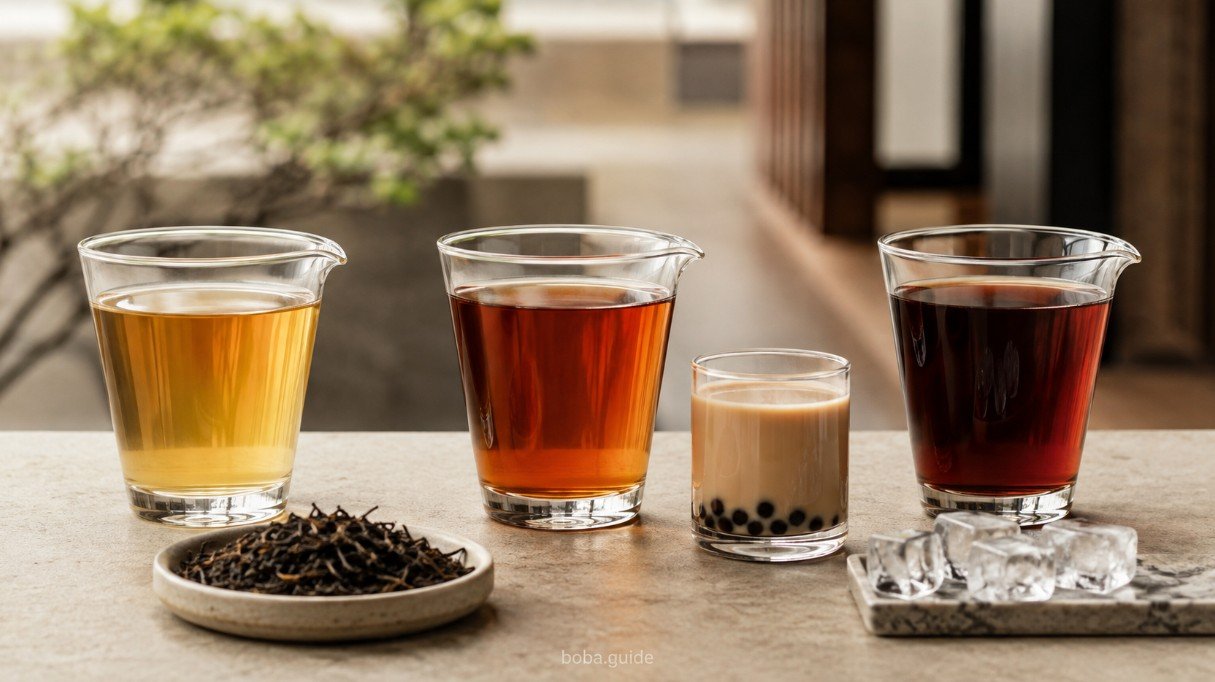
For robust black tea used in milk tea, a practical starting range is about 25–33 g of tea per liter of water, or roughly a 1:40 to 1:30 tea-to-water ratio by weight. The correct strength is not the darkest brew or the most bitter brew. It is the concentration that still tastes clearly like tea after milk, sweetener and ice are added.
There is no universal multiplier such as “always brew boba tea twice as strong.” Different teas, leaf cuts and finished drinks need different treatment. The most reliable method is to measure the base, build the actual drink, taste it after dilution and change one variable at a time.
Boba tea should be concentrated enough to survive dilution without tasting harsh
The base should taste more assertive than ordinary sipping tea if the finished drink will contain milk, syrup and ice. But “strong” should come from enough tea concentration and clean extraction, not from pushing every brewing variable to its limit.
Tea disappears once the drink is built
The brewed tea may smell pleasant, yet milk makes it flat and ice makes it watery. Sweetness becomes the main flavor because the tea has too little body underneath it.
- Tea aroma fades quickly after shaking.
- The finished cup tastes mostly sweet or creamy.
- Adding more syrup makes the imbalance worse, not better.
Tea stays recognizable after milk, sugar and ice
The base tastes assertive before dilution, then settles into a clear tea-forward flavor in the finished cup. Milk rounds the edges without erasing the tea.
- Aroma remains obvious when the drink is cold.
- The cup has body without a drying finish.
- Tea, milk and sweetness remain distinguishable.
Bitterness and astringency dominate the cup
A base can be highly extracted but still poorly balanced. Extra sugar or milk may hide some roughness, but they do not turn an over-extracted tea into a clean one.
- Dry or puckering finish.
- Burnt, woody or medicinal notes.
- The drink needs excessive sweetness to feel pleasant.
A practical black-tea starting range is about 1:30 to 1:40
Commercial bubble-tea preparation examples for robust black tea commonly fall around 1:40 tea-to-water, with stronger milk-tea bases moving toward 1:30. That equals roughly 25–33 g of tea per liter of water. Treat this as a calibration range, not a universal recipe.
About 25 g tea per 1 L water
About 33 g tea per 1 L water
| Water | Tea at 1:40 | Tea at 1:30 |
|---|---|---|
| 300 mL | 7.5 g | 10 g |
| 500 mL | 12.5 g | 16.7 g |
| 1 L | 25 g | 33.3 g |
| 2 L | 50 g | 66.7 g |
Water weight ÷ ratio number = tea weight
For kitchen-scale work, 1,000 mL of water is approximately 1,000 g. At 1:40, 1,000 ÷ 40 = 25 g tea. At 1:30, 1,000 ÷ 30 ≈ 33.3 g tea.
For the full brewing process—temperature, steeping, straining and cooling—use how to brew tea for boba. This page stays focused on strength calibration.
Concentration and extraction are not the same thing
You can make a tea base more concentrated by using more leaf for the same amount of water. You can also extract each gram of tea more aggressively with more heat or more time. Those changes do not produce the same flavor.
More leaf relative to water
Moving from 1:40 toward 1:35 or 1:30 raises the amount of tea material available to the brew. If temperature and time stay controlled, this can increase body and aroma without automatically creating a harsher finish.
More compounds pulled from each gram of tea
Hotter water and longer contact generally increase extraction. They can add body, but they can also pull more bitterness and astringency. That is why a weak finished drink is not always fixed by steeping longer.
Use the finished cup to tell whether the tea is weak, balanced or over-extracted
The concentrated base is only half the test. The real decision happens after the drink is assembled.
What it tastes like: pleasant tea aroma before mixing, then almost no tea identity after milk or ice.
First correction: raise leaf concentration slightly and keep the other variables steady.
What it tastes like: clear tea aroma, enough body to support milk and sweetness, no lingering harshness.
Correction: none. Record the ratio and repeat it.
What it tastes like: strong bitterness, woody notes or a puckering finish that remains after milk and sugar.
First correction: reduce extraction pressure before reducing every other ingredient.
- adding much more tea;
- raising water temperature;
- extending steep time;
- reducing milk;
- changing sweetener.
If several variables change together, you will not know which change improved or damaged the cup.
Milk, sweetener, cold temperature and melting ice all change perceived tea strength
A tea that tastes perfect on its own may become too quiet once the rest of the drink is added. Strength has to be matched to the finished recipe.
Tea base
This is the most concentrated stage and the easiest point to detect aroma, body and astringency.
Milk or creamer
Milk softens sharp edges but can also mute delicate floral, roasted and malty notes.
Sweetener
Sweetness lowers perceived bitterness, but too much can make the tea feel generic.
Ice
Melting ice adds water, while cold temperature can make aroma seem less intense than it did in the hot brew.
Build backward from the cup you actually serve
A milk-heavy drink with a full cup of ice needs more tea structure than a lightly sweetened clear tea. That is why the same base can be excellent for one drink and too weak for another.
If milk balance is the variable you are adjusting, continue with how to make milk tea.
Use strength ranges as a starting point, then adjust for the tea in front of you
Black tea, jasmine green tea, oolong and white tea do not respond identically to the same ratio, temperature or steep time. The goal remains the same: enough concentration to survive the finished drink without destroying the tea’s character.
| Tea style | Strength approach | Main risk | First adjustment |
|---|---|---|---|
| Robust black tea | Can support a concentrated milk-tea base; 1:30–1:40 is a practical commercial benchmark. | Harshness if extraction is pushed too far. | Raise leaf concentration before automatically extending steep time. |
| Jasmine green tea | Commercial examples can sit around 1:40–1:47 with gentler heat than many black-tea methods. | Bitterness and loss of floral aroma. | Protect fragrance first; do not chase darkness. |
| Oolong | Depends heavily on roast and oxidation level. | Flattening aroma or over-emphasizing roast. | Calibrate the specific oolong rather than the category name. |
| White tea | Usually benefits from careful concentration rather than aggressive extraction. | Losing delicate aroma under milk or fruit. | Use a lighter finished-drink build or raise leaf concentration cautiously. |
For choosing the tea itself, compare styles in best tea for boba.
Taste the same batch before and after dilution
This is the simplest way to stop guessing. Keep the measurements consistent so the next test actually tells you something.
Record the ratio
Write down tea weight, water amount, temperature and steep time.
Taste the base
It should be assertive and aromatic, but not burnt, medicinal or aggressively drying.
Build one real serving
Use the milk, sweetener and ice amounts you actually intend to serve.
Taste again after two minutes
Let the ice begin to melt, then ask whether tea is still clearly identifiable.
Change one variable
If the tea is clean but weak, raise leaf concentration modestly. If it is harsh, ease extraction pressure first.
A calibrated boba tea base should pass three checks
Match the correction to the symptom
Different problems can all be described as “weak tea,” but they need different fixes.
Once the tea base is calibrated, use how to make bubble tea to assemble the complete drink.
The right tea strength is the one that survives the finished boba drink cleanly
For robust black-tea milk tea, about 1:30–1:40 tea-to-water is a practical commercial starting range. For more delicate teas, both ratio and extraction conditions may need to be gentler.
Do not chase maximum darkness. Build enough concentration to keep aroma and body after milk, sweetener and ice, then stop before bitterness and astringency take over.
For the broader tea-base decision, continue to Tea for Boba.
Tea strength for boba: common questions
Should tea for boba be stronger than normal tea?
Usually, yes. Tea used in milk tea or heavily iced boba often needs more concentration than tea served plain because milk, sweetener and melting ice reduce the tea flavor you perceive. Stronger should mean more concentrated and structured, not simply more bitter.
What tea-to-water ratio should I use for boba?
For robust black tea used in milk tea, a practical commercial starting range is about 1:30 to 1:40 tea leaves to water by weight, equal to roughly 25 to 33 grams of tea per liter. Delicate teas may need different ratios and gentler extraction.
How much tea do I need for 500 mL of boba tea base?
At a 1:40 ratio, 500 mL of water uses about 12.5 grams of tea. At 1:30, it uses about 16.7 grams. Treat those amounts as starting points and judge the finished drink after milk, sweetener and ice are added.
Can I just steep tea longer to make it stronger for boba?
Longer steeping increases extraction, but it can also increase bitterness and astringency. If the tea is clean but weak, increasing leaf concentration while holding temperature and time steady is often a better first test.
Why does my milk tea taste weak even when the brewed tea looks dark?
Color does not guarantee flavor intensity. The tea may be over-diluted by milk and ice, or it may have extracted dark compounds without enough aroma and body. Judge the finished drink rather than color alone.
Is a 1:30 tea ratio too strong?
Not necessarily. Some commercial bubble-tea methods use about 1:30 for robust black or oolong milk-tea bases. Other teas, especially delicate green, floral or white styles, may need a gentler approach.
Should jasmine green tea for boba be brewed as strong as black tea?
Not automatically. Commercial jasmine-green-tea examples can sit around 1:40 to 1:47 and often use gentler heat than robust black-tea methods. The goal is to preserve jasmine aroma while keeping enough body for the finished drink.
Does ice make boba tea weaker?
Yes. As ice melts it adds water and lowers the concentration of tea, milk and sweetener. A heavily iced drink therefore needs a base and recipe designed around the expected dilution.
How do I know when my boba tea base is too strong?
Warning signs include a drying or puckering finish, burnt or woody flavors, harsh bitterness and a finished drink that needs excessive sugar to become pleasant. Adjust one variable at a time.
What is the best way to make tea strength consistent for boba?
Weigh tea leaves, measure water, control temperature, use a timer and record the recipe. Then taste the same batch as a finished boba drink. Consistency comes from measuring instead of using scoops and visual estimates.