
Boba Ingredients: Tea, Milk, Sweeteners, Pearls, Flavors & Toppings
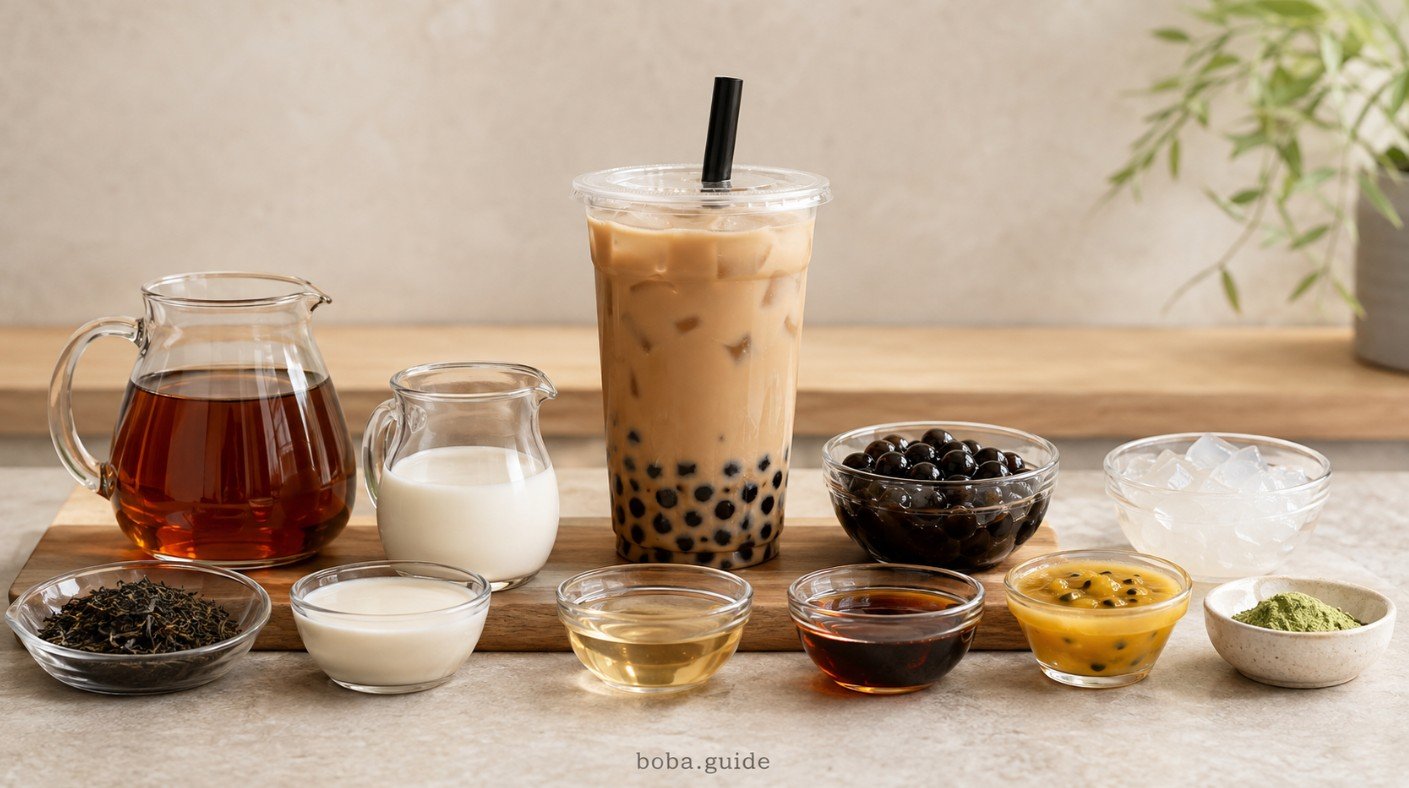
Most boba drinks are built from a small number of ingredient families, even when the menu looks enormous. Start with a liquid base, add a milk or flavor system if needed, control sweetness and ice, then add texture. The apparent complexity comes from mixing those modules in different ways.
That means “boba ingredients” can refer to very different things: loose tea leaves, fresh milk, non-dairy creamer, fructose syrup, fruit jam, flavored powder, cooked tapioca, jelly, pudding or foam. A home kitchen may use five ingredients; a commercial shop may stock dozens because it needs speed, consistency and a much wider menu.
The five-part ingredient system behind most boba drinks
You do not need every ingredient on this page to make bubble tea. A useful way to read any recipe or shop menu is to identify which role each ingredient is performing.
Usually brewed black, green, jasmine or oolong tea, but it can also be fresh milk, coffee, fruit liquid or a blended base.
Fresh dairy, plant milk, evaporated milk, non-dairy creamer or a prepared milk-tea powder changes richness and mouthfeel.
Simple syrup, liquid fructose, cane syrup, brown sugar, honey, fruit jam, puree or flavor concentrate can supply sweetness, flavor or both.
Tapioca pearls, jelly, pudding, crystal-style pearls, popping boba, aloe and other toppings create the chew or bite people associate with the category.
Water and ice are ingredients too. Brewing water sets tea extraction; melted ice changes concentration; hot drinks require a different balance from heavily iced cups.
For the shorter composition question, use what boba is made of. This page is the wider ingredient map.
Tea bases determine aroma, bitterness, color and how well a drink survives milk and ice
A generic sweet milk base can hide weak tea, but a strong boba program usually treats tea as an ingredient family of its own.
Assam and other black teas bring body, malt, tannin and enough structure for classic milk tea.
Floral and lighter; commonly paired with fruit, lighter dairy and clear tea drinks.
Ranges from floral to roasted and can create a more tea-forward fresh-milk drink than a generic milk-tea base.
A familiar Taiwanese hand-shaken tea category with a fragrant profile that works well as straight tea or with light toppings.
A powdered whole-leaf ingredient rather than an infused tea in the usual sense. It contributes body, color and suspended tea solids.
Current Northern Taiwan 50嵐 menus separately list jasmine green, Assam black, Four Seasons and golden oolong. That is a useful reminder that “tea” is not one interchangeable brown liquid in Taiwanese-style beverage shops.
For brewing strength and tea-specific decisions, continue to tea for boba and how to brew tea for boba.
Water and ice can change tea flavor before milk, syrup or toppings enter the cup
Bubble tea is mostly water by mass once brewing water and ice are counted, yet water quality is often treated as invisible. Taiwan’s Tea and Beverage Research Station has tested how brewing water changes tea color, aroma, taste and extracted compounds — which makes water a real formulation variable rather than a neutral carrier.
In Taiwan tea research, higher-pH brewing water produced higher-pH tea liquor. Some waters also produced darker or more yellow liquor than the preferred visual result.
For Wenshan Paochung and high-mountain tea in the cited research, waters associated with better color, aroma and taste shared relatively low total hardness and pH below 7.
The same research compared 80°C, 90°C and boiling water and found tea-style-specific sensory differences. Black tea performed better around 90°C to boiling than at 80°C, while some lighter teas preferred lower temperatures.
Every melting cube adds water after brewing. A tea base designed for a cold boba drink therefore has to survive both its initial recipe water and later ice melt.
The Taiwan research tested several packaged waters, tap water and reverse-osmosis water on specific Taiwanese teas. It supports the principle that water chemistry changes tea quality; it does not prove one universal pH, hardness or filtration target for every boba shop, tea style or city.
For a home drink, the practical test is simple: if your plain brewed tea tastes flat, metallic, harsh or unusually dull before milk and syrup are added, compare it with a different filtered or bottled drinking water before blaming the tea leaves. For a shop, water consistency matters because every tea batch, ice bin and diluted syrup depends on the same local water system.
Fresh milk, plant milk and non-dairy creamer create different drinks
The dairy system affects flavor, opacity, texture, storage and allergen labeling. It is one of the first things worth identifying when a menu simply says “milk tea.”
Used for fresh-milk teas and tea lattes. Fat level changes body; stronger tea usually helps prevent the cup from tasting like flavored milk.
Flavor and stability vary. Some products foam well; others separate or alter tea flavor. Nut and soy allergens must be considered individually.
Powdered creamer is shelf-stable before opening and produces a consistent creamy body. “Non-dairy” does not automatically mean milk-allergen-free.
Condensed milk is both dairy and sweetener; evaporated milk adds concentrated dairy body without the same sugar load.
Bossen’s current Taiwan-origin non-dairy creamer lists glucose syrup, hydrogenated palm-kernel oil and sodium caseinate — a milk derivative. A customer can hear “non-dairy” and incorrectly assume “milk-free” unless the actual ingredient and allergen statements are checked.
Use best milk for boba, non-dairy milk for boba and creamer for boba for the individual buying decisions.
Boba shops use liquid sweeteners because speed and repeatability matter
Granulated sugar works at home, but busy shops often prefer liquids that disperse instantly in cold tea and can be dispensed in measured amounts.
Neutral sweetness. Easy to batch, measure and mix into cold tea.
Widely used in commercial beverage systems because it can be dispensed rapidly and programmed by volume.
Adds caramelized flavor and dark color as well as sweetness; often used with pearls or fresh milk.
Contributes aroma as well as sugar, so it changes the flavor architecture more than neutral syrup.
Jam, puree or concentrate may already contribute substantial sugar before any separate syrup is added.
Current Bossen commercial fructose dispensers allow programmable sweetener delivery in 1 ml increments and market preset levels such as 25%, 50% and 75%. That does not make those percentages universal nutrition values; it shows how commercial shops can operationalize repeatable sweetness settings.
For the ingredient category itself, see sweeteners for boba and brown sugar for boba.
Tapioca pearls are a prepared topping, not just dry starch balls
Dry commercial pearls are only the starting ingredient. Cooking, rinsing, sweetening and holding transform them into the topping that goes into a finished cup.
Commercial pearls can include tapioca starch plus water, colors, flavoring, stabilizers or preservatives depending on the product.
Starch gelatinizes during cooking, producing the elastic chew expected from fresh pearls.
Brown sugar, cane sugar, fructose or honey can flavor pearls after cooking.
Bossen’s current large-pearl directions recommend serving cooked pearls within about 4 hours.
One current Bossen large-pearl product suggests approximately 50 g of cooked pearls for a 16 oz drink and lists an 8.5 mm cooked diameter. Another express-cook product suggests 60–80 g for a 16 oz drink. Those numbers are supplier-specific examples, not a universal serving standard.
The full ingredient, cooking, texture and storage story belongs in tapioca pearls.
Fresh fruit, juice, puree, jam and syrup are not interchangeable
They can all create a fruit drink, but they affect sweetness, acidity, texture, speed and shelf life differently.
Best for aroma, visible pulp and fresh acidity; highly perishable and variable by season.
Home drinks, premium seasonal drinks, citrus and fresh-fruit concepts.
Fast and relatively fluid; can be fresh, refrigerated or shelf-stable depending on processing.
Lemon, grapefruit and blended fruit-tea styles.
More fruit solids and body; can make a drink thicker and more visibly fruit-forward.
Mango, strawberry, peach and smoothie-style drinks.
Fruit pieces or pulp plus significant sweetness; gives flavor and sweetener in one ingredient.
High-volume tea shops that need consistency and quick assembly.
Lowest fruit-like texture but extremely fast to portion and combine.
Large flavor menus, lemonades, soda-style drinks and cost-controlled operations.
Commercial U.S. suppliers illustrate how large this ingredient category has become: Bossen currently sells concentrated syrups and fruit jams alongside tea leaves, powders and toppings rather than treating “fruit” as one product type.
For this family in depth, continue to fruit purees for boba and syrups for boba.
Some boba powders are tea; others are complete flavored drink mixes
This distinction matters because “powder” can mean pure matcha, ground taro ingredients, flavored milk-tea mix, creamer-based mix or a highly formulated instant product.
Matcha is the clearest example: finely milled tea leaf that becomes part of the drink rather than being strained out.
Taro, honeydew, chocolate and other powders may combine flavor, color, sugar, starch and dairy/creamer components.
Designed to collapse several steps into one commercial ingredient for speed and consistency.
Separate prepared mix for cream or cheese-style toppings; often combined with dairy during preparation.
A powder can be convenient without being chemically simple. Read the ingredient statement rather than judging by the front-of-bag flavor name.
For the wider category use boba powders. Taro has its own ingredient entity at taro powder for boba.
Commercial topping labels can look completely different from the finished texture
“Boba topping” describes a menu role, not one food chemistry.
Starch-based, cooked before service and usually held in sweetener.
Translucent chewy toppings often built from different gelling systems than traditional tapioca.
Liquid-filled spheres with a gel membrane; composition and process are fundamentally different from cooked tapioca.
Chewy fermented-coconut gel cut into pieces and often flavored with fruit.
Soft custard-style topping; dairy and egg content depends on formulation.
Soft gel texture with herbal or tea flavor; recipes and commercial formulations vary widely.
Because these products belong to different ingredient families, storage rules and allergen assumptions cannot be copied from one topping to another.
Use boba toppings, crystal boba and popping boba when you need the individual topping systems.
Milk foam and crema add fat, salt, aroma and texture above the tea
Foam is not merely decoration. A creamy topping changes how each sip enters the mouth and can contribute significant dairy, sugar or sodium depending on the recipe.
Can use milk, cream, cream cheese, sugar and salt in different proportions. Requires refrigeration and a short service window.
Powdered systems can include creamer, sugar, gums and flavoring, then be blended with milk or cream.
For a quantitative example, Bossen’s current crema mix recipe uses approximately a 1:4 ratio of whipping powder to milk plus heavy cream, yields about 250 cc, and recommends same-day service even though the prepared product can be refrigerated for up to three days according to its instructions. That is one supplier formula, not a universal cheese-foam recipe.
Six common boba drinks, broken down by ingredient role
Looking at finished drinks this way is useful because it separates the actual ingredient structure from the menu name.
Tea: black tea
Body: creamer or milk
Sweetness: cane or fructose syrup
Texture: tapioca pearls
Tea: oolong
Body: fresh milk
Sweetness: light syrup or none
Texture: optional pearls or jelly
Base: fresh milk
Flavor: brown/black sugar syrup
Tea: may be absent
Texture: usually sweetened tapioca pearls
Tea: jasmine or green tea
Fruit: puree, jam, juice or syrup
Sweetness: often partly built into fruit base
Texture: jelly or aloe optional
Tea: optional depending on recipe
Flavor/body: taro powder, paste or fresh taro system
Milk: fresh milk or creamer depending on build
Texture: tapioca optional
Tea: matcha powder
Body: fresh or plant milk
Sweetness: syrup
Texture: tapioca or another chewy topping
The practical lesson is that “bubble tea ingredients” are not a fixed checklist. A brown-sugar fresh milk can be a boba-shop drink with no tea; a straight oolong can belong to the same shop with no milk; and a fruit tea can use the same sweetness and topping systems as milk tea.
Why shops buy tea leaves, powders, jams and syrups instead of making every component from scratch
A commercial ingredient is often chosen because it solves an operational problem: prep time, storage, consistency, portioning or waste.
Shops can choose strength and extraction, but every batch needs water, timing, filtering and cooling.
Dissolves quickly and reduces brewing equipment, but does not behave exactly like freshly brewed leaf tea.
Requires washing, cutting, yield management and refrigeration; season and ripeness affect flavor.
Useful for high-volume drinks because the flavor and solids are easier to portion repeatedly.
Low labor and easy pumping make syrup attractive for broad menus, though it contributes less fresh-fruit texture.
A shop can keep a dry ingredient on hand instead of relying entirely on refrigerated dairy.
Bossen’s U.S. catalog currently separates concentrated syrup, powder mix, tea leaves, fruit jams, tapioca/crystal boba, jellies and canned toppings into distinct product families. That supplier taxonomy mirrors how many shops actually manage ingredients behind the counter.
Ingredient economics depend on usable yield, not package price alone
For a shop, a fair comparison has to convert the package into portions and then account for prep loss, storage and labor.
What the bag, bottle or case costs before freight and discounts.
How much of the product becomes sellable drink after brewing, cooking, trimming or dilution.
The grams or milliliters actually used in one cup.
Cooked pearls that age out, milk that expires, fruit trim and opened products that cannot be sold.
Brewing, cooking, cutting, blending and cleaning all cost time even when the raw ingredient is inexpensive.
Heavy syrup, canned toppings and cases of liquid can cost more to move than lightweight powders or dry tea.
For a current scale example, Bossen lists one 1 kg large-tapioca bag as making about 20 servings at 50 g per 16 oz drink. Its express-cook 3 kg format lists roughly 35–50 servings at 60–80 g per drink. The two products therefore should not be compared on bag price alone; serving guidance and cooking workflow differ.
Commercial fruit bases show another kind of math. Bossen’s current passion-fruit jam is sold in a 9.24 lb bottle and is formulated with fructose, passion-fruit pulp, sugar, water, acids and stabilizers. That product is doing several jobs at once: fruit flavor, sweetness, body and consistency. Comparing it directly with a pound of fresh passion fruit would ignore labor, trim, seasonality and portioning.
When the question shifts from formulation to purchasing, compare package size, usable yield, freight and storage rather than choosing by sticker price alone.
Five swaps that look simple on paper but can change the whole drink
Bubble tea is modular, but the modules are not perfectly interchangeable. Changing one ingredient can alter sweetness, body, dilution, color and even how a topping feels.
Creamer can increase opacity and give a rounder, more standardized body without the refrigerated handling of fresh milk. It may also add its own sweetness or flavor depending on formulation.
Recheck tea strength and sweetener. A recipe balanced for fresh milk can become too heavy or too sweet when a formulated creamer is substituted gram-for-gram.
Syrup usually removes fruit solids and increases the proportion of flavor carried by dissolved sugar and aroma compounds.
Acidity, water and sweetener may all need recalibration. The same milliliters of syrup and puree rarely produce the same body or sugar level.
Prep time falls dramatically, but the formulation and cooking behavior can differ. Supplier directions should be treated as part of the ingredient specification.
Do not copy cooking time from another pearl. Water ratio, rest time and holding window can change by product.
Brewing labor disappears, but aroma, suspended solids and concentration behavior may change.
Start from the powder manufacturer’s dilution guidance, then rebalance milk and sweetener instead of assuming one teaspoon equals one brewed-tea portion.
Sweetness gains caramel, molasses-like or roasted notes and often a darker visual effect.
Reduce competing flavor syrups and taste the pearls separately. Brown sugar can easily dominate delicate jasmine or light oolong.
A substitution is successful when the finished drink remains balanced, not when two ingredients occupy the same measuring spoon. This is especially important when converting a home recipe into a commercial formula or replacing one supplier with another.
A home boba kitchen and a high-volume shop should not buy ingredients the same way
The home user optimizes for freshness, small quantities and flexibility. A shop must also optimize for labor, speed, yield, storage space and consistency across staff.
Smaller bags, better aroma, flexibility to brew one or two bases.
Case pricing, consistent lot profile, repeatable concentrate and fast batch workflow.
Use what tastes best and fits dietary needs before it spoils.
Reliable supplier, refrigeration capacity, cost per cup and consistent fat/body.
Simple syrup can be made cheaply in a saucepan.
Liquid syrup integrates with pumps or programmable dispensers for speed.
Fresh fruit or small bottles of puree are practical.
Jam, concentrate and puree may reduce prep time and seasonal inconsistency.
Small bags and quick-cook products reduce waste.
Cook time, batch yield, holding quality and cost per serving matter more.
Only buy flavors you will actually use.
Powders can support a wide menu with predictable portioning and lower prep labor.
For commercial operators, the ingredient price on a bag is only the beginning. Yield, waste, shipping weight, refrigeration, prep time and the amount used per drink can change the real cost more than a small difference in unit price.
How to read a commercial boba ingredient label in the U.S.
A useful label check is less about whether an ingredient sounds “natural” and more about understanding what role it plays and whether it creates a dietary, operational or sensory consequence. Under U.S. FDA rules, major food allergens in packaged foods must be identified by food source in the ingredient list or a “Contains” statement when the law applies.
They tell you what the product is mostly made from. A “taro” powder led by sugar and creamer behaves differently from a taro-heavy paste.
Sugar, glucose syrup, fructose, honey, fruit concentrate and brown sugar can appear in the same drink from different components.
Caseinate and milk powder matter even when packaging uses language such as creamer or non-dairy.
Gums, starches, alginate and other stabilizers can explain why a jelly, powder or foam behaves consistently during service.
An unopened shelf life does not tell you how long a product remains practical once opened, mixed, cooked or refrigerated.
An ingredient can be free of a particular component yet still carry cross-contact information relevant to customers with allergies.
Dry, refrigerated, opened and prepared boba ingredients have different clocks
One of the easiest mistakes is treating a shelf-stable bag as though the prepared ingredient made from it has the same life.
Protect from heat, moisture, oxygen and strong odors. Aroma loss can make old tea technically usable but noticeably weaker.
Keep dry and resealed. Humidity can cause clumping and shorten practical usability before the printed date.
Keep refrigerated and follow the dairy product’s date and food-safety instructions.
Follow the specific manufacturer. Shelf-stable before opening does not imply room-temperature storage after opening.
Supplier rules vary. One current Bossen large-pearl product recommends proper resealing and consumption within 48 hours of opening.
Texture deteriorates quickly. The same supplier recommends best service within about four hours rather than refrigeration for ordinary holding.
Refrigerate according to recipe and manufacturer. A mix may have a long dry shelf life while the prepared foam has a short service life.
Always separate four dates in your head: unopened shelf life, opened-package life, prepared-product life and peak-quality service window.
Food allergens, gluten concerns and caffeine should be checked as separate questions
Boba drinks are modular, so one topping or powder can change the dietary answer. In the United States, FDA recognizes nine major food allergens: milk, eggs, fish, Crustacean shellfish, tree nuts, peanuts, wheat, soybeans and sesame. Gluten and caffeine are separate concerns and should not be treated as synonyms for food-allergen status.
Can appear in fresh dairy, condensed milk, milk powder, sodium-caseinate-containing creamer, pudding or foam. FDA requires milk-source declaration when a packaged food contains milk protein subject to allergen-labeling requirements.
Nut-based plant milks, flavor pastes and cross-contact statements can matter even when the brewed tea itself contains no nuts.
Soy milk is obvious, but formulated powders, processed toppings and other packaged components need their own label check. Sesame is also one of the nine major U.S. allergens.
FDA’s major-allergen category is wheat, not “gluten.” Tapioca starch itself is not wheat, but formulated powders, toppings and cross-contact statements still need to be checked when someone avoids wheat or gluten.
Pudding, custard-style toppings and some prepared mixes may contain egg even when the tea and pearls do not.
Caffeine is not a food allergen. It is a separate intake question: black, green, oolong, jasmine and matcha contribute caffeine, while a fruit-looking drink can still contain a caffeinated tea base.
For a serious food allergy, do not infer safety from the category name “boba,” “milk tea,” “gluten-free” or “non-dairy.” Check the current ingredient and allergen information for the exact packaged component and ask the shop about preparation and cross-contact. FDA labeling rules apply to packaged foods, but a made-to-order drink also depends on how the shop handles ingredients.
What ingredients should a beginner buy first?
A first home setup does not need fruit jam, six powders, three jellies and a gallon of fructose. Buy the ingredients that teach you the structure of the drink.
Black tea is the easiest classic starting point; jasmine or oolong is a good second base.
Fresh milk, a preferred plant milk or one creamer — not all three.
Simple cane-sugar syrup is inexpensive and lets you learn sweetness before buying specialty syrups.
Quick-cook pearls are easier for occasional home use; traditional pearls make more sense if you want to study texture and technique.
Choose a flavor you genuinely drink — matcha, taro, fruit puree or brown sugar — rather than building a shelf of opened products.
Once those five parts make a balanced drink, expand into jelly, fruit bases, foam and specialty sweeteners. Buying more ingredients does not fix weak tea or overcooked pearls.
For equipment and purchasing rather than ingredient taxonomy, use boba supplies. For a full home assembly workflow, see how to make boba at home. The dedicated shopping page is where to buy boba ingredients.
Choose the ingredient family you want to understand next
This page is deliberately broad. Each ingredient page can go deeper into formulation, buying, storage and use without forcing one article to become a product catalog.
Understand the difference between powdered tea and flavored instant drink mixes.
PrepQuick-Cook vs Traditional Tapioca PearlsCompare time, texture, holding and workflow before choosing a pearl format.
PearlsFresh vs Instant Boba PearlsCompare prep time, texture, holding and convenience.
Found a boba ingredient label that deserves a closer look?
Send the product name, country of origin, ingredient panel, package size and a clear photo to info@boba.guide. Supplier formulations can change, so exact package evidence is more useful than copied marketplace descriptions.
Boba ingredients: common questions
What are the basic ingredients in boba tea?
A basic boba milk tea usually needs brewed tea, milk or creamer, sweetener, cooked tapioca pearls and ice. Fruit tea may replace the milk component with fruit juice, puree, jam or syrup, and many modern drinks use different toppings.
What kind of tea is used for boba?
Black tea, jasmine green tea and oolong are common boba bases. Taiwanese menus also use teas such as Four Seasons and other regional or seasonal teas. Matcha is used differently because the powdered leaf remains in the drink.
What milk is used in bubble tea?
It depends on the drink. Shops may use fresh dairy milk, plant milk, evaporated milk, condensed milk or powdered non-dairy creamer. Conventional milk tea and fresh-milk tea are often separate menu categories.
Does non-dairy creamer mean dairy-free?
Not always. Some products marketed as non-dairy creamer contain sodium caseinate, which is a milk derivative. Check the exact ingredient and allergen statement rather than relying on the category name.
What sweetener is used in bubble tea?
Common options include simple or cane syrup, liquid fructose, brown or black sugar syrup and honey. Fruit jam, puree, flavored powder and cooked pearls can also add sweetness before a separate syrup is used.
What are tapioca pearls made from?
Traditional boba pearls are based on tapioca starch, but commercial formulations can also contain water, coloring, flavoring, stabilizers or preservatives. The pearls are cooked and usually sweetened before serving.
Are bubble tea powders the same as tea powder?
No. Pure matcha is a powdered tea leaf, while many boba flavor powders are formulated mixes that may contain sugar, creamer, flavoring, color and stabilizers. Read the ingredient list for the exact product.
What fruit ingredients do boba shops use?
Depending on the drink and shop, fruit flavor can come from fresh fruit, juice, puree, jam, concentrate or flavored syrup. Each form changes texture, sweetness, prep time and storage needs.
How long do cooked tapioca pearls last?
The best texture window is much shorter than the shelf life of dry pearls. One current Bossen commercial large-pearl product recommends serving cooked pearls within about four hours. Follow the instructions for the exact product you use.
What boba ingredients should I buy first for home use?
Start with one strong tea, one milk or creamer option, a simple sweetener and one bag of tapioca pearls. Add one favorite flavor only after you can make the basic tea, sweetness and pearl texture work together.