
Tea for Boba
Matcha for Boba: How to Use Real Matcha in Fresh-Milk and Bubble Tea Drinks
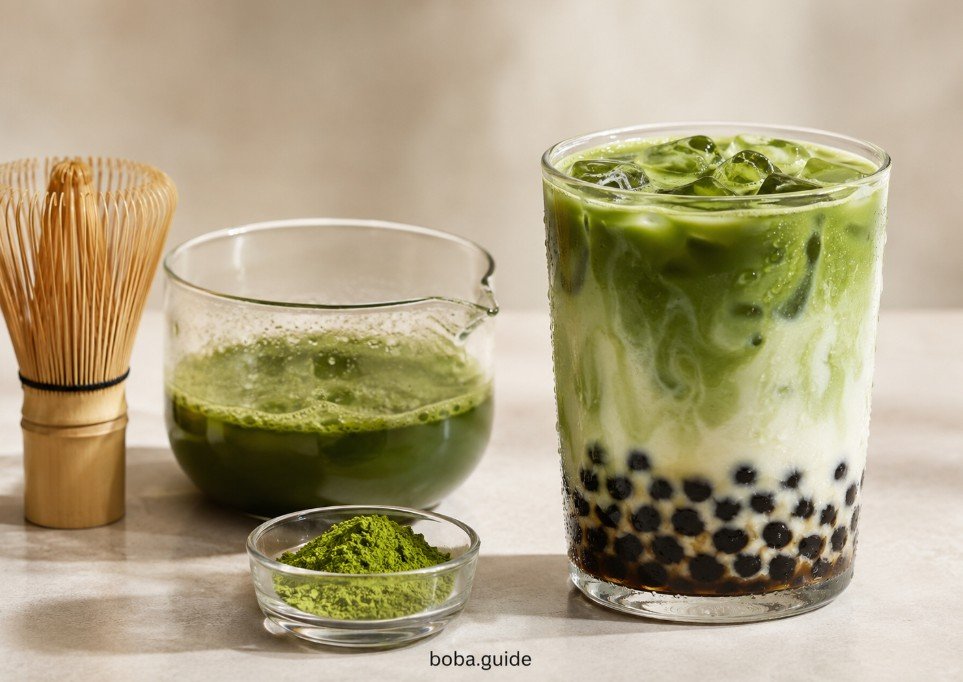
Matcha works for boba, but it behaves very differently from steeped tea. Instead of brewing and straining leaves, you suspend powdered green tea directly in the drink. That gives matcha boba its distinctive opaque green body, soft tea texture, and stronger grassy-to-creamy character. It also means proportion, sifting, whisking, milk choice, sweetness, and ice dilution matter more than they do in a standard brewed-tea milk tea.
The easiest way to think about matcha for boba is this: you are not trying to make a neon dessert or a thin green milk drink. You are trying to keep real matcha recognizable after milk, sweetener, ice, and toppings enter the cup. If the tea disappears completely, the recipe is too weak. If it becomes muddy, chalky, or aggressively bitter, the recipe or technique needs adjustment.
No leaf straining. The tea remains in the drink.
Matcha is strongest when milk is present but not overwhelming.
Enough to round bitterness without burying the tea.
Chew and brown-sugar sweetness fit matcha naturally.
How matcha behaves in boba
Why matcha works differently from ordinary green tea in bubble tea
Most tea bases for boba are brewed, cooled, and then mixed with milk or fruit. Matcha skips that step. Because the powder remains inside the drink, it gives more body, more color, and a more immediate tea presence than most steeped green teas.
Powdered and fully suspended
The leaf is stone-ground into fine powder, whisked into water, and consumed whole. That makes the final drink opaque and more textural.
Brewed and strained
The leaves are removed after extraction, so the drink reads clearer, lighter, and usually less creamy unless milk or syrup adds body.
Matcha needs balance, not brute force
You do not need to turn the cup into mud. You need enough matcha so that the tea still tastes real after milk, ice, and tapioca.
If you want the bigger tea picture first, start with the main tea guide. If you specifically want drinks rather than tea technique, the flavor-focused matcha boba guide is the next practical step.
Buying the right matcha
What kind of matcha is best for boba?
For most boba recipes, the sweet spot is a good culinary, café, or latte-style matcha that still tastes clean and green. You do not need your most delicate ceremonial bowl for tapioca and syrup, but you also should not use dull, stale powder that tastes only bitter.
Café or latte grade
Usually the most practical choice. It stays visible in milk, handles sweetness well, and does not waste premium ceremonial nuances.
Good culinary grade
Works well when it is fresh, vibrant, and not overly harsh. Many home boba recipes are best here.
Ceremonial grade
Excellent on its own, but often more expensive than a boba build really requires. Use it if you already love the powder and do not mind the cost.
Old, gray-olive, flat powder
If the powder smells dusty, looks brownish, or tastes sharply bitter even before milk, the drink will not improve after assembly.
Visual accuracy
What should matcha boba look like?
Good matcha boba rarely looks neon. In fresh milk or milk tea, it should sit somewhere between soft jade, olive green, and creamy pistachio-adjacent tones, but it should still read clearly as tea rather than candy syrup or vegetable smoothie.
Opaque, not transparent
Because matcha is suspended powder, the drink should not look like a clear green tea.
Green with a believable milk shift
Milk lightens the color. Ice and sweetener lighten it further. That is normal.
Not fluorescent
If the cup looks artificially glowing, the recipe is visually drifting away from real matcha behavior.
Not muddy swamp brown
That usually means poor powder, excessive dilution, over-sweet powder mixes, or too much brown-sugar streaking dominating the cup.
Expecting matcha to stay bright after everything is added
Once you add milk, ice, and tapioca, even very good matcha becomes softer and creamier in color. The correct test is not “Is it electric green?” but “Does it still look and taste like real matcha in a milk drink?”
Even a well-made matcha boba can settle over time because the powder is suspended, not dissolved. A quick stir or shake during drinking is normal and not automatically a quality problem.
Technique matters
How do you mix matcha for boba without clumps?
Clumps usually come from one of three things: unsifted powder, too little initial water, or weak mixing at the concentrate stage. The fix is simple: treat matcha as a concentrate first, then build the drink.
Sift the powder
Run the matcha through a fine strainer into a bowl or shaker cup. This breaks up packed clumps before any liquid touches the powder.
Add a small amount of warm water
Use enough water to make a smooth concentrate rather than a paste. Warm, not boiling, water is the most forgiving route for home boba.
Whisk or shake until fully smooth
A bamboo whisk works well, but a small frother or tightly sealed shaker can also work. The goal is an even concentrate with no obvious dry specks.
Only then combine with milk, syrup, and ice
Once the concentrate is smooth, the rest of the drink comes together much more easily and the tea tastes more even from top to bottom.
Practical strength
How much matcha should you use for boba?
There is no single universal number because cup size, milk choice, sweetness, and ice load all change the result. Still, a practical starting zone is easy to build at home.
Ippodo’s standard usucha method uses 2 g matcha + 60 ml water at 80°C / 176°F and whisks for about 15 seconds. Japan’s Ministry of Agriculture, Forestry and Fisheries also publishes a matcha-milk example using 50 ml water + 50 ml additional hot water + 100 ml milk. The boba numbers below are a stronger Boba Guide calibration for a drink that must survive milk, ice and toppings—not a claim that there is one official boba ratio.
Use this as a practical test range for one regular iced matcha milk tea or fresh-milk boba. Start near 2 g for a softer cup and move toward 3 g if milk and ice are burying the tea.
Lower milk keeps the tea more intense. Higher milk gives a softer, creamier cup.
Start lighter if your tapioca is already sweet from brown sugar syrup.
Enough chew for boba identity without turning the drink into mostly topping.
Lighter iced matcha milk tea
Use the full 3 g concentrate with the lower end of the milk range and modest sweetness. Good when you want the tea to lead.
Classic fresh-milk boba direction
Use 2.5–3 g matcha, moderate milk, black pearls, and 30–50% sweetness. This is the most reliable first cup.
Richer brown-sugar matcha milk
Works best when the matcha concentrate is slightly stronger, because brown sugar and milk quickly soften the tea impression.
Balance choices
Which milk and sweetness level work best with matcha boba?
Matcha usually tastes best when the milk supports it instead of trying to imitate ice cream. The right sweetness should round bitterness and help the cup feel finished, but not erase the green-tea personality.
Fresh dairy milk
Easy, balanced, and familiar. Good for first tests because it shows whether your matcha strength is correct without adding extra flavor noise.
Whole milk or richer milk blend
Softer and fuller. Useful when the powder is assertive, but too much richness can make the tea feel less vivid.
Oat or soy milk
Often pair well, especially oat for texture and soy for a classic tea-latte feel. Sweetened plant milks may require less added syrup.
30–50% sweetness
Usually the safest zone for beginners. It lets the tea stay visible while taking the rough edge off the finish.
If the cup tastes like sweet milk with a green afterthought, reduce the milk or increase the matcha slightly. If it tastes grassy and punishing, reduce the powder a little or raise sweetness one step.
Texture pairing
Which toppings pair best with matcha boba?
Classic black tapioca pearls remain the most reliable pairing because they add chew and gentle caramel sweetness without competing too hard with the tea. After that, the best topping depends on whether you want cleaner tea expression or a more dessert-like cup.
Black tapioca pearls
Soft, chewy, familiar, and strong enough to make the drink unmistakably boba without distracting from the matcha.
Crystal boba
Works when you want a fresher, cleaner finish and less syrup weight than classic pearls.
Red bean or pudding
Useful when you want the drink to lean into Japanese-style dessert territory, but they make the cup heavier and sweeter.
Strong fruit popping boba
Bright mango, strawberry, or passion fruit centers can pull attention away from matcha’s quieter tea profile.
In-shop ordering
How should you order matcha boba if you are new to it?
The easiest first order is not the wildest menu special. Start with a cup that gives the tea a fair chance to be noticed, then customize after you understand the baseline.
Iced matcha milk tea with black tapioca pearls, 30–50% sweetness, regular ice
This order is balanced, recognizable, and easy to judge. You can tell whether the tea is present, whether the milk is too heavy, and whether the pearls improve the cup for you.
Choose matcha milk tea or matcha fresh milk rather than a heavily blended specialty drink.
Pick one topping only for the first try.
Ask for lower sweetness if the shop uses brown-sugar pearls.
If you want a stronger tea taste, ask whether they can make it less milky rather than just “more sweet.”
If ordering language still feels confusing, the site’s how to order boba guide walks through sweetness, ice, size, and topping decisions in the right sequence.
Energy profile
Is matcha boba high in caffeine?
Matcha can feel meaningfully caffeinated because the drink contains the powdered tea itself rather than only a strained infusion. The exact amount still depends on the powder dose, cup size, and whether the shop uses a real matcha concentrate or a diluted mix.
ITO EN currently lists approximately 31 mg caffeine per gram for one of its organic ceremonial matcha powders. At a 2–3 g dose, that specific product would contribute about 62–93 mg caffeine. Different powders can vary, so use this only as a concrete reference point rather than a guaranteed number for every cup.
Weak green-tea fruit drinks
Because a light brewed green tea can be much gentler than a properly built matcha concentrate.
Black-tea milk tea
Some strong black milk teas are also caffeinated, so the comparison depends on recipe strength rather than color alone.
Use less powder or choose hojicha
If you want a roasted Japanese tea profile with a gentler feel, hojicha for boba is a useful alternative direction.
Tea comparisons
How does matcha compare with other tea bases for boba?
Matcha is not simply “green tea but stronger.” It belongs to a different textural and visual category because of the powder format. That matters when you choose your next cup.
Matcha vs. brewed green tea
Matcha is thicker, more opaque, and more immediately tea-forward. Brewed green tea is lighter, clearer, and often more refreshing in fruit tea formats. For the broader steeped-tea angle, see green tea for boba.
Matcha vs. hojicha
Matcha is grassy, creamy, and vegetal. Hojicha is roasted, nutty, and brown rather than green. Matcha usually feels brighter; hojicha usually feels warmer and toastier.
Matcha vs. genmaicha
Genmaicha brings a lighter brewed profile with roasted-rice aroma. It can be gentler and easier to sip as a clear tea, while matcha is much more milk-friendly as an opaque concentrate drink.
Matcha vs. oolong milk tea
Oolong tends to read floral, creamy, or roasted depending on style, but it still behaves like a brewed tea base. Matcha makes the cup feel more latte-like and more obviously green.
Simple home calibration
A clean starting method for matcha boba at home
This is not the only correct recipe. It is a dependable first build for understanding whether you personally want more tea, more milk, more sweetness, or less topping.
- 1
Sift 2.5–3 g matcha into a bowl or cup
Start in the middle rather than too weak. A timid dose often disappears once milk and ice are added.
- 2
Add 50 ml warm water and whisk smooth
A smooth concentrate is the foundation. Fix lumps now, not after milk goes in.
- 3
Add 15–20 ml simple syrup or your preferred sweetener
Adjust lower if the cooked tapioca is already sweet.
- 4
Put 40–60 g cooked tapioca pearls into the serving cup
Use warm, soft pearls for the best texture. Old pearls quickly harden the experience.
- 5
Add ice and 170–200 ml milk, then pour in the matcha concentrate
Stir or shake gently until even. Taste once before adding more syrup.
- 6
Change only one variable in the next cup
If you want a stronger result, raise matcha slightly or reduce milk slightly. Do not change five things at once.
Matcha for boba succeeds when the tea stays recognizable after milk, sweetness, ice, and topping.
That is the practical benchmark. You are building a boba drink, but the matcha still needs to deserve being named.
Editorial note
Where this page fits on Boba.guide
This page focuses on matcha as a tea base for boba: powder choice, technique, ratios, milk balance, and real-world ordering. Its main job is technical: how matcha behaves as a tea base in the cup, rather than serving as a broad flavor encyclopedia.
Boba Guide combines hands-on tasting, home recipe testing, menu analysis, ingredient disclosures, and practical tea preparation research. For editorial standards and updates, see Editorial Policy and Corrections Policy.
Questions and answers
Can you use real matcha for boba?
Yes. Real matcha works very well in boba, especially in fresh-milk and milk-tea style drinks. The key difference is that matcha is powdered tea kept inside the drink, so it needs proper whisking and balanced milk and sweetness levels.
Is matcha boba the same as green tea boba?
Not exactly. Matcha is a powdered green tea, while many green-tea boba drinks use brewed and strained green tea. That makes matcha more opaque, more textural and often more concentrated in both color and flavor.
What type of matcha is best for boba?
A good culinary, café, or latte-style matcha is usually the most practical choice. It should still smell fresh and taste clean, but it does not need to be your most delicate ceremonial powder if the drink will include milk, syrup, ice and tapioca.
How much matcha should I use in one boba drink?
A practical starting point for one regular iced drink is about 2–3 grams of matcha whisked with roughly 45–60 ml warm water, then combined with milk, sweetener, ice and optional tapioca. Adjust from there based on how tea-forward you want the final cup to taste.
Why does matcha boba sometimes taste weak?
The most common reasons are too little matcha, too much milk, heavy ice dilution, or overly sweet add-ins that bury the tea. A stronger concentrate and slightly lower milk ratio usually fix the problem faster than simply adding more syrup.
Why does matcha boba get clumpy or settle?
Matcha settles because it is suspended powder rather than fully dissolved tea. Clumps usually come from unsifted powder or poor mixing. Sifting the powder first and whisking a smooth concentrate before adding milk greatly improves the texture.
What toppings go best with matcha boba?
Black tapioca pearls are the safest first choice because they add chew and mild brown-sugar sweetness without overpowering the tea. Crystal boba, red bean and pudding can also work, while very fruity popping boba often competes too strongly with matcha.
Is matcha boba high in caffeine?
It can be meaningfully caffeinated because the drink contains powdered tea rather than only a strained infusion. The exact caffeine level still depends on the amount of matcha used, the cup size and the recipe style.
What is the best first order if I have never tried matcha boba?
A strong first order is an iced matcha milk tea or matcha fresh milk with black tapioca pearls at about 30–50% sweetness. That gives you a balanced first impression without hiding the tea under too much sugar, flavoring or extra toppings.