
Herbal Tea Boba: The Best Herbal Bases for Bubble Tea
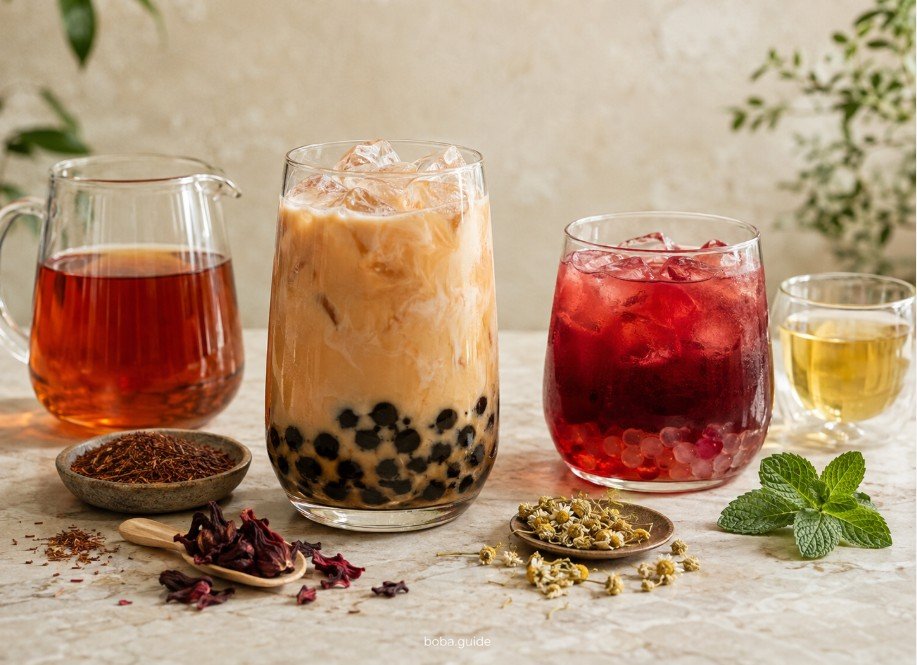
Herbal tea can make excellent boba, but the best base depends on the drink you want. Rooibos can carry milk and tapioca, hibiscus shines in tart fruit drinks, mint stays refreshing with citrus, and delicate florals need a lighter hand.
The useful question is not simply “Can I put boba in herbal tea?” It is which infusion has enough aroma, body, acidity and structure to stay recognizable after ice, milk, sweetener and toppings are added. This guide shows how to make that decision without treating every botanical infusion as if it behaved like black tea.
Start with the base
What counts as herbal tea in boba?
In everyday menus, “herbal tea” usually means an infusion made from botanicals other than the tea plant Camellia sinensis. That can include rooibos, hibiscus, mint, chamomile, ginger, flowers, fruit pieces and spice blends.
Black, green, white and oolong teas all come from Camellia sinensis; herbal and fruit infusions are a different family. The distinction matters in boba because those bases do not share one predictable level of tannin, body or bitterness. Some feel round and naturally sweet. Some are tart. Some are almost perfume-like. Others are spicy or cooling.
If you want to compare these bases with black, green, jasmine, oolong and other traditional options, start with the broader guide to tea bases for boba.
A flavor map, not a ranking
The herbal bases that actually make sense for boba
There is no single “best” herbal tea for boba. The strongest choices are the ones whose flavor still makes sense after dilution and whose character matches the finished drink style.
Rooibos is one of the easiest herbal bases to understand in bubble tea because it has enough warm, woody-sweet character to support milk without tasting like colored water. It works especially well with fresh milk or oat milk, vanilla, restrained brown sugar and black tapioca pearls.
Its weakness is not harshness but dilution: a cup that tastes pleasantly gentle on its own can disappear once ice and milk enter the drink. Brew the base with the final glass in mind. For a deeper treatment of this one botanical, use the dedicated rooibos boba guide.
Hibiscus plays almost the opposite role. Its sharp, cranberry-like acidity is excellent for cold fruit-style boba, especially with citrus, berry, peach or passion-fruit directions. Crystal boba, aloe-style toppings and light jellies usually leave more room for its brightness than heavy caramel tapioca.
Milk is possible in carefully designed recipes, but it is not the default recommendation. A strongly acidic infusion can taste awkward with dairy and may also destabilize some milk systems. If the goal is creamy, choose a friendlier base instead of forcing every herbal infusion into milk-tea format.
Mint works best when the drink remains refreshing. Citrus, cucumber, lychee-like fruit profiles and light syrups can make sense; dark brown sugar and multiple chewy toppings usually do not. The aromatic oils are assertive, so a “more is better” approach can make the drink taste medicinal or toothpaste-like.
Chamomile is a quiet base. It can work with gentle honey-like sweetness, pear, peach or a lightly creamy direction, but it loses quickly against strong syrups, dark tapioca and several toppings at once. Keep the drink simple enough that the floral aroma is still the point.
Chamomile is a food ingredient, not a reason to turn a boba guide into a health-claim page. People with allergies to related plants such as ragweed may also need to be cautious with chamomile products, so ingredient awareness matters.
Ginger, cinnamon and spice-led infusions can make excellent colder-weather boba when paired with coconut, milk, brown sugar or citrus. The important word is blend: two products sold as “ginger herbal tea” may have completely different ingredient lists and strengths. Treat the actual package as the recipe input, not the category name.
Choose the drink style first
Milk tea or fruit tea? Start with the herbal base
If the infusion is rounded and low in sharp acidity, it is more likely to work in a creamy boba. If it is tart, bright or strongly aromatic, a clear fruit-style drink is often the better format.
These are pairing guidelines, not rules. A well-designed shop recipe can make unusual combinations work, but the base should still be recognizable in the finished drink.
The hidden problem
Why herbal tea can disappear in a boba drink
A herbal infusion that tastes balanced in a mug may become too weak once it is turned into bubble tea. Ice adds water, milk softens aroma and acidity, syrup competes for attention, and toppings add their own sweetness and texture.
The goal is not to make every infusion brutally strong. The goal is to make it strong enough for its intended final dilution. Delicate flowers can become rough or perfumey when pushed too far; spice blends can become aggressive; some fruit infusions become more sour rather than more useful. Adjust the base according to the ingredient, not a universal “steep longer” rule.
Build for the finished cup
How strong should herbal tea be for boba?
Brew herbal tea so it still tastes intentional after the ingredients you plan to add. For an iced milk boba, that usually means starting with a more concentrated base than you would pour as a plain hot drink.
Read the blend first
“Herbal tea” is not one ingredient. A rooibos blend, peppermint, hibiscus-fruit mix and ginger-spice blend need different treatment. Use the producer’s preparation guidance as the baseline instead of forcing one temperature and one steep time on all botanicals.
Brew for dilution
If the finished drink will contain a large amount of ice or milk, taste the infusion slightly stronger than your ideal plain cup. For cold drinks, cooling a concentrated base before assembly gives you more control than trying to compensate with excessive tea after the glass is built.
Test the assembled drink
The meaningful test is the final cup. Add the intended milk, fruit, sweetener and topping, then ask whether you can still identify the botanical base. If not, either strengthen the base or simplify the competing ingredients.
For the broader extraction method—including tea concentration, cooling and dilution logic—see how to brew a stronger base for boba.
Pair by structure
Choose toppings that leave room for the herbs
The topping should support the base, not become a second competing flavor system. Dark tapioca works naturally with warm, creamy herbal drinks; translucent toppings are often better for bright fruit infusions; delicate florals benefit from restraint.
Rooibos → milk → tapioca
Fresh milk or oat milk, restrained brown sugar, vanilla and black pearls make a coherent drink. Keep the syrup moderate so the rooibos still reads as a tea-like botanical base rather than caramel milk.
Hibiscus → citrus → crystal boba
Use the natural tartness as an advantage. Passion fruit, berry or citrus can reinforce it, while crystal boba or light jelly adds texture without dragging the drink toward a dark molasses profile.
Mint or chamomile → simple topping
One topping is usually enough. A light jelly, aloe-style topping or even no chewy topping at all may preserve the aroma better than a loaded cup.
Five useful starting points
Herbal boba orders that make sense
If you are experimenting at home or decoding a shop menu, start with a combination whose ingredients are pulling in the same direction.
Strong rooibos + fresh or oat milk + light-to-medium brown sugar + black tapioca. Best when you want a caffeine-free-style alternative to classic milk tea without losing warmth and body.
Hibiscus base + passion fruit + moderate sweetness + crystal boba. Tart, vivid and refreshing, with a topping that does not compete with the color or acidity.
Mint infusion + lemon or lime direction + light syrup + restrained jelly. Keep the mint fresh and cooling rather than aggressively menthol-like.
Chamomile + peach + light sweetness + a soft, neutral topping. The drink succeeds when the fruit supports the floral base instead of burying it.
Ginger-led infusion + coconut milk + moderate sweetener + black or golden-style tapioca. A stronger, warmer combination that can handle more body than chamomile or mint.
Check the ingredients, not the label
Is herbal tea boba caffeine-free?
Often, but not automatically. Rooibos and chamomile are examples of herbal infusions that are naturally caffeine-free, while yerba mate, guayusa and blends containing true tea or other caffeinated botanicals can contain caffeine.
This is why “herbal” should not be used as a guarantee. A café may also combine a botanical infusion with green tea, black tea, matcha or another caffeinated component even when the dominant flavor sounds herbal. If caffeine avoidance matters, ask for the actual base or ingredient list.
Ask: “Is the base only the herbal infusion, or is it blended with green or black tea?” That is more useful than asking whether the flavor is herbal.
For drink-level options rather than tea taxonomy, see the guide to caffeine-free boba.
Troubleshoot the cup
Common mistakes with herbal tea boba
Most disappointing herbal boba is not caused by a “bad” herb. It is caused by a mismatch between the base and the rest of the drink.
Build a stronger base before adding ice or milk instead of trying to rescue the finished cup with more syrup.
Use one texture first. A delicate botanical drink rarely improves when tapioca, pudding and jelly all compete at once.
Move the drink toward a clear fruit format, or choose a rounder herbal base such as rooibos for creamy boba.
Check the blend. Mate, guayusa, guarana and added true tea can change the caffeine picture.
Reduce syrup until the botanical aroma is easy to identify again. Sweetness should frame the base, not erase it.
One-screen decision
Which herbal boba should you choose?
Choose by the experience you want, not by which herb sounds healthiest or most unusual.
Herbal tea boba is most successful when the botanical base is treated as the main flavor decision, not as an interchangeable substitute for black tea. Once you choose the right format—creamy, fruit-forward, cooling, floral or spiced—the rest of the drink becomes much easier to build.
If you are still deciding between traditional tea families and other bubble-tea styles, the broader boba tea guide explains how tea, milk, toppings, sweetness and drink formats fit together.
Editorial note
How we approached this guide
Boba Guide treats herbal infusions primarily as beverage ingredients. We use tea-industry definitions for the difference between true tea and botanical infusions, and we avoid turning flavor guidance into medical advice. For chamomile safety and caffeine questions, authoritative health and regulatory sources take priority over wellness marketing.
Herbal Tea Boba FAQ
Can you make boba with herbal tea?
Yes. Herbal infusions can work very well as boba bases, but the drink should be built around the character of the infusion. Rooibos is naturally suited to creamy milk boba, while hibiscus, mint and many fruit-herbal blends are often better in clear or fruit-forward drinks.
What is the best herbal tea for boba?
There is no single best herbal tea for every boba drink. Rooibos is one of the easiest choices for milk tea, hibiscus is excellent for tart fruit boba, mint works in refreshing citrus-style drinks, and chamomile is better when the sweetener and toppings stay light.
Is herbal tea boba caffeine-free?
Many herbal infusions are naturally caffeine-free, including pure rooibos and chamomile, but herbal does not automatically mean caffeine-free. Yerba mate, guayusa, guarana-containing blends and herbal blends mixed with true tea can contain caffeine. Check the actual ingredients or ask the shop what base it uses.
Does rooibos work with tapioca pearls?
Yes. Rooibos has a warm, rounded flavor that pairs well with black tapioca pearls, milk, vanilla and restrained brown sugar. The main challenge is brewing it strongly enough that the rooibos remains noticeable after milk and ice are added.
Can you make milk tea with herbal tea?
Yes, but some herbal bases are much better with milk than others. Rooibos and certain spice-led blends tend to work well. Highly tart hibiscus drinks are usually easier to balance as clear fruit-style boba, while delicate floral infusions can be overwhelmed by heavy dairy and syrup.
Is hibiscus good for boba?
Hibiscus is excellent for bright, refreshing boba. Its tart cranberry-like character pairs naturally with citrus, berry and passion-fruit flavors and with lighter toppings such as crystal boba or jelly. It is less naturally suited to a heavy classic milk-tea format.
What toppings go well with herbal tea boba?
Match the topping to the base. Black tapioca works well with rooibos and warm spice blends; crystal boba, aloe-style toppings and light jellies suit hibiscus and fruit-herbal drinks; mint and chamomile usually benefit from one restrained topping rather than a loaded cup.
Should herbal tea be brewed stronger for bubble tea?
Often, yes. Ice, milk, syrup and toppings can all make a botanical infusion taste weaker. Brew for the finished drink rather than the plain cup, but do not assume every herb should simply steep longer—delicate floral or spice-heavy blends can become unbalanced when over-extracted.