
Caffeine-free base · South African red bush
Rooibos Boba: A Caffeine-Free Herbal Base That Can Handle Milk
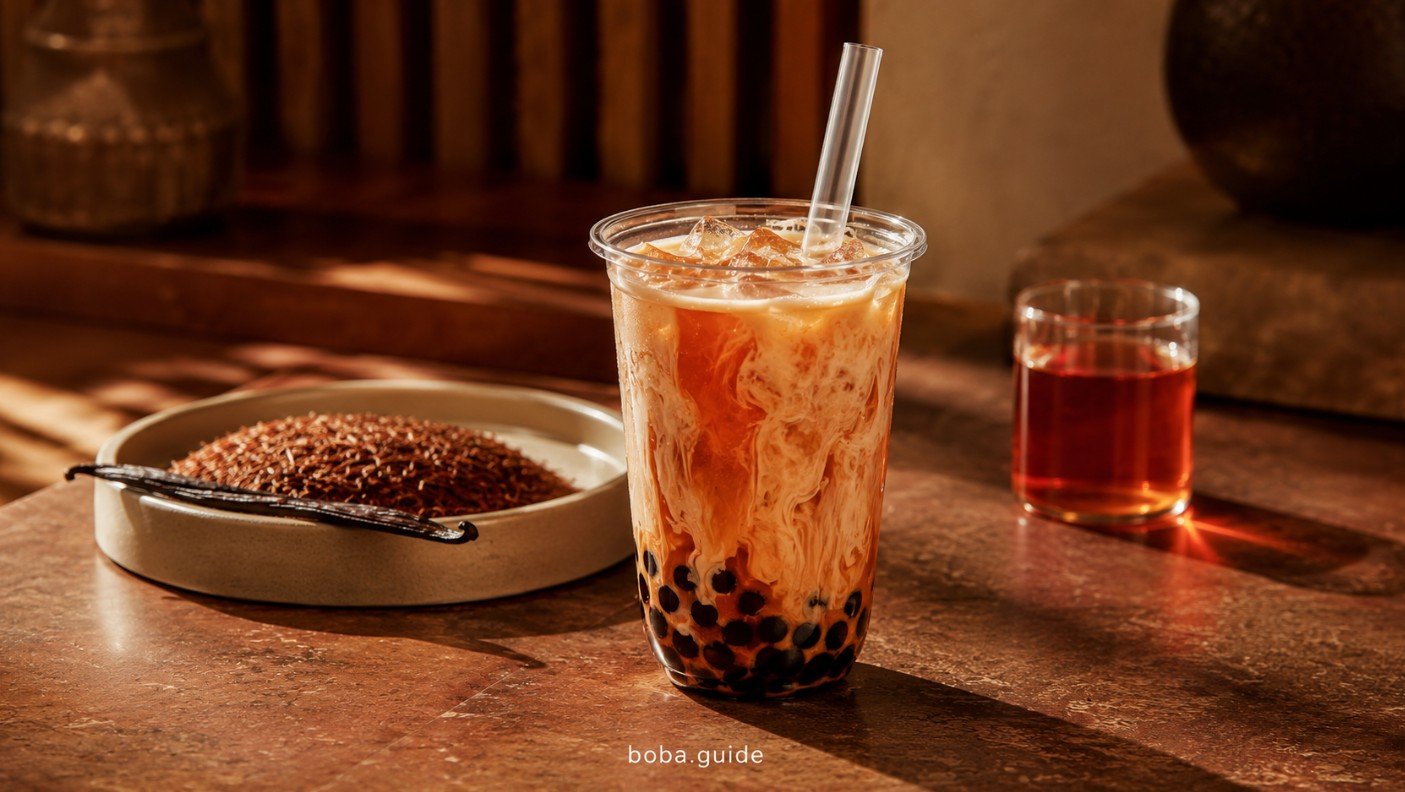
Rooibos boba works because rooibos solves a problem that many caffeine-free drinks do not: it has enough warm aroma and body to stay interesting after milk, ice and toppings are added. The result is not a copy of black milk tea. A good rooibos boba should taste softer, rounder and naturally red-amber, with a gently sweet, woody-fruity character that can lean toward vanilla, caramel-like warmth or citrus depending on the blend.
It is also a fundamentally different ingredient from black, green, oolong or white tea. Rooibos comes from Aspalathus linearis, a South African shrub, not Camellia sinensis. That distinction matters because rooibos is naturally caffeine-free and tolerates hotter, longer extraction without behaving exactly like conventional tea. In practical boba terms, you can build a strong base without chasing tannic bite.
Choose rooibos when you want a tea-like boba experience without caffeine, especially for milk tea, vanilla-forward drinks, gentle spice, citrus or warm dessert pairings. The biggest mistake is treating “caffeine-free” as the whole recipe: pearls, chocolate, coffee jelly, matcha foam or other add-ons can change the final drink completely.
Inside this guide
Rooibos is not red tea in the black-tea sense
Menus often call rooibos “red tea” or “red bush tea,” which is understandable from the color, but the ingredient belongs to a different botanical family from traditional tea. Rooibos is made from Aspalathus linearis, a shrub native to a defined production area in South Africa. South African government material and the protected geographical indication framework tie the name Rooibos/Red Bush to product from designated parts of the Western and Northern Cape.
That origin is more than trivia. It explains why a rooibos boba should not be judged by whether it tastes like Assam, Ceylon or jasmine. Its job is different. Rooibos brings red-amber color, a naturally soft finish and an aroma that can read as fruity, woody, honeyed or gently caramel-like rather than brisk or tannic.
Aspalathus linearis. Rooibos is a herbal infusion, not a true tea from Camellia sinensis.
Commercial rooibos is tied to a protected South African growing region rather than being a generic “red tea” grown anywhere.
Traditional oxidized rooibos develops its recognizable deep amber to red-copper color during processing. Green rooibos is a separate less-oxidized style with a different profile.
Plain rooibos is naturally caffeine-free. That makes it especially relevant to the broader caffeine-free boba category.
If your goal is to understand herbal bases more broadly, compare rooibos with the other infusions in our herbal tea boba guide. Rooibos is unusually useful for milk-based drinks because it has more warm body than many delicate herbal infusions.
Red rooibos and green rooibos are not interchangeable bases
Most people who say “rooibos” mean the familiar oxidized red style. After harvest, the plant material is bruised and allowed to oxidize, which develops the deep amber-red color and the rounded aroma associated with classic rooibos. Green rooibos is processed to limit that oxidation, so its color and flavor stay lighter and fresher.
That difference matters in boba. Classic red rooibos is the easier milk-tea base because its warm, fruity-woody character has enough presence to survive dairy, oat milk and tapioca. Green rooibos is more delicate and can feel more herbaceous, so it usually makes more sense in clear iced drinks, citrus builds or recipes where milk is intentionally light.
Better default for milk boba
Red-copper infusion, rounded warmth, easier pairing with vanilla, oat milk, black pearls and dessert-style flavors. This is the style most readers should picture when a boba menu simply says “rooibos.”
Better candidate for clear builds
Lighter and fresher in character, with less of the familiar red-bush warmth. It can be interesting with citrus or fruit, but it should not be assumed to behave like green tea just because both words include “green.”
Identify which rooibos style the shop is using before predicting the drink. The same menu name can produce two noticeably different cups because classic red rooibos and green rooibos do not taste or behave exactly alike.
Why rooibos still tastes like rooibos after milk, ice and pearls
A finished boba drink is not just brewed liquid. Milk changes aroma and perceived bitterness. Ice dilutes. Syrup raises sweetness. Tapioca contributes its own dark caramel-like sweetness and a lot of texture. A base that tastes pleasant when plain can vanish after all of that.
Rooibos works because its flavor does not depend on a sharp tannic edge. You can brew it assertively, then let milk soften it without turning the drink into bland beige sweetness. The drink still needs balance, but the base has room to become richer instead of merely harsher.
What has to stay in balance
Think of the drink as four separate decisions. If one becomes too dominant, the rooibos stops being recognizable.
Rooibos behaves like a brewed tea base in the cup even though botanically it is a tisane. Our tea for boba guide compares it with conventional tea bases used in bubble tea.
Rooibos already appears on some milk-tea menus. As of August 2026, Bubble N Tea lists organic South African redbush vanilla milk tea and a hot vanilla rooibos latte among its caffeine-free options. One shop does not define how rooibos boba must be made, but the example shows that rooibos can work as a genuine milk-tea base rather than only as a plain herbal drink.
Brew rooibos with enough body to survive milk and ice
Rooibos is forgiving under heat compared with many conventional teas. The South African Rooibos Council notes that longer steeping makes the infusion stronger and richer rather than pushing it into the same bitter profile many people associate with over-steeped green or black tea. That is valuable when the final drink will contain ice, milk and sweetener.
For boba, however, “forgiving” does not mean “brew forever.” The goal is controlled concentration. You want enough aromatic material in the base to remain obvious once the drink is assembled. If the plain infusion already tastes watery at room temperature, milk and ice will not rescue it.
Easy to drink plain, but often too quiet for a full milk-tea build.
Aromatic and full enough that you can still identify rooibos after chilling and adding milk.
Not necessarily bitter, but can become flat, woody or one-dimensional if extraction is pushed only for darkness.
Why “stronger” can mean more leaf, not just more time
If you need a concentrated base for a large amount of milk, increasing leaf-to-water ratio is often cleaner than extending extraction indefinitely. The tea-strength guide for boba goes deeper into concentration. The practical point here is simple: strength is about how much flavor survives the finished drink, not how dark the infusion looks.
That becomes especially important for iced service. A hot infusion that tastes perfect before dilution may become surprisingly quiet once it hits a full cup of ice. Brew, cool a sample, then judge the tea at approximately the temperature at which the customer will actually drink it.
“Rooibos is caffeine-free” does not automatically mean the whole boba is
Plain rooibos is naturally caffeine-free. That is one of its strongest practical advantages. But boba drinks are assembled systems, so the final caffeine status depends on everything the shop adds after the rooibos is brewed.
A rooibos base mixed with ordinary milk, sugar syrup and tapioca pearls can remain caffeine-free. A rooibos drink topped with coffee jelly, mixed with matcha, blended with chocolate that contains caffeine, or combined with another tea base may not.
This is why the ordering question should be “Is the finished drink caffeine-free?”, not merely “Is rooibos caffeine-free?” If caffeine avoidance matters, use our caffeine-free ordering guide and confirm the actual recipe at the shop.
The difference between naturally caffeine-free bases and caffeinated tea drinks is covered in caffeinated vs caffeine-free boba.
Milk can make rooibos feel rounder without deleting the base
Many herbal infusions become vague when milk is added. Rooibos is different enough that milk can actually reinforce its warm side. Vanilla, oat, dairy, caramel-like sweetness and gentle baking-spice notes can all make sense because they extend flavors that the infusion already suggests.
The danger is excess. A heavy creamer formula can flatten rooibos into generic sweetness. A very high milk ratio can make the drink taste like flavored milk with a reddish tint. The right amount depends on how concentrated the tea base is, which is why milk ratio should be designed around the infusion rather than copied blindly from black milk tea.
For comparison, the best tea bases for milk tea shows how conventional teas behave with dairy and plant milks. For proportions, see the tea-to-milk ratio guide.
Four flavor directions that suit rooibos
Rooibos is flexible, but not neutral. Pairings work best when they either reinforce its warm red-bush character or create a clean contrast. Rather than chasing every flavor on a boba menu, start by deciding which direction you want the cup to move.
Vanilla, caramel-like sweetness, oat milk
This is the easiest path to a comforting rooibos milk tea. Keep added syrup restrained so the base still reads as rooibos rather than generic dessert milk.
Orange, lemon peel, peach, apple
Citrus and orchard fruit can lift rooibos without fighting its red-amber flavor. Use acid carefully if milk is also present.
Dairy, oat, almond, light coconut
Plant milks can make a strong caffeine-free latte-style boba. Choose the milk for flavor as well as dietary need; sweetened oat or coconut can change the entire sugar balance.
Cinnamon, ginger, cardamom — lightly
Warm spice can be excellent, but a chai-level spice load can make the rooibos irrelevant. Treat spice as a modifier unless the goal is specifically a spiced rooibos drink.
If your goal is a brighter caffeine-free fruit build rather than a milk drink, compare how conventional tea behaves in best tea for fruit tea. Rooibos gives a different result: less grassy or floral, more rounded and red-fruit-adjacent.
Rooibos usually needs less sweetness to feel rounded
Rooibos often tastes naturally soft even without much added sugar, so a heavy sweetness setting can make it seem flatter rather than richer. Black tea can sometimes use sugar to round obvious tannin. Rooibos has less need for that correction. In a well-brewed base, sweetener should lift the fruit-and-caramel side of the infusion, not become the main flavor.
This is especially relevant with vanilla. Vanilla syrup can make rooibos feel luxurious, but it also arrives with its own sweetness. The same is true for brown-sugar pearls, sweetened oat milk, pudding and many fruit purees. If a shop allows sweetness adjustment, the visible percentage usually controls only one syrup stream, not all sugar in the cup.
Start by asking whether the brewed rooibos is strong enough to taste without syrup. Weak tea plus extra sugar still tastes weak.
Check whether the milk itself is sweetened. Oat, coconut and flavored creamers can shift the drink before any shop syrup is added.
Black pearls are often held in syrup. Pudding and jellies can add another sweet layer that the menu percentage does not describe.
Use the adjustable sweetness setting to tune the finished build, not as a universal measure of total sugar.
This is why a “0% sweetness” rooibos boba may still taste sweet. The setting can remove added drink syrup while leaving sugars from milk, flavored powders, fruit, pearls or toppings. Our boba sweetness levels guide explains that distinction in detail.
Hot rooibos and iced rooibos can feel like different drinks
Temperature changes aroma, perceived sweetness and dilution. Rooibos has an advantage here because it is naturally comfortable as a hot infusion and can also be brewed strongly enough for ice. That gives it more range than many boba bases that only really make sense cold.
Warm service emphasizes aroma, vanilla, milk and spice. There is no ice dilution, so the base does not need to be concentrated for melting ice. Topping options may be more limited because not every pearl or jelly texture performs well in a hot cup.
This is the easiest format for classic boba. Brew the rooibos with enough concentration to survive chilling, then judge the finished cup after the first minute of dilution rather than only at assembly.
The drink can taste stronger because there is less immediate dilution, but shops do not all compensate volume in the same way. Less ice is therefore a flavor and temperature decision, not a guaranteed “more drink” hack.
If you want a broader comparison of hot service, use hot boba tea. The boba ice levels guide explains how ice can change dilution, temperature and the way a finished drink tastes.
Which toppings let rooibos stay recognizable
Rooibos can support black tapioca pearls more comfortably than very delicate white tea, but that does not mean every heavy topping is a good idea. Think about the topping’s flavor weight, sweetness and chewing time. A drink can become caffeine-free and still become completely incoherent.
Useful for clear citrus or fruit rooibos. They add texture without forcing the drink into dessert territory.
A strong match for milk rooibos because the pearls echo the drink’s warm sweetness. Keep the portion normal; a double pearl load can dominate aroma.
Can work with vanilla or milk-forward rooibos, but pushes the cup toward dessert and adds its own sweetness.
Possible, but now the topping is competing with the herbal base. Use only when the recipe is intentionally built around the foam.
These may undermine the reason you chose rooibos in the first place. Ask about ingredients if caffeine avoidance matters.
For a wider comparison of pearls, jellies, pudding and foam, see the boba toppings guide. If pearl texture matters most, the tapioca pearls guide explains chew, cooking and holding.
How to order rooibos without burying the base
Rooibos is still uncommon enough that you may not see a standardized “rooibos boba” button on every menu. The easiest approach is to start with the rooibos itself, then add only the milk, sweetness, topping and temperature choices that support the kind of drink you want.
For a first rooibos boba
Rooibos milk tea + normal pearls + moderate sweetness + regular ice. This is the easiest way to understand whether you like the base itself.
For a lighter drink
Iced rooibos + peach or citrus + aloe or light jelly + less sweetness. Confirm that the fruit component is not pre-sweetened beyond adjustment.
For strict caffeine avoidance
Rooibos + milk of choice + tapioca pearls, then ask the shop to confirm that no caffeinated tea, coffee, matcha or caffeinated topping is included.
Availability and sweetness settings vary by shop, so these examples are starting points rather than fixed recipes. The how to order boba guide explains common menu choices and customization language.
How to tell whether the drink is actually rooibos-forward
A beautiful red-brown drink is not automatically a good rooibos drink. Syrup can create color. Milk can hide weak extraction. Vanilla can imitate warmth. A better test is whether the rooibos still has a recognizable role after the first few sips.
You can identify the base before the topping
The first impression should include warm herbal-red-bush aroma, not only milk, vanilla or sugar.
The milk rounds the drink instead of whitening it into anonymity
A strong base should leave enough red-copper character that the cup does not become indistinguishable from generic milk tea.
Sweetness supports rather than manufactures flavor
If the drink only becomes interesting at a very high sugar setting, the base may be too weak or the recipe may be relying on syrup instead of rooibos.
The topping has a reason to be there
Pearls can echo the warm character of rooibos. A random pile of jelly, pudding and foam usually makes the drink harder to read, not more sophisticated.
The caffeine claim matches the whole recipe
If the menu markets rooibos as caffeine-free, the build should not quietly introduce matcha, coffee or a caffeinated tea blend unless that is clearly disclosed.
To judge pearls, tea strength, sweetness and freshness more broadly, see the boba quality guide.
Why rooibos is more than a caffeine-free fallback
Many caffeine-free boba options are built around fruit, milk, taro or other non-tea flavor bases. Those can be excellent, but they do not recreate the experience of a brewed aromatic base. Rooibos gives a shop or home maker another route: a drink that still has infusion logic, brewing strength, aroma and milk interaction without relying on tea-leaf caffeine.
That makes rooibos particularly interesting for evening boba, people who avoid caffeine, and anyone who likes milk tea structure but wants something softer than black tea. It can also bridge categories: hot latte in winter, iced milk tea in summer, clear citrus drink, or a vanilla-forward dessert cup.
Rooibos should not be treated as “tea without caffeine.” It has its own flavor, provenance and preparation behavior, and the drink is better when the recipe is built around those qualities rather than around substitution alone.
When rooibos is the wrong boba base
Rooibos is versatile, but it is not a universal substitute for tea. If what you love about milk tea is brisk tannin, malty Assam depth, roasted oolong structure or floral jasmine lift, rooibos will not reproduce those sensations. Choosing it purely because it is caffeine-free can lead to disappointment if you actually wanted the briskness, roast, malt or floral lift of conventional tea.
It is also a poor choice when the recipe is built around extremely aggressive flavors. A huge brown-sugar coating, thick cheese foam, several sweet toppings and strong spice can leave almost no sensory space for the base. At that point, paying attention to which rooibos was brewed matters less because the rest of the drink has taken over.
And if you dislike warm woody or herbal flavors, rooibos may simply not be for you. A caffeine-free fruit drink, fresh-milk boba or non-tea build might be more satisfying. The non-tea boba drinks guide covers alternatives built around fruit, milk and other bases.
Rooibos works best when the drink is built around what it actually offers: brewed aroma, red-amber warmth, good milk compatibility and natural freedom from caffeine. It does not need to imitate black, green or oolong tea to earn a place on a boba menu.
Sources & context
For botanical identity, origin, caffeine status and processing characteristics, this guide relies primarily on information from the South African Rooibos Council and South African government material on the protected Rooibos/Red Bush geographical indication.
A Bubble N Tea menu reviewed in August 2026 lists organic South African redbush vanilla milk tea and latte among its caffeine-free offerings. Menus change, and one shop’s version should not be treated as a universal rooibos recipe.
Seen rooibos on a boba menu?
Rooibos still appears far less often than black, jasmine or oolong on bubble-tea menus, which makes real shop examples unusually valuable. If you spot a rooibos milk tea, red-bush fruit drink, unusual topping pairing or a shop that explains its caffeine-free build especially well, send the details through our contact page. Real menu examples help us keep this guide grounded in what shops are actually serving.
Rooibos boba questions
Is rooibos boba caffeine-free?
Plain rooibos is naturally caffeine-free, so a rooibos boba can be caffeine-free too. The finished drink still depends on the other ingredients. Matcha, coffee jelly, chocolate, blended tea bases or other add-ons can introduce caffeine, so confirm the complete recipe when caffeine avoidance matters.
What does rooibos boba taste like?
Rooibos is usually soft, red-amber and gently sweet in character, with fruity, woody, honeyed or caramel-like impressions depending on the product and preparation. In milk boba it tends to feel warm and rounded rather than brisk or tannic like many black teas.
Is rooibos a real tea?
Not in the botanical sense. Rooibos is made from Aspalathus linearis, a South African shrub, so the brewed drink is technically a herbal infusion or tisane. It can still function like a tea base in a boba recipe because it is brewed, concentrated and combined with milk, ice, sweetener and toppings.
Does rooibos work with milk?
Yes. Rooibos is one of the herbal bases that can work very well with milk because its warm flavor is not especially fragile. Dairy, oat and almond milk are all plausible, but the correct ratio depends on how strongly the rooibos was brewed. Too much milk can still erase the base.
What toppings are best with rooibos boba?
Black tapioca pearls are a strong starting point for rooibos milk tea. Aloe or light jellies can work in clearer fruit-style rooibos drinks. Pudding, cheese foam and very sweet toppings are heavier and should be used more selectively because they can dominate the infusion.
Can rooibos be brewed strongly for boba?
Yes. Rooibos tolerates hot water and longer extraction better than many delicate teas, which makes it useful for concentrated boba bases. Stronger is not automatically better, though. The cooled infusion should be aromatic and full, not simply dark or woody.
What flavors pair well with rooibos boba?
Vanilla, gentle caramel-like sweetness, oat milk, orange, peach, apple and restrained warm spices are natural directions. The best pairing depends on whether you want a creamy milk tea, a clear fruit drink or a spiced dessert-style cup.
Is rooibos the same as red tea?
The term red tea is ambiguous. Rooibos is often called red bush tea because of its red-amber infusion, but it is not the same plant as black tea or Chinese teas that may also be translated as red tea. Checking the ingredient name Aspalathus linearis removes the ambiguity.
Is rooibos boba a good evening option?
It can be. Plain rooibos is naturally caffeine-free, so it offers a brewed, aromatic base without tea-leaf caffeine. Check the complete recipe, though: coffee, matcha, chocolate, tea blends or certain toppings can change the caffeine content of the finished drink.
Can I order rooibos boba hot?
Yes, if the shop offers rooibos and a hot drink format. Rooibos works naturally as a hot latte-style drink because it handles milk and warm aromatics well. Topping availability can differ for hot drinks, so check what the shop recommends.