
Bubble tea straw buyer’s guide
Best Boba Straws: Size, Material and Topping Guide
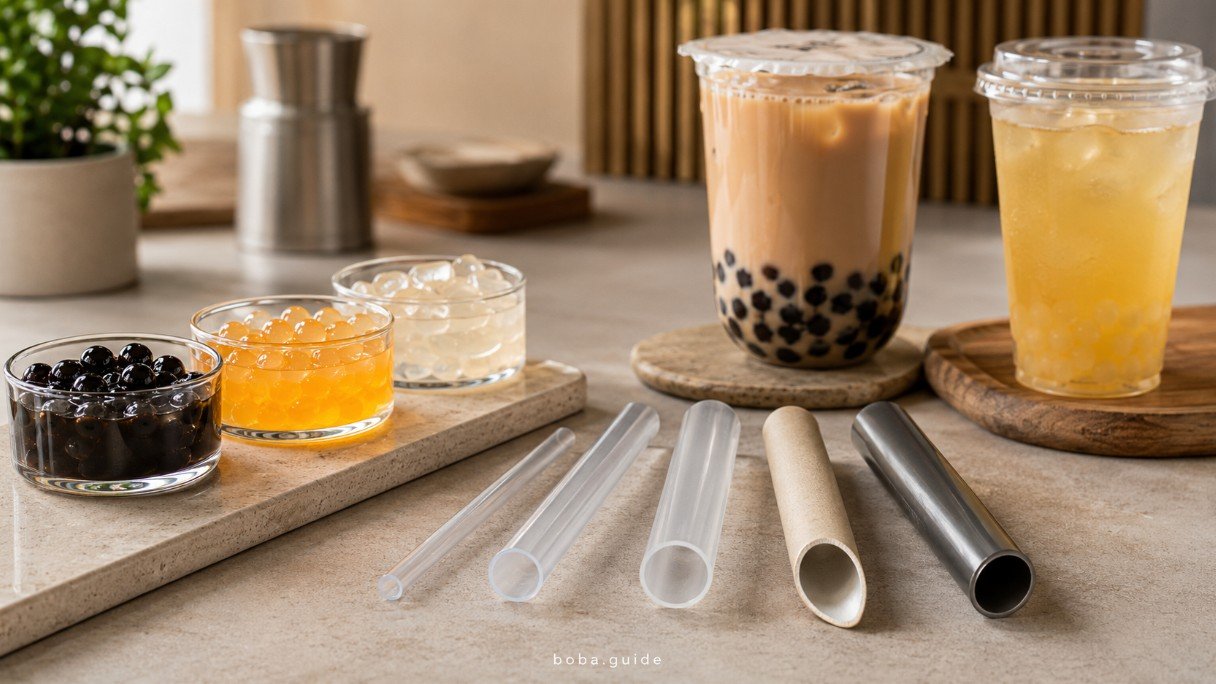
The best boba straw is the one that reliably moves the drink and its toppings from cup to customer without clogging, collapsing or fighting the lid. That sounds simple until you compare a standard 6 mm drinking straw with a 10 mm U.S. boba straw, a 12 mm Taiwan-style boba straw, a paper version that softens in liquid and a rigid reusable straw designed to last for years.
Diameter matters first, but it is not the only specification. Length needs to match the cup. A diagonal tip is useful when the drink is sealed with film. Wrapping changes hygiene and cost. Material affects rigidity, mouthfeel and how long the straw performs in an iced drink. And a straw that works beautifully with classic tapioca may still struggle with large jelly pieces or a topping nearly as wide as the bore itself.
This guide focuses on choosing the straw itself. For the broader cups, sealers, containers and shop tools around it, start with our boba supplies guide.
Start With Diameter, Not Color
“Wide straw” is too vague for bubble tea. Current supplier specifications show several very different diameters being sold for different beverage jobs.
Useful for ordinary beverages without large solid toppings.
Karat currently sells 0.39-inch boba straws, which it specifies as 10 mm.
Kei Fu currently lists 12 mm × 21 cm as its boba-straw format.
The jump from 6 mm to 10–12 mm is not cosmetic. The usable opening grows enough to accommodate pearls, jelly and other add-ons that would instantly block a regular soda straw.
A 12 mm straw is not automatically better than a 10 mm straw. It is simply more forgiving when toppings are large, irregular or likely to swell slightly during service.
Match the Straw to the Topping You Actually Serve
The most important fit is between the topping’s largest practical dimension and the straw’s internal opening. This is why a product catalog that only says “boba straw” is not enough information for a careful buyer.
10–12 mm is the useful commercial zone
Traditional tapioca pearls need a genuinely wide bore. A 10 mm straw is common in the U.S.; 12 mm gives more clearance when pearls are slightly larger or softer.
Clearance can become tight
Many popping pearls are around 9.5–10 mm. That means a nominal 10 mm straw can leave very little margin once wall thickness, pearl variation and liquid friction are considered.
Shape matters as much as diameter
Crystal-style toppings can be softer and less perfectly spherical. Test the actual product rather than assuming every 10 mm straw will behave identically.
Irregular shapes create clogs
A cube or strip can rotate sideways and block a straw even when one dimension appears small enough on paper.
For the topping side of the decision, see our guides to tapioca pearls, popping boba, crystal boba and the broader boba toppings guide.
U.S. and Taiwan Suppliers Do Not Use One Universal Boba Straw Size
Current supplier catalogs make this especially clear.
10 mm × 9 inches
Karat/Lollicup lists its common boba straw at 0.39 inch diameter, specified as 10 mm, and 9 inches long.
12 mm × 21 cm
Kei Fu separates its 12 mm boba straw from a 6 mm standard skinny straw, both at 21 cm length.
Twenty-one centimeters is about 8.27 inches, so the Taiwan example is slightly shorter but wider than the common 9-inch U.S. example.
Straw Length Matters More Than It Seems
A straw needs enough exposed length above the lid for comfortable drinking while still reaching the toppings at the bottom of the cup.
Longer is not automatically better. An excessively long straw can look awkward in a small cup and increase leverage against a thin lid. A straw that is too short can disappear into a deep cup or make the final tapioca pearls difficult to reach.
The practical test is simple: fill your tallest normal drink, seal or lid it exactly as served, insert the straw and confirm that there is comfortable usable length above the cup while the end still reaches the bottom.
Diagonal Cut vs Flat Cut
The tip becomes important when the cup is sealed with plastic film.
Karat’s current 10 mm boba straws use one flat end and one diagonal end specifically so the pointed end can puncture film.
If drinks use a lid with a dedicated straw opening, the sharp piercing tip is less important.
A weak or softened straw can still fail to pierce film even when it starts with a diagonal cut. That is one reason material rigidity matters in a sealed-cup workflow.
Plastic, Paper or Reusable?
Material should be evaluated by how the straw behaves during the entire drink—not by a one-word environmental or durability label.
Rigid and predictable
Commercial polypropylene-style straws remain common because they hold their opening, pierce film reliably and cost little per serving.
Best fit: high-speed disposable service where permitted.Disposable alternative
Wide paper boba straws are available in commercial cases, including 12 mm formats. Performance depends heavily on wall construction and how long the drink sits before consumption.
Best fit: operators prioritizing a paper disposable format.More durable use cases
Suppliers now offer rigid 12 mm alternatives made from plant-fiber or composite systems. Reusable straws shift the operational burden from disposal to washing and sanitation.
Best fit: home use or controlled reusable service.A material change should never silently reduce the bore. If you switch from a 12 mm plastic straw to an 8 mm alternative, the topping compatibility has changed even if both products are marketed for specialty drinks.
Wrapped vs Unwrapped Straws
Wrapping affects cost, handling and the way straws are distributed to customers.
Cleaner handoff and self-service
Useful when customers pick up their own straws, orders travel through delivery services or the straw is placed directly into a takeout bag.
Lower packaging cost
Works well when staff dispense straws from a protected holder and the operation has a controlled service workflow.
Current Karat pricing shows a real cost difference. A 1,600-count case of individually wrapped 10 mm × 9-inch straws is currently listed at $39.75, while a 1,600-count unwrapped version is listed at $28.50.
That works out to approximately:
What Commercial Boba Straws Currently Cost
The straw is a small component of drink cost, but high-volume shops use enough of them that case economics still matter.
The 3,500-count $65.25 case works out to roughly 1.86 cents per straw. The 2,000-count $41.25 wrapped 7.5-inch format is about 2.06 cents per straw.
These are current August 2026 supplier examples, not national averages. Freight, business pricing and regional disposable-product rules can change the actual purchasing decision. :contentReference[oaicite:2]{index=2}
The Best Boba Straw for Home Use
Most households do not need thousands of disposable straws. The practical choice is usually a small pack of genuinely wide straws or a reusable straw whose bore is large enough for the toppings you normally make.
Large enough for most classic boba use cases.
A reusable straw needs a brush or cleaning system that reaches the full interior.
Match the tallest cup you actually use rather than buying an oversized novelty straw.
If you also want a reusable cup rather than just the straw, see our best reusable boba cups guide.
The Best Boba Straw for a Shop
A shop should choose the straw as part of a standardized service system. The question is not simply whether customers like the color.
Use the largest regular topping as the test
If your menu includes large popping boba, jelly or fruit pieces, test those rather than only standard tapioca.
Test the sealing film
A diagonal tip must actually pierce your specific film without excessive force.
Choose a consistent length
One straw size that works across your main 16–24 oz cup range simplifies purchasing and training.
Choose wrapped or unwrapped deliberately
Base the decision on service style, hygiene handling and actual cost rather than habit.
Calculate case turnover
A 1,600-count case at 100 drinks per day represents only about 16 days of straw demand.
Keep one approved specification
Write down diameter, length, material and cut so a replacement order does not quietly substitute a narrower straw.
For the broader checklist of equipment and consumables around the drink station, use our boba equipment checklist.
The Straw Must Match the Entire Cup System
A straw can be perfect by itself and still fail in the finished service setup.
Can the largest pieces enter the straw?
Is the bore wide and rigid enough?
Can the straw pierce or pass through cleanly?
Is the straw long enough to reach the bottom?
Kei Fu’s current packaging catalog illustrates how these parts are sold as a system: 12 mm boba straws appear alongside 16 oz and 22 oz paper cups, 500–750 ml PP cups, 90–95 mm lids and cup-sealing film.
For purchasing rather than product selection, continue to where to buy boba supplies.
How to Compare Two Boba Straws Properly
Check diameter in millimeters
Ignore vague words such as jumbo or giant until you know the actual bore specification.
Test the largest topping
Use the real cooked pearl, popping boba or jelly from your menu, not an estimated diameter from memory.
Check length against the tallest cup
The straw should reach the bottom comfortably while leaving enough length above the lid.
Match the cut to the closure
Use a reliable diagonal tip when piercing sealing film; a flat tip is acceptable when the lid already provides access.
Compare material under real drink conditions
Test stiffness, wet resistance, mouthfeel and whether the straw remains usable through the entire drinking time.
Decide whether wrapping is worth the cost
Wrapped straws simplify customer handoff; unwrapped straws can reduce packaging and per-unit cost.
Calculate cost per drink
Divide case price by usable straw count and include shipping before comparing suppliers.
The best boba straw is therefore not the widest straw in the catalog. It is the narrowest straw that still gives your largest regular topping comfortable clearance, works with your cup closure, survives the drink and makes sense at your service volume.
Know a Straw Specification We Should Test?
Boba shops often discover straw problems only after changing pearls, toppings, sealing film or cup suppliers. If you operate a shop or manufacture bubble-tea straws, send current diameter, length, material, case count or compatibility details to info@boba.guide.
Submitted products and specifications are treated as research leads. Providing a sample does not guarantee inclusion or a favorable recommendation.
Questions About Choosing Boba Straws
These are the practical questions that matter when a straw has to work with real toppings, cups and sealing film.
What size straw is best for boba?
A diameter around 10–12 mm is a practical commercial range for many boba drinks. Current U.S. examples commonly use 10 mm, while Taiwan suppliers also list 12 mm boba straws. The better choice depends on the actual size and shape of the tapioca pearls, popping boba, jelly or other toppings you serve.
Is a 10 mm straw wide enough for tapioca pearls?
It is commonly used for standard commercial boba, but topping size varies. A 10 mm straw can work well with normal tapioca pearls, while a 12 mm straw gives more clearance for larger pearls or irregular toppings. Test the straw with the actual cooked topping before ordering a large case.
Can popping boba fit through a 10 mm straw?
Some can, but the margin may be tight. Many current popping-boba products are close to 9.5–10 mm in diameter. A nominal 10 mm straw therefore leaves little clearance once variation in pearl size and the usable internal bore are considered. A wider straw may work more reliably.
Why do boba straws have a pointed end?
The diagonal point is designed to pierce cup-sealing film. Current commercial Karat boba straws use one flat end and one diagonal end for this purpose. If a drink uses a regular lid with a straw opening, the piercing point is less important.
How long should a boba straw be?
Common current commercial examples are around 21 cm or 9 inches long. The correct length depends on the cup. The straw should reach the bottom comfortably while leaving enough length above the lid or sealing film for normal drinking.
Are paper boba straws available in wide sizes?
Yes. Taiwan suppliers currently list paper boba straws in 12 mm × 21 cm formats. Performance varies by construction, so test whether the straw stays rigid for the expected drinking time and can pierce sealing film if that is part of your service system.
How much do commercial boba straws cost?
In an August 2026 U.S. supplier snapshot, a 1,600-count case of individually wrapped 10 mm × 9-inch Karat boba straws was $39.75, or about 2.48 cents per straw before shipping. A 1,600-count unwrapped case was $28.50, or about 1.78 cents each. Prices and freight can change.
Are wrapped boba straws worth the extra cost?
They can be for takeout, delivery and self-service because each straw remains individually protected until use. Unwrapped straws cost less and can work well when staff dispense them from a protected holder. The better choice depends on service style, handling and local requirements.
What is the best reusable straw for boba?
Choose a reusable straw with a genuinely wide bore, usually around 10–12 mm for typical boba use, enough length for your tallest cup and a cleaning brush that reaches the full interior. Rigid reusable materials can work very well at home, but the straw still needs to be tested with the largest topping you normally use.