
How Is Boba Made? From Tapioca Starch to the Finished Drink
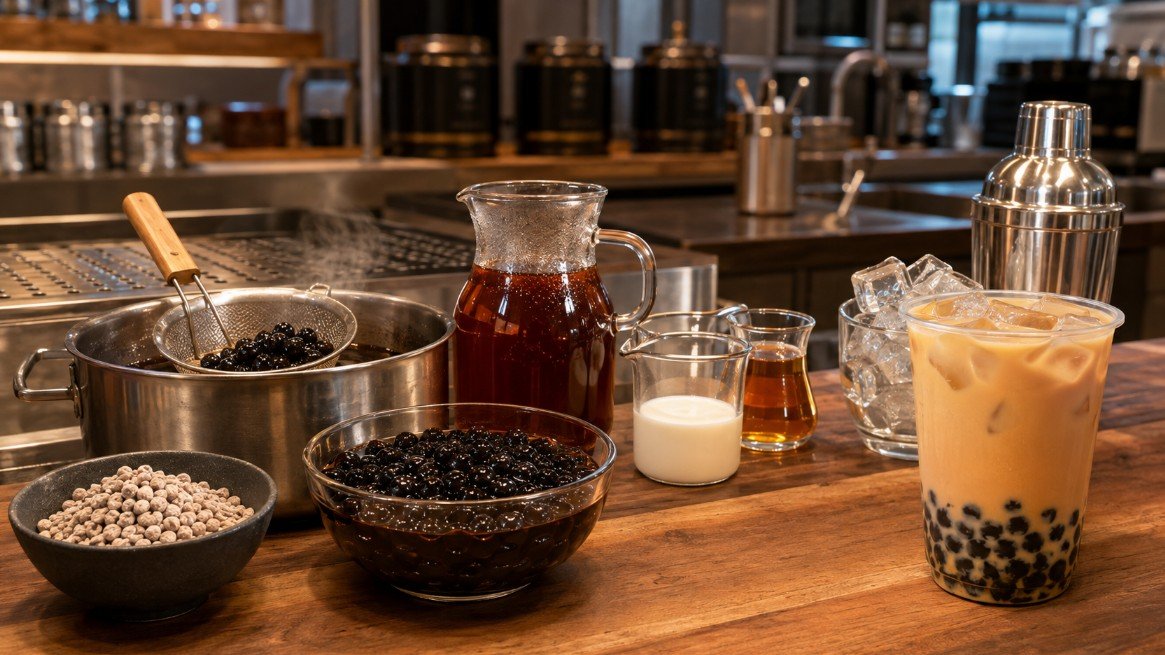
Boba is made in two parallel parts. First, tapioca starch is formed into small pearls and cooked until the starch becomes hydrated, soft and chewy. Separately, tea or another drink base is brewed or prepared, then combined with milk, fruit, sweetener, ice or other ingredients. The cooked pearls are portioned into the cup and the finished drink is mixed, shaken or layered before serving.
That distinction matters because the black pearls at the bottom are not made inside the milk tea itself. Pearl cooking and drink preparation are separate workflows. A shop may cook a batch of tapioca, brew tea in another station and assemble individual drinks only when customers order.
The exact recipe varies by shop and product, but the overall logic is remarkably consistent: make the pearl, cook the pearl, prepare the drink, customize it, then bring everything together. Understanding those stages also explains why two cups that look similar can have very different quality. The pearl texture, tea strength, syrup balance, temperature and final mixing all come from separate decisions made before the straw ever reaches the cup.
The complete boba-making process has two tracks that meet in the cup
When someone asks how boba is made, they may be asking about the chewy pearls, the finished drink or both. A complete answer needs to show the two processes together.
The starch base for traditional chewy pearls.
Starch and moisture are combined into a form that can be shaped.
The starch mixture becomes small pearl-sized pieces.
Heat and water transform the firm pearls into a chewy topping.
Cooked pearls may be rested in syrup or another sweet mixture.
Tea, fresh milk, fruit or another base is prepared separately.
Milk, sweetness, flavor, ice and toppings are selected.
The prepared components are combined into the final drink.
This is why “boba is tapioca starch mixed into tea” is not an accurate description of the process. The starch is transformed into a separate topping first. Only after the pearls are cooked do they become part of the beverage.
It is also why the same shop can use one batch of cooked pearls across several very different drinks. The tapioca may be identical, while the liquid around it changes from roasted milk tea to jasmine fruit tea, matcha fresh milk or another menu style. The drink and the topping are modular parts of the same service system.
Traditional boba pearls begin with tapioca starch
Tapioca starch comes from cassava, a starchy root crop. The cassava is processed so its starch can be separated and refined. That starch is the main structural ingredient behind traditional tapioca pearls.
This is an important distinction: the familiar black pearl is not simply a tiny piece of cassava root. The root is the agricultural source; tapioca starch is the processed ingredient used to make the pearl.
Commercial pearl formulations can vary. Some products include additional starches, sugars, colors or other ingredients, so there is no single universal formula that describes every pearl sold by every manufacturer.
The starch matters because it is responsible for the physical transformation that follows. Before cooking, the pearl is compact and firm. After enough heat and water have moved through it, the starch network behaves very differently. That change is the foundation of the chewy texture people associate with traditional boba.
For the ingredient side in more depth, see what boba is made of.
The starch must become a workable mass before it can become pearls
Dry tapioca starch does not naturally behave like a finished pearl. It has to be combined with moisture and processed into a mass that can hold together long enough to be cut or shaped.
Exactly how this is done depends on the pearl formulation. Some methods use warm or hot liquid to begin changing part of the starch so the mixture can bind. Commercial production may use controlled mixing and shaping equipment, while smaller-scale or handmade methods can involve rolling, cutting or rounding pieces manually.
Loose powder with no pearl structure.
Moisture allows the starch mass to hold together.
Small pieces are formed into consistent portions for cooking.
Consistency matters here because pearl size influences how evenly the pieces cook. If one batch contains dramatically different sizes, the smallest pearls can soften before the largest ones have hydrated through the center. Commercial pearls are therefore shaped for repeatability as much as appearance.
The goal at this stage is not yet to create the soft texture you experience through a wide straw. Uncooked pearls are still firm. Their defining transformation happens during cooking.
If you want the identity of the pearl itself rather than the production sequence, see what boba pearls are.
Cooking is what turns a firm starch pearl into something soft and chewy
This is the key physical transformation in traditional boba production. The shaped pearls are cooked in hot water so moisture can move into the starch structure.
The pearl has not yet developed the fully hydrated, elastic texture expected in a finished drink.
The starch absorbs water and changes structure as it cooks.
A properly prepared pearl develops the resilient mouthfeel associated with classic boba.
At a basic level, this transformation involves starch gelatinization. Heat and water disrupt the organization of starch granules, allowing them to hydrate and change texture. The full food-science explanation is more detailed, but this is the process that helps explain why a cooked tapioca pearl behaves so differently from its uncooked form.
The best result is not simply “as soft as possible.” Good pearls should retain enough structure to feel springy and chewy instead of dissolving into a paste. That balance is one reason cooking and holding technique matter so much.
The center is particularly revealing. A pearl can look dark and glossy outside while still being insufficiently hydrated inside. That is why judging doneness by appearance alone is unreliable. What matters is the texture through the full bite: there should not be a dry, chalky or sharply hard core hiding beneath a soft exterior.
For the deeper starch and texture mechanisms, continue to boba science.
Dry pearls cannot simply be dropped into a finished milk tea and expected to become boba
The drink itself does not provide the same controlled heat and hydration environment as a cooking vessel. Traditional dry tapioca pearls need to be cooked separately so the starch can hydrate properly through the pearl.
If that transformation is incomplete, the pearl may remain unpleasantly firm or develop a dense center. If the pearl is cooked or held poorly in the opposite direction, it can become excessively soft and lose the springiness people expect.
Dense or hard center, limited elasticity.
Hydrated through the pearl while retaining a pleasant chew.
Weak structure and a mushier eating experience.
The separation between cooking and serving also lets shops control two variables independently. They can prepare pearls for the desired chew without over-heating the finished milk tea, and they can serve cold drinks without asking cold liquid to perform a cooking job it cannot perform efficiently.
Cooked pearls are often rested with sweetener before they enter the cup
Freshly cooked tapioca provides texture, but its finished flavor can also be shaped by what happens after cooking. Many boba shops hold or coat their cooked pearls in a sweet syrup, often involving brown sugar or another sugar mixture.
This step can add surface sweetness, deepen the familiar caramel-like flavor associated with some black pearls and keep the finished topping appealing during service.
The pearls have already been cooked before the sweetening stage.
Syrup can add sweetness and a brown-sugar or caramel-like character.
Pearls can be prepared in batches and portioned into drinks as orders arrive.
That does not mean every traditional boba pearl is automatically a brown sugar pearl. Different shops use different syrups and recipes, while some drinks rely much more heavily on brown sugar than others.
The sweetening stage also affects how the pearls interact with the finished drink. Mildly sweet pearls can add contrast to a tea-forward base, while strongly syruped pearls can become one of the dominant flavors in the cup. A well-designed recipe accounts for both the drink’s sweetener and the sweetness already carried by the topping.
It is also important not to treat cooked tapioca as an indefinitely stable product. Texture changes as prepared pearls sit, which is one reason freshness is so noticeable in a good boba shop.
While the pearls are prepared, the beverage base is made separately
Classic bubble tea grew out of tea culture, and brewed tea still provides the backbone for many popular drinks. Black tea, green tea, jasmine tea and oolong are common examples, each bringing different aroma, bitterness, body and roast character.
The tea is brewed separately from the pearls. A shop may prepare tea in batches or brew certain styles differently depending on its workflow. The goal is to produce a tea base strong enough to remain recognizable once other ingredients such as milk, syrup and ice are added.
Often used for classic milk tea.
Common in lighter milk teas and fruit teas.
Useful when a stronger tea character is wanted.
Brewing is not just about making tea strong. Time, water temperature, leaf type and the planned final drink all influence the base. A tea intended to be combined with milk and ice may need enough body to survive dilution, while a lighter fruit tea may be designed around aroma and freshness instead.
The tea side deserves its own guide because brewing style changes the final drink dramatically. See our guide to tea in boba for the major bases and how they differ.
Milk, fruit, sweetness and flavor are built around the chosen base
There is no single universal liquid recipe for boba. The category now includes several drink systems that share a customization model but can taste completely different.
Tea + milk + sweetness
A brewed tea base is combined with dairy or another creamy component and adjusted with sweetener. Tapioca pearls are a classic pairing, but they are optional in many shops.
Tea + fruit + sweetness
Green, jasmine or another tea base can be combined with fruit flavor, juice or fruit preparations. Jelly, aloe and popping toppings are common alternatives to tapioca.
Milk-centered drink + syrup or flavor
Some popular boba drinks are built around fresh milk and syrup rather than tasting like a conventional brewed milk tea.
Tea + restrained additions
The beverage can stay closer to brewed tea, using less milk or flavor so the character of the leaves remains obvious.
The customization step is also where sweetness levels begin to matter. A shop can often vary the syrup added to the liquid independently from the topping portion. That is why reducing the drink’s sweetness does not necessarily make sweetened tapioca completely unsweetened, and why two orders with the same percentage setting can still taste different if their toppings differ.
The broader range of drink formats is covered in our boba drinks guide.
The finished boba drink is assembled only after the major components are ready
Once the pearls and drink base are prepared, the shop can build an individual order. The exact order of operations varies by beverage and shop, but a typical workflow looks something like this:
Cooked tapioca, jelly, pudding or another topping enters the cup.
Tea, milk, flavor and sweetener are measured according to the order.
The drink reaches its intended serving temperature and dilution.
Ingredients are combined so flavor and temperature become more even.
The completed drink is closed and paired with an appropriate straw.
Not every drink follows this exact order. Layered brown sugar drinks, fresh-milk drinks and shop-specific beverages may deliberately keep components separate for visual or flavor reasons.
Temperature is another reason assembly order can change. A hot milk tea with pearls, a shaken iced jasmine tea and a layered cold fresh-milk drink are solving different preparation problems. Shops may therefore use different sequences even though they all end with a cup described as boba.
What matters is that the pearls are already a prepared topping by the time final assembly begins.
Shaking is part of the drink-making process, not just café theater
Hand-shaken tea is an important part of the category’s Taiwanese beverage heritage, and shaking can serve several practical purposes in a modern shop.
Distributes tea, milk, syrup and flavor more evenly.
Brings a cold drink toward serving temperature quickly when used with ice.
Can create a light foamy layer and alter the immediate mouthfeel of the tea.
Helps a shop combine measured ingredients in a repeatable way.
Shaking can also change perception. A thoroughly mixed cold drink delivers tea, sweetness and milk more consistently from the first sip, while a deliberately layered drink may be designed to change as the customer stirs or drinks it. Neither approach is automatically better; they are different drink styles.
Not every modern boba drink must be shaken. Layered drinks and some milk-based beverages may be assembled differently. The technique is one tool inside the broader preparation system rather than a universal rule for every cup.
The basic workflow changes when the drink or topping changes
Cooked tapioca + brewed tea + milk + sweetness
This is the easiest version for understanding the standard two-track process. Tapioca is cooked separately, tea is brewed separately, then the two are combined in the final drink.
Pearls play a larger flavor role
The cooked pearls may be heavily coated or held in brown sugar syrup. That syrup can become part of the drink’s visual and flavor identity, especially in fresh-milk styles.
Fruit and tea replace the creamy milk-tea profile
The drink track changes while the topping track can remain independent. A fruit tea can still use tapioca, but it may also use aloe, jelly or popping boba.
A completely different topping process
Popping boba is not produced by cooking traditional tapioca pearls until they become liquid-filled. It is a separate type of topping with a thin outer structure and liquid center, so the classic tapioca cooking workflow does not apply.
This is why “how is boba made?” has more than one possible answer. If boba means traditional tapioca pearls, the starch-cooking process matters. If boba means the finished drink, the full beverage workflow matters. If it means popping boba, a different topping technology is involved.
It also explains why visual appearance alone can be misleading. Two round toppings can look similar through a clear cup but react completely differently when bitten. Manufacturing method determines much of that difference: tapioca is built around cooked starch and chew, while popping boba is built around a thin shell and liquid center.
For a broader topping comparison, use the boba toppings guide.
The same basic process scales differently in a professional tea shop
Home cooks often start with packaged dry pearls, cook a smaller amount, brew tea in household equipment and mix drinks individually. The focus is flexibility rather than high-volume repeatability.
Shops may prepare pearls and tea in batches, organize toppings in service containers and use measured recipes, shakers and cup-sealing equipment to produce many customized drinks consistently.
The underlying logic remains similar: prepare components first, then assemble the requested combination. The difference is scale. A professional shop needs enough prepared tea and toppings for service without making so much that quality declines before the batch is used.
That creates a rhythm behind the counter that customers rarely see. Tea may be brewed while another batch cools, pearls may be prepared on a separate schedule, toppings are replenished independently and final drinks are assembled only after an order specifies base, sweetness, ice and additions. The cup is the last stage of a much longer workflow.
The business side — equipment, inventory, speed and staffing — belongs to a different question than the food-production process itself.
If your goal is actually making drinks at home with quantities and methods, use the boba recipes collection rather than treating this process explainer as a recipe card.
Hot pearls, chilled tea and ice all affect the final texture and balance
A boba drink is assembled from components that may begin at very different temperatures. Freshly cooked pearls are warm. Brewed tea may be hot before chilling. Milk is usually refrigerated. Ice is added only at or near final service. Bringing those components together changes both texture and flavor.
Freshly prepared tapioca may feel more tender and aromatic when it has not been chilled for long.
Cold service and ice can soften aroma and reduce perceived strength, so the base has to be designed for the final cup.
Pearls do not remain frozen at one ideal state. Temperature and time continue influencing chew after service.
A well-made boba drink depends on more than whether the recipe contains pearls
Every stage affects the result. Excellent ingredients can still produce an underwhelming drink if the pearls, tea and final assembly are poorly controlled.
An undercooked center feels hard; an overly soft pearl loses the springy chew that makes tapioca appealing.
Prepared pearls do not stay at their ideal texture forever, so timing and service conditions influence quality.
Weak tea can disappear once milk, syrup and ice are added.
A heavily sweetened cup can hide the flavor of the tea and make every component taste similar.
Too much uncontrolled dilution can make a carefully brewed tea taste thin.
A topping can be perfectly prepared yet still feel wrong if its texture or sweetness overwhelms the drink.
A good production system therefore aims for coordination, not just correctness in isolation. Strong tea can still fail if the topping is stale. Excellent pearls can still disappear inside a drink overloaded with syrup. The final experience depends on whether each prepared component was designed for the others.
The broader tasting and freshness criteria are covered in our boba quality guide.
From cassava starch to the finished cup
Questions about how boba is made
How is boba made?
Traditional boba pearls are made by forming tapioca-based starch into small pearls and cooking them in water until they become soft and chewy. The tea or other beverage base is prepared separately, customized with milk, flavor, sweetness and ice, then combined with the cooked topping.
How are boba pearls made?
Tapioca starch is combined with moisture and processed into a shapeable mixture. Small pearls are formed, then cooked in hot water so the starch hydrates and develops the characteristic chewy texture. Prepared pearls may then be rested in syrup before serving.
Is boba made from cassava?
Traditional tapioca boba is indirectly made from cassava because tapioca starch is extracted from cassava roots. The root itself is processed into starch before that starch is used to make pearls.
How do tapioca pearls become chewy?
Heat and water change the starch during cooking. As the pearl hydrates and the starch gelatinizes, its texture shifts from firm and starch-dense to soft, elastic and chewy. Proper cooking has to reach the center rather than softening only the outside.
Are boba pearls cooked before they go into the drink?
Yes. Traditional dry tapioca pearls are cooked separately before final drink assembly. They cannot develop the same properly hydrated texture simply by sitting in cold milk tea.
Is boba always made with tea?
No. Tea remains central to many classic boba drinks, but modern menus also include fresh-milk drinks, slushes, smoothies and other formats that may not use a conventional brewed-tea base.
Is brown sugar added to every boba pearl?
No. Brown sugar syrup is common, especially in brown sugar boba drinks, but different shops and products use different sweeteners and holding mixtures. The sweetness of the topping and the sweetness of the liquid can also be adjusted as separate parts of the drink.
Why do boba shops shake drinks?
Shaking can combine ingredients, chill the beverage, distribute sweetness and create light aeration or foam. Not every modern boba drink is shaken, particularly when the drink is intentionally layered.
Is popping boba made the same way as tapioca boba?
No. Popping boba is a different topping with a thin outer structure and liquid center. It does not get its texture from boiling traditional tapioca pearls until they become chewy.
Can boba be made at home?
Yes. Home cooks can prepare bubble tea with purchased dry tapioca pearls or make pearls from scratch, then brew and customize the drink separately. Exact quantities and cooking instructions depend on the pearl product or recipe being used.
HOW BOBA IS MADE IN ONE IDEA
The pearls and the drink are made separately first. Tapioca starch becomes cooked chewy pearls, tea or another base is prepared and customized, and the two tracks meet only when the final boba drink is assembled.