
What Does Boba Feel Like? Texture, Chew and Mouthfeel Explained
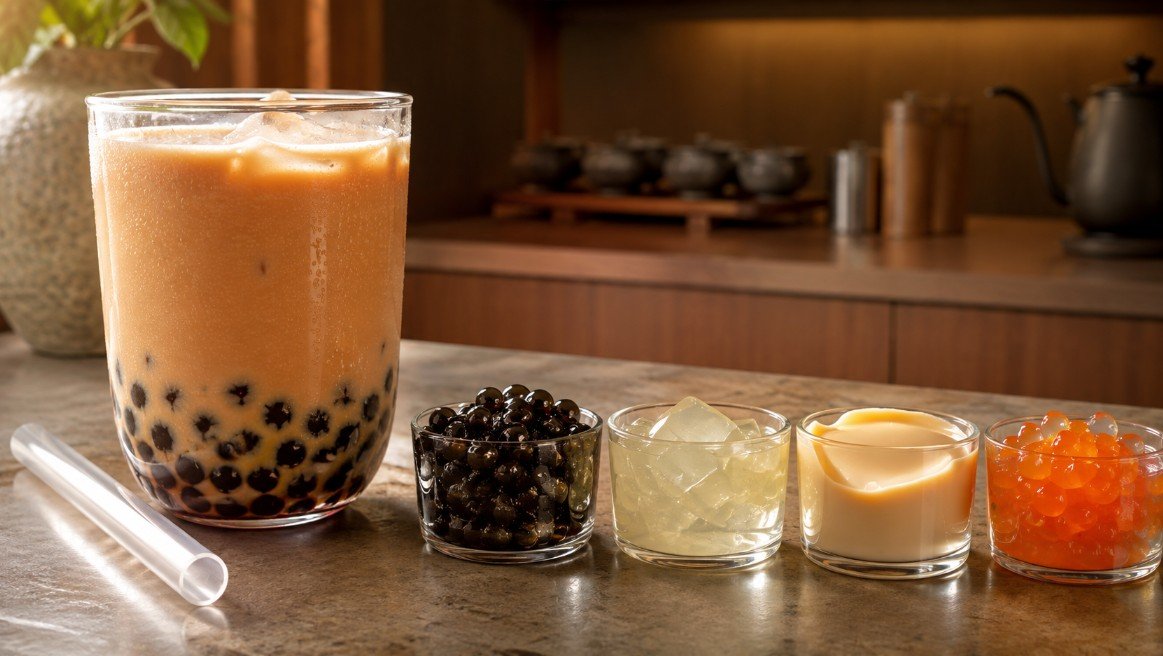
Classic boba feels smooth and slippery at first, then soft, springy and chewy when you bite it. A tapioca pearl should give way easily without disappearing immediately: there is a gentle resistance that makes you chew it several times before swallowing.
The unusual part for a first-time drinker is that boba is both a drink and an eating experience. You sip tea through a wide straw, a pearl arrives with the liquid, and suddenly a smooth cold drink becomes something you chew. That contrast is a major part of what makes boba feel different from ordinary iced tea or milk tea.
And not every boba topping feels like tapioca. Modern drinks can combine soft pudding, slippery jelly, juicy aloe, creamy foam or thin-skinned popping spheres. If you first want the broader definition of the drink and topping, see what boba actually means. Here, we are concentrating on mouthfeel.
Boba feels unusual because you drink and chew at the same time
Imagine taking a normal sip of cold milk tea. The liquid moves easily through the straw and feels smooth across your tongue. Then a soft sphere follows it into your mouth. Instead of swallowing immediately, you catch the pearl with your teeth and chew.
That tiny interruption changes the rhythm of the entire drink. You alternate between liquid and solid, smoothness and resistance, sipping and eating. It is why describing boba only by flavor misses a large part of the experience.
Sip
Tea, milk or fruit drink reaches your mouth first as a cool flowing liquid.
Catch
A pearl travels through the wide straw and becomes a distinct object in the sip.
Bite
The smooth exterior yields under your teeth instead of cracking or bursting.
Chew
The pearl pushes back gently, then becomes softer as you continue chewing.
The experience can be surprising during the first few sips because most beverages do not ask your jaw to participate. Once you know what to expect, that texture becomes one of the easiest ways to distinguish traditional pearl milk tea from a drink with no topping at all.
What does a tapioca pearl actually feel like?
A well-cooked tapioca pearl usually feels smooth on the surface, tender when first bitten and resilient through the center. It should remain a recognizable pearl while you chew instead of instantly dissolving or collapsing.
The exterior is moist and often coated with syrup, so the first contact can feel slippery. Once your teeth compress the pearl, its starch structure produces the characteristic elasticity. The resistance is much gentler than hard candy and normally less dense than a gummy candy.
A properly prepared pearl also should not contain an obviously dry, chalky center. That kind of contrast usually suggests uneven cooking rather than the intentionally springy bite people associate with good tapioca.
If you want to understand the ingredient behind that texture rather than just the sensation, our guide to what boba pearls are explains tapioca starch and how cooking transforms it.
“Q” is closer to satisfying resilience than simple softness
When people describe the appealing chew of foods such as tapioca pearls, one useful Taiwanese sensory concept is Q, sometimes intensified as QQ. There is no perfect one-word English equivalent.
“Chewy” gets close, but it does not explain everything. The desirable sensation involves elasticity and bounce: the food yields under pressure, yet has enough structure to push back before breaking down.
Calling good boba simply “rubbery” can therefore be misleading. Rubberiness in English often implies unpleasant toughness. A satisfying pearl should be easier and more pleasurable to chew: tender enough to bite comfortably but resilient enough to remain interesting.
Does boba feel like gummy candy, jelly or a soft noodle?
Comparisons help, but none is exact. Tapioca pearls belong to their own starch-gel texture. Here is the practical difference you are likely to notice.
Tapioca pearl
Soft and elastic. It compresses, pushes back gently and requires several chews. The surface is smooth rather than sticky like many candies.
Gummy candy
Usually denser and tougher. Gummies often have stronger elastic resistance and require more force before they break down.
Jelly
Softer and easier to cut through. Many boba jellies slide and deform with less spring-back than tapioca.
Soft noodle
Closer in starchiness, different in structure. Both can become tender and springy, but a pearl gives you a thicker, compact bite in a small sphere.
If your main question is flavor rather than physical sensation, read what boba tastes like. A person can enjoy the flavor of milk tea while disliking tapioca texture — or love the chew while preferring a completely different drink base.
One bubble tea menu can contain an entire world of textures
A modern boba shop may use the drink as a platform for several very different mouthfeels. This matters because someone who dislikes classic tapioca may still enjoy bubble tea with another topping — or with no topping at all.
Tapioca
Springy, smooth and substantial enough to keep you chewing after the sip.
Aloe
Lighter and more delicate, with a moist bite rather than the dense elasticity of tapioca.
Jelly
Soft pieces slide easily through the drink and usually require less chewing force.
Pudding
Soft, custard-like and easy to break apart, giving milk tea a denser creamy sensation.
Popping boba
A thin outer layer gives way quickly and releases liquid instead of producing a prolonged starch chew.
Milk or cheese foam
A creamy upper layer changes how each sip meets your lips without giving you a solid object to chew.
The full boba texture guide goes deeper into chewy, firm, soft, juicy, jelly-like and creamy textures and how to choose between them.
Good boba should resist your teeth without fighting them
The pleasant zone sits between two extremes. Pearls should not be so firm that you have to work hard to bite through them, but they should not be so soft that they lose their shape as soon as they reach your mouth.
Hard center, dry bite, excessive toughness.
The pearl yields comfortably, stays cohesive and gives a clean springy chew.
Mushy structure, little resistance, collapsing pearls.
There is no single universal firmness that every customer must prefer. Pearl size, recipe, cooking method, holding conditions and personal preference all matter. But the contrast between an intentionally elastic pearl and one with an obviously uncooked center is usually noticeable.
If you want to evaluate freshness, tea balance and preparation beyond texture alone, use our guide to judging boba quality.
Why can boba feel hard, dry or mushy?
Tapioca texture is highly dependent on preparation and time. Heating allows starch to take up water and gelatinize, but the pearl still needs enough cooking for that transformation to reach the center.
If the outside softens while the inside remains insufficiently cooked, you can get a distinctly firm or chalky core. More cooking changes that structure further. Push preparation too far, however, and the pearl may lose too much definition and become excessively soft.
Cooling and holding matter as well. Cooked starch does not remain structurally frozen in the state it had the moment it left the pot. Texture changes with temperature, moisture, syrup, formulation and time, which helps explain why fresh warm pearls and pearls that have spent a long time in a cold drink can feel different.
Often associated with incomplete or uneven cooking.
Can appear as cooked pearls cool or change during holding.
Too little remaining structure after excessive cooking or prolonged holding.
You can enjoy bubble tea without tapioca pearls
Disliking tapioca does not mean you dislike boba drinks. Because menus are customizable, you can usually remove traditional pearls entirely or choose a topping with a different mouthfeel.
Our boba toppings guide is the better place to compare the full range of alternatives and how they pair with different drinks.
Start with the mouthfeel that sounds least intimidating
There is no requirement that your first bubble tea must contain tapioca. If unfamiliar texture is your main concern, move through the category in whatever order feels comfortable.
Aloe
A gentle introduction to having small pieces in a drink without the substantial chew of a starch pearl.
Pudding or jelly
More obvious texture, but generally soft enough to break apart with little effort.
Tapioca pearls
The classic experience: smooth spheres with a soft, resilient bite that keeps you chewing.
Popping boba
Not tougher than tapioca, but more surprising because the sphere gives way suddenly and releases liquid.
This ladder is about how noticeable the texture feels, not a ranking of which topping is “better.” If you want the site to help match a drink to your sweetness, flavor and texture preferences together, continue to Choose Your Boba.
The texture may seem strange for thirty seconds — give yourself time to notice what you actually dislike or enjoy
For someone who has only consumed drinks without solids, the first pearl can feel unexpected simply because the sensory pattern is unfamiliar. That does not automatically mean the pearl is bad or that you will dislike it after a few sips.
Notice the specific reaction. Is the chew itself unpleasant? Is the pearl too firm? Is the drink too sweet? Do you dislike objects coming through a straw? Would a softer topping feel better? Those are different problems with different solutions.
The most useful first-boba question is therefore not “Do I like boba?” but “Which part of this texture experience do I like?” Once you can answer that, ordering becomes much easier.
Questions about how boba feels
Is boba supposed to be soft or hard?
Traditional cooked tapioca pearls should generally be soft enough to bite comfortably while retaining some springy resistance. An obviously dry or chalky hard center is different from intentional chewiness.
Is boba supposed to be chewy?
Yes. Chewiness is one of the defining sensory qualities of classic tapioca boba. Other bubble tea toppings can be much softer, juicier or designed to burst instead.
Does boba feel rubbery?
Some people use “rubbery” when they are unfamiliar with the texture, but good tapioca is better described as soft, elastic or springy. If a pearl feels unpleasantly tough and requires excessive effort to chew, that is not the ideal texture most shops are aiming for.
Does boba feel like gummy candy?
There is some similarity because both are chewy and elastic, but tapioca pearls are usually softer, wetter and less dense than conventional gummy candy. Their starch-based texture also breaks down differently as you chew.
Does tapioca boba pop in your mouth?
No. Traditional tapioca pearls are solid cooked starch structures that you chew. Popping boba is a different topping with a thin outer layer and liquid center designed to burst.
Why does my boba feel hard in the middle?
A distinctly firm or dry center can occur when a pearl has not cooked evenly through its full thickness. Pearl size, product type and preparation method affect cooking, so there is no single timing rule that applies to every formulation.
Why does boba sometimes feel slimy?
Cooked tapioca naturally has a smooth, moist starch surface, and pearls are often held in syrup. That can feel slippery. A pleasant glossy surface is different from a severely broken-down batch in which pearls are losing their structure.
Do you chew boba or swallow it whole?
Tapioca pearls are designed to be chewed and enjoyed as a textural part of the drink. Chewing also lets you experience the pearl’s elasticity and any syrup it has absorbed instead of treating it like a piece of liquid.
Can I order bubble tea without chewy pearls?
Usually, yes. Many shops let you remove tapioca or replace it with another topping such as jelly, aloe, pudding or popping boba. You can also order many tea and milk drinks with no solid topping.
THE FEEL IN ONE SENTENCE
Classic boba feels smooth when it reaches your mouth, soft when you first bite it and pleasantly springy as you chew. Everything around that pearl — tea, ice and other toppings — can add another layer of mouthfeel.