
Boba Around the World: How Bubble Tea Changes Across Countries
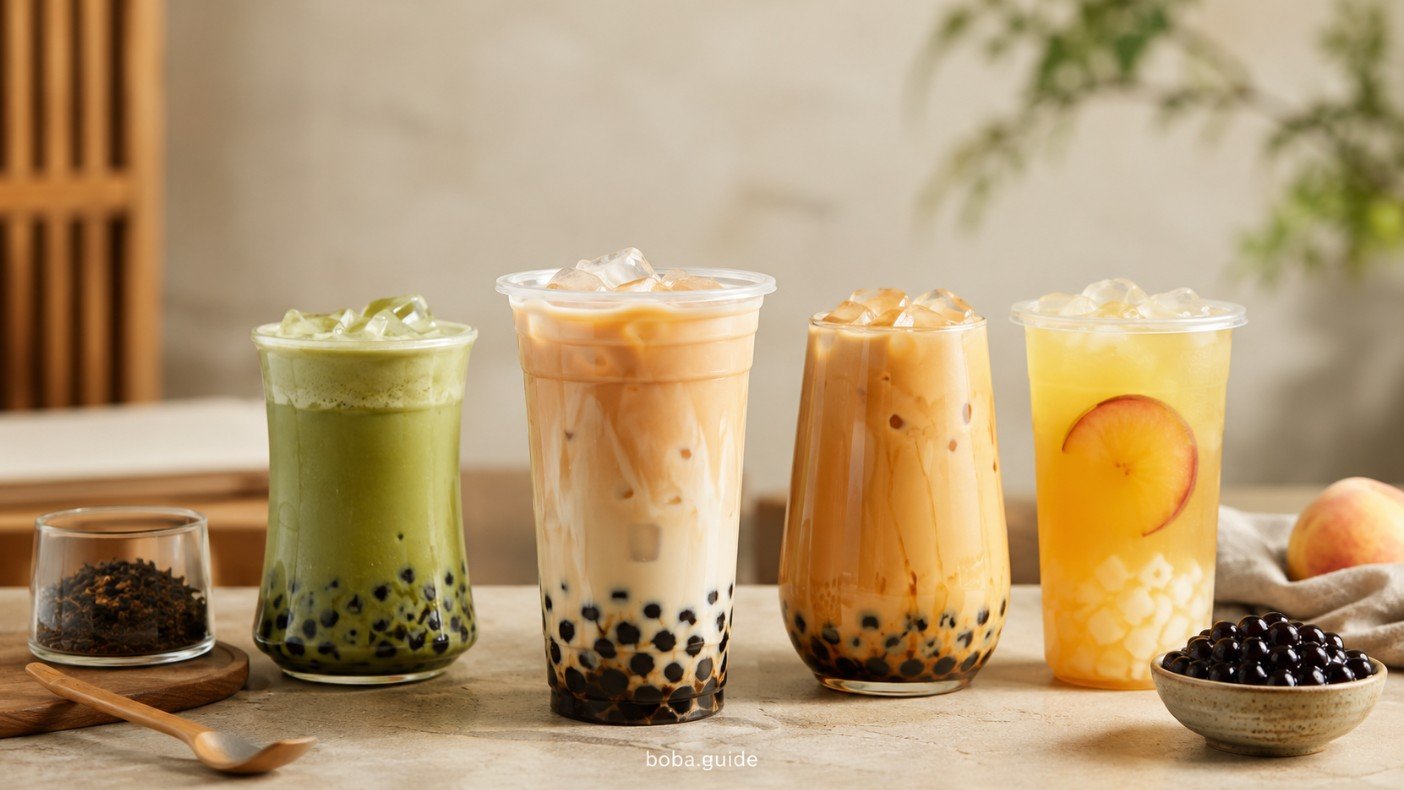
Boba began as a Taiwanese drink culture, but it did not travel as one fixed recipe. As bubble tea spread, shops kept the basic logic — tea or another base, sweetness, texture, temperature and toppings — while adapting those pieces to local tea traditions, dairy habits, fruit flavors, desserts and customer expectations.
That is why a “boba shop” in Tokyo may lean into matcha, kinako and seasonal tea craft, a Malaysian menu can bring in gula Melaka or local tropical flavors, a Korean chain may publish detailed caffeine and sugar data, and a U.S. menu may place Taiwanese tea, fruit drinks, brown sugar, taro and multiple toppings in the same ordering system. The category is global because the structure is portable.
Five parts of boba change as the drink crosses borders
The word “globalization” can make bubble tea sound like one Taiwanese product exported everywhere. In practice, several parts of the drink change independently.
Tea base
Assam, jasmine, oolong and black tea remain common, but local tea culture can introduce matcha, hojicha, regional oolongs, floral teas or darker roasted styles.
Sweetness system
Some shops offer percentage-style customization; others sell recipes with fixed sweetness because the flavor depends on a premixed syrup, puree, powder or topping.
Milk and cream
Fresh milk, non-dairy creamer, condensed milk, plant milk and milk foam produce very different drinks even when the tea and pearls are similar.
Texture
Tapioca travels well, but local menus add konjac, nata de coco, pudding, grass jelly, red bean, mochi-like toppings, aloe and other regional textures.
Flavor memory
Shops localize with ingredients people already know: gula Melaka in Malaysia, Uji matcha in Japan, condensed milk in Vietnam, Thai tea in Thailand, or familiar fruit and dessert flavors in the U.S.
For the broad definition of the drink itself, see what bubble tea is. This page focuses on what changes after that drink system moves into different markets.
Taiwan is not just where pearl milk tea began — it is where the broader hand-shaken drink system became highly developed
Taiwan’s beverage culture is much larger than one cup of black milk tea with black pearls. Tea shops routinely work with multiple tea bases, different sweetness and ice settings, fresh milk, creamers, fruit, foams and an extensive topping vocabulary.
Core words matter
- 珍珠
- “Pearls,” often the smaller classic tapioca size.
- 波霸
- Often used for larger tapioca pearls in Taiwan, though U.S. “boba” became broader.
- 粉圓
- A traditional word for starch-based round pearls.
- 奶茶
- Milk tea; not automatically the same thing as fresh-milk tea.
- 鮮奶茶
- Fresh-milk tea, where fresh milk is part of the identity.
- 奶蓋
- Milk/cream cap or foam layer, depending on the shop.
The drink is modular
A Taiwanese hand-shaken menu often asks you to make several decisions: tea family, dairy or non-dairy direction, sweetness, ice, toppings and sometimes cup size. That modularity is one reason the format adapted so easily abroad.
Taiwan also continues to treat hand-shaken beverages as a substantial everyday retail category. Government agencies regulate everything from food safety to disposable drink cups because the format is woven into daily consumption, not limited to occasional novelty drinks.
Bubble tea developed in Taiwan in the 1980s, but specific invention claims remain disputed. A global guide does not need to choose one shop as the unquestioned inventor.
For deeper cultural context, continue to boba in Taiwan or the broader boba culture section.
Japan pulls boba toward tea craft, matcha and seasonal dessert texture
Japan’s boba boom has cooled from its most viral phase, but tea chains continue to localize the format around Japanese tea and dessert language. Gong cha Japan presents itself as a Taiwanese tea café, yet its current menu includes categories such as straight tea, milk tea, brown sugar, fruit tea, almond milk tea and frozen “Gelatea,” showing how the café model has expanded beyond tapioca alone.
In June 2026, Gong cha Japan ran a seasonal first-flush matcha series using 100% matcha from a long-established Shizuoka tea producer. The lineup included matcha milk tea plus a frozen matcha drink with azuki and kinako milk foam. Earlier in 2026, the chain also used soft mochi-like pearls in a New Year matcha drink.
The dedicated country page will go deeper into chains, terminology and tea culture: boba in Japan.
South Korea combines pearl texture with highly specified café-style menu information
Korean bubble-tea menus use familiar loanwords such as 펄 for pearls and 타피오카 펄 for tapioca pearls, but the surrounding café culture is strongly localized. Current Gong cha Korea product pages publish cup volume, calories, sugars, protein, saturated fat, sodium and caffeine — a level of menu specification that is especially useful for comparing actual builds.
For example, the current Double Matcha Milk Tea + Pearl uses jasmine tea, matcha and matcha foam. Its cold large size is listed at 473 ml, while a brown-sugar signature milk tea with pearls is sold in both 473 ml and 651 ml cold sizes. The menu also includes mini pearls, showing that pearl size itself can be a customization dimension.
Current cold large size on cited Gong cha Korea products
Current jumbo size on some brown-sugar milk tea products
Caffeine listed for one current 473 ml Double Matcha Milk Tea + Pearl
These are current Gong cha Korea product examples, not national Korean standards. Cup sizes and nutrition vary by chain and drink.
For the country-level picture, use boba in South Korea.
Local sweetness, tropical flavors and tea diversity reshape the classic milk-tea template
Singapore and Malaysia are mature modern beverage markets where Taiwanese-style chains coexist with strong local flavor memory. That creates menus where pearl milk tea can sit next to palm sugar, blackcurrant, tropical fruit, oolong and increasingly specialized teas.
Gula Melaka turns local palm sugar into a boba flavor language
KOI Thé currently lists Gula Melaka Milk Tea as a Malaysia-exclusive drink. Tealive’s current menu also shows how broad the Malaysian tea-shop format has become: Original Pearl Milk Tea sits alongside brown-sugar drinks, Da Hong Pao, jasmine, peach oolong, bamboo oolong, matcha, hojicha, fruit tea, coffee and smoothies.
That is a useful reminder that “bubble tea” in a mature market often functions more like an all-day customizable beverage café than a narrow pearl-milk-tea shop.
International chains can localize with familiar non-tea flavors too
KOI’s current area-exclusive list includes Ribena Black Tea for Singapore, pairing a familiar blackcurrant flavor with black tea. The result still follows a tea-shop structure, but the flavor reference is locally recognizable rather than imported from a Taiwanese classic.
Singapore’s dense beverage market also exposes customers to many competing tea formats, so menu differentiation frequently comes from ingredients, limited editions and texture combinations rather than pearls alone.
For broader regional comparisons beyond these two markets, continue to boba in Southeast Asia.
Existing milk-and-tea traditions give imported boba a local shortcut
Bubble tea does not enter a blank market. Thailand and Vietnam already have strong sweet beverage identities, so localization can feel natural when chains combine the boba-shop system with flavors customers already understand.
Thai tea already has a bold color, spice profile and milk identity
KOI’s current Thailand-exclusive Crunchy Thai Tea combines its Thai milk tea with a crunchy topping. The point is not that Thai tea “became boba”; it is that a familiar local tea can enter the customizable topping format without losing its recognizable identity.
Condensed milk creates a different creamy logic
KOI currently lists Oolong Sweetened Milk Tea for Vietnam, combining condensed milk with oolong milk tea. Condensed milk contributes both dairy body and significant sweetness, so a Vietnamese-style adaptation can behave differently from a fresh-milk tea that receives sugar separately.
A “less sweet” request cannot remove sweetness already built into condensed milk, brown-sugar pearls, flavored powder or a premixed fruit component. This is true globally, but regional ingredients make the issue especially visible.
The U.S. menu often compresses several Asian beverage traditions into one giant category
American boba shops range from tea-focused Taiwanese chains to dessert cafés, Vietnamese-owned tea shops, pan-Asian snack cafés and highly localized independents. That diversity is one reason the U.S. menu can feel unusually broad: milk tea, fruit tea, matcha, taro, slushes, coffee, brown sugar, cheese foam, aloe, pudding, popping boba and crystal-style toppings may all appear together.
Gong cha’s current U.S. menu illustrates the hybrid model. It lists black, jasmine green, oolong and Earl Grey bases; milk teas; fruit drinks; milk foams; smoothies; and toppings such as pearls, white pearls, pudding and jellies. Current drinks include winter melon with Alishan tea and Earl Grey milk tea with three jellies, combinations that would be difficult to summarize as simply “Taiwanese milk tea.”
The country page will cover chains, regional adoption and Asian-American context in greater depth: boba in the United States. To find actual shops, use Boba Near Me.
What international boba chains keep the same — and what they deliberately change
Large chains are not the whole boba world, but they are useful evidence because one company has to decide which parts of its identity travel and which parts need local adaptation. KOI Thé currently lists more than 700 stores across markets including Singapore, China, Indonesia, Cambodia, Japan, Vietnam, Thailand, Malaysia, the United States, the Philippines, Canada, France and Australia. Gong cha Japan describes Gong cha as a Taiwan-born global tea café with more than 2,000 stores worldwide.
A recognizable tea-shop operating language
Tea bases, milk-tea categories, toppings, cold/hot choices and some form of customization create continuity. A customer who understands the system in one market can often decode another market faster even when the product names change.
The ingredients that carry cultural memory
Sweeteners, local tea, fruit, dessert ingredients and seasonal references are much easier to localize than the entire store system. Gula Melaka, Uji matcha, Ribena, Thai tea and condensed milk can all enter a Taiwanese-style ordering framework without making the shops identical.
Logo, cup identity, core pearl or tea products, store experience.
Tea brewing, topping prep, cup sizes, ordering sequence and standardized staff workflow.
Area-exclusive drinks, local ingredients, seasonal collaborations, regional sweetness and customer preferences.
Availability can still vary by location, inventory, franchise operation and season.
This matters because a “global boba trend” seen at one international chain can be one of several things: a true worldwide core item, a country-exclusive product, a seasonal campaign, or a store-level variation. Those categories should not be mixed together.
How the same boba system currently expresses itself in different markets
The table below uses current chain and market evidence to show differences worth noticing. It is not claiming that every shop in each country behaves the same way.
The original market has a deeper menu language than the English word “boba” suggests.
Local tea provenance and dessert culture can become part of boba identity.
Café specification and seasonal layering can be as important as pearl milk tea tradition.
Local palm sugar can coexist with increasingly tea-specific menus.
Local familiarity can come from non-Taiwanese flavor memory while tea remains the structure.
A strong pre-existing local tea identity can enter the boba system without disappearing.
Dairy and sweetener can merge into one ingredient, changing customization logic.
The U.S. often treats boba as a broad customizable beverage category rather than one drink.
Japan is not “the matcha boba country,” Malaysia is not “the gula Melaka boba country,” and the U.S. is not one giant dessert menu. These examples show mechanisms of localization, not national rules.
“Milk tea” hides very different tea bases around the world
One reason international boba menus look more interesting when you stop reading only flavor names is that the tea underneath can change completely.
Strong body and malt make it a common classic milk-tea foundation.
Floral and lighter; frequently paired with fruit or lighter milk builds.
Can be floral, roasted, creamy or mineral depending on the tea and processing.
Japan gives matcha a particularly strong local provenance and seasonal quality story.
Roasted aroma creates a less grassy, more toasted milk-tea direction.
Da Hong Pao, Alishan, peach oolong, bamboo oolong and other named teas increasingly appear on contemporary menus.
If you want to compare tea as an ingredient rather than country culture, use tea for boba.
The global topping menu is much bigger than tapioca pearls
Tapioca remains the visual icon of boba, but toppings are where regional dessert habits and industrial innovation become especially obvious.
The classic Taiwanese reference topping.
Common in modern chain menus and useful when customers want a different bite.
Strong Southeast Asian ingredient connection; often fruit-flavored.
Connects boba shops with older East Asian dessert and herbal-jelly traditions.
Turns tea into a more dessert-like drink.
Japan shows how a local dessert texture can be translated into pearl form.
A later global topping innovation that behaves very differently from chewy starch pearls.
For the topping universe by itself, see boba toppings.
Sweetness and ice systems look global, but they are not standardized
Percentage-based sweetness is now familiar across many boba markets, yet 50% at one chain is not chemically or sensorially equal to 50% somewhere else.
Pearls may already be sweetened. Fruit puree may contain sugar. Powder can be sweetened. Condensed milk contributes sugar. Brown-sugar coatings may be integral to the drink.
Some shops fill to a fixed line, some adjust the liquid build, and some recipes rely on ice melt as part of the intended balance.
Seasonal and specialty drinks can use premixed components or textures that are designed around a fixed recipe. Gong cha Japan’s 2026 matcha dessert drink, for example, explicitly did not allow sweetness or ice changes.
For the two controls separately, see boba sweetness levels and boba ice levels.
Global boba terminology is messy because translation follows local menus, not a dictionary
English speakers often treat “boba,” “bubble tea” and “tapioca” as interchangeable. Across languages, the distinctions can be more specific.
Different terms for pearl/starch-ball concepts; 波霸 can imply a larger pearl in Taiwanese usage.
Tapioca and “pearl” loanword usage appear on menus; modern toppings may use other dessert terms such as mochi.
Pearl, tapioca pearl and mini pearl terminology is explicit on current chain menus.
“Boba” can refer to the tapioca topping, the finished drink or the entire category depending on context.
The safest translation habit is to preserve the local term when it carries information that English would erase. A Taiwanese menu’s 波霸 and 珍珠 should not automatically be flattened into the same English word if size is part of the distinction.
Five boba numbers you should not compare across countries without context
Global menus create the temptation to put every price, cup size and sugar number into one table. That can create false precision because the underlying products and markets are not equivalent.
A ¥620 drink and a $6 drink are not directly comparable from the menu number alone
Taxes, wages, rent, exchange rates, local promotions, cup size and ingredient structure differ. Currency conversion can answer “what is this worth today?” but not “which market has expensive boba?” without broader purchasing-power and product context.
“Large” is not a measurement
One current Korean Gong cha product uses 473 ml for Large and 651 ml for Jumbo, while other countries and chains use different labels and volumes. Compare ml or fl oz when the actual volume is published.
50% is a recipe setting, not 50% sugar by weight
It generally means a reduced amount of the shop’s adjustable sweetener relative to that recipe. It says nothing universal about grams of sugar in the final drink.
A named flavor does not predict caffeine reliably
Matcha, black tea, jasmine, coffee and mixed bases contribute differently. Gong cha Korea’s current Double Matcha Milk Tea + Pearl lists 201 mg caffeine for its 473 ml cold large, but that number belongs to that exact market/product/size.
Topping and milk systems can dominate the comparison
Two drinks called “brown sugar milk tea” may use different cup volumes, milk bases, pearl portions and syrups. Nutrition should be compared only when serving size and product build are clear.
Market + chain + exact product + exact size + date. That prevents a temporary Japanese seasonal drink, a Korean large cup and a U.S. standard milk tea from being presented as if they were the same product.
The best global lesson is to stop ordering only by flavor name
Looking at Taiwan, Japan, Korea and Southeast Asia makes one weakness of many U.S. menus obvious: customers often choose “taro,” “mango” or “brown sugar” before asking what the actual drink is built from.
“Oolong milk tea” tells you more than “milk tea.” “Jasmine mango fruit tea” tells you more than “mango boba.” Tea base changes aroma, caffeine, bitterness and what sweetness level works.
They produce different body and sweetness. A drink can look pale and creamy without being the same type of milk tea.
Pearls, konjac, pudding, nata de coco and mochi-style toppings have different chew, sweetness and serving behavior. Choose texture intentionally.
A named oolong, a local palm sugar, seasonal matcha or regional fruit often reveals more about a shop’s identity than its most photographed brown-sugar cup.
If you dislike creamy powders, reducing sugar will not turn a powder-based taro drink into fresh taro tea. If you dislike chewy textures, “less sweet” tapioca remains chewy.
For turning that knowledge into an actual first order, use how to order boba.
Use this page as the atlas, not the final stop
The global overview shows the patterns. Country pages can then explain local chains, terminology, flavor history and market-specific practices without forcing all that detail into one article.
Found a boba drink that only makes sense where you live?
Send the country, city, shop, local drink name, tea base, topping and what makes it regional to info@boba.guide. Menu photos, ingredient details and local-language names are especially useful when they show something that disappears from the international version of the same chain.
Boba around the world: common questions
Did boba originate in Taiwan?
Yes. Bubble tea developed in Taiwan in the 1980s, although specific claims about which shop invented the first version remain disputed. Taiwan is the clearest cultural reference point for the modern pearl milk tea and hand-shaken drink system.
Is bubble tea the same in every country?
No. The basic drink system travels well, but tea bases, milk, fruit, sweeteners, toppings, cup sizes, menu language and customization rules change by market and chain.
What is boba called in Taiwan?
Common Taiwanese terms include 珍珠 for pearls, 粉圓 for starch pearls or round starch pieces, and 波霸, which can be used for larger pearls. Menu usage varies, so the terms should not always be translated as perfect synonyms.
Why is matcha boba especially common in Japan?
Matcha fits naturally into Japan’s existing tea and dessert culture. Current Japanese chain menus also combine matcha with local ingredients such as azuki, kinako and mochi-like toppings, so the adaptation goes beyond simply adding green color to milk tea.
How is boba different in South Korea?
Korean menus combine familiar milk tea and pearl formats with café-style seasonal drinks, matcha, brown sugar, mini pearls and detailed nutrition or caffeine information. Current Gong cha Korea products also show larger cup formats such as 473 ml and 651 ml.
What flavors are associated with boba in Southeast Asia?
There is no single Southeast Asian flavor profile. Current regional examples include gula Melaka in Malaysia, blackcurrant tea in Singapore, Thai milk tea in Thailand and condensed-milk oolong in Vietnam, alongside many Taiwanese-style teas and toppings.
Is 50% sweetness the same everywhere?
No. Percentage settings are internal shop recipes, not a universal measurement. A 50% drink at one chain can taste very different from another, and some sugar may already come from pearls, condensed milk, powders, fruit components or brown-sugar coatings.
Does less ice mean more drink in every country?
No. Fill methods vary by shop. Some recipes replace part of the missing ice with more liquid, while others keep the same measured liquid and simply use less ice. Less ice also changes temperature and dilution.
Are tapioca pearls still the most important boba topping worldwide?
Tapioca remains the iconic reference topping, but mature boba menus now use many other textures, including konjac, white pearls, nata de coco, grass jelly, pudding, aloe, mochi-style toppings, crystal boba and popping boba.
What should I order at a boba shop in another country?
Look first for a local tea, sweetener, fruit or topping that is not common on the chain’s international menu. Then check the tea base, milk system, sweetness and texture so you understand what the regional item actually is.