
Boba in Taiwan: What Bubble Tea Is Really Like in Taiwan Today
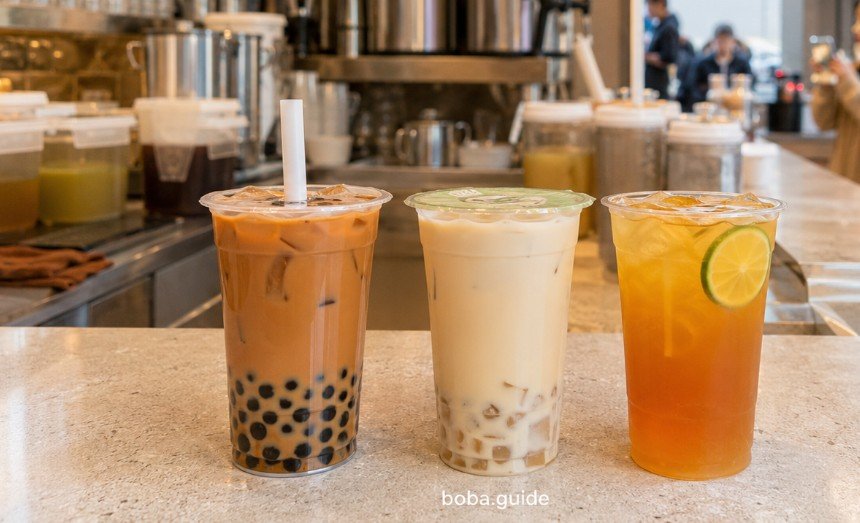
Boba in Taiwan is not a novelty drink category hiding inside a few specialty cafés — it is part of a huge everyday hand-shaken beverage market. The modern Taiwanese customer can move from straight tea to a fresh-milk latte, fruit tea, winter-melon drink, pearl milk tea or a limited seasonal creation without leaving the same beverage-shop ecosystem.
The most useful way to understand Taiwan is therefore not to hunt for one “most authentic boba.” Learn how the local menu is organized, which tea is underneath the flavor, how milk tea differs from fresh-milk tea, what the pearl terminology means, and how sugar, ice and toppings are customized. Once those pieces make sense, the menu stops looking like a wall of unfamiliar Chinese drink names.
Taiwan has more than sixteen thousand hand-shaken drink shops
Official Ministry of Economic Affairs statistics give a much clearer picture than travel clichés about “bubble tea everywhere.”
registered in Taiwan at the end of September 2025.
making up 56% of those beverage-shop businesses.
for the broader beverage-shop category across the five years through 2024.
with January–October 2025 revenue another 7.2% above the same period a year earlier.
That scale explains why Taiwan’s drink market can support more specialization than many U.S. cities. A shop does not have to survive by selling one iconic pearl milk tea to tourists. It can compete through tea sourcing, fresh milk, fruit, unusual textures, seasonal products, app ordering, delivery, collaborations, store design or speed.
The government statistics separate hand-shaken drink shops from the broader beverage-shop category, which also includes other drink businesses. Do not treat every “beverage shop” in the 28,788 total as a boba store.
What people can actually order in a modern Taiwanese tea shop
Current chain menus show that the center of the market is hand-shaken drinks broadly, not one permanent combination of black tea, milk and pearls.
Jasmine green, black tea, Four Seasons, oolong, high-mountain tea, pu-erh and other brewed teas.
Tea combined with creamer or another milk-tea system, with or without pearls.
Tea latte / 鮮奶茶 formats where fresh dairy is an explicit ingredient choice.
Lemon, grapefruit, passion fruit, pineapple, lychee, guava and seasonal fruit builds.
Winter melon, honey, plum and other flavors that connect modern tea shops with older Taiwanese drink traditions.
Pudding, ice cream, milk foam, brown sugar, taro and other richer combinations.
Current 清心福全 alone separates pure tea, milk tea, fresh milk/latte, specialty drinks, seasonal fruit, winter melon, yogurt-style drinks, ice cream and fruit-vinegar categories. That breadth is normal market behavior, not an exception.
For the culture and drink architecture behind these categories, use Taiwanese bubble tea.
Four shop types show how different the Taiwanese market can be
These brands are useful examples because each emphasizes a different part of the market. They are not a ranking of the best boba in Taiwan.
Northern Taiwan’s current menu foregrounds jasmine green, Assam black, Four Seasons and golden oolong, then expands into milk tea, pearls, pudding, coconut jelly, citrus and fresh-milk drinks. The company explicitly notes that its northern website is not one nationwide menu.
Current menu architecture separates pure tea, milk tea, fresh milk/latte, fruit, winter melon and multiple specialty families. The brand explicitly describes its service as customized.
Milksha’s Taiwan headquarters and current drinks reinforce how important fresh milk and tea lattes have become inside the modern market, while regional promotions also show that product availability and pricing can vary by area.
Chun Shui Tang combines hand-shaken tea and pearl milk tea with a sit-down tea-house model and food. Its current official menu system is branch- and region-specific rather than one identical national board.
Independent shops add another layer. Some compete on single-origin tea, seasonal fruit, local dairy, house-made toppings or minimalist menus rather than the enormous flavor range that overseas visitors sometimes expect from “boba.”
What do hand-shaken drinks cost in Taiwan?
Taiwan does not have one national bubble-tea price. Public official price pages are often regional, promotional or product-specific, so the examples below show the breadth of the current hand-shaken beverage market rather than a national average for pearl milk tea.
A 2026 regional promotion lists several pure teas — jasmine green, oolong, Four Seasons and others — at NT$55 in participating southern/eastern and island-region stores.
The same official 2026 regional program lists barley latte at NT$85, several tea lattes at NT$90–95 and buckwheat latte at NT$105.
An August 2026 promotion lists 杏福咖 at NT$75 during the promotion, with an indicated regular price of NT$85.
They prove that contemporary Taiwan spans inexpensive straight tea through higher-priced milk and specialty drinks. They do not prove that “boba costs NT$55–105 everywhere.” Milksha’s cited prices are specifically regional bottled products, while the 清心 example is a promotional specialty drink.
Delivery platforms can also differ from in-store pricing. Milksha posted a July 2026 notice specifically about price adjustments for some drinks on delivery platforms, which is another reason to compare the ordering channel before treating an app price as the shop-counter price.
How to order boba in Taiwan without overcomplicating it
At a busy takeaway counter, the easiest order is built in the same logical order the shop uses.
Start with the tea or drink family before worrying about every modifier.
Do not assume U.S. “medium” and “large” conventions apply. Some Taiwanese menus use one default size for certain drinks.
Ask for regular, less, half, light or no adjustable sugar according to what that shop supports.
Regular ice, less ice, minimal ice, no visible ice or hot availability depends on the recipe.
Some named drinks already contain pearls or jelly, so check before adding another texture.
drink → size → sugar → ice → topping. You can point to the menu and handle only the modifiers verbally if language is difficult.
For the general ordering workflow outside Taiwan too, see how to order boba.
Sweetness and ice settings in Taiwan are relative shop controls
Ordering “half sugar” is useful, but it does not mean every chain will put the same number of grams of total sugar in your cup.
Regular or full adjustable sweetness for that recipe.
Less sugar than the regular shop setting.
A half-sugar setting in the shop’s dispensing logic, not necessarily half of total final-drink sugars.
A light-sugar setting.
No adjustable sugar; sweetened pearls, jam or another premade component may still contribute sugar.
Less ice.
Very light ice.
Usually no visible ice after preparation; this does not guarantee a warm drink or a larger amount of tea.
Current 清心福全 product pages show options such as 無糖, 微糖, 半糖 and 少糖, while the chain describes customization as part of its service. The exact options still depend on the drink.
See boba sweetness levels and boba ice levels for the deeper mechanics.
What toppings are normal in Taiwan?
Tapioca is historically central, but current Taiwanese menus treat texture as a modular choice.
Classic pearls, often the smaller option when a menu distinguishes sizes.
Often associated with a larger pearl format; shop terminology can vary.
Traditional starch-ball terminology that remains alive in modern menus.
Coconut-jelly / nata-de-coco-style chew.
Soft pudding turns tea into a more dessert-like drink.
Grass jelly adds a soft herbal dessert texture.
Tea jelly gives a lighter gel texture and can reinforce the tea flavor.
Aloe is common in fruit and lighter tea combinations.
A current 清心福全 menu includes pearl/large-pearl milk tea, 粉圓 milk tea, pudding, grass jelly, coconut jelly, coffee jelly, tea jelly and aloe-containing drinks. Taiwan’s own market therefore disproves the idea that “real boba” must always mean one layer of black tapioca.
For the complete texture taxonomy, use boba toppings and tapioca pearls.
Taipei, Taichung, Tainan and Kaohsiung all matter — but for different reasons
Official statistics show beverage-shop businesses concentrated strongly in Taiwan’s major cities, while brand histories and regional menus show that the market is not operationally identical from north to south.
Visitors can encounter mass-market takeaway chains, specialty tea bars, department-store branches, fresh-milk concepts and internationalized menus within a relatively small urban radius.
Chun Shui Tang is rooted in Taichung, making the city important to bubble-tea history. That does not mean every Taichung shop is “more authentic” than shops elsewhere.
Hanlin’s origin claim and Milksha’s Tainan roots make the city significant, while current regional promotions also show that southern Taiwan can have different product programs.
Government data place Kaohsiung among the cities with more than a tenth of Taiwan’s broader beverage-shop business count, alongside Tainan, Taichung and Taipei.
There is not enough evidence to say “Taipei likes X, Tainan likes Y, Kaohsiung likes Z” as a universal consumer rule. City differences are better documented through brand origins, store density, regional menus and local product programs than through personality stereotypes.
What should you try in Taiwan if you want to understand the market?
Use contrast. Each drink below teaches a different part of the Taiwanese beverage system.
Start with no milk and no pearls. It tells you whether the shop’s tea program itself is interesting.
Now add the iconic combination and judge whether tea, dairy, sweetness and Q texture stay balanced.
Compare it directly with conventional milk tea so you can taste what the milk system changes.
Lemon, grapefruit or another fruit tea shows how acidity and tea work without the heavy dessert profile.
This is where contemporary Taiwan appears: collaborations, regional fruit, fresh dairy, specialty tea or a new texture rather than a museum reconstruction of 1980s pearl milk tea.
If you only drink brown-sugar fresh milk and taro during an entire Taiwan trip, you may enjoy excellent drinks while still missing much of what makes Taiwan’s beverage culture tea-centered.
What an everyday hand-shaken drink stop in Taiwan can feel like
Visitors sometimes imagine “Taiwan boba” as a pilgrimage to a famous tea house. That exists, but a large share of the market is much more routine: a compact neighborhood counter, a visible preparation line, a menu board, a pickup shelf and people buying drinks between work, school, errands and meals.
The production area can occupy more space than customer seating. Tea, ice, syrup and toppings move through a repeatable sequence so staff can make customized drinks quickly.
The staff may need your sugar and ice choice immediately after the drink name. This is why learning the ordering sequence matters more than memorizing a long Mandarin sentence.
Shakers, tea containers, sealed cups, topping bins and measured ingredients make preparation more visible than in a conventional bottled-beverage purchase.
Current 2026 chain news shows summer fruit launches, character collaborations, regional products and limited promotions. A menu photo from last year may therefore be useful historically but wrong for today’s visit.
Taiwan Panorama has described the industry’s evolution not only through the liquid in the cup but through store materials, visual design and branded cups. Milksha, for example, used natural wood, green and gray store styling to signal a different value proposition, while other brands turned cup design into part of the product identity. This helps explain why “boba culture” in Taiwan is partly retail design and service culture, not just a recipe.
Photograph the current menu before ordering if the line is long. You can identify the drink family, then decide sugar, ice and topping before reaching the register instead of trying to decode everything while staff wait.
Delivery, online ordering and digital payment are changing the Taiwan drink-shop business
Taiwan’s hand-shaken drink culture is still physically visible on the street, but the commercial system behind it has become more digital. This matters for travelers because the price, available products and pickup workflow can differ depending on how the order is placed.
Milksha issued a July 2026 notice specifically about adjusting prices for some drinks on delivery platforms. An app listing should therefore be treated as a channel-specific price, not automatically the same price you will see at the counter.
Major chains increasingly provide their own ordering links or systems alongside phone and walk-in service. This can reduce queue time, but promotional eligibility may differ between walk-in, pickup and delivery.
In the Ministry of Economic Affairs’ beverage-shop statistics, payment and collection methods have shifted materially since 2021: transfer/remittance channels that include delivery platforms and online ordering rose sharply, mobile payment also increased, while the cash share declined.
Current chain campaigns can limit discounts to in-store pickup, a particular payment service, a region, a bottle return, membership status or a specific app. Read the conditions before comparing two screenshots as though they describe the same purchase.
One 2026 Milksha regional bottle campaign illustrates how specific the conditions can become: it applies only in designated southern, eastern and island areas, excludes department-store counters and some special store formats, distinguishes pickup from delivery, and even provides a NT$10 discount for returning the original bottle for another purchase in that series. Those details are not trivia; they show why Taiwan price research has to record where, when and how the drink was bought.
brand + product + region or branch + date + cup/format + ordering channel. Anything less risks turning a temporary or regional price into a fake national fact.
Bring a reusable cup and the current rules can save you NT$5
Taiwan’s modern drink culture is so large that single-use cups became a national waste-policy issue. That has practical consequences for anyone buying hand-shaken drinks today.
Taiwan’s Environmental Ministry says customers who bring their own drink cup receive a NT$5 discount under the single-use beverage-cup rules.
By September 2024, the local implementation schedules had reached the point where beverage shops nationwide were prohibited from using plastic single-use beverage cups under the program.
The Environmental Ministry estimated the policy could reduce roughly 790 million plastic single-use drink cups per year.
This does not mean takeaway drinks disappeared. Shops can use other cup materials, customers can bring reusable cups, and circular-cup systems are another option. The ministry also notes that paper beverage cups commonly contain a waterproof lining and should be sorted into the appropriate recycling system rather than treated casually as ordinary trash.
If you carry a reusable cup, ask whether the shop can use it for the drink you are ordering. The discount is a real current policy feature, but cup compatibility, size and specialty-drink handling can still depend on the store and product.
Six things visitors often misunderstand about boba in Taiwan
The problem is usually not ordering the “wrong” drink; it is assuming the Taiwanese market works exactly like a U.S. boba menu.
Many menus lead with tea and treat pearls as one topping among many.
Look for 鮮奶, 鮮奶茶 or 拿鐵 when fresh dairy specifically matters to you.
Pearls, winter melon, jam and specialty components can remain sweet even when adjustable syrup is removed.
50嵐 explicitly says its northern operation is not a nationwide menu; Chun Shui Tang says menu versions vary by area and branch.
A strong plain tea or one fresh topping can tell you more about shop quality than a cup loaded with five textures.
Taiwan’s market is still innovating. Heritage matters, but so do current tea, milk, fruit and product-development trends.
How to judge a boba shop in Taiwan
A useful quality test works whether the shop is a famous chain or a tiny neighborhood counter.
Can you still identify the tea under milk or fruit? A shop with strong straight tea usually has less need to hide behind sweetness.
Fresh tapioca should have elastic resistance without a hard core or mushy collapsing surface.
Sweetness, dairy and topping should support rather than erase tea when the drink is tea-based.
High turnover can help short-lived toppings such as cooked tapioca move through the service window faster.
A smaller menu with distinct tea and ingredient choices can be more informative than hundreds of near-identical syrup combinations.
Clear category names, ingredient distinctions and food-safety information make it easier to know what you are actually buying.
For a dedicated evaluation framework, see boba quality.
How drinking boba in Taiwan can feel different from ordering in the United States
This is a comparison of common market patterns, not a rule that applies to every shop in either country.
Taiwan: straight-tea categories and named tea bases are highly visible on major-chain menus.
U.S.: excellent tea-focused shops exist, but many menus foreground flavor families or signatures more heavily.
Taiwan: conventional 奶茶 and 鮮奶/拿鐵 can be clearly separated.
U.S.: “milk tea” may be used as a broader English label unless the shop explains dairy/creamer choices.
Taiwan: winter melon, Four Seasons tea, grass jelly and regional tea vocabulary feel ordinary.
U.S.: taro, matcha, brown sugar, fruit, Vietnamese coffee or local mashups can occupy more menu space depending on city and audience.
Taiwan: hand-shaken drinks are a broad everyday beverage category.
U.S.: “boba” itself is often the umbrella category name even for drinks without tapioca.
Neither market is “correct” and the other “inauthentic.” Taiwan is the origin and reference market; overseas boba is a localization story. The useful question is which elements were preserved, adapted or newly added.
For that larger comparison, continue to boba around the world and boba in the United States.
Where to go next
Taiwan’s current market makes more sense when you can separate the origin story, drink culture and preparation details.
Seen a regional Taiwan drink, menu term or price we should document?
Send the shop name, city, date, original Chinese drink name, in-store price and a clear menu photo to info@boba.guide. Regional evidence is especially useful because a chain’s Taipei, central and southern programs are not always identical.
Boba in Taiwan: common questions
Is boba really popular in Taiwan?
Yes. Taiwan’s Ministry of Economic Affairs reported 16,113 hand-shaken drink shops at the end of September 2025, representing 56% of the country’s 28,788 beverage shops. The category is a major everyday beverage market, not only a tourist novelty.
How much does boba cost in Taiwan?
There is no single national price. Official 2026 examples include NT$55 regional Milksha pure teas and NT$85–105 regional tea-latte products, but that program was regional and ran while supplies lasted, so those figures are not a national or guaranteed current price range for pearl milk tea. Chain, size, toppings, store type and ordering channel all affect what you pay.
What is the most authentic boba to order in Taiwan?
Classic pearl milk tea is historically important, but there is no single drink that represents the whole modern market. Try a straight Taiwanese-style tea, a pearl milk tea, a fresh-milk tea and one seasonal or fruit drink to understand more of the hand-shaken beverage culture.
What is the difference between 珍珠 and 波霸 in Taiwan?
Both refer to tapioca-pearl formats. In Taiwanese usage, 珍珠 can refer to smaller pearls while 波霸 is often associated with a larger format, though terminology and exact pearl size can vary by shop.
Does milk tea in Taiwan always use fresh milk?
No. Conventional 奶茶 may use creamer, while 鮮奶茶 or latte-style drinks explicitly use fresh milk. Current Taiwanese chains often separate these categories on the menu.
Can you choose sugar and ice levels in Taiwan?
Yes, customization is common. Options such as less sugar, half sugar, light sugar, no adjustable sugar, less ice and no visible ice appear across Taiwanese hand-shaken drink culture, although exact settings vary by chain and drink.
Is 0% sugar boba in Taiwan actually sugar-free?
Not necessarily. A no-sugar setting usually removes adjustable sweetener, but pearls, fruit jam, winter-melon base, pudding or another prepared component can still contain sugar.
Which Taiwan cities are best known for bubble tea?
Taipei has extremely dense drink-shop competition, while Taichung and Tainan are especially important to bubble-tea history and brand development. Kaohsiung is also one of Taiwan’s largest beverage-shop markets. There is no reliable basis for assigning one universal boba flavor preference to each city.
What boba toppings are common in Taiwan besides tapioca?
Current Taiwanese menus include coconut jelly, pudding, grass jelly, tea jelly, coffee jelly and aloe as well as different tapioca formats. Topping availability varies by chain and shop.
Is bubble tea in Taiwan different from boba in the U.S.?
The categories overlap, but Taiwan’s major-chain menus often make tea bases, conventional milk tea, fresh-milk tea and local texture vocabulary especially visible. U.S. boba has developed its own localized flavor mixes, dairy options and menu conventions.