
Taiwanese Bubble Tea: Tea, Pearls, Milk, Toppings & How Taiwan Orders Boba
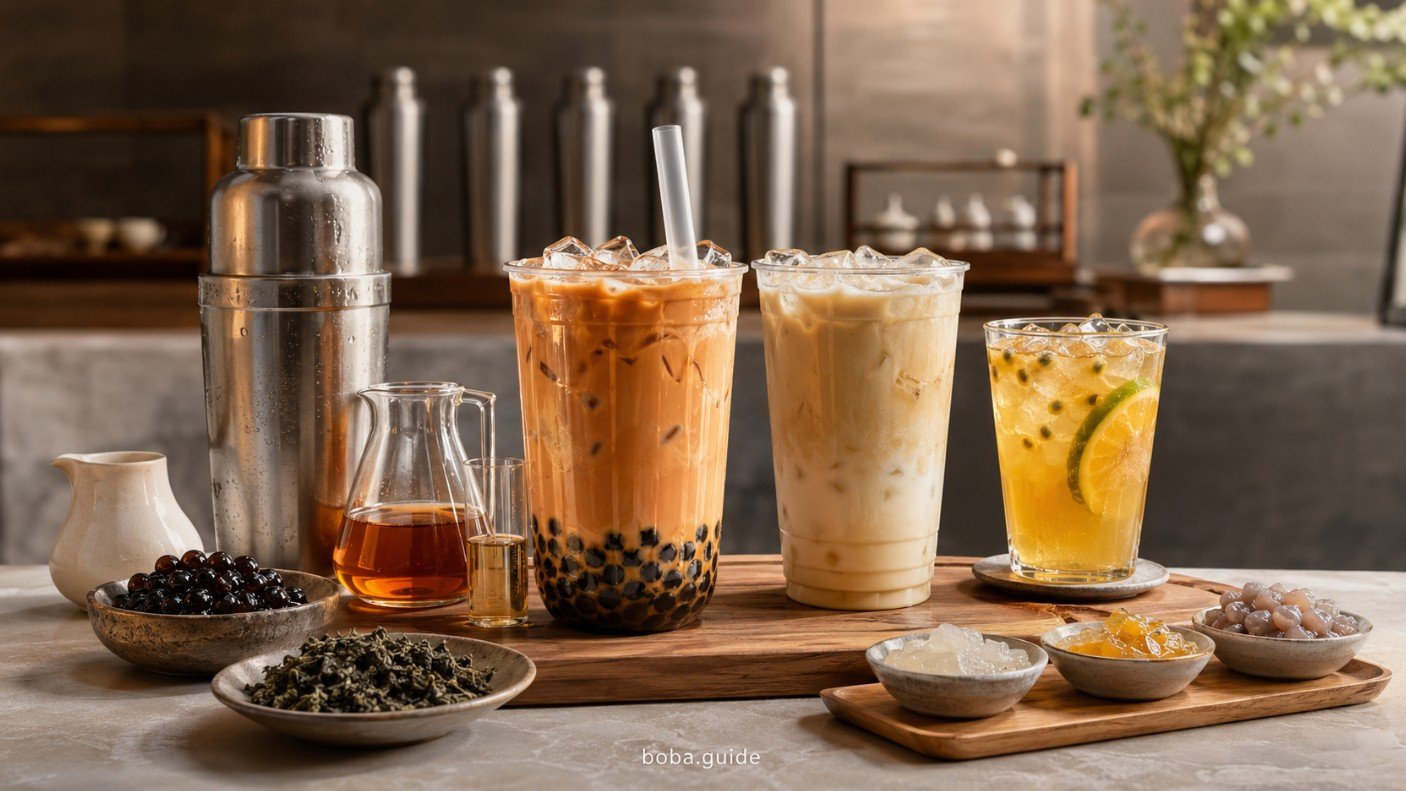
Taiwanese bubble tea is better understood as a hand-shaken tea culture than as one fixed milk-tea recipe. Pearl milk tea is the icon, but modern Taiwan drinks far beyond that cup: straight tea, jasmine and oolong, fresh-milk tea, fruit tea, milk foam, winter melon, pudding, grass jelly, aloe, small pearls, large pearls and highly customized ice and sweetness.
That broader view changes how you order. In Taiwan, the most important question is often not “Which boba flavor?” but “Which tea base, milk system, texture and sweetness level do I want?” The drink starts with a structure, then the customer modifies it.
Taiwanese bubble tea is a customizable tea-shop system
Pearl milk tea remains the most recognizable Taiwanese export, but current Taiwanese menus make clear that the category is much wider.
Current Taiwan menus prove the point. Northern Taiwan 50嵐 lists jasmine green tea, Assam black tea, Four Seasons tea and golden oolong before you even reach milk tea. It then separates 奶茶-style drinks, tapioca drinks, pudding, coconut jelly and latte/fresh-milk-style drinks. 清心福全 does something similar, separating straight teas, milk teas, fresh-milk/latte drinks, specialty beverages, fresh fruit, winter melon and other categories.
If you need the broad definition first, see what bubble tea is. This page focuses on the Taiwanese structure behind the category.
Taiwanese boba culture starts with tea families, not syrup flavors
One of the clearest differences between tea-literate Taiwanese menus and generic “bubble tea” stereotypes is that the tea base is visible as a real choice.
Floral and lighter, useful for fruit tea and lighter milk-tea builds.
Stronger body and tannin make it a classic milk-tea foundation.
A familiar Taiwanese tea-shop category with a fragrant, refreshing profile.
Can be lighter, roasted, floral or fuller depending on the style and shop.
50嵐’s current Taiwan menu makes this hierarchy visible: 茉莉綠茶, 阿薩姆紅茶, 四季春青茶 and 黃金烏龍 are menu items in their own right. The tea is not hidden behind “flavor”; it is the flavor architecture.
For ingredient-level comparison, continue to tea for boba.
珍珠, 波霸 and 粉圓 do not always mean exactly the same thing
Taiwanese menus preserve distinctions that English-language menus often collapse into “boba” or “tapioca pearls.”
Pearls
A common term for tapioca pearls, often associated with a smaller pearl size on menus that distinguish sizes.
Larger pearls
In Taiwanese usage, 波霸 is often associated with a larger tapioca format, while 珍珠 can refer to smaller pearls. Current 50嵐 menus list 波霸 and 珍珠 as separate choices, although that menu page itself does not publish pearl diameters.
Starch-ball term
A broader traditional term for round starch-based pieces. Some menus still use 粉圓 directly in drink names.
For sizes, ingredients, pricing and cooking behavior rather than language, use the dedicated tapioca pearls guide.
奶茶 and 鮮奶茶 are not automatically the same drink
English menus often translate several creamy tea styles simply as “milk tea,” but Taiwan menus may distinguish conventional milk tea from tea prepared with fresh milk.
Milk tea
Can use a creamer-style milk component rather than fresh dairy. 清心福全 explicitly describes its milk-tea line as tea combined with selected 奶精, while offering a separate fresh-milk/latte category.
Fresh-milk tea / tea latte
Tea combined with fresh milk. Current 清心福全 products include 紅茶拿鐵 / 鮮奶茶 and 珍珠紅茶拿鐵 / 珍珠鮮奶茶, clearly separating fresh milk from conventional milk tea.
Taiwan’s own market includes both creamer-based milk tea and fresh-milk tea. Authenticity is not a contest where one must erase the other.
How Taiwanese bubble tea ordering actually works
Customization is one of the most durable features of Taiwan’s hand-shaken drink culture. The exact options vary by chain and drink, but the ordering logic is remarkably reusable.
Choose the drink family
Straight tea, milk tea, fresh-milk tea, fruit tea, winter melon, specialty drink or another category.
Choose the tea base if the menu allows it
Black, green, Four Seasons, oolong and other teas create different aroma, bitterness, color and caffeine profiles.
Choose sweetness
Many made-to-order drinks allow less sugar, but some specialty components already contain sweetness that cannot be completely removed.
Choose ice or temperature
Regular ice, less ice, minimal ice, no visible ice or hot options depend on the product.
Add texture
Pearls are only one option. Pudding, coconut jelly, tea jelly, grass jelly, aloe and combinations can change the drink more than another syrup flavor would.
清心福全 explicitly describes its service as 客製化 — customized — and says customers can choose sugar level, ice level and toppings. That makes customization a current operational reality, not just a tourist explanation of Taiwanese boba.
Taiwanese sweetness and ice levels are shop settings, not standardized measurements
The vocabulary is widely understood, but the recipe behind each option belongs to the shop.
少糖 or 微糖 does not equal one universal gram amount
A percentage or named level usually changes the adjustable sweetener portion. Sugar already contained in pearls, fruit puree, winter-melon syrup, condensed ingredients or premixed components may remain.
少冰 and 去冰 change temperature and dilution, not just cup appearance
Less ice can change how quickly tea warms and how much water melts into the drink. Whether a shop replaces missing ice with extra liquid is a shop-specific operational choice.
For the two controls in depth, see boba sweetness levels and boba ice levels.
Taiwanese hand-shaken drinks use far more than tapioca pearls
One reason the Taiwanese menu feels different from a simple flavored-tea shop is that texture is treated as a major design element.
Chewy tapioca in different sizes and naming traditions.
Coconut jelly / nata-de-coco-style chew, often crisper than tapioca.
Soft custard-like pudding that makes the drink feel more dessert-like.
Grass jelly with a softer, herbal dessert texture.
Aloe pieces add a lighter, fresher bite to fruit and tea drinks.
Tea jelly lets the tea flavor appear in both liquid and solid form.
Current 清心福全 products alone include pearl milk tea, pudding milk tea, coconut-jelly milk tea, coffee jelly, grass jelly, tea jelly and aloe-containing fruit drinks. A Taiwanese menu is therefore easier to understand if you ask “What texture do I want?” rather than “Do I want boba or no boba?”
For the wider texture taxonomy, use boba toppings.
Q texture helps explain why Taiwanese drink toppings are judged by chew, not just flavor
In Taiwan, Q is commonly used to describe an elastic, springy, pleasantly resistant texture. It is especially useful for understanding why a pearl can taste sweet enough yet still be considered poor if its chew is wrong.
Dense or chalky center; resistance without elasticity.
Springy resistance, cooked center and a surface that stays intact while chewing.
Mushy surface, collapsing shape or little rebound.
Q is not a laboratory unit and different foods express it differently. The value of the term is sensory: it reminds you that Taiwanese texture culture cares about bounce, elasticity and resistance, not merely softness.
Fresh milk became a distinct Taiwanese bubble-tea category, not just a premium substitute
A 2023 Taiwan Panorama report described fresh-milk choices as common across Taiwanese drink shops while noting that milk-forward recipes had been much less common earlier. That evolution matters because it changed menu architecture.
Milksha helped build a fresh-milk identity
Taiwan Panorama describes Milksha, founded in Tainan, as a brand that had focused on the fresh-milk segment since 2004. Instead of treating dairy as a hidden modifier, the brand made milk quality visible as part of what the customer was buying.
Fresh milk created new product names
Modern Taiwan menus distinguish 鮮奶, 鮮奶茶 and 拿鐵 from conventional 奶茶. 50嵐 currently lists black tea latte, green tea latte, golden oolong latte, 波霸鮮奶 and 珍珠鮮奶 separately from its classic milk-tea line.
The distinction also helps explain brown-sugar fresh-milk drinks. A cup can contain milk, brown sugar and pearls with little or no tea and still belong naturally inside the same hand-shaken beverage ecosystem.
Fruit tea, straight tea and specialty drinks are central to Taiwan’s modern beverage culture
If someone thinks authentic bubble tea must be creamy, Taiwan’s current menus are the fastest correction.
Jasmine green, Assam black, Four Seasons, oolong and other teas can be ordered without milk or pearls.
Lemon green, grapefruit green, pineapple black tea, lychee black tea and other combinations keep tea recognizable while adding acidity and fruit aroma.
Winter melon and honey-style drinks show that Taiwan’s beverage culture also draws from flavors older than modern pearl milk tea.
Tea can be combined with yogurt-style drinks, ice cream, vinegar drinks, foam or other textures depending on the chain.
清心福全’s current menu is especially illustrative: straight tea, fresh fruit, winter melon, yogurt-style drinks, vinegar drinks, milk tea, fresh milk and specialty combinations all live under the same hand-shaken drink brand.
Three Taiwan-style orders, translated by structure rather than by flavor name
These examples show why literal translation is not enough. Two drinks can both contain black tea and pearls yet feel completely different because the milk system, pearl size or sweetness logic changes.
The classic structure: brewed tea + conventional milk-tea component + tapioca pearls + sweetness + ice. Depending on the chain, the milk component may be creamer rather than fresh dairy.
What to notice: tea strength, pearl chew and whether the sweetness lets the tea remain identifiable.
Black tea + fresh milk + tapioca pearls. Current 清心福全 uses both 珍珠紅茶拿鐵 and 珍珠鮮奶茶 language for this fresh-milk family.
What to notice: cleaner dairy flavor, different body and a more obvious distinction between tea and milk than in some creamer-based milk teas.
50嵐 currently lists 四季春+珍波椰, a drink that makes the modular logic very visible: Four Seasons tea plus small pearls, larger boba and coconut jelly.
What to notice: the base is still straight tea. Texture can be complex without turning the drink into milk tea.
Translate the architecture first — tea base, dairy system and topping — then translate the flavor. That preserves more useful information than turning every drink into “___ boba.”
The modern market moved from novelty pearls toward tea quality, fresh ingredients and product identity
Calling something “traditional Taiwanese boba” can accidentally freeze Taiwan in the 1980s. The actual market kept evolving. Taiwan’s Tea and Beverage Research Station has described the tea-beverage market as becoming more international, younger and more demand-driven for novelty, while its product-development work increasingly emphasizes health, flavor and locally distinctive ingredients.
The combination of cold tea, milk and chewy tapioca was itself enough to distinguish the drink.
Black, green, oolong, Four Seasons and named specialty teas create a menu in which the tea base itself can carry brand identity.
Fresh milk, latte-style drinks and brown-sugar fresh milk become distinct products rather than merely substitutions inside old milk-tea recipes.
Taiwan Panorama’s reporting on Taiwanese hand-shaken brands shows quality, natural ingredients, cup design and store design being used as points of differentiation.
Taiwan’s Tea and Beverage Research Station also notes that commercial hand-shaken drinks have become a major part of contemporary tea consumption, contrasting them with older hot-brew tea habits. The important point for a U.S. reader is that Taiwanese authenticity is not limited to copying an old pearl-milk-tea formula; innovation inside Taiwan is part of the tradition too.
Good Taiwanese bubble tea is a balance problem, not a toppings contest
Adding more pearls, more syrup and a stronger flavor powder does not automatically make the drink more Taiwanese or more premium.
You should still be able to identify tea aroma and some tea structure when the drink is supposed to be tea-based.
Tapioca should feel freshly cooked, elastic and integrated with its syrup rather than hard from holding or collapsing into mush.
Sweetener should connect tea, dairy and topping rather than covering weak tea or stale pearls.
Ice should chill the drink without turning a carefully brewed tea into flavored water before the cup is half finished.
Each topping should contribute a texture or flavor role. A drink with one deliberate topping can be more coherent than a cup overloaded with three unrelated add-ons.
A sweet milk tea can still show tea character. The more useful distinction is whether sweetness supports the brewed base or replaces it.
For the dedicated quality test, use how to judge boba quality.
What actually makes a bubble tea feel Taiwanese?
There is no single legally protected recipe for “authentic Taiwanese bubble tea.” A better test is whether the drink reflects the habits that grew inside Taiwan’s tea-shop culture.
You can tell whether the drink is built on black, jasmine, oolong or another real tea rather than generic sweetness alone.
Pearls or jelly are chosen for a specific chew and serving quality, not added merely because a photo needs black dots.
The menu distinguishes milk tea, fresh milk, latte-style builds or foam instead of pretending they are interchangeable.
Sugar and ice can be adjusted where the recipe allows it, while fixed specialty ingredients are treated honestly.
Tea, sweetness, dairy, fruit and topping should still taste like parts of one beverage rather than five independent add-ons.
Straight tea, fruit tea and fresh-milk drinks can be completely normal Taiwanese hand-shaken drinks without tapioca.
Taiwan has established conventional milk-tea lines using creamer as well as separate fresh-milk categories.
Customization itself is Taiwanese; choosing less sugar does not make the drink less authentic.
Black tea is historically central, but jasmine, oolong and other tea families are deeply normal on current Taiwan menus.
For how this culture developed historically, see the history of bubble tea. For how Taiwan’s format changes abroad, see boba around the world.
What American boba drinkers can borrow from Taiwan’s ordering habits
You do not need to recreate a Taiwanese shop to use the same decision logic.
If a menu says only “milk tea,” ask whether it uses black, jasmine, oolong or another base. That tells you more about the finished cup than a generic flavor adjective.
Fresh milk, creamer and plant milk do not behave the same. A tea latte and conventional milk tea can taste radically different at the same sweetness setting.
One well-matched topping often gives a cleaner cup than stacking pearls, pudding and jelly simply because all three are available.
Lower sugar can make tea more visible, but “0%” is not automatically superior if the drink was designed around a sweet component.
A shop’s plain jasmine, oolong or black tea is one of the fastest ways to judge whether the tea program itself is strong.
Do not order only by asking “What is your best boba?” In a Taiwanese-style shop, that can hide the most important choice. Ask what tea they brew best, whether a drink uses fresh milk or creamer, and which topping is freshest at that moment. You will usually learn more about the shop than by choosing the most elaborate signature cup.
If you are still learning the menu mechanics, use how to order boba.
Where to go next
This page explains the drink culture. The next pages can isolate geography, history or ingredients without repeating the same material.
Seen a Taiwanese drink term that English menus translate badly?
Send the original Chinese name, shop, city, drink description and a menu photo if you have one to info@boba.guide. We are especially interested in pearl-size terms, local tea names, ice/sugar vocabulary and drinks whose English translation hides how they are actually built.
Taiwanese bubble tea: common questions
What is Taiwanese bubble tea?
Taiwanese bubble tea is part of Taiwan’s broader hand-shaken drink culture. It can include pearl milk tea, straight tea, fresh-milk tea, fruit tea, milk foam, jellies, pudding and other toppings, usually with some level of made-to-order customization.
Is Taiwanese bubble tea always milk tea?
No. Taiwanese drink shops sell many non-milk options, including straight black, green and oolong teas, fruit teas, winter-melon drinks and other specialty beverages. Pearl milk tea is historically important but not the entire category.
What is the difference between 珍珠 and 波霸?
Both can refer to tapioca pearls. In Taiwanese usage, 珍珠 can describe smaller pearls while 波霸 is often associated with a larger format. Current 50嵐 menus list the two separately, but the menu page itself does not publish pearl diameters.
What does 粉圓 mean?
粉圓 is a traditional term for round starch-based pieces or tapioca-style balls. Some Taiwanese drink menus still use 粉圓 directly in names such as 粉圓奶茶 or 粉圓鮮奶茶.
What is the difference between 奶茶 and 鮮奶茶?
奶茶 means milk tea and may use a creamer-style milk component. 鮮奶茶 specifically means fresh-milk tea. Taiwanese chains often separate conventional milk tea from fresh-milk or latte-style categories.
What does Q mean in Taiwanese boba?
Q describes a pleasantly elastic, springy and chewy texture. For tapioca pearls, good Q means the pearl offers resistance and bounce without a hard uncooked center or a mushy surface.
Can you customize sugar and ice in Taiwan?
Yes, customization is common in Taiwanese hand-shaken drink shops, although exact levels and which products can be adjusted vary by chain and recipe. Some sweetness may already be built into pearls, fruit bases or specialty ingredients.
Does authentic Taiwanese milk tea use fresh milk?
Not necessarily. Taiwan has both conventional milk tea, which may use creamer, and fresh-milk tea or tea lattes. Both are established parts of the current Taiwanese drink market.
What toppings are common in Taiwanese bubble tea besides tapioca?
Common examples include coconut jelly, pudding, grass jelly, tea jelly and aloe, along with different sizes and styles of tapioca pearls. Availability varies by shop.
What should I order to understand Taiwanese bubble tea better?
Try one strong tea-based milk tea or fresh-milk tea with a single pearl topping, then try a straight oolong, jasmine or Four Seasons tea. Comparing the tea by itself with the textured milk drink makes the tea-first logic much easier to understand.