
History of Bubble Tea: From Taiwanese Shaken Tea to Global Boba
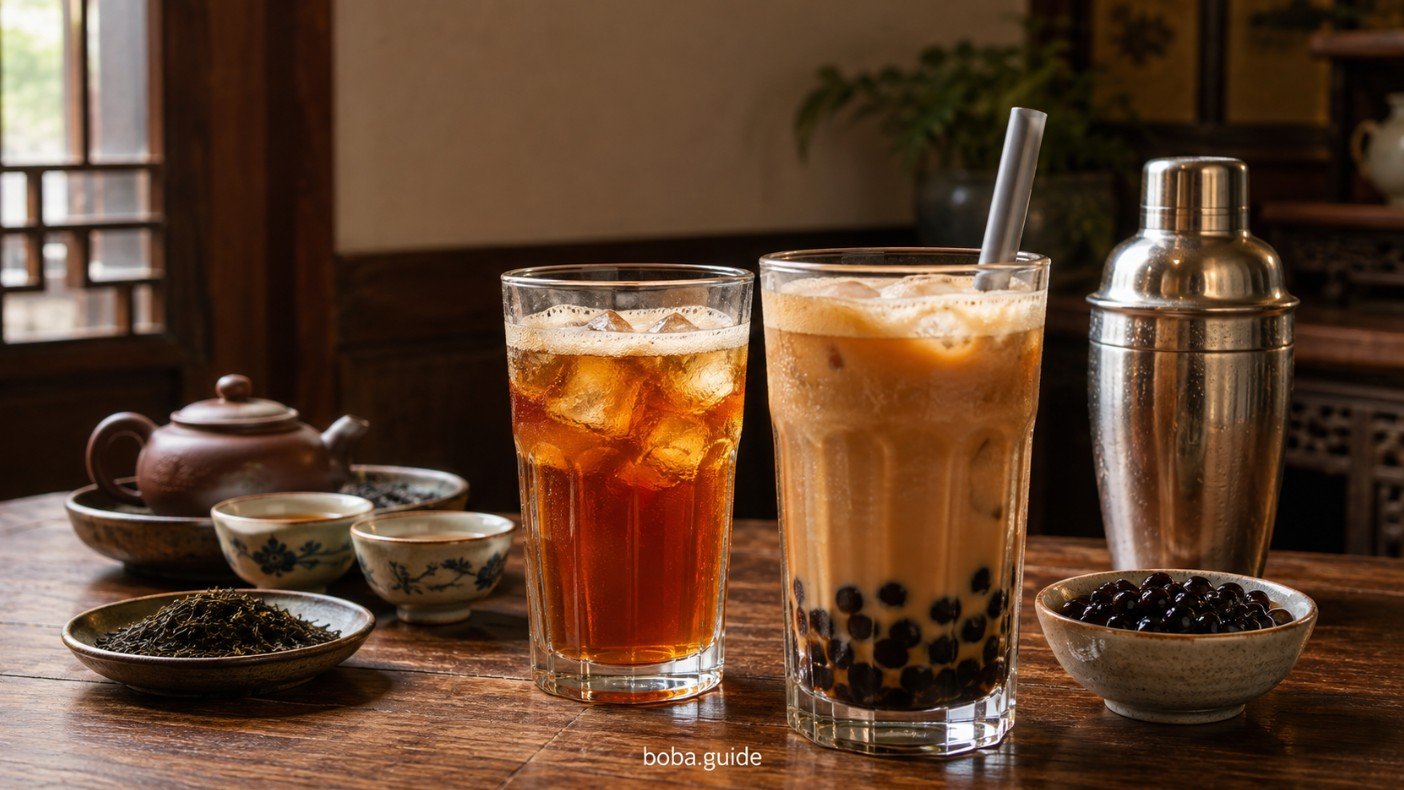
Bubble tea did not appear in one magical moment when someone dropped tapioca into milk tea. The drink became possible because several Taiwanese food traditions were already moving toward one another: established tea culture, cold and hand-shaken tea, milk tea, tapioca-based desserts, shaved-ice toppings and a rapidly modernizing beverage-shop scene.
By the 1980s, those pieces came together in Taiwan as pearl milk tea. More than one tea business later claimed a role in the invention, and the historical record does not support reducing the story to one uncontested person, shop and date. What is clear is that the drink emerged in Taiwan, became a national icon, and then evolved into the global boba category we recognize today.
Before bubble tea, Taiwan already had the ingredients for a new kind of tea culture
Modern bubble tea makes more sense when you stop treating tapioca pearls as the starting point. Taiwan already had deep tea traditions, a taste for sweet cold foods, and tapioca-based textures long before pearl milk tea became a named drink.
Tea cultivation and tea drinking were already embedded in Taiwanese life. Oolong, black tea and other tea styles created a flavor vocabulary that later beverage shops could modernize rather than invent from nothing.
Sweet beans, starch balls, jellies and other chewy or soft toppings belonged comfortably in Taiwanese dessert culture. Putting texture into a drink was innovative, but the textures themselves were familiar.
Round starch pieces known as 粉圓 were eaten in sweet preparations before pearl milk tea. Bubble tea’s breakthrough was not inventing tapioca starch; it was moving a familiar chewy element into a portable tea drink.
If you want the ingredient story separately from the historical timeline, see tapioca pearls. For Taiwan as a living boba market rather than an origin story, use boba in Taiwan.
The first major innovation was cold hand-shaken tea, not tapioca
A useful way to read the history is to separate bubble tea in the older Taiwanese sense of foamy shaken tea from pearl milk tea, the drink containing tapioca pearls.
From tea ritual to a faster cold drink
Taiwan Panorama’s account of Chun Shui Tang founder Liu Han-chieh describes an important transition. During a trip to Japan, Liu saw iced coffee prepared by brewing coffee, adding ice and vigorously shaking it in a cocktail shaker. According to the account, he later experimented with the same technique for tea after returning to Taiwan.
That mattered for more than temperature. Shaking tea with ice creates aeration and a fine layer of foam. In Taiwanese usage, this foamy quality helped give rise to the idea of 泡沫紅茶 — literally a foamy or frothy black tea style.
It cooled the drink rapidly, mixed sweetener efficiently, aerated the tea and created a visual foam layer. The modern sealing machine changed the cup; the shaker had already changed the beverage.
Why Taiwan in the 1980s was ready for pearl milk tea
Taiwan’s National Archives describes pearl milk tea as a drink that rose in the Taiwanese tea market during the 1980s. That framing is useful because it avoids pretending that one disputed invention claim is the whole story.
Cold tea and tea-house experimentation made tea easier to sell to younger customers who did not necessarily want a traditional hot-tea ritual.
A metal shaker created speed, foam and a recognizable counter-side action. Tea became something visibly made to order.
Sweet creamy tea could carry a chewy topping without tasting as austere as plain unsweetened tea.
Tapioca balls did not have to teach consumers how to enjoy chewy starch. The novelty was drinking them through tea.
The combination fit a growing market for customized cold drinks that could be prepared quickly and carried away.
Taiwan’s National Archives places the rise of pearl milk tea in the Taiwanese tea market in the 1980s. A separate Taiwan National Immigration Agency account identifies Chun Shui Tang in Taichung and Hanlin Tea Room in Tainan with competing invention claims. Taken together, those sources support Taiwan and the 1980s while leaving the single-inventor question unsettled.
Chun Shui Tang’s story: shaken tea first, pearls added later
The Chun Shui Tang version of the story begins with founder Liu Han-chieh’s experiments with cold shaken tea. Taiwan’s Tea Research and Extension Station says the business introduced pearl milk tea in 1988, while other Chun Shui Tang-linked accounts date the development slightly earlier. The safest conclusion is that the late 1980s were the key period, not that every source agrees on one precise day.
In the best-known version of the pearl story, employee Lin Hsiu-hui added tapioca balls to milk tea during a staff meeting. Taiwan’s National Immigration Agency repeats the 1988 version of this account. The drink worked, the company developed it, and pearl milk tea became one of Chun Shui Tang’s signature products.
Hanlin Tea Room’s story: tapioca pearls enter cold tea in Tainan
Hanlin Tea Room was founded in Tainan in 1986. Its founder, Tu Tsong-he, has long been associated with a competing claim to pearl milk tea, describing inspiration from white tapioca balls seen in a market and the later development of darker pearls.
Taiwan government sources continue to present Hanlin alongside Chun Shui Tang when discussing the drink’s origins. The National Immigration Agency, for example, identifies both Tu Tsong-he and Chun Shui Tang’s Lin Hsiu-hui as people associated with competing invention claims rather than naming one uncontested inventor.
Why “Who invented bubble tea?” does not have one clean answer
Many food histories become less accurate when a complicated development is compressed into a single inventor story. Bubble tea is a good example.
Two major claims developed independently
Chun Shui Tang in Taichung and Hanlin in Tainan both became associated with the origin story. Taiwan’s own archival and government materials acknowledge both places rather than erasing one.
The ingredients predate the claimed invention
Tea, milk tea, tapioca starch balls, sweet desserts and cold drinks all existed separately. The innovation was a combination and service format, which makes simultaneous or near-simultaneous experimentation plausible.
Dates vary by source and by what is being dated
Some dates refer to a tea shop opening, some to shaken iced tea, some to the first pearl milk tea experiment, and some to when a product became commercially established. Those are not the same historical event.
Legal conflict did not produce a simple monopoly on the idea
Taiwan’s National Immigration Agency summarizes the later dispute by noting that the drink remained available for tea shops to serve generally. Whatever the competing stories, pearl milk tea became part of a shared Taiwanese beverage culture rather than a permanently exclusive recipe.
Bubble tea emerged in Taiwan in the 1980s. Chun Shui Tang in Taichung and Hanlin Tea Room in Tainan are both strongly associated with competing origin claims for pearl milk tea.
The narrower question of which place and claimant came first deserves its own treatment. This page stays focused on the larger historical development.
The history of bubble tea in seven stages
The most useful timeline separates long cultural foundations from the much shorter period in which pearl milk tea itself appeared.
Taiwan has established tea culture and familiar starch-based dessert textures. These become the raw materials for later beverage experimentation.
Tea-house operators experiment with ice and cocktail shakers, turning tea into a colder, faster, foamier made-to-order drink.
Taiwan Panorama describes an early bar area serving hand-shaken tea and an expanding customer response to iced tea.
Hanlin becomes one of the two businesses most frequently associated with the origin of pearl milk tea.
Government and archival sources place the emergence and growing popularity of pearl milk tea in Taiwan in this period. Chun Shui Tang’s frequently cited staff-meeting story is commonly dated to 1988.
Tea shops expand beyond one pearl drink into fruit tea, fresh milk, foams, flavored teas and increasingly complex customization.
Taiwanese chains, Asian diaspora businesses and local entrepreneurs adapt the format abroad. “Boba” increasingly becomes an English-language name for both the pearls and the broader drink category.
The timeline intentionally uses “late 1980s” for the emergence of pearl milk tea because official and company-linked sources do not all assign the same exact year to every stage of development.
Why tapioca pearls were such a powerful addition to tea
Tapioca did something unusual: it changed a beverage into an activity. Drinking now included chewing, and the cup had a second sensory rhythm.
The pearl’s elastic chew — often described in Taiwan through the idea of Q texture — gave tea a food-like dimension without turning it into a plated dessert.
Cooked pearls can be held in sugar or syrup, so the topping adds flavor as well as texture. This created a second sweetness layer beneath the tea.
Dark pearls at the bottom of a clear cup made pearl milk tea recognizable from across a room, long before social media intensified that effect.
Once the straw had to carry both liquid and pearls, the physical interface of the drink changed too. Cup, seal and straw design became part of boba culture.
The original historical importance of tapioca also explains why “boba” can still mean two things in English: the pearls themselves and the drink category built around them.
The real Taiwanese export was a whole hand-shaken beverage culture
If the 1980s story ended with one successful pearl milk tea, modern boba shops would all look roughly the same. Instead, Taiwan’s beverage industry kept adding new bases, toppings, milk systems, fruits and ordering choices.
Taiwan Panorama reported more than 28,000 drinks shops in Taiwan in November 2022, citing Ministry of Finance data. That figure covers the wider drinks-shop category rather than proving that every one was a hand-shaken tea shop. The scale still matters: bubble tea grew inside a much larger everyday beverage economy, not as a novelty frozen in its 1980s form.
Bubble tea, pearl milk tea, boba: the names do not preserve the same meaning
Part of the historical confusion comes from translation. A word that referred to foam, pearls or a particular pearl size in Taiwan can become a broad category term abroad.
Foamy or frothy black tea
The “bubble” can refer to the foam produced by shaking, not necessarily tapioca pearls.
Pearl milk tea
Literally centers the pearls as the defining addition to milk tea.
A Taiwanese term associated with larger pearls
In Taiwanese menu usage, 波霸 can distinguish a larger pearl from smaller 珍珠.
A much broader English-language category word
In the United States, “boba” can mean the tapioca pearls, a drink containing them, or the entire bubble-tea shop category — including drinks with no tapioca at all.
For the modern category rather than the historical vocabulary, see what bubble tea is and boba culture.
Bubble tea spread because the format could localize without losing its identity
The drink carried several recognizable signals abroad — tea, a clear cup, wide straw, chewy topping, visible customization — but none of those required every market to copy the same recipe.
Pearl milk tea becomes one successful product inside a broader hand-shaken drink industry.
Boba becomes familiar in communities with cultural and commercial links to Taiwan and East Asia.
Tea brewing, topping prep, sealing, sweetness settings and franchise systems make the format easier to reproduce across cities and countries.
Matcha, regional fruits, palm sugar, condensed milk, coffee and local dessert textures give different markets their own versions.
Consumers begin using the word for a whole social and retail experience rather than only a specific Taiwanese pearl milk tea.
The next stage of the story is not one universal recipe spreading unchanged, but a Taiwanese drink format being adapted market by market.
Bubble tea became scalable because the cup, straw, shaker and ordering ritual all worked together
A recipe can become famous without creating a new retail category. Bubble tea did something more: it developed a recognizable service format that customers could understand, shops could repeat, and chains could adapt.
Hand shaking gave cold tea a specific preparation ritual. The action cooled and aerated the tea, but it also made the counter part of the experience. Customers could watch the drink being finished rather than receiving an anonymous pre-bottled product.
Pearls sitting at the bottom of a transparent cup created a strong visual identity. The drink advertised its own texture: even someone who had never tasted pearl milk tea could see that it was not ordinary iced tea.
A conventional narrow straw could not reliably carry tapioca pearls. The wider straw turned sipping and chewing into one continuous action, helping make the topping part of the drink rather than something eaten afterward with a spoon.
As sealed cups became common in hand-shaken drink shops, customers could carry a filled cup without relying on a loose lid alone. The format suited commuting, shopping, school and casual social drinking, which mattered as the category moved beyond sit-down tea houses.
Sweetness, ice, tea, milk, toppings and size could increasingly be treated as choices instead of fixed properties. That made the category unusually adaptable: one shop could serve someone who wanted strong unsweetened oolong and another customer who wanted a sweet milk tea with two toppings from the same operating system.
Pearl milk tea started as a recognizable drink, but hand-shaken beverage culture turned it into a repeatable way of designing drinks. That distinction explains why today’s boba shop can sell dozens of beverages that would look unfamiliar beside an early 1980s tea-house menu and still feel like part of the same family.
In the United States, “boba” became broader than pearl milk tea
The U.S. helped popularize “boba” as a category label. Shops could be Taiwanese, Chinese, Vietnamese, Korean, pan-Asian or locally founded, and menus increasingly mixed several beverage traditions in one place.
A boba shop may sell milk tea, fruit tea, matcha, slushes, coffee, fresh milk, brown-sugar drinks and cheese foam alongside tapioca.
Customers can choose jelly, pudding, aloe, crystal-style toppings, popping boba and other textures, making “boba” less literal as a description.
Boba shops increasingly function as social spaces near schools, universities, shopping districts and nightlife — part café, part dessert stop, part cultural meeting place.
American menus often emphasize non-dairy milk, larger flavor ranges and mashups that would not make sense as a strict reconstruction of a 1980s Taiwanese tea-house drink.
For the country-level development, use boba in the United States. For finding a shop today, use Boba Near Me.
An early pearl milk tea and a modern boba-shop order are related — but no longer the same kind of product
The easiest way to see bubble tea’s historical development is to compare what made an early pearl milk tea distinctive with what a customer can now encounter in a contemporary shop.
Tea was the obvious center of the drink: black tea and other familiar tea-house bases shaped the flavor.
Tea remains important, but shops may offer many named black, green, jasmine and oolong bases alongside matcha, coffee, fruit and non-tea drinks.
Tapioca pearls were the disruptive idea — one chewy topping inside a cold tea drink.
Tapioca now competes with crystal-style pearls, nata de coco, pudding, grass jelly, aloe, popping boba, mini pearls and other textures.
Milk tea created the classic creamy base associated with pearl milk tea.
Fresh milk, creamers, plant milks, condensed milk, milk foam and dairy-free builds can all create different drink architectures.
The drink was sweetened as a recipe.
Many shops now expose sweetness as a customer-facing control, while some specialty recipes keep it fixed because sugar is built into other ingredients.
Ice was central to the shaken cold-tea innovation.
Customers may now choose regular, less or no ice, although the exact effect on liquid volume varies by shop.
“Pearl milk tea” described a fairly recognizable drink.
“Boba” can now describe an entire storefront category even when a specific order has no milk, no tea or no tapioca.
The important historical change is structural. Once tea base, milk system, sweetness, ice and topping became modular, shops could create new drinks without abandoning the recognizable boba ordering experience.
Modern Taiwanese and international menus often distinguish conventional milk tea from fresh-milk tea. That distinction matters because the creamy component can now be part of the drink’s identity rather than just an invisible ingredient.
Fruit allowed shops to sell bright, acidic, refreshing drinks to customers who did not want creamy milk tea. The same toppings and customization habits could remain, which helped the category grow without depending on one flavor profile.
That is why reconstructing “the original bubble tea” is interesting historically but not enough to explain the modern category. The enduring invention was not only a recipe. It was the idea that tea could be cold, shaken, textured, customized and continuously redesigned.
What stayed Taiwanese even after boba became global
Modern boba may contain ingredients that were never part of the first pearl milk teas, but several ideas from Taiwan’s hand-shaken drink culture remain unusually durable.
The customer often chooses sweetness, ice, toppings or size rather than receiving one fixed bottled beverage.
Even highly flavored menus retain black, green, jasmine and oolong families because the category grew from tea shops, not from soda fountains.
The idea that chewing can be part of drinking remains one of bubble tea’s most distinctive cultural exports.
Automated equipment may handle some modern preparation, but hand-shaken tea is still part of the category’s identity and performance.
Sweetness and ice controls are now so familiar that many customers interpret them as a defining feature of boba-shop ordering.
Those traits help explain why bubble tea can keep changing ingredients without becoming unrecognizable. Its identity is partly a recipe, but also a method of building and serving a drink.
Five bubble tea history myths worth dropping
The most repeated version of a food story is often the easiest one, not the most accurate one.
The evidence supports Taiwan in the 1980s and strong competing claims, not one universally settled inventor-and-date story.
The older shaken-tea story involves foam created by shaking. Pearls later became the most iconic “bubbles” in international interpretation.
Starch-ball desserts predate pearl milk tea. The beverage innovation was incorporating that texture into a cold tea drink.
Taiwan’s hand-shaken drink culture includes plain tea, fruit tea and many other non-milk drinks. Pearl milk tea is historically central, not the only legitimate form.
Local adaptations are real, but the tea-shop structure, toppings, customization and cultural vocabulary still trace strongly back to Taiwan’s hand-shaken beverage industry.
For the specifically Taiwanese style of the drink, continue to Taiwanese bubble tea.
Go deeper into the origin or forward into modern boba
This timeline connects the historical pieces. The next pages can isolate one part without repeating the entire story.
Remember an early boba shop, menu or drink that should be documented?
If you have an old menu, storefront photo, family story, dated advertisement or personal memory connected to early bubble tea in Taiwan, the U.S. or another country, send the details to info@boba.guide. Dates, city names, original-language menu terms and photographed evidence are especially useful for separating memory from repeated internet legend.
Bubble tea history: common questions
Where did bubble tea originate?
Bubble tea originated in Taiwan. Taiwanese government and archival sources place the rise of pearl milk tea in the 1980s and associate its origins especially with Chun Shui Tang in Taichung and Hanlin Tea Room in Tainan.
When was bubble tea invented?
Pearl milk tea emerged in Taiwan during the 1980s. Different sources attach different exact years to competing origin stories, so the late 1980s is safer than presenting one date as universally settled.
Who invented bubble tea?
There is no universally uncontested inventor. Chun Shui Tang and Hanlin Tea Room are both strongly associated with competing claims. Chun Shui Tang’s Lin Hsiu-hui is often linked to a 1988 staff-meeting experiment, while Hanlin founder Tu Tsong-he has a separate origin story involving tapioca pearls in Tainan.
Did Chun Shui Tang invent bubble tea?
Chun Shui Tang has one of the strongest and best-documented claims, especially through its role in popularizing cold hand-shaken tea and its account of adding tapioca to milk tea. However, Hanlin Tea Room has a competing claim, so it is more accurate to describe Chun Shui Tang as one of the central origin claimants rather than the uncontested inventor.
What does the “bubble” in bubble tea originally mean?
In the older Taiwanese hand-shaken tea context, the bubbles can refer to the fine foam created when tea is shaken with ice. Internationally, people later associated the word with tapioca pearls as those became the drink’s visual signature.
Were tapioca pearls invented for bubble tea?
No. Tapioca and starch-ball desserts existed before pearl milk tea. The innovation was combining familiar chewy starch pearls with a cold tea or milk-tea format.
Why was shaking important in early bubble tea?
Shaking rapidly chilled tea, mixed sweetener, aerated the drink and produced a fine foam layer. It also made preparation visible and helped create the made-to-order hand-shaken tea culture that later expanded far beyond pearl milk tea.
When did boba become popular outside Taiwan?
International spread accelerated from the 1990s onward through Taiwanese brands, Asian diaspora communities and local tea businesses. Expansion continued through the 2000s and 2010s as chains standardized preparation and local markets added their own flavors and toppings.
Why is bubble tea called boba in the United States?
In U.S. usage, “boba” became a common name for tapioca pearls and then broadened to describe the finished drink and even the entire bubble-tea shop category. The English usage is broader than some of the more specific Taiwanese terms for pearl sizes and drink types.
Is modern boba still Taiwanese?
Modern boba is globally adapted, but its core culture remains strongly connected to Taiwan: tea-based drink construction, chewy toppings, hand-shaken preparation, sweetness and ice customization, and the historical pearl milk tea model all developed through Taiwan’s beverage industry.