
How to Brew Tea for Boba: Strength, Temperature and Cooling
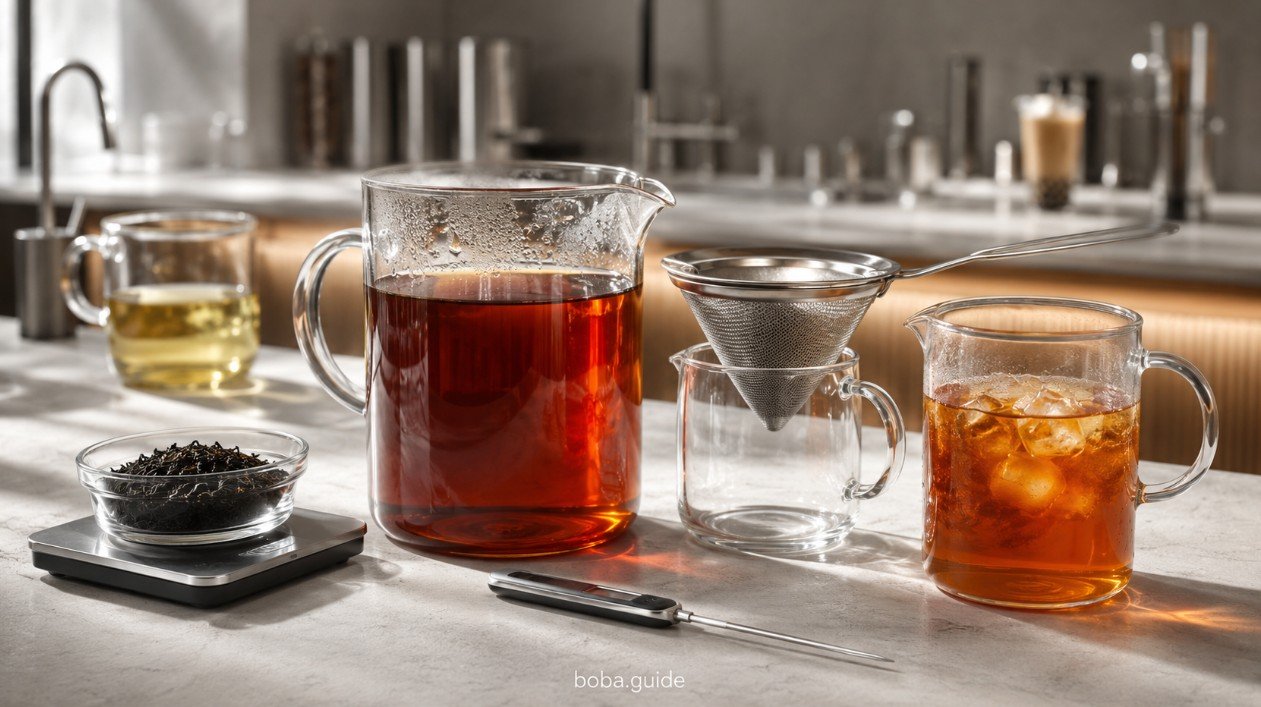
Tea for boba is not simply ordinary tea poured into a cup with pearls. The base has to remain recognizable after milk, syrup, ice and toppings enter the drink. That means brewing for the finished cup, not for the tasting cup: enough extraction to survive dilution, but not so much heat or contact time that the tea becomes coarse, bitter or drying.
The most reliable approach is to control five things deliberately: leaf amount, water temperature, steep time, straining and cooling. Change one of those variables and the final boba can change dramatically. A weak black tea may disappear under milk; an over-extracted jasmine tea may taste harsh before the pearls even arrive; a hot tea poured straight over too much ice may taste perfect for thirty seconds and watery five minutes later.
Tea that tastes right plain can disappear in a finished boba
A tea that tastes balanced on its own may become nearly invisible once a drink receives milk, sweetener and a full cup of ice. Conversely, a tea that tastes slightly more concentrated than you would drink plain can become balanced after the rest of the drink is assembled. The target is therefore not maximum strength. The target is the right strength after everything else happens.
If you are still choosing the tea itself, compare the best tea bases for boba first. Once the tea is chosen, brewing determines whether its aroma and structure remain clear in the finished drink.
Temperature matters because extraction is selective. Taiwan’s Tea and Beverage Research Station has reported that higher brewing temperatures increase extraction of soluble compounds, while higher-temperature infusions can also become more bitter and astringent as caffeine and polyphenols extract more rapidly. The same institution also reports different sensory preferences by tea type: green tea performed better at lower temperatures than boiling water, while black tea performed better around 90°C to boiling in its tests.
That gives us the central brewing rule for boba: do not compensate for weak tea only by making the water hotter or leaving the leaves in forever. Strength can also be increased with more leaf, a different ratio, a more suitable tea, or a better cooling plan.
Measure, brew, strain and cool in the same order every time
Good boba tea is easier to reproduce when the process has a clean start and a clean stop. The sequence below matters more than decorative tea equipment.
Measure the leaf
Use weight when consistency matters. Scoops become unreliable when one tea is dense and rolled while another is large and wiry.
Set the water temperature
Choose it for the tea family rather than automatically using a full boil.
Start the timer
Time begins when the leaves are fully in contact with the water, not after you finish tidying the counter.
Strain completely
Separate liquor from leaf so the tea does not continue extracting while it waits for milk or ice.
Cool with a plan
If the drink is iced, decide whether chilling ice is part of the recipe rather than treating it as an afterthought.
The common failure is not one spectacular mistake. It is uncontrolled drift: a little more leaf, water that cooled while you were busy, a timer that ran long, leaves left in the pitcher, then an unpredictable amount of ice. The drink may still look right, but the taste changes from cup to cup.
Water temperature should follow the tea, not the habit
There is no single “boba temperature.” Taiwan’s official tea resources make that clear. One brewing guide notes roughly 75–80°C water for green tea in a tea-ceremony context, while another Tea and Beverage Research Station comparison found green tea performed better at 80°C than boiling water. In the same research, black tea performed better around 90°C to boiling than at 80°C.
Judge tea strength after imagining the finished cup
“Strong” tea means very little until you know what the tea must survive. A fruit tea may need clarity and aroma more than tannic weight. A classic milk tea needs enough body to stay present next to dairy or creamer. A brown-sugar-heavy build may need an especially assertive base, while a delicate jasmine drink can become unpleasant if you chase body by over-extracting it.
For a closer look at concentration, see how strong tea should be for boba. At home, a simple test works well: brew, cool a small sample, add the approximate milk or water dilution your recipe will use, then taste again. That second taste tells you more than the hot brewer alone.
Account for melting ice before you finish the brew
Cold boba creates a second brewing problem: the hot tea must become cold without losing the concentration you worked to create. If a large amount of ice melts during chilling and then more service ice melts in the cup, the drink can drift from tea-forward to thin very quickly.
Think in four moments, not one
That does not mean “less ice always gives more drink.” Shops use different fill systems, and our boba ice levels guide explains why the relationship between ice and liquid volume varies. For brewing, the important point is that expected melt water needs to be included in the recipe.
If you flash-chill with ice, use a repeatable quantity. If you chill the strained tea without dilution, account for that difference when you later assemble the cup. For another approach entirely, cold-brew tea for boba avoids hot extraction but creates its own strength and timing questions.
Use more leaf before forcing more heat or steep time
Taiwan’s official tea guide gives about one part tea to fifty parts water as a general big-teapot drinking ratio, with a 5–6 minute steep. That is a reference point for ordinary tea—not a universal boba formula.
When a tea base disappears under milk, many people respond by extending the steep or raising the water temperature. Sometimes the cleaner fix is simply using more leaf for the same amount of water.
Why? Because time and temperature do not extract every compound at the same rate. The Tea and Beverage Research Station’s extraction research found that higher temperatures increase extraction of soluble material, but also accelerate compounds associated with bitterness and astringency. Increasing leaf quantity can raise concentration without necessarily forcing the tea into a harsher temperature-time combination.
Commercial boba operations may therefore use more concentrated ratios than ordinary table tea, but there is no single industry number that can be safely applied to every tea and recipe. A supplier SOP might work for one black tea, particle size and creamer build while being much too hard for a delicate jasmine.
Use a ratio as a repeatable starting point, then adjust one variable at a time. Once the base is brewed, the tea-to-milk ratio becomes the next variable in a milk-tea build.
Different tea families need different brewing priorities
Boba menus can make black, green, jasmine and oolong look interchangeable. In the brewer, they are not. The real question is not merely “how many minutes?” but which qualities need to survive while you build enough body for the finished drink?
| Tea family | Protect this | Common boba risk | Good adjustment to try first |
|---|---|---|---|
| Black tea | Malt, briskness, aroma and body | Dry, rough extraction from excessive contact | Use an appropriate hot brew and adjust leaf ratio before pushing steep time indefinitely. Compare black tea for boba. |
| Green tea | Fresh, vegetal or nutty aromatics | Harsh bitterness from excessive heat | Lower the water temperature and increase concentration more carefully. See green tea for boba. |
| Jasmine tea | Floral lift over the underlying tea | The base becomes astringent while the aroma feels thin | Treat it according to the underlying tea and avoid using heat as the only strength lever. See jasmine tea for boba. |
| Oolong | Floral, roasted, creamy or mineral character depending on style | Assuming every oolong behaves like the same medium-oxidized tea | Identify the style first. Our oolong tea for boba guide separates those profiles. |
| White tea | Subtle florals, honeyed and soft fruit notes | Either vanishing after dilution or being flattened by aggressive extraction | Use sufficient leaf and restrained pairing rather than turning it into pseudo-black tea. |
If the tea family is still undecided, compare tea options for boba before settling on the brew.
Water can flatten a tea base before milk ever touches it
Tea is mostly water, so the water itself is not a neutral carrier. Taiwan’s Tea and Beverage Research Station notes that water pH and hardness affect tea color, aroma, taste and catechin extraction, and reported better sensory results for several Taiwanese teas with water below pH 7 and lower total hardness.
For a home boba maker, this does not mean you need laboratory water. It means that if your tea suddenly tastes dull, chalky, murky or unusually flat, the leaves may not be the only variable. Very hard water can change how tea presents itself. If your tap water has a strong mineral taste, try the same tea once with a neutral filtered water and compare before changing the tea recipe.
This matters especially with lighter bases. A delicate jasmine, green or high-mountain oolong can lose clarity faster than a robust Assam-style black tea. With milk tea, hard water can also make it difficult to tell whether the muted flavor comes from the water, the milk, or the extraction itself.
Leaf size changes the clock
Two teas can have the same name and still extract at very different speeds. A broken black tea with small particles exposes much more surface area to water than a large twisted whole-leaf tea. A tightly rolled oolong also changes as the leaves unfurl. This is why copying a steep time without knowing the leaf form can produce wildly different results.
Smaller particles usually extract faster. That can suit a high-volume milk-tea workflow, but it also narrows the margin between enough body and excessive astringency. Large whole leaves may need more space and more time to open, while very fine tea inside some bags can become hard quickly if you treat it like a large-leaf loose tea.
This also explains why “one tablespoon” is such a poor universal measurement. A tablespoon of dense rolled tea and a tablespoon of fluffy twisted tea do not represent the same mass. If you want repeatable boba, weighing the dry tea removes that ambiguity.
The brewing vessel should let the tea move—and let you stop the brew fast
A fancy pot is not required. What matters is whether the vessel gives the leaves enough room to contact water evenly and whether you can separate tea from leaves promptly when the timer ends.
A narrow infuser packed tightly with expanding leaves can create uneven extraction. The outer leaves receive fresh water while the compressed center opens slowly. At the other extreme, a giant open container with no practical straining method can turn a controlled three-minute infusion into a five-minute one simply because draining takes too long.
For home batches, a heat-safe pitcher or pot plus a basket strainer often works well because the whole leaf mass can be lifted at once. A fine mesh is especially effective for broken black tea or smaller particles. For larger batches, think about the time it takes for the entire liquor to leave the leaves. The first liter and final liter should not experience radically different contact times.
Do not squeeze the exhausted leaves or filter bag just to recover a little more liquid. The extra liquid is not automatically better liquid, and aggressive pressing can push a rougher finish into a base that was balanced moments earlier.
Milk and sugar belong after you know what the tea tastes like
If you add milk, creamer or syrup before tasting the brewed liquor, you lose the clearest chance to judge the tea on its own. Taste the strained base first. You are looking for enough aroma and structure to survive the finished build without obvious burnt, rough or stale notes.
Then taste again after the planned additions. This second tasting is where many recipes reveal their real problem. A tea that seemed powerful when hot may suddenly disappear under whole milk. A fragrant jasmine may remain aromatic but become too drying once syrup raises sweetness and makes the astringency more noticeable by contrast. A roasted oolong may become smoother and fuller with milk even when its plain liquor felt slightly austere.
The order also matters for recipe development. If you change the tea extraction and the milk ratio at the same time, you will not know which change fixed the drink. Get the tea base close first, then decide whether the tea itself has enough structure for milk. If the base still feels wrong for a creamy build, compare the best teas for milk tea. Adjust sweetness separately using the boba sweetness levels as a guide.
For very sweet drinks, remember that toppings can contribute sweetness too. Brown-sugar pearls, pudding and some jellies can make the finished cup feel sweeter even if the tea base itself is not heavily sweetened. Brewing cannot correct an overbuilt cup after the fact.
Tea bags can work, but count tea—not bags
Tea bags are convenient because they standardize handling and simplify cleanup. The problem is that “one bag” is not a brewing unit. Different products contain different tea weights, leaf grades and particle sizes. If one brand puts 2 grams in a bag and another puts substantially more, the same number of bags will not create the same base.
For home boba, check the tea weight when it is available. Use enough total tea for your water volume, keep the bags fully submerged, and remove them when the planned contact time ends. Do not leave them sitting in the cooling pitcher simply because the drink will later receive milk.
Loose leaf gives more freedom to choose origin, cultivar, roast and grade, while bags give convenience and speed. Neither format guarantees quality by itself. If you are deciding between the two formats, compare loose-leaf tea and tea bags for boba.
Use a miniature finished-cup test before brewing another full batch
When you are developing a recipe, you do not need to waste an entire cup of pearls and milk every time you change the tea. Take a measured sample of the strained base and reproduce the final dilution at small scale.
For example, if the finished drink will contain tea, milk and a meaningful amount of ice melt, make a small test with the same proportions. Chill it. Taste it cold. The tea you loved at 70°C can feel completely different once cold temperature suppresses aroma and the rest of the drink softens its edges.
Run the test in pairs whenever possible. Keep everything the same except one variable: a little more leaf, a slightly lower green-tea temperature, a shorter black-tea steep, or a different cooling method. Side-by-side tasting makes small improvements much easier to detect than trying to remember yesterday’s cup.
This turns guesswork into a comparison you can actually repeat. You do not need professional tasting vocabulary; you only need to notice whether the tea is clearer, rougher, more aromatic, more present after milk, or less diluted after chilling.
Once the tea base is reliable, the rest of the drink—milk, sweetness, toppings and ice—becomes much easier to tune through boba customization.
When the brewed base tastes wrong, change the right variable
Troubleshooting becomes much easier when you stop treating “stronger” and “weaker” as the only two outcomes. Tea can be weak but harsh, aromatic but thin, dark but flat, or perfectly pleasant hot and disappointingly diluted once iced.
The same logic applies when comparing finished drinks: strong color alone does not prove good extraction. For broader signs of freshness, tea balance and pearl quality, see our boba quality guide.
Large batches do not brew exactly like a small pot
A home-size pot and a multi-liter shop batch do not behave identically. Large volumes change heating, cooling, straining speed and hold time. The objective remains the same: every part of the batch should receive a predictable extraction and then stop extracting.
Measure by weight
For larger volumes, a repeatable grams-to-water ratio is much safer than “two big scoops.” Leaf density varies too much between rolled oolong, broken black tea and wiry whole leaf.
Strain the whole batch promptly
If the first liter leaves the filter while the final liter remains in contact with leaves for several extra minutes, the batch is not truly uniform.
Cool deliberately
Room-temperature drift can leave the tea warm for too long. If ice is used for rapid chilling, include that added water in the recipe rather than guessing.
For home preparation, you do not need commercial equipment. A scale, thermometer, timer, spacious brewing vessel and fine strainer are enough to keep the main variables consistent. For a simpler setup, see whether tea bags can work for boba and what changes when the leaf is pre-portioned.
What tea base is giving you trouble?
Black tea that disappears under milk? Jasmine that turns sharp? Oolong that tastes great hot and thin over ice? Send your brewing setup and what changed in the finished cup through our contact page. If a recipe works hot but falls apart after milk or ice, tell us what changed. Real brewing problems help us make this guide more practical for other readers.
Sources & notes
For the temperature, water-quality, conventional brewing-ratio and extraction references in this guide, we consulted the Taiwan Tea and Beverage Research Station, its official brewing guidance, and Taiwan Ministry of Agriculture black-tea guidance. Commercial boba batching practices vary by shop, equipment, tea and recipe, so individual commercial specifications should be treated as examples rather than universal standards.
Questions about brewing tea for boba
Should tea for boba be stronger than normal tea?
Often, yes—but stronger should mean concentrated enough to remain recognizable after the final drink is assembled, not simply more bitter. Milk, sweetener and ice can dilute or mask tea flavor, so a boba base may need more leaf or a different ratio than a plain sipping cup. The exact strength depends on the tea and the recipe.
What temperature should I use to brew tea for boba?
There is no single temperature for every tea. Green tea generally benefits from lower temperatures than black tea, while oolong varies by style. Taiwan tea research shows that higher temperatures increase extraction but can also increase bitterness and astringency, so match the water temperature to the tea family instead of automatically using boiling water.
How long should black tea steep for boba?
A reasonable starting point depends on leaf grade, ratio and water temperature. Taiwan Ministry of Agriculture guidance gives roughly 3–5 minutes at 95–100°C for one conventional western-style black-tea method, but a concentrated boba base may use a different ratio. Stop the extraction by straining rather than leaving the leaves in the pitcher.
Can I just steep tea longer to make it stronger?
You can increase extraction with more time, but that is not always the best way to add body. Longer contact can pull more bitter and astringent compounds. If a tea is clean but too weak after milk or ice, increasing the leaf-to-water concentration can be a better first experiment than dramatically extending the steep.
Should I brew green tea with boiling water for boba?
Usually not as the default. Official Taiwan tea guidance uses lower water temperatures for green tea than for black tea, and Tea and Beverage Research Station testing found green tea performed better at lower temperatures than boiling water. If you need more body for boba, adjust leaf concentration carefully instead of assuming hotter water is always better.
Do I need to cool tea before making iced boba?
You need a controlled cooling plan. Hot tea poured over ice will melt part of that ice and add water, which changes concentration. You can deliberately flash-chill with a measured amount of ice or cool the strained tea another way, but the dilution should be part of the recipe rather than an accident.
Why does my milk tea taste watery even when the hot tea tasted strong?
The most common explanation is that the finished drink diluted the tea more than expected. Milk adds volume, chilling ice may melt, and service ice continues melting. Taste a small sample of the brewed base after reproducing the approximate milk and water dilution of the final cup; that often reveals whether the base was actually strong enough.
Can I use tea bags to brew tea for boba?
Yes. Tea bags can work, especially for home boba, but their leaf quantity, particle size and blend vary. For repeatability, pay attention to the total tea weight rather than only the number of bags. Avoid leaving the bags in indefinitely just because the finished drink will contain milk.
Is loose-leaf tea better for boba?
Loose leaf gives you more control over tea type, leaf quantity and extraction, but it is not automatically better in every recipe. A good tea bag brewed with a measured ratio can produce a more consistent drink than excellent loose tea brewed carelessly. The important variables are the tea itself, ratio, temperature, time, straining and dilution.
What is the easiest way to make boba tea more tea-forward?
First identify where the flavor is being lost. If the brewed tea is already weak, increase leaf concentration or use a more suitable base. If it tastes strong before assembly but weak afterward, reduce unnecessary dilution or rebalance milk and ice. Do not automatically solve every problem with a hotter or longer steep.